
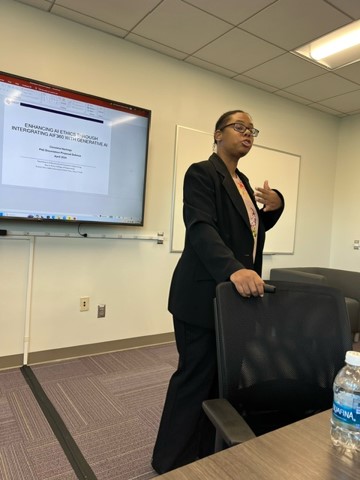
Prairie View A&M University is recognized as one of the leading producers of African American PhD graduates in Electrical Engineering in Texas. This year, Christina Hastings proudly graduates with her PhD, marking a significant milestone as the second African American female to complete this program. Notably, she is also the first African American woman to earn her bachelor’s degree from PVAMU and continue on to a PhD in Electrical Engineering, highlighting the success of our five-year BS/MS program in supporting underrepresented minorities in this field.
Christina’s groundbreaking dissertation focused on reducing bias in Artificial Intelligence. We are immensely proud of her achievements, especially as her sister completed her doctoral degree in our College of Juvenile Justice just last year.
On October 11, 2024, Ms. Hastings successfully defended her dissertation titled “Enhancing AI Ethics Through Integrating AIF360 with Generative AI.” Her research provides a comprehensive validation of sample reweighting techniques to tackle bias in AI ethics, offering valuable insights into the effectiveness of various traditional classification algorithms across different protected attributes. This work significantly contributes to advancing fairness in AI and explores how generative AI models can create synthetic tabular data to enhance AI fairness.
Christina Hastings’ research is important for several reasons:
- Addressing Bias in AI: AI systems can inadvertently perpetuate and amplify societal biases, leading to unfair outcomes. Her work focuses on identifying and mitigating these biases, which is crucial for building equitable AI systems.
- Advancing Fairness in Machine Learning: By integrating AIF360 with generative AI, Christina’s research contributes to the development of innovative tools and methods that enhance fairness in machine learning models.
- Ethical AI Development: As AI technologies increasingly influence decision-making in various domains (like hiring, lending, and law enforcement), ensuring these systems are ethical and transparent is vital for maintaining public trust and accountability.
- Synthetic Data as a Resource: Her exploration of generative AI to create synthetic data offers a potential solution for training models without exposing them to biased real-world data, improving overall fairness.
- Interdisciplinary Insights: Her research bridges multiple fields—computer science, ethics, and social justice—encouraging collaboration and dialogue among diverse disciplines.
- Implications for Policy and Regulation: Findings from her work can inform policymakers and organizations looking to implement ethical AI practices, potentially guiding future regulations in this rapidly evolving field.
Overall, Christina’s work is vital for fostering a more just and equitable approach to AI development, ensuring that technological advancements benefit all members of society fairly.
Christina’s academic journey has been supported by her advisor, Dr. Pamela Obiomon, Professor and Dean of the Roy G. Perry College of Engineering, who has played an instrumental role in her success. Additionally, her co-advisor, Dr. Dong, a Professor in the Electrical and Computer Engineering program, was crucial in shaping her research and introducing her to cutting-edge tools in AI fairness. The support from the Center of Excellence in Research and Education for Big Military Data Intelligence (CREDIT) ,led by Dr. Lijun Qian, also significantly contributed to her work. We celebrate Christina’s accomplishments and eagerly anticipate her contributions to the field of Electrical Engineering.