

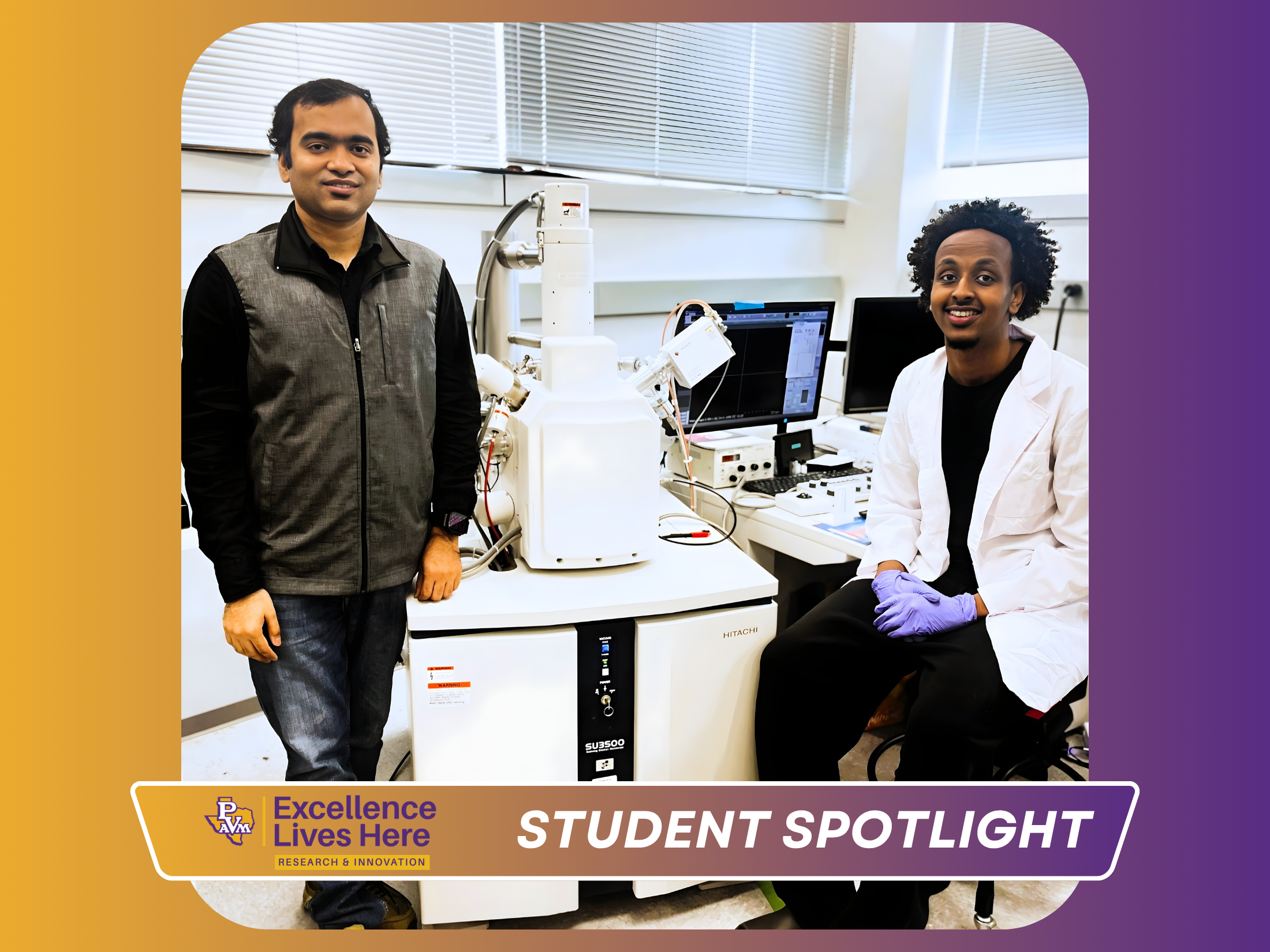
When undergraduate Mustafa A. Ali stepped into Prairie View A&M University’s Microelectronics Characterization Laboratory last fall, he didn’t just join a research team, he became part of a pioneering effort to build the university’s first experimental semiconductor program.
Under the guidance of Dr. Avra S. Bandyopadhyay, Mustafa mastered the art of manipulating two-dimensional materials and fabricated PVAMU’s very first MoS₂/graphene van der Waals heterostructure—a tiny but powerful structure that signals big things for the future of electronics.
This groundbreaking work earned Mustafa the 2026 Student Achievement in Microelectronics Award at the Georgia Tech HBCU CHIPS Conference and highlights PVAMU’s commitment to preparing the next generation of engineers and innovators in a national priority field.
For Ali, though, the real work is just beginning, and it’s right in front of him in the lab.
“Working in Dr. Bandyopadhyay’s lab introduced me to the challenges and possibilities of microelectronics research, particularly with emerging materials,” Ali said. “Pushing this work forward will help overcome the scaling limits of traditional silicon.”
This award motivates him to keep pushing the boundaries of semiconductor research, as he looks with anticipation towards the future.
“My goal is to pursue graduate studies and contribute to the development of next-generation semiconductor technologies that enable more energy-efficient and scalable electronic systems,” Ali said. “I hope to help create technologies that are more efficient, scalable, and transformative.”
Ali joined Dr. Bandyopadhyay last fall as a RISE Undergraduate Research Fellow and became one of the first undergraduate researchers to participate in PVAMU’s developing microelectronics research program. He arrived at PVAMU following collaborative work at Texas A&M University, which laid the groundwork for him to contribute this valuable research to his new team.
Since then, he has not only quickly gotten up to speed with his team, but he’s also played a key role in the exciting work of paving new paths in research in this field.
“After beginning work with Dr. Bandyopadhyay, I quickly developed strong skills in semiconductor materials processing and characterization,” Ali said. “Within a few months, I helped establish early research workflows in the Microelectronics and Advanced Materials Laboratory and played a key role in introducing two-dimensional materials research at PVAMU.”
Perhaps most importantly, Ali’s impact extends beyond his own research. He is part of a larger story at PVAMU—one defined by collaboration, mentorship, and shared success.
In the lab, he works side by side with fellow researchers while guiding undergraduates through both foundational techniques and advanced discoveries. He actively supports undergraduate training in the laboratory by assisting other students in learning silicon wafer handling, clean laboratory practices, 2D materials exfoliation, and nanoscale characterization techniques.
His efforts reflect a broader mission.
While he builds research capacity at PVAMU and strengthens the university’s presence in cutting-edge, competitive research in a field of growing national importance, he remains rooted in the heart of PV: cultivating the next generation of engineers.