CIVIL ENGINEERING ACCREDITATION
The Bachelor of Science program in Civil Engineering is accredited by the Engineering Accreditation Commission (EAC) of ABET, https://www.abet.org.
Mission
The mission of the Civil and Environmental Engineering Department is to produce Civil Engineers who will become innovative practitioners, leaders, researchers, and entrepreneurs. The department attracts and retains high-quality faculty and maintains state-of-the-art infrastructure to achieve excellence in teaching, research, and service. The department, through its rigorous curriculum, hands-on laboratory experiences, and design-oriented course projects, trains students in a broad range of civil engineering topics and engages them in research and service activities, so that they can make significant contributions to society and in improving the quality of life.
Program Educational Objectives (PEOs)
The program educational objectives of the civil engineering program are to produce graduates who (within a few years of graduation):
- Have careers in Civil Engineering or related fields that lead to increasing levels of responsibility and leadership
- Obtain professional licensure/certifications
- Complete graduate studies in Civil Engineering or related fields
- Engage in professional development and service.
Student Outcomes (SOs)
The Student Outcomes leading to the attainment of the Program Educational Objectives are:
- an ability to identify, formulate and solve complex engineering problems by applying principles of engineering, science and mathematics.
- an ability to apply engineering design to produce solutions that meet specified needs with consideration of public health, safety and welfare, as well as global, cultural, social, environmental and economic factors.
- an ability to communicate effectively with a range of audiences.
- an ability to recognize ethical and professional responsibilities in engineering situations and make informed judgments, which must consider the impact of engineering solutions in global, economic, environmental and societal contexts.
- an ability to function effectively on a team whose members together provide leadership, create a collaborative and inclusive environment, establish goals, plan tasks, and meet objectives.
- an ability to develop and conduct appropriate experimentation, analyze and interpret data, and use engineering judgment to draw conclusions.
- an ability to acquire and apply new knowledge as needed, using appropriate learning strategies.
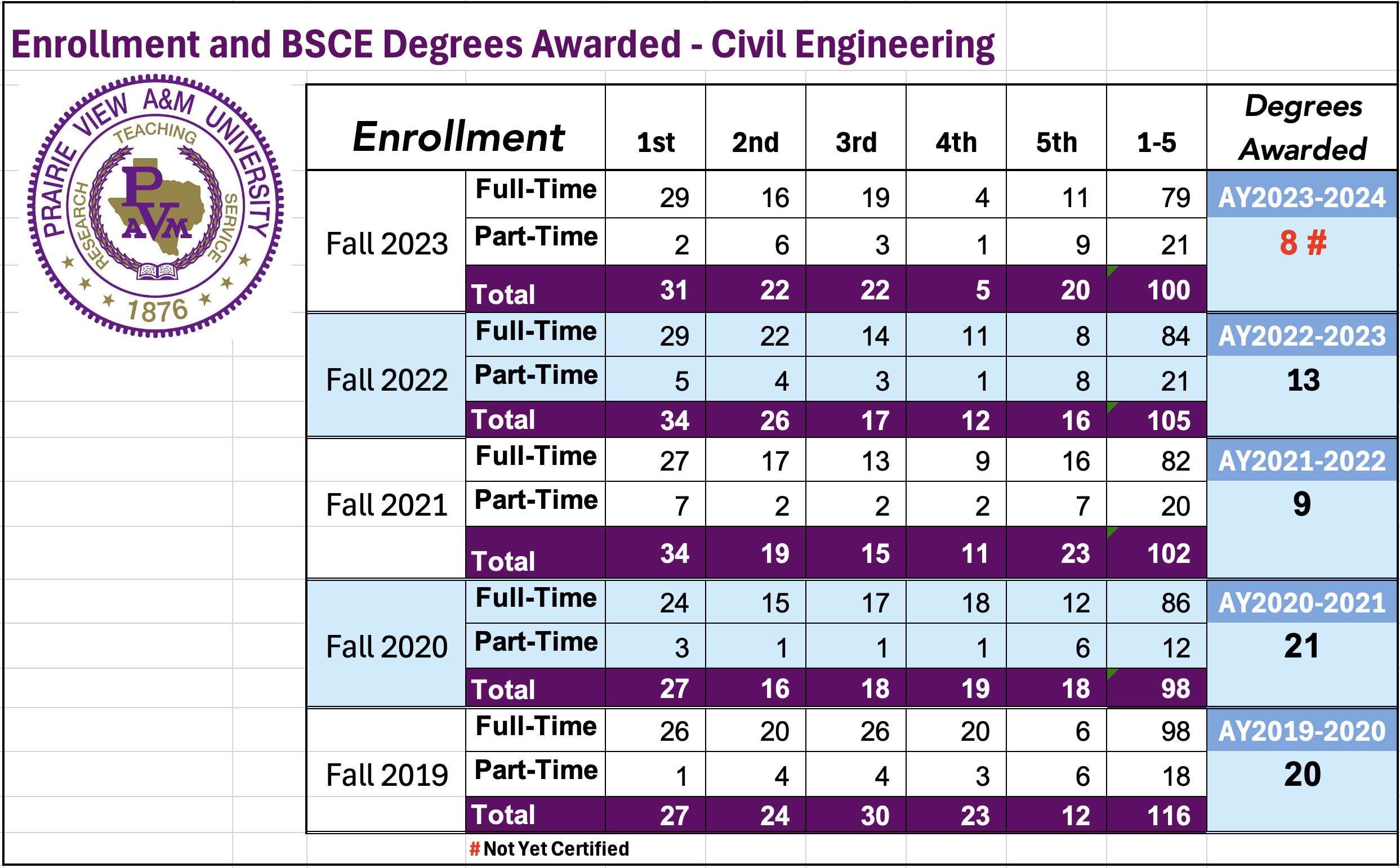
Undergraduate Program Enrollment and Graduation Data