


My PhD journey was anything but traditional. I began this chapter at the age of 60, after being out of school for 35 years. When I earned my master’s degree in 1986, computers were not yet a part of everyday academic life. I vividly remember submitting punch cards in the computer lab to process data for my thesis. Fast forward to 2021, when I embarked on my doctoral studies, I found myself in a world of eCourses, Canvas, and digital platforms I had never encountered before.
Although I consider myself technologically savvy, I was unfamiliar with these tools. Thankfully, I wasn’t alone. My cohort, Cohort 15, became my lifeline. I’ll never forget one of my fellow members who looked at me and said, ‘I got you, Ms Patt.’ From that moment on, everything changed. With her support and the encouragement of others, I found my footing and my confidence in this new academic landscape.
The most transformative moment of my journey came in Dr. William Parker’s class. I completed both my undergraduate and master’s degrees at North Carolina State University, a predominantly white institution (PWI). Growing up in the 1960s, I often watched Westerns and dreamed of being a cowgirl—riding horses, chasing adventure, and living boldly. But as I got older, I realized something unsettling: in those narratives, I wouldn’t have been the cowgirl. I would have been cast as the ‘Indian,’ often portrayed as the outsider or the antagonist. That realization left me questioning where I truly fit in the stories I had grown up with.

I knew the history, but it never made sense because I couldn’t see myself in it. It wasn’t until Dr. Parker’s class, where we explored the power of narrative, that the pieces finally came together. For the first time, I saw where I fit in history. That moment of clarity, of belonging, was the most memorable and meaningful experience of my entire educational journey. Attending an HBCU through the PhD program has changed my life forever.
My dissertation, “The Lived Experiences of Black Female Leaders at an HBCU Whose Predecessors are Non-Black Female,” was inspired by my early career in Training and Development at a PWI. I was initially sponsored and mentored by a Black male leader; however, when he left, and a non-Black leader assumed the role, I lost that support. When I began my PhD program at PVAMU, we were asked to identify potential research topics during the first semester. I chose this topic to explore the differences in leadership experiences between PWIs and HBCUs.
That experience shaped not only my research but also my purpose. With my PhD, I intend to advance knowledge on Black female leaders in Higher Education, teach as an adjunct faculty member, lead research on Black female leadership in Higher Education, deliver organizational culture and climate consulting, and present insights at leading conferences.
As I reflect on this journey, I remain committed to lifting others as I climb. I often share the story of Russell Wilson, a well-respected NFL quarterback who also attended North Carolina State University. Russell once asked his father why he had received so many accolades for his football skills. His father replied, ‘Why not you?’
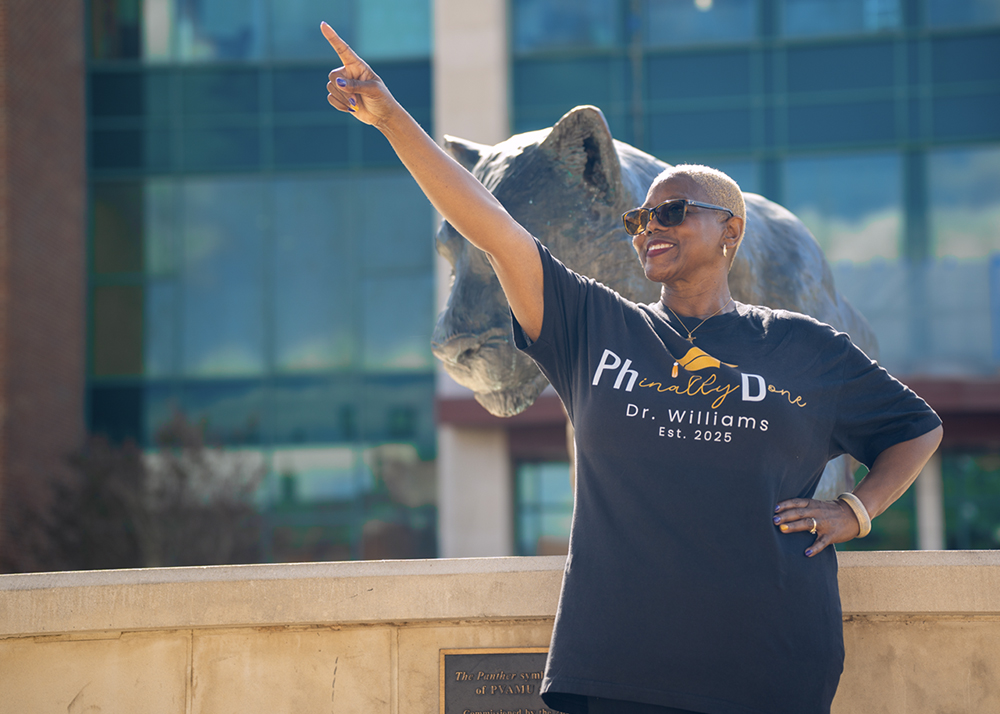
So, to anyone reading this, whether you’re just starting your journey or finding your way back, remember this: Why not you? You are capable. You are worthy. And your story matters.
Patt Williams graduates from Prairie View A&M University this fall with a Doctor of Philosophy in Educational Leadership.
Click here to view a complete listing of this semester’s notable graduates.
-PVAMU-