

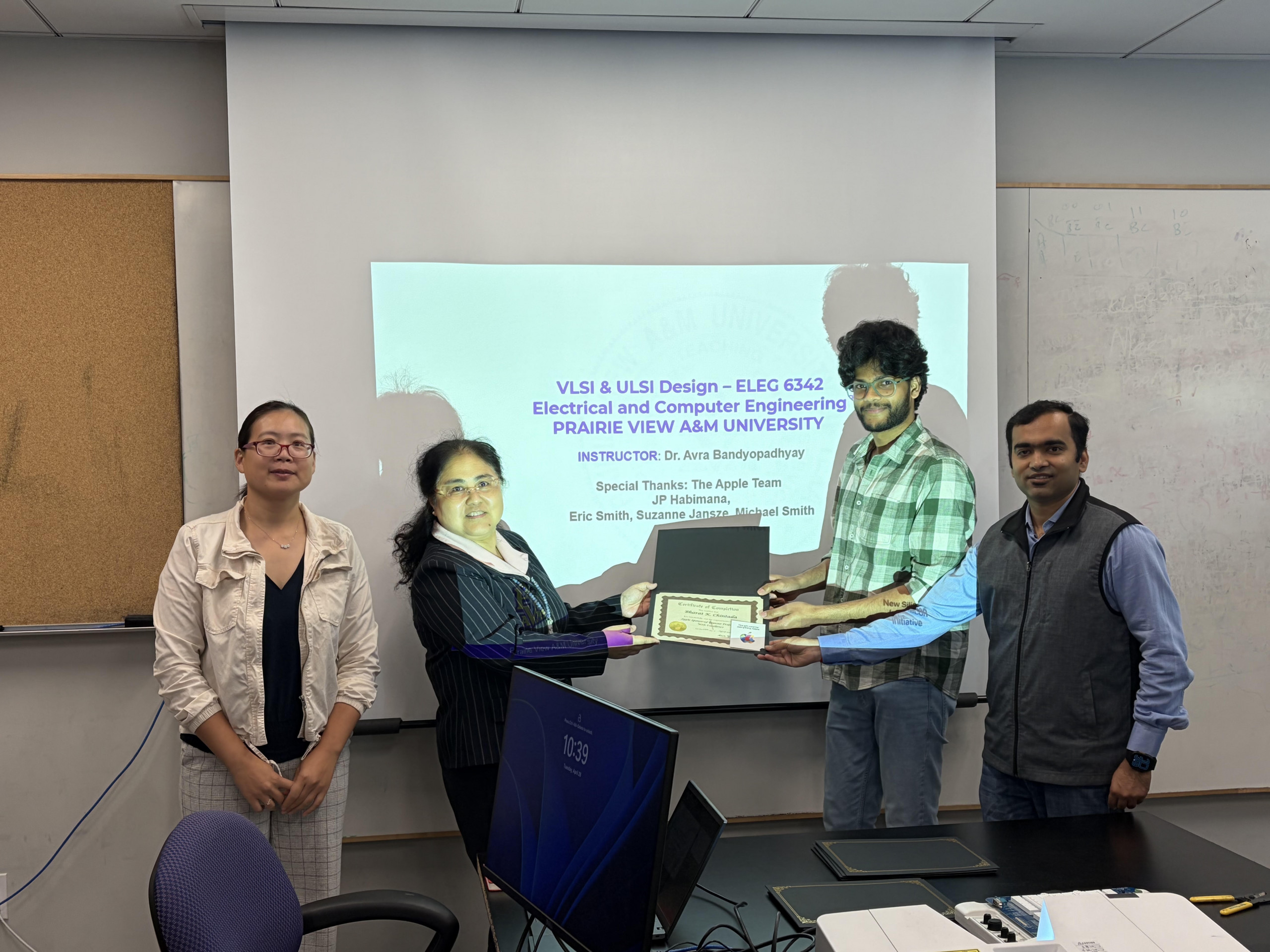
PRAIRIE VIEW, Texas (August 24, 2026) – Apple has named Bharath Kumar Chintada, a PhD student at Prairie View A&M University, the winner of a chip design contest.
Since joining Prairie View this spring, Chintada, a PhD student in electrical engineering working under Dr. Avra Bandyopadhyay, assistant professor in the Department of Electrical and Computer Engineering, quickly became a part of an expanding effort to strengthen semiconductor education and research at PVAMU.
Chintada, a PVAMU RISE Fellow, developed the winning full-custom integrated-circuit design in a contest by Apple.
His winning design grew out of PVAMU’s Very Large Scale Integration (VLSI) and Ultra-Large-Scale Integration (ULSI) Design (ELEG 6342), a graduate-level course offered through Apple’s New Silicon Initiative (NSI). The program provides students with hands-on experience in modern integrated-circuit design and gives them the opportunity to move beyond textbook concepts toward a real silicon tape-out, culminating in the design of an arithmetic circuit intended for fabrication through the Apple NSI program.
Over the course of the semester, Chintada took a leading role in the technical implementation of the class project and in supporting the course during the critical final stages of tape-out. His work focused on the hierarchical full-custom implementation of an 8-bit ripple-carry adder, progressing from fundamental Complementary Metal-Oxide-Semiconductor (CMOS) building blocks to a complete integrated design.
Apple took notice of the productive Panther.
Following the completion of the tape-out, Apple notified Chintada that he had been selected as the winner of the University’s tape-out course design contest, and the recognition subsequently took the Panther beyond The Hill.
In July, Chintada joined Dr. Bandyopadhyay and other PVAMU faculty involved with the Apple NSI program at the Apple Convening at Apple Park in Cupertino, California.
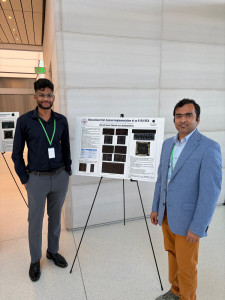
There, Chintada presented a poster highlighting the team’s work on the hierarchical full-custom implementation of the 8-bit ripple-carry adder, providing an opportunity to discuss the design with representatives from Apple and other institutions.
“Working on the tape-out project gave me an opportunity to experience the complete VLSI design process beyond what we normally learn from textbooks,” Chintada said. “Taking a design from basic CMOS building blocks through full-custom layout and final verification was challenging, but extremely rewarding. Being recognized by Apple and having the opportunity to present our work at Apple Park has motivated me to continue developing my research and design skills in semiconductor technologies.”

For Chintada, the project also represents the intersection of graduate education and research.
Rather than treating chip design solely as a classroom exercise, the course exposes students to the complete process through which an idea progresses from circuit concepts to a design ready for fabrication.
Additionally, this early recognition from the iPhone maker notches a key milestone in his doctoral journey—and also illustrates the opportunities that can emerge when graduate education, research mentorship, and industry engagement come together.
“Bharath joined my research group only this spring, and seeing what he has accomplished within such a short period has been extremely rewarding,” Dr. Bandyopadhyay says. “He not only developed the technical skills required for full-custom VLSI design, but also took significant responsibility during the final stages of our tape-out. Having his work recognized by Apple and then seeing him present that work at Apple Park was a proud moment for our group and for PVAMU.”
By Christine Won