

The Latest Solar Images
Note: All images on this website © 2018-2026 by Brian Cudnik and Prairie View A&M Physics. All rights reserved.
Observations are happening daily, except for most Saturdays, all Sundays, and holiday periods; and are governed by duty schedule, weather, and solar activity. When the Sun has very low activity (spotless), observations will be limited or non-existent. Whenever the Sun becomes active again, the observing program will become active as well, weather permitting. The Sun is expected to reach the maximum activity level of the current Cycle 25 solar cycle. So we anticipate more events in terms of active region size and number, and solar flares.
One can monitor the Sun via several websites that provide real-time images of the Sun. The website, https://www.solarmonitor.org/, has such images in six different channels. The numbers are the NOAA designations for active regions (with the “1” at the start of the designation removed for convenience). Another website with up-t0-date information on solar activity and other goings-on in the skies is www.spaceweather.com. Additional information about the Sun’s current activity can be obtained from https://www.swpc.noaa.gov/, and real-time full-disk H-alpha images from observatories around the world can be viewed at http://halpha.nso.edu/.
A typical observing run may last from one to four hours, depending on seeing considerations, weather, and other work responsibilities, but will include active region monitoring of available active regions and the collection of frames for high-resolution solar mosaics in H-alpha. Each session includes at least one mosaic, which is a series of images made of all parts of the Sun’s disk that can later be stitched together to form a whole-disk image. At the very least, this ensures that all visible features such as prominences, filaments, and active regions (sunspot groups) are all captured in image form at least once per session. Usually observations are carried out in the late morning hours, but an additional session may occur in the mid-afternoon hours and it will include its own mosaic. If a sunspot group is expected to be active, then it becomes a main focus for observation for extended periods of time.
Solar activity is summarized in each day’s entry below, based on the forecast discussion product issued by the Space Weather Prediction Center each morning, along with observed activity (or lack of) the day of the featured observations. Regions are numbered by the NOAA/SWPC and are often provided in four-digit format (e.g. 3327), although I and other sources use the full five-digit designation (13327). Solar flares are described in terms of their X-ray intensity and optical “importance” (apparent brightness and area covered). One can learn more about the X-ray class of solar flares often discussed below by going to this website: https://www.spaceweather.com/glossary/flareclasses.html. Finally the SWPC 3-day forecast for solar activity is provided at the end of each entry.
More information about solar flares can be found at these websites: https://www.swpc.noaa.gov/phenomena; https://www.space.com/solar-flares-effects-classification-formation; and https://www.spaceweatherlive.com/en/solar-activity/solar-flares.html. I have also found the following website to be very useful: spaceweatherlive.com
The solar images are recorded through a Meade 16-inch f/8 Cassegrain telescope equipped with a 0.3 Å Hydrogen-alpha filter and a 16-bit, 3326×2504 pixel SBIG STF-8300 CCD camera. The aperture of the scope is stopped to 4-7/8 inch by an energy-rejection filter, which renders the system an f/26. A neutral density filter is added to bring the sunlight intensity down by 90%. Each image is automatically dark-subtracted as it is saved and each exposure is 0.1 second long for the red off-band continuum images and 0.5 second for the on-band H-alpha images. Flat field images are taken at periodic intervals throughout the observing session and are obtained by training the telescope to focus near the center of the Sun’s disk. Five images are then taken while dithering the frame 1′ to 5′ N,S,E, and W. The idea is to try to get images that are slightly blurred (either due to seeing or scope motion) and off set from each other. A set of 30 bias images (0-second exposures with the dome closed and scope parked) are taken at the end of each observing session.
Select images are processed for further study and display. A program called MaxIM DL is used to do basic calibration (bias-subtraction and flat field correction), and the levels are adjusted for optimum display contrast. Choice images are then selected for online display. All of the images are archived in their raw FITS format, sorted by date, and backed up twice. At a later time we can mass process these and make them available for scientific use. Inquiries can be made of Brian Cudnik, at bmcudnik@pvamu.edu, or Premkumar Saganti, at pbsaganti@pvamu.edu.]
NOTE: Images of the March 14, 2025 total lunar eclipse are posted at https://www.pvamu.edu/pvso/cosmic-corner/total-lunar-eclipse-1/
NOTE: Images of the April 8, 2024 solar eclipse are posted at https://www.pvamu.edu/pvso/cosmic-corner/partial-solar-eclipse/.
Observations have been conducted since then at the PVSO, primarily with H-alpha. There was a period of time when magnetospheric data were collected but the work had primarily been regional H-alpha images of active regions and filaments. Regular observations continued through the mid-2000’s, then became more sporadic through 2015. After a five-year pause, regular observations resumed (in their current format) on 8 January 2020.
Solar Cycle 25 Update
We continue to work through the high end of the current solar cycle. In fact, the Sun had been active since 2022, with the peak of activity (based on sunspot number averages and F10.7 cm radio flux) occurring in August 2024. Since then both indices have trended downward, with the corresponding decline in sunspot number and solar flare activity. The following plot shows the sunspot number progression, along with predictions through 2030, from https://www.swpc.noaa.gov/products/solar-cycle-progression.
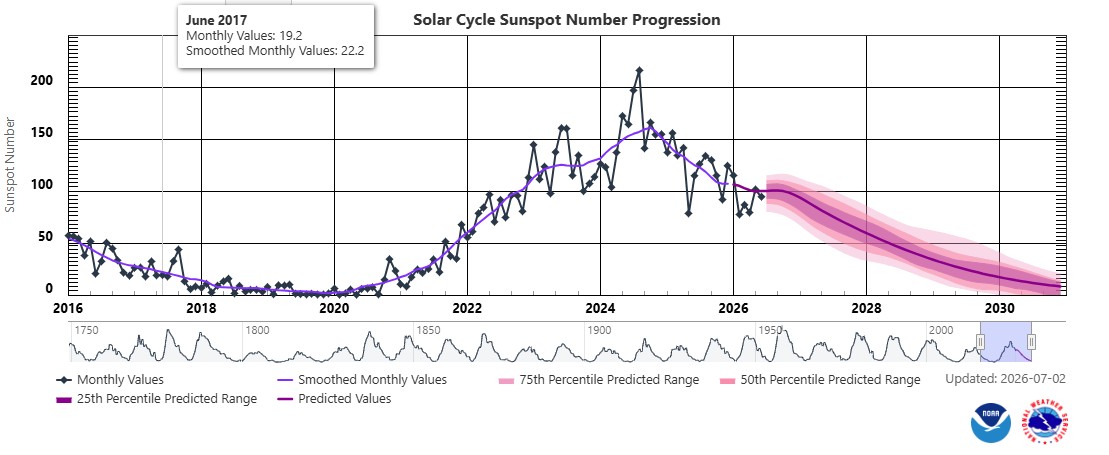
It is interesting to note that Solar Cycle 25 has yet to see an X10 or greater flare. The last time a flare of that size erupted was on 10 September 2017, during Solar Cycle 24. The overall trend of strong solar flares seems to have declined over the last three solar cycles. The website, spaceweatherlive.com, posts the top 50 flares for each of the last three solar cycles. For Solar Cycle 23, when PVSO began regular operations in May 1999, there were 10 flare events of X10 or greater (5 of these were greater than X20 and one exceeded X40), and 125 total X-class flares (X1.0 or greater).
Solar Cycle 24 only had two flares of X10 or greater, the strongest of which was an X13.3. Altogether, there were 49 flares of X1.0 or greater during Solar Cycle 23, less than half the number of the prior solar cycle’s flare activity. The current Solar Cycle 25 features 100 X-class flares, with the 50th recorded X-class flare happening in June 2024. The strongest flare of the current cycle was an X9.0 on 3 October 2025. The most recent X-class flare (as of 13 May 2026) was an X2.5 on 24 April this year.
Solar activity, while having its monthly ups and downs, should continue to trend downward over the next four years, reaching solar minimum sometime around 2030.
A New Development in Solar Physics: https://nso.edu/press-release/nsf-inouye-solar-telescope-enables-major-discovery-of-a-hidden-solar-process/
__________________________________________________________
September 30, 2026
Solar activity continues at low levels with few C-class flares from the northeast limb and from visible active regions on the disk. AR 14544 did grow some but remained active all day today. AR 14535 produced the largest, and only, C-class flare today, a C8.6/1F that peaked at 2:46 UT, 30 September. The flare launched a CME, which was first observed by satellite imagery at 3:12 UT. This may provide a glancing blow to Earth’s magnetic field on 4 October, but this needs to be finalized.
The first column below includes red continuum images, each 0.15 sec exposure; and the second column hosts H-alpha line center images, each 0.20 sec exposure and enhanced slightly to bring out detail. Each of the images covers 7.8’x11.4′ on the sky. Celestial north is up, west is right in each image.
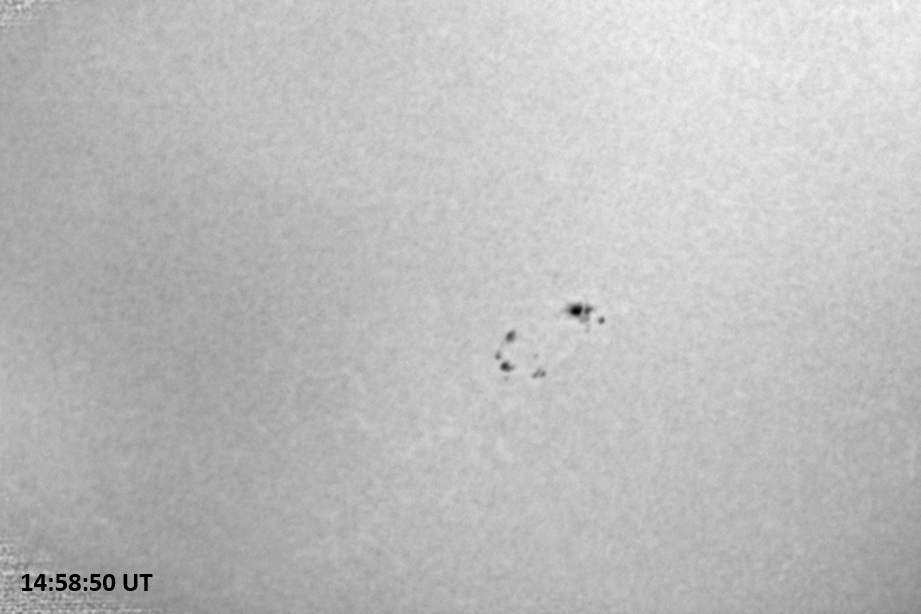
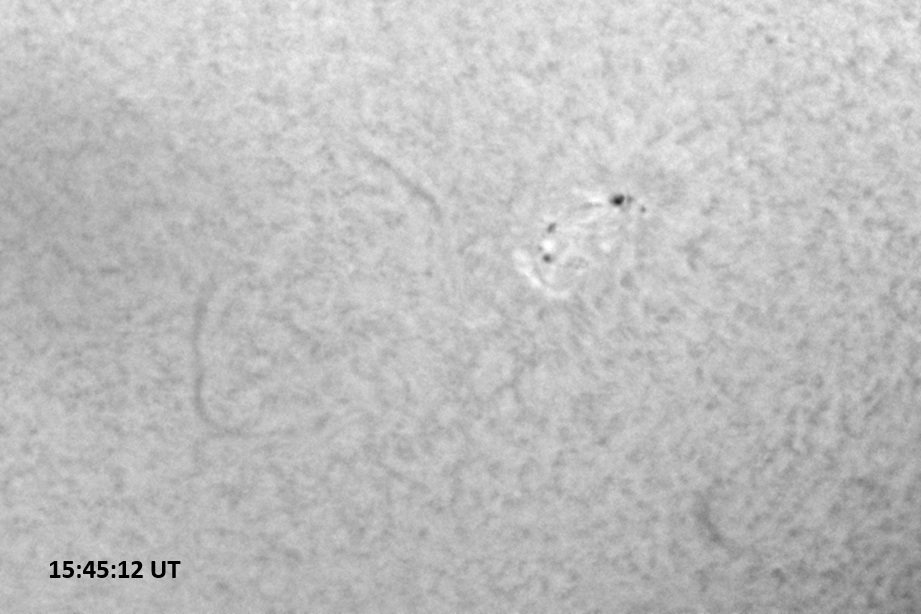
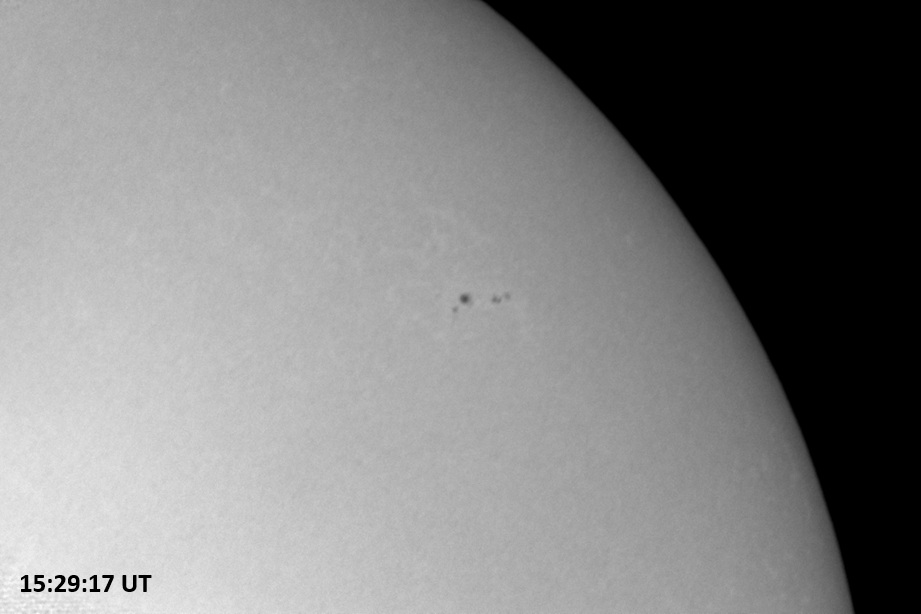 AR 14535 is starting to approach the western edge of the Sun. AR 14535 is starting to approach the western edge of the Sun. |
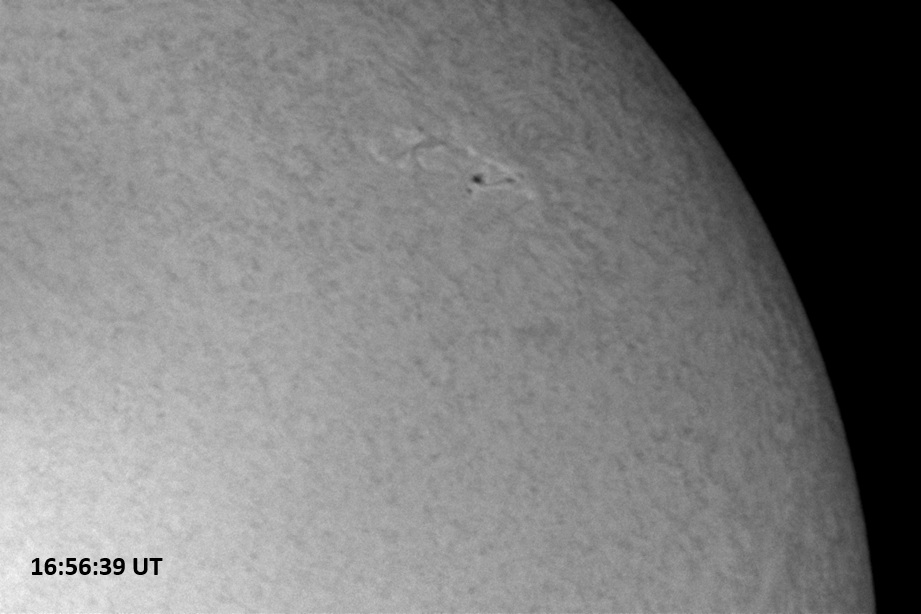 AR 14535 produced an almost-M-class-flare, a C8.6 early today (UT). AR 14535 produced an almost-M-class-flare, a C8.6 early today (UT). |
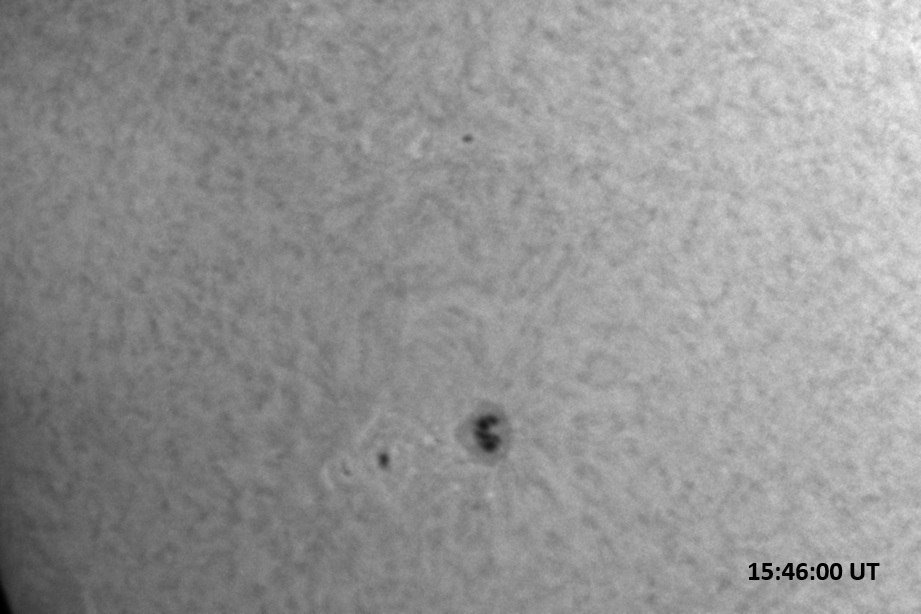
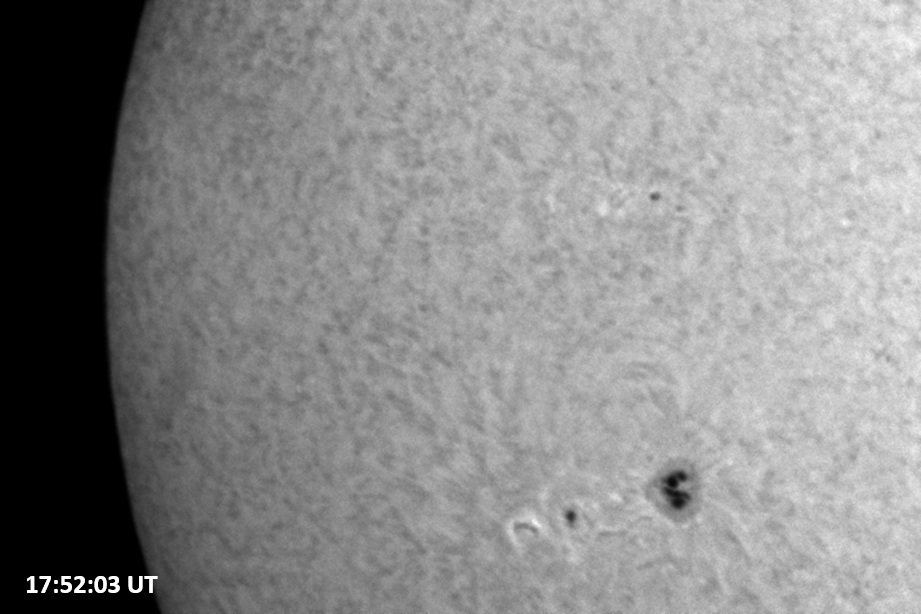
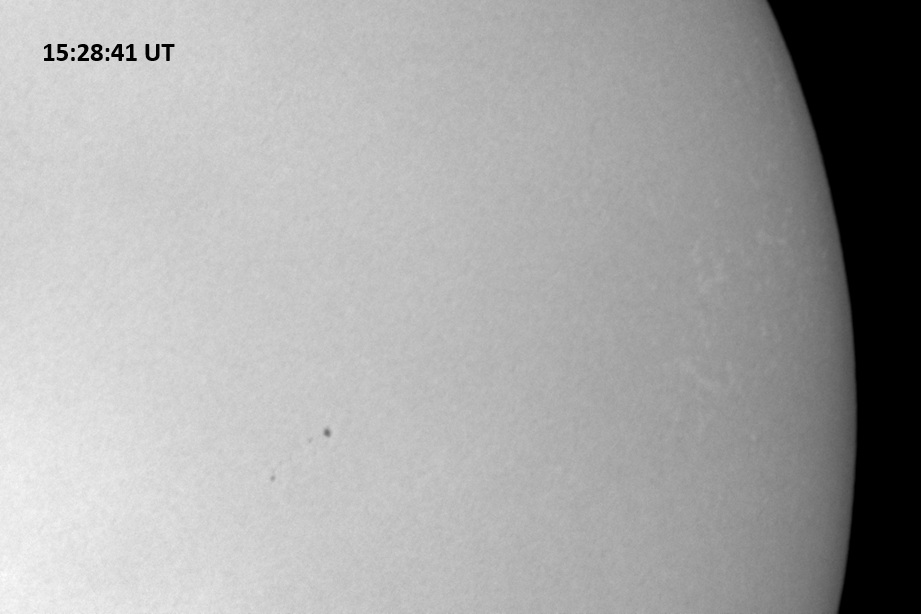 AR 14544 appears below and left of image center; old remnants of regions (bright spots near Sun’s edge) are also visible. AR 14544 appears below and left of image center; old remnants of regions (bright spots near Sun’s edge) are also visible. |
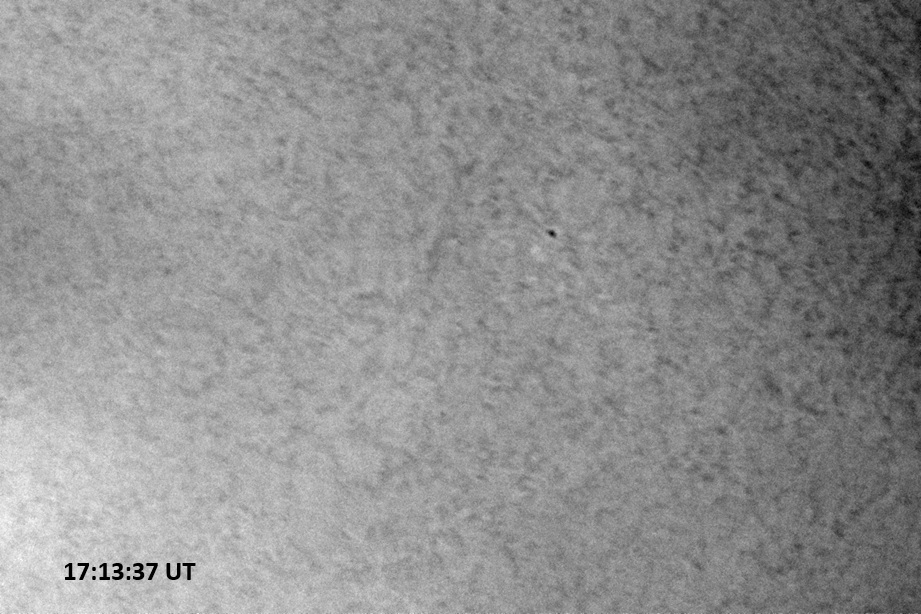 This zone of the Sun has been quiet all day. In spite of its growth, AR 14544 did not produce any flare activity tod This zone of the Sun has been quiet all day. In spite of its growth, AR 14544 did not produce any flare activity tod |
Solar activity is likely to remain at low levels, with a slight chance for M-class flares through 2 October.
September 29, 2026
Solar activity continues at low levels with occasional C-class flares from the northwest limb of the Sun. AR 14535 is one of only two spotted active regions on the visible solar disk. The other is a newly emerged pair of spots just southwest of the center of the solar disk. This became AR 14544. A filament erupted around 13:00 UTC yesterday, 28 September, in the west-northwest part of the solar disk. This launched a coronal mass ejection which had two main components first observed off the western limb of the Sun by LASCO C2 images at 14:48 and 15:24 UT yesterday. The second may be related to the phenomena we observed around the latter time yesterday.
Today, there was a C1.1 at 13:11 UT, also from the northwest limb; and a C1.5 at 21:46 UT, from an undetermined location.
The first column below includes red continuum images, each 0.09 sec exposure; and the second column hosts H-alpha line center images, each 0.15 sec exposure and enhanced slightly to bring out detail. Each of the images covers 7.8’x11.4′ on the sky. Celestial north is up, west is right in each image.
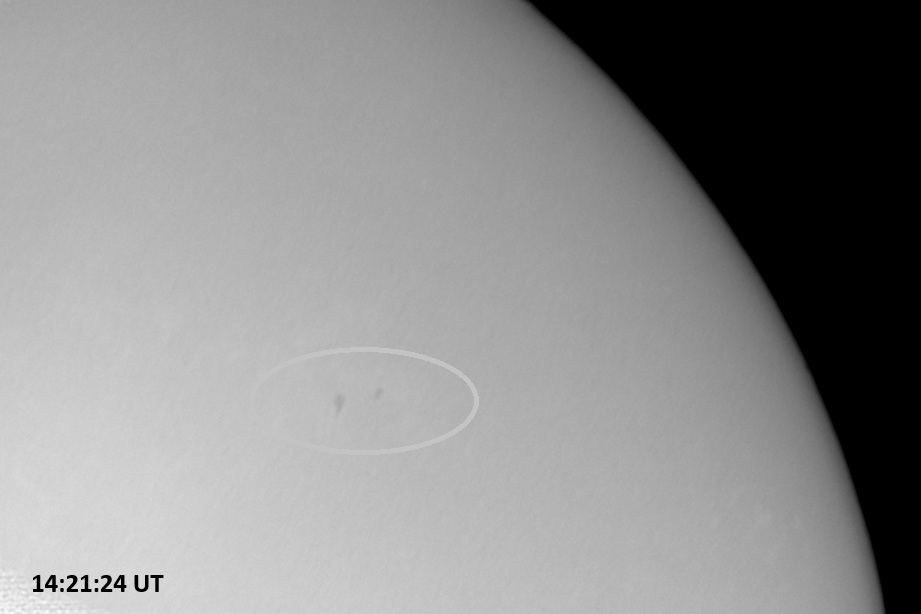 AR 14535 (circled) continues to slowly fade away. AR 14535 (circled) continues to slowly fade away. |
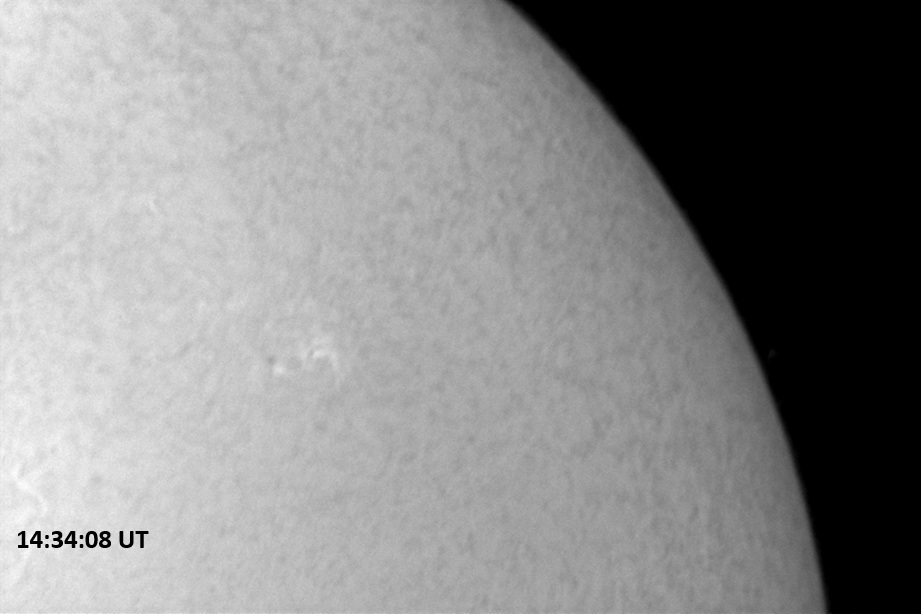 Brightening can be seen in the region of AR 14535, the decaying glow from a B5.9 event that peaked 13 minutes after the image was taken. Brightening can be seen in the region of AR 14535, the decaying glow from a B5.9 event that peaked 13 minutes after the image was taken. |
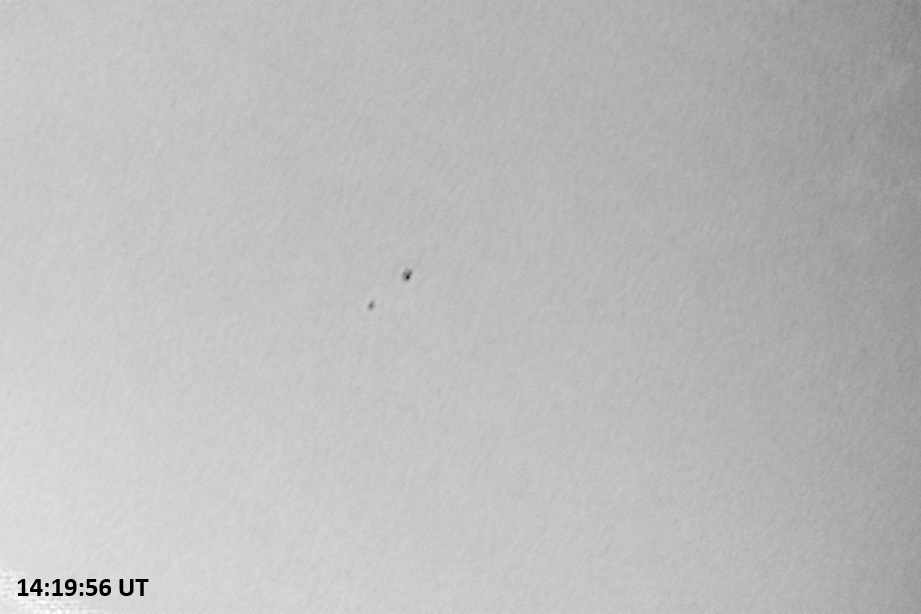 This new pair of spots was not there yesterday at this time. This new pair of spots was not there yesterday at this time. |
 New AR 14544 emerged but remained quiet for the most part today. New AR 14544 emerged but remained quiet for the most part today. |
Solar activity is likely to remain at low levels, with a slight chance for M-class flares through 1 October.
September 28, 2026
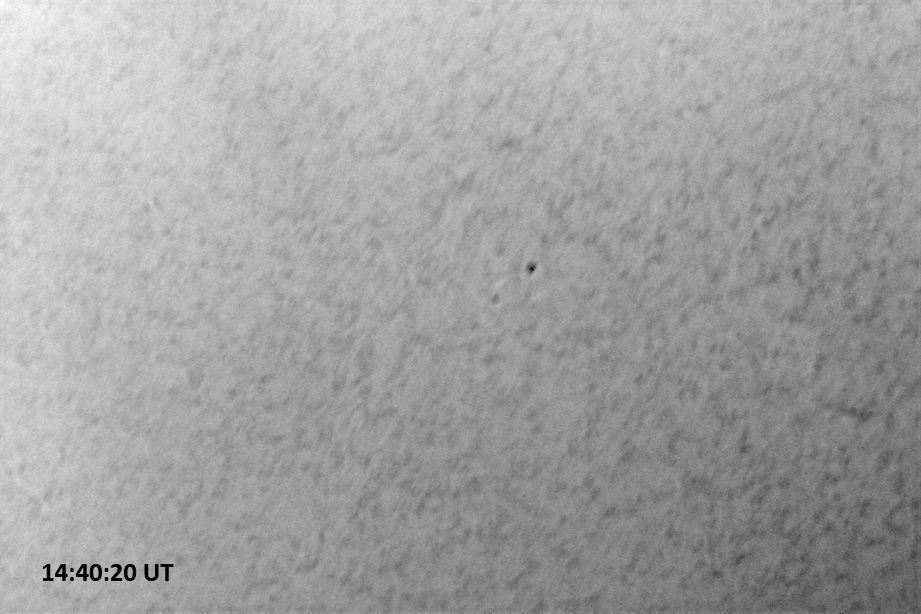
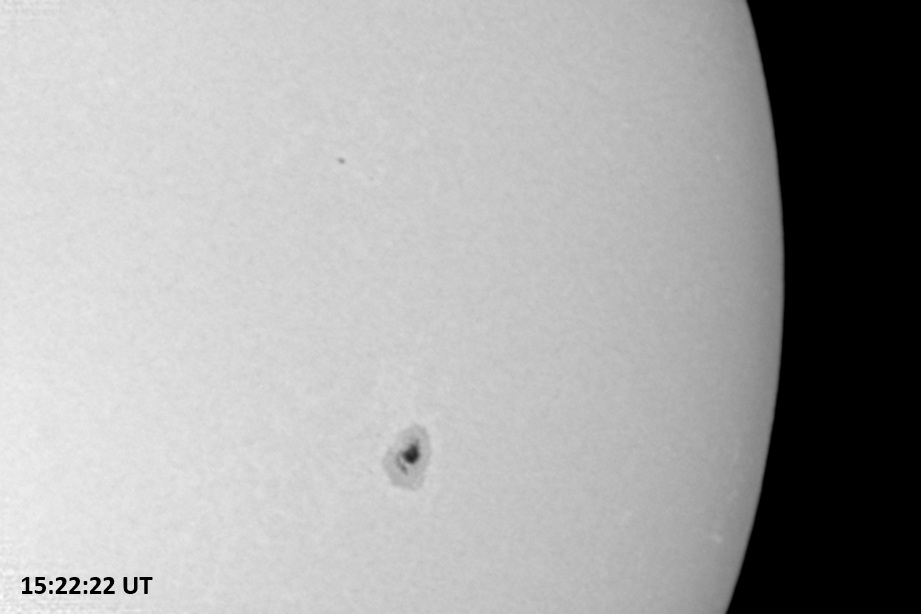
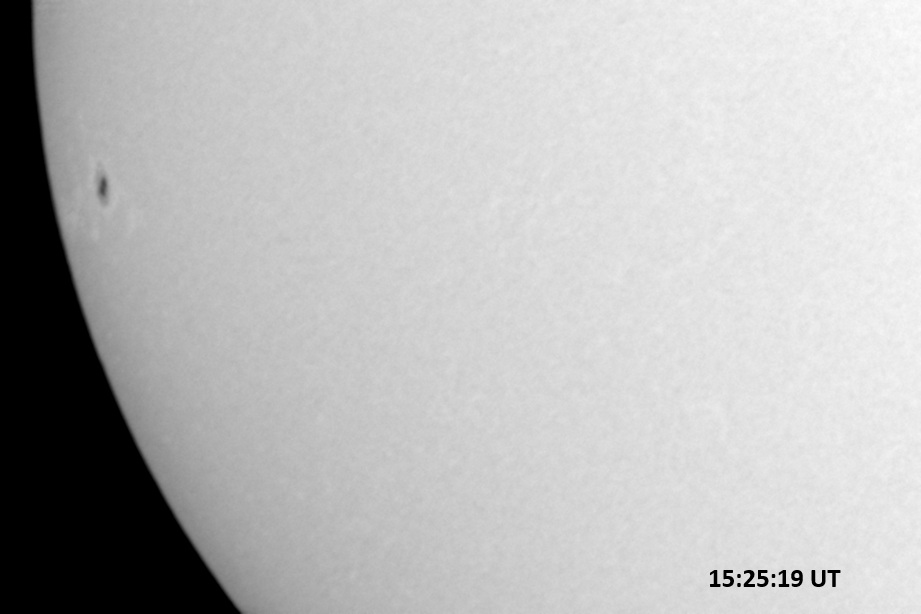
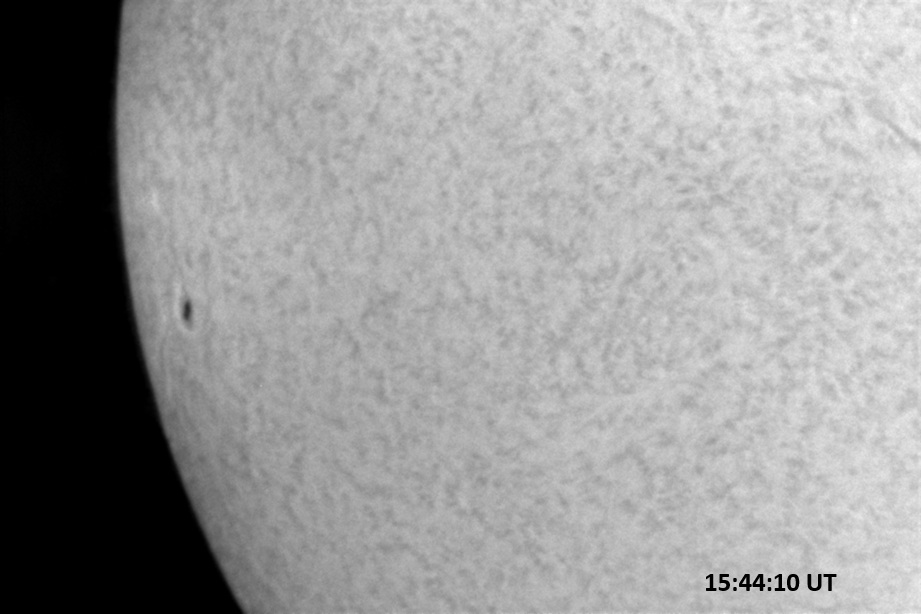
Solar activity remains at low levels, with C1 flares coming from AR 14535. There are only two spot groups remaining on the solar disk, as other spot groups have decayed to spotless plage or rotated out of view. AR 14535 had grown slightly but now seems to be in decay mode. A long-duration c2.5 occurred at 15:19 UT while we were imaging in the red continuum/off band mode. This event seems to have come from AR 14536, which is right on the solar limb, and it produced a surging prominence which was observed in the red continuum from 15:25 – 15:32 UT, then in H-alpha six times from 15:42-15:53 UT. The visibility of the in the red continuum (at 6561.1 Å with a 0.3 Å FWHM), blueward of the H-alpha center line meant that we imaged material heading toward Earth at a velocity between 70 and 90 km/s.
The first two images below were taken in the red continuum, each a 0.09 sec exposure; and the third frame is an H-alpha line center image, 0.15 sec exposure and enhanced slightly to bring out detail. Each of the images covers 7.8’x11.4′ on the sky. Celestial north is up, west is right in each image.
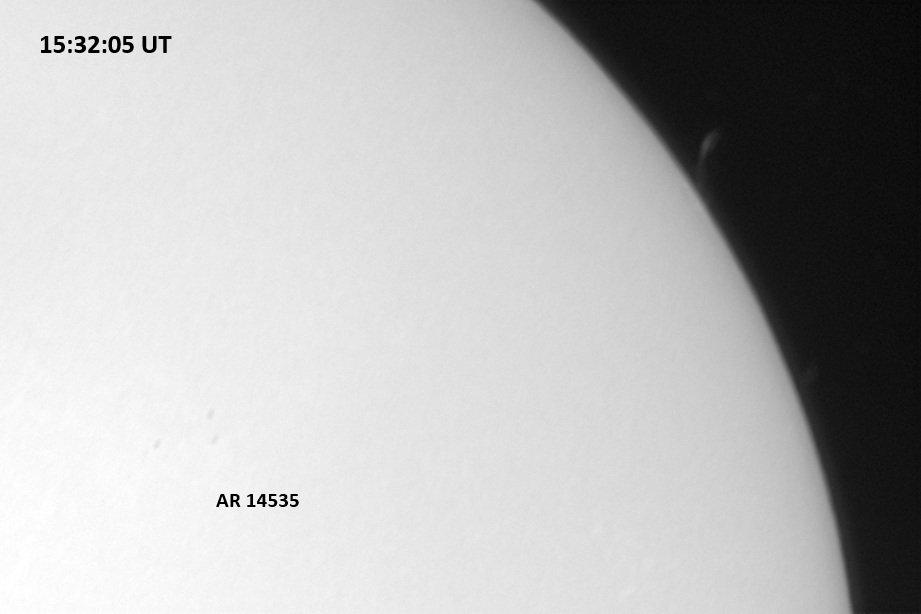 AR 14535 is becoming more inconspicuous, but a flare surge (upper right) was discovered in this image today. AR 14535 is becoming more inconspicuous, but a flare surge (upper right) was discovered in this image today. |
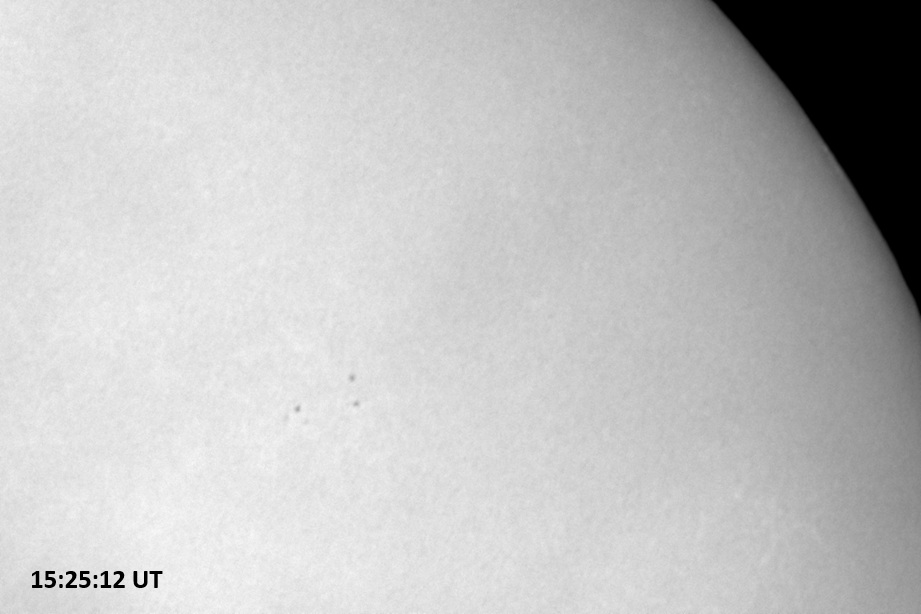 Another view of the flare sure in the upper right corner of the image, just before H-alpha filter activation. Another view of the flare sure in the upper right corner of the image, just before H-alpha filter activation. |
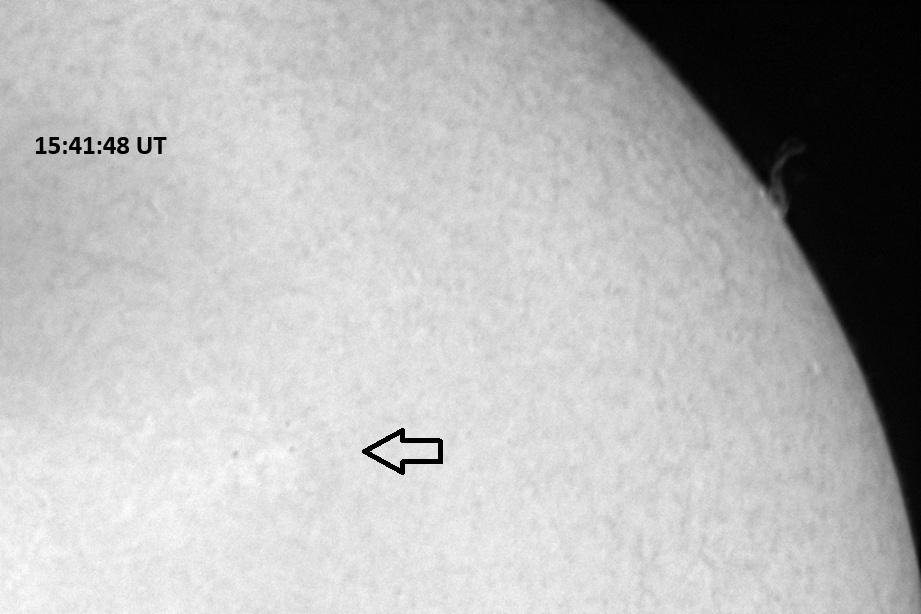 AR 14535 is even more difficult to see in H-alpha so it is arrowed. The surging, post-flare prominence remains visible, but mostly faded ten minutes later. AR 14535 is even more difficult to see in H-alpha so it is arrowed. The surging, post-flare prominence remains visible, but mostly faded ten minutes later. |
Solar activity is expected to be at low levels with a slight chance for an M-class flare on 28 September; then is expected to drop to very low levels from 29 to 30 September.
September 25, 2026
Solar activity continues to be at low levels, with three C-class flares so far today: A C1.1 at 2:44 UT today from AR 14536, and a C1.2 at 8:16 UT today from beyond the west limb. There was also a C1.2 flare from AR 14534 at 18:30 UT today. Eight spotted and numbered active regions remain visible today, but our observations picked up a ninth spot group south of AR 14536, which has yet to receive a number/designation. AR 14536 is now the only region in growth phase, the rest (with the possible exception of this ninth new region) are either stable or in decay.
The first column below includes red continuum images, each 0.09 sec exposure; and the second column hosts H-alpha line center images, each 0.15 sec exposure and enhanced slightly to bring out detail. Each of the images covers 7.8’x11.4′ on the sky. Celestial north is up, west is right in each image.
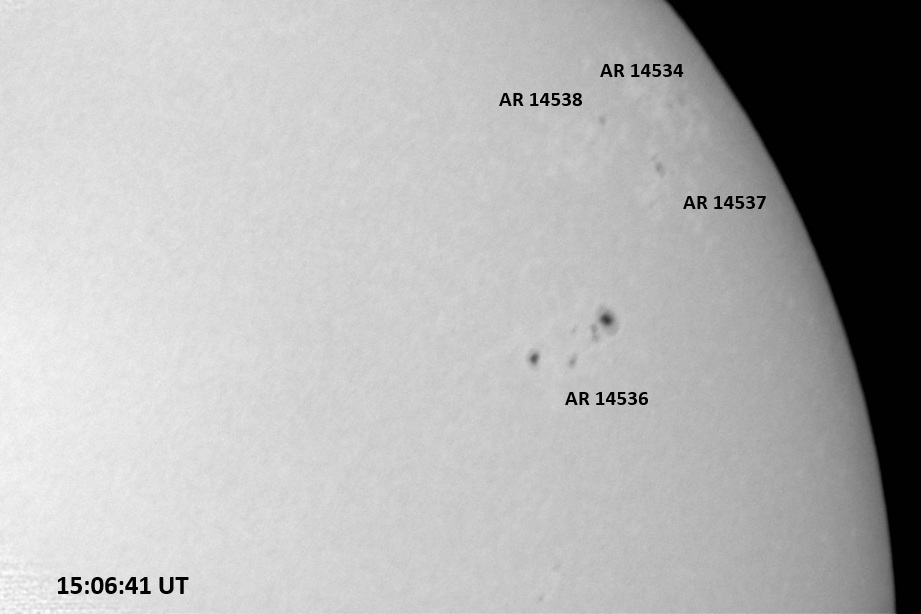 This cluster or “nest” of sunspot groups approach closer to the solar limb. This cluster or “nest” of sunspot groups approach closer to the solar limb. |
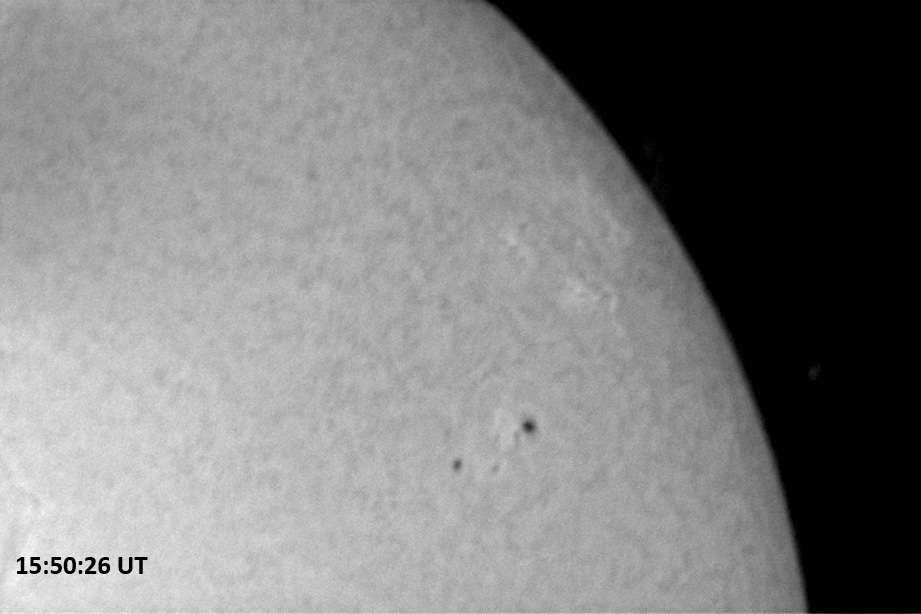 Two of the regions in this cluster produced low-level C-class flares today. Two of the regions in this cluster produced low-level C-class flares today. |
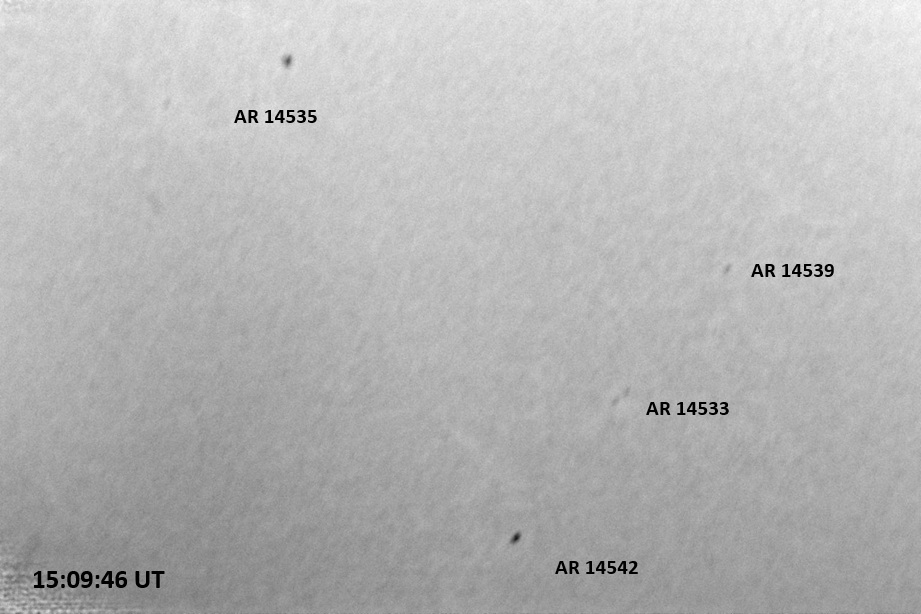 These active regions continue to decay and shrink…. These active regions continue to decay and shrink…. |
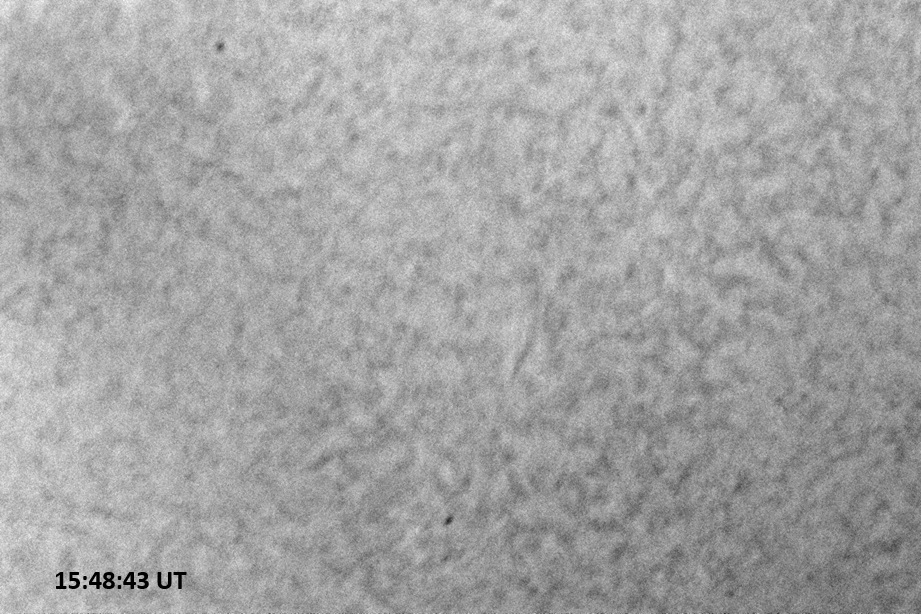 …to the extend they are very difficult to pick out of the H-alpha network. …to the extend they are very difficult to pick out of the H-alpha network. |
Solar activity is likely to remain at low levels, with isolated to occasional C-class flares and a slight chance for M-class flares through 27 September.
September 24, 2026
Solar activity continues to be at low levels, with C-class flares every once in a while. The largest (and today’s only) C-class flare was a C1.5 flare at 9:03 UT on 24 September from AR 14536. Since then, the X-ray plot has been flat (with occasional B-class enhancements) around the B4 level. There are eight numbered active regions on the solar disk, but four of them are preparing to rotate out of view in the next several days. ARs 14535, 14536, and 14537 all grew. The rest were either stable or in decay. A solar filament in the south central part of the solar disk lifted off around 16:00 UT yesterday, 23 September. The material rose for a short time, then fell back down and got reabsorbed.
The first column below includes red continuum images, each 0.15 sec exposure; and the second column hosts H-alpha line center images, each 0.25 sec exposure and enhanced slightly to bring out detail. Each of the images covers 7.8’x11.4′ on the sky. Celestial north is up, west is right in each image.
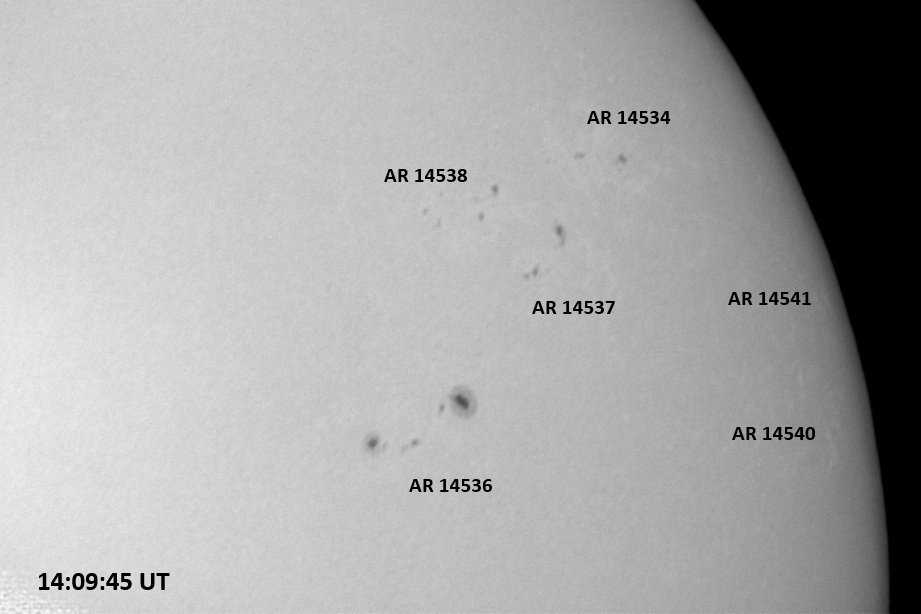 This cluster, or “nest” of spotted active regions is approaching the limb. This cluster, or “nest” of spotted active regions is approaching the limb. |
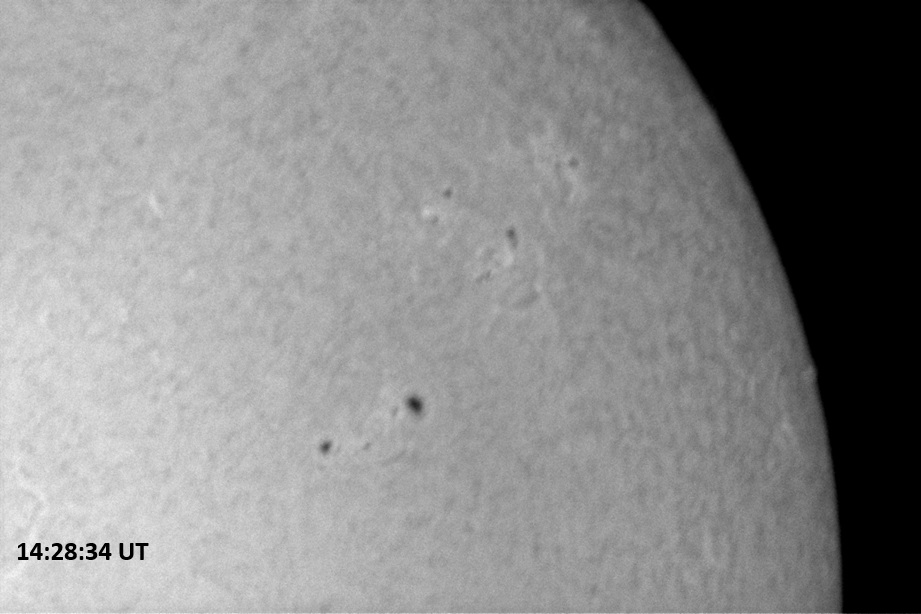 AR 14536 (bottom center) produced today’s only and largest C-class flare event. All the other regions were quiet. AR 14536 (bottom center) produced today’s only and largest C-class flare event. All the other regions were quiet. |
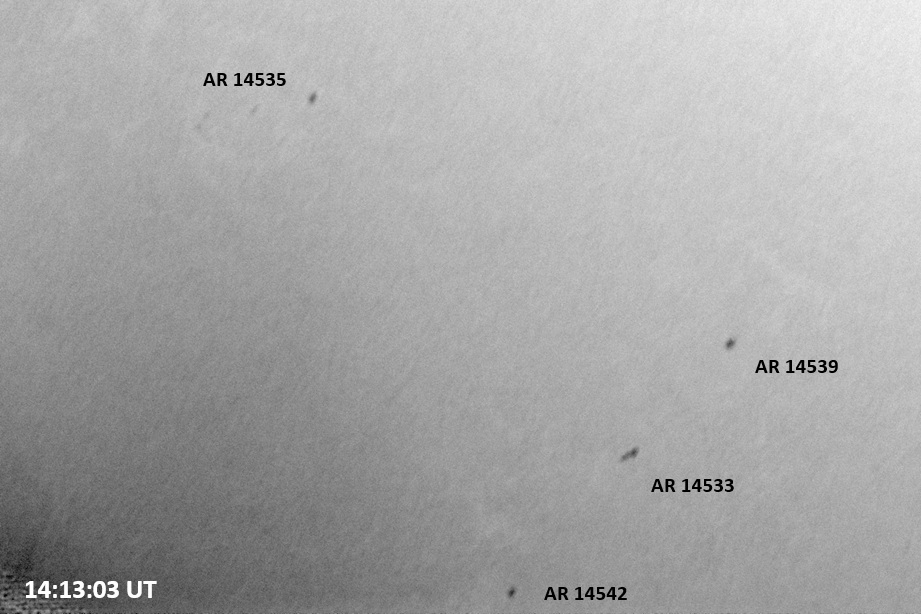 Several small active regions approach the solar central meridian. Several small active regions approach the solar central meridian. |
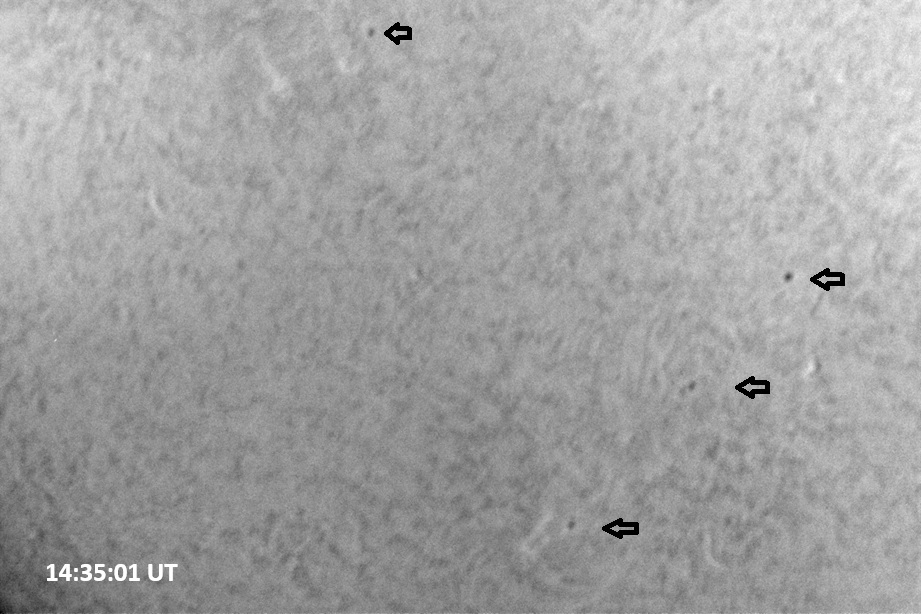 These regions are so small and inactive that arrows were provided to locate each one. These regions are so small and inactive that arrows were provided to locate each one. |
Solar activity is likely to remain at low levels, with isolated to occasional C-class flares and a slight chance for M-class flares through 26 September.
September 23, 2026
Solar activity continues to be at low levels. The largest event of yesterday and today (so far…through 22:00 UT) was a C2.4 flare at 17:20 UT on 22 September from AR 14534. There are eight visible spot groups on the solar disk currently. AR 14535 has grown a bit and produced a C1.3 flare today at 6:21 UT. AR 14536 is also growing, and it produced a C1.1 flare at 17:58 UT, 22 September. This is the largest spot group on the visible disk currently. AR 14537 lengthened but simplified magnetically, and produced a C1.6 flare today at 11:31 UT. AR 14538 and 14539 also continues to grow, but AR 14540 has dissipated (not readily visible during this morning’s visual sunspot counts). Also, newly numbered AR 14541 is easily seen nearing the western limb.
The first column below includes red continuum images, each 0.15 sec exposure; and the second column hosts H-alpha line center images, each 0.25 sec exposure and enhanced slightly to bring out detail. Each of the images covers 7.8’x11.4′ on the sky. Celestial north is up, west is right in each image.
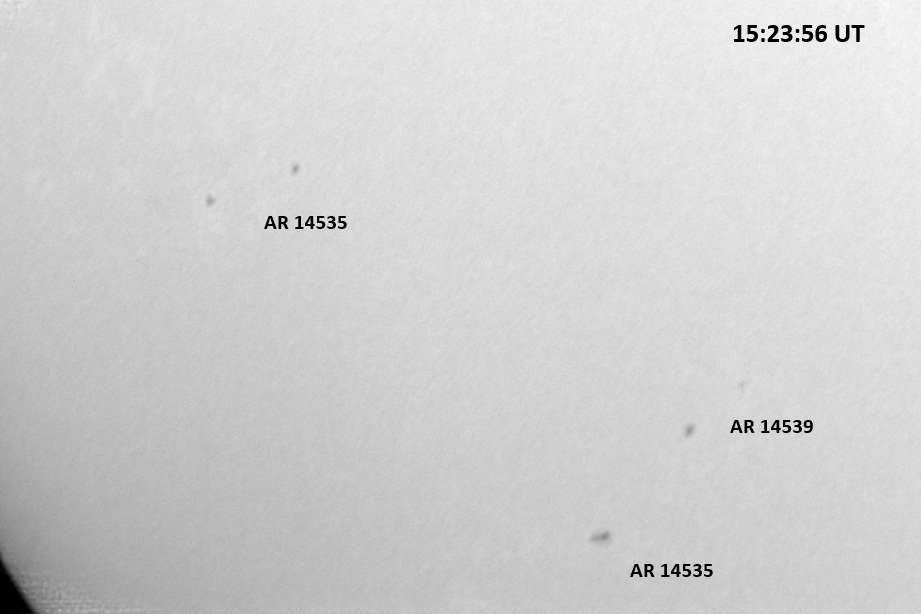 Three small active regions continue to march across the visible solar disk. Three small active regions continue to march across the visible solar disk. |
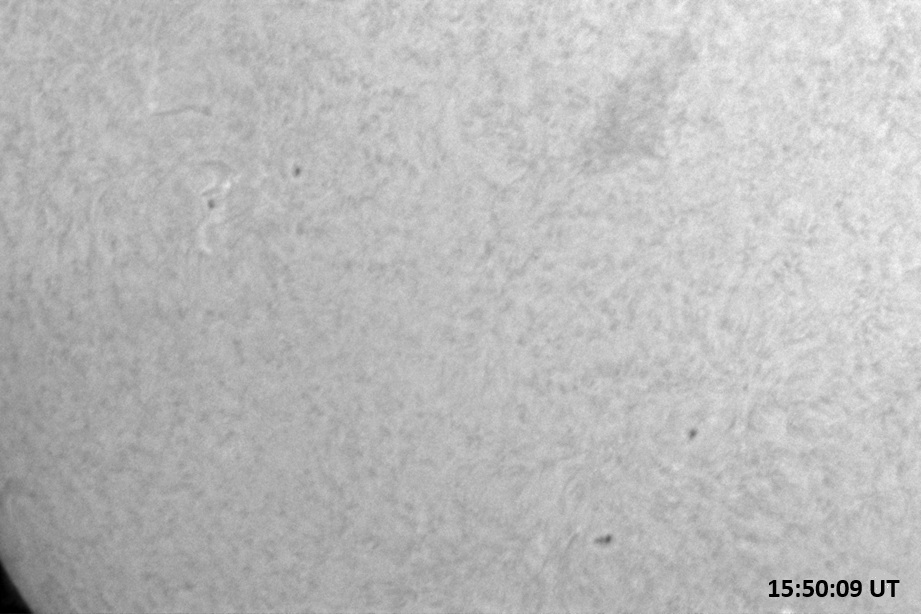 AR 14535 (top) produced a C1.3/SF at 6:21 UT today. The other two regions in this image were quiet all day. AR 14535 (top) produced a C1.3/SF at 6:21 UT today. The other two regions in this image were quiet all day. |
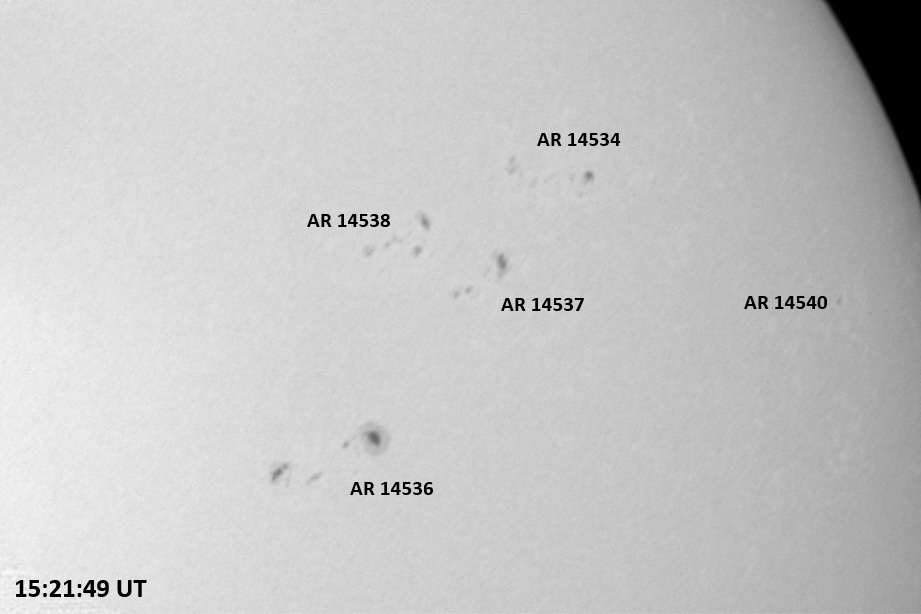 The “sunspot nest” of four active regions continues to grow slightly. The “sunspot nest” of four active regions continues to grow slightly. |
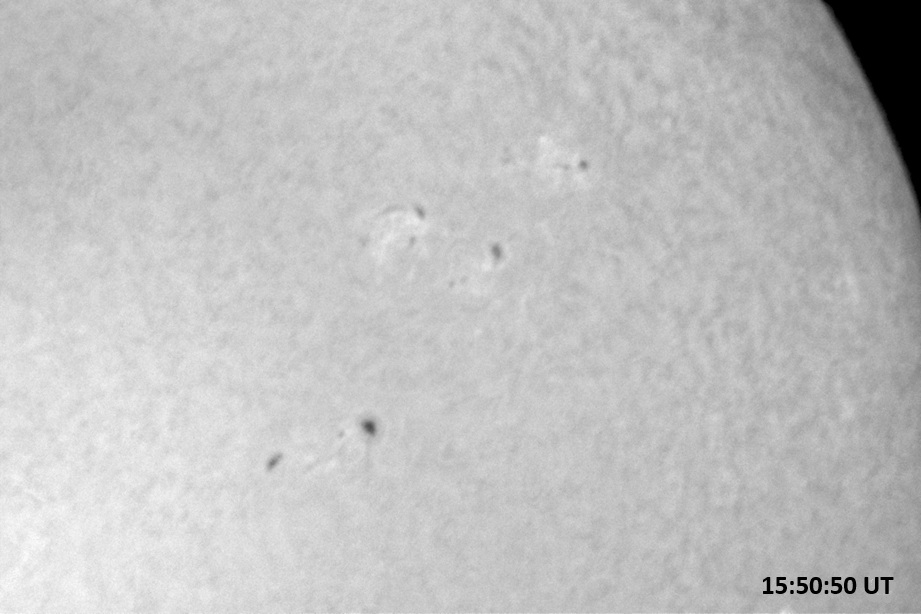
AR 14537 produced a C1.6 flare today at 11:31 UT. Otherwise, this zone on the Sun has |
Solar activity is likely to remain at low levels, with a slight chance for M-class flares through 25 September.
September 22, 2026
Solar activity remains at low levels as sunspot groups blossom on the sun’s surface. There were 9 groups identified this morning visually, 7 of which are numbered. AR 14536 produced a C2.0 flare early today at 4:51 UT. AR 14533 is a stable, single spot; AR 14534 is growing in size, spot number, and magnetic complexity; AR 14535 is decaying and some of tis spots submerging; and ARs 14536, 14537, and 14538 grew slightly. AR 14539 emerged rapidly since yesterday, and a pair of small bipolar regions emerged close to each other, the complex is centered near W50 S08 or in the west-southwest part of the solar disk. They have yet to be numbered.
The strongest flare so far today (through 22:18 UT) is a C2.4 X-ray flare from AR 14534. The last time an M-class flare occurred was on 5 September 2026 (about 2.5 weeks ago), an M1.0 event; the last time an X-flare happened was on 4 July 2026 (about 2.5 months ago), an X1.3 event (source of this information: spaceweatherlive.com).
The first column below includes red continuum images, each 0.09 sec exposure; and the second column hosts H-alpha line center images, each 0.15 sec exposure and enhanced slightly to bring out detail. Each of the images covers 7.8’x11.4′ on the sky. Celestial north is up, west is right in each image.
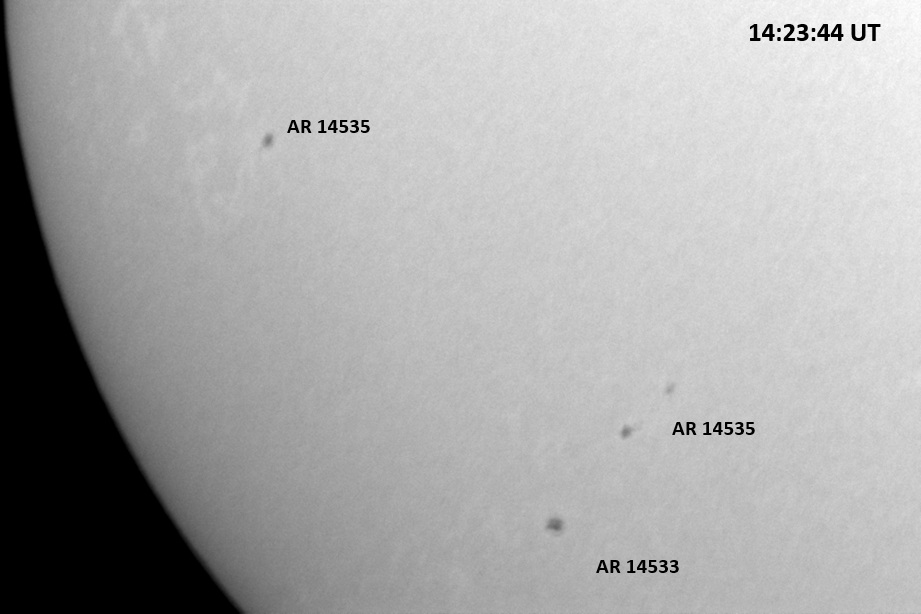 Three spotted groups (labeled) are visible in the eastern part of the solar disk. Three spotted groups (labeled) are visible in the eastern part of the solar disk. |
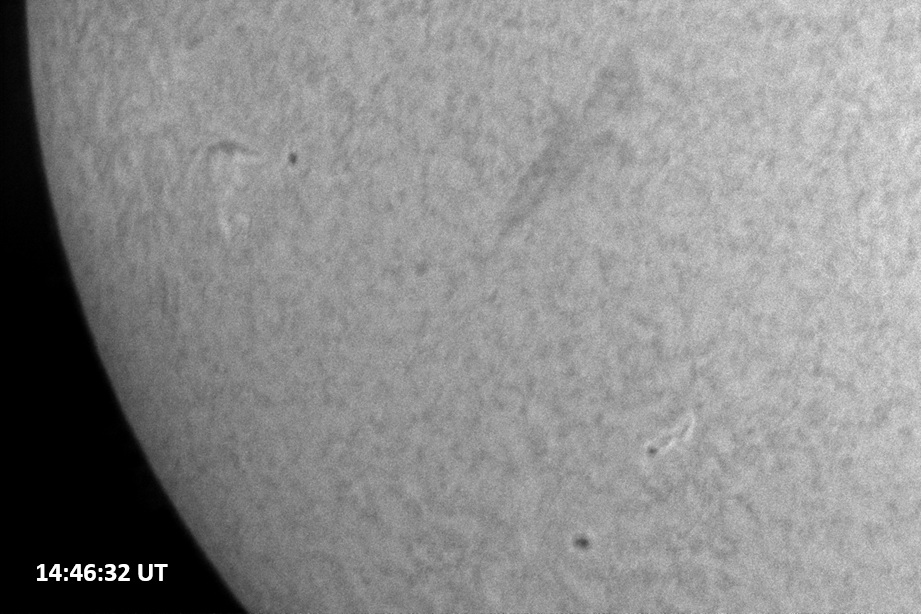 These groups have been quiet all day so far. Note the filament in the top part of the picture. These groups have been quiet all day so far. Note the filament in the top part of the picture. |
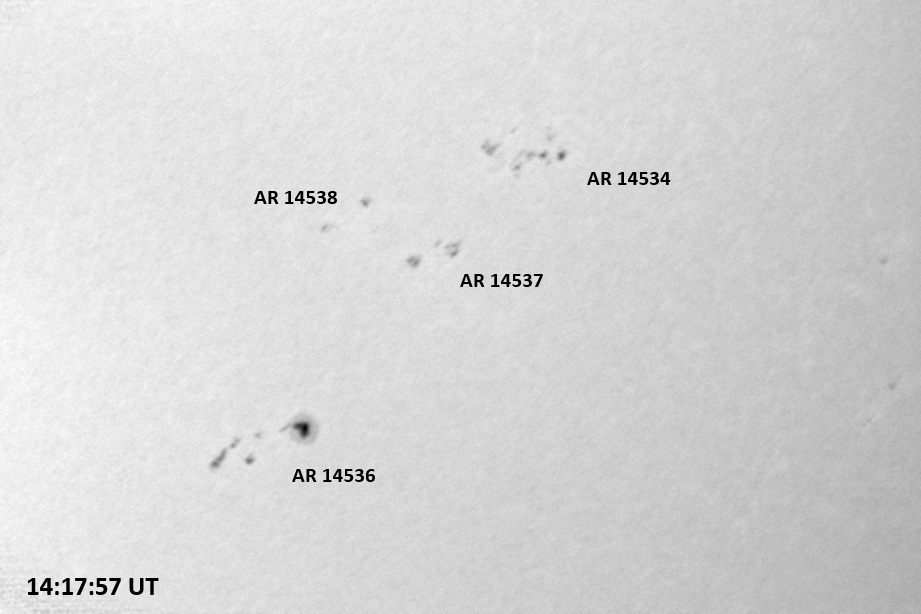 These four groups form what appear to be a “sunspot nest”, something I wrote about a number of years ago. These continue to grow in size and spot number. These four groups form what appear to be a “sunspot nest”, something I wrote about a number of years ago. These continue to grow in size and spot number. |
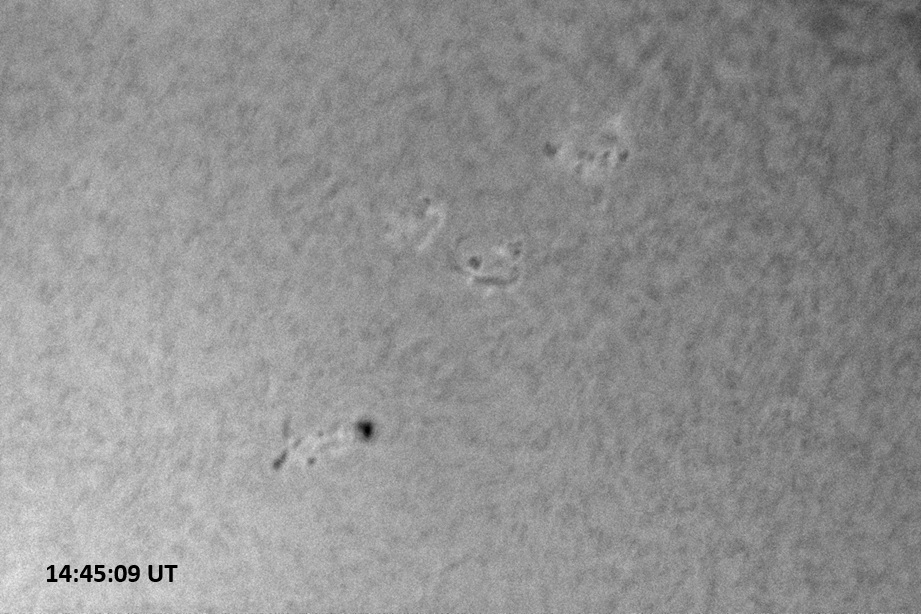 These regions are forming bright plage, something not as apparent in yesterday’s observations. ARs 14534 and 14536 each produced at least 1 C-class flare today. These regions are forming bright plage, something not as apparent in yesterday’s observations. ARs 14534 and 14536 each produced at least 1 C-class flare today. |
Solar activity is likely to remain at low levels, with a slight chance for M-class flares through 24 September.
September 21, 2026
Solar activity returned to low levels on 19 September with a C33 flare event at 18:17 UT from an active region just over the northeastern limb of the Sun. Following this were four more more C-class flares: a C1.1 at 5:18 UT on 20 September from AR 14535; a C3.7/1F flare from AR 14534 at 22:34 UT, 20 September; a C1.1 at 1:13 UT, 21 September from AR 14534; and a C1.2 at 6:29 UT on 21 September, also from AR 14534. There had been no further C-class activity since then, through 21:25 UT.
From a spotless disk on 18 September, two spot groups (consisting of single spots at the time) emerged on the solar disk on 19 September. On 20 September, these were joined by two active regions rotating over the eastern limb; then today, two additional regions emerged near the center of the solar disk. Two of these are AR 14534 and 14536, both of which were showing rapid magnetic flux emergence. The remaining regions were stable (there are six total, up from zero three days earlier).
The first column below includes red continuum images, each 0.09 sec exposure; and the second column hosts H-alpha line center images, each 0.15 sec exposure and enhanced slightly to bring out detail. Each of the images covers 7.8’x11.4′ on the sky. Celestial north is up, west is right in each image.
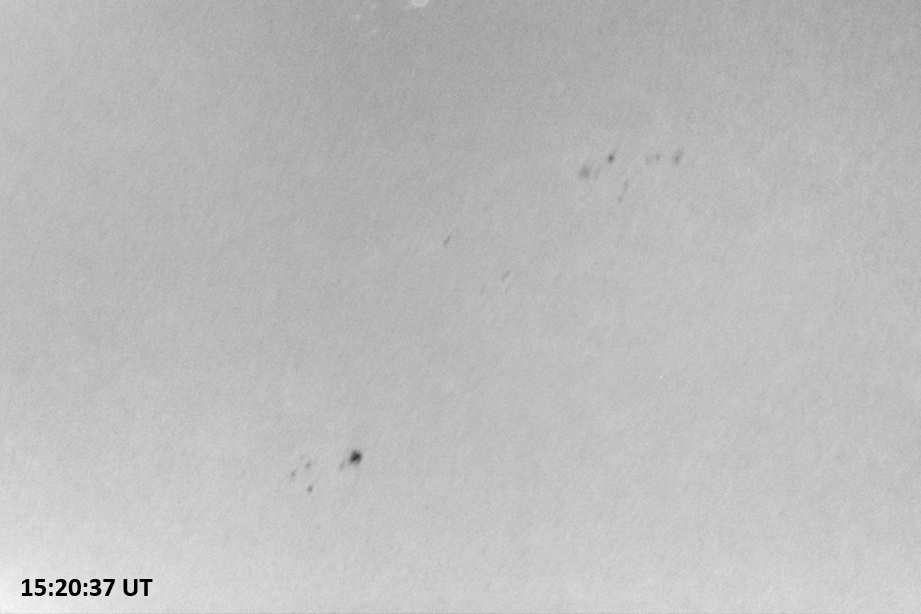 These two recently emerged onto the solar disk: AR 14534 (top right) and 14536 (bottom left). There are hints of a new AR emerging between them. These two recently emerged onto the solar disk: AR 14534 (top right) and 14536 (bottom left). There are hints of a new AR emerging between them. |
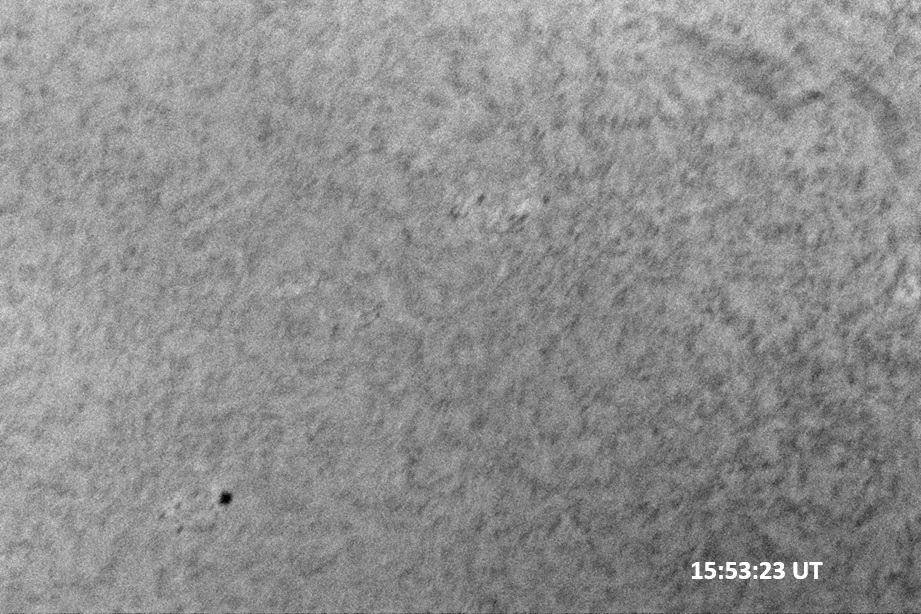 These regions become difficult to see in H-alpha, but a filament is easily visible in the upper right corner of the image. These regions become difficult to see in H-alpha, but a filament is easily visible in the upper right corner of the image. |
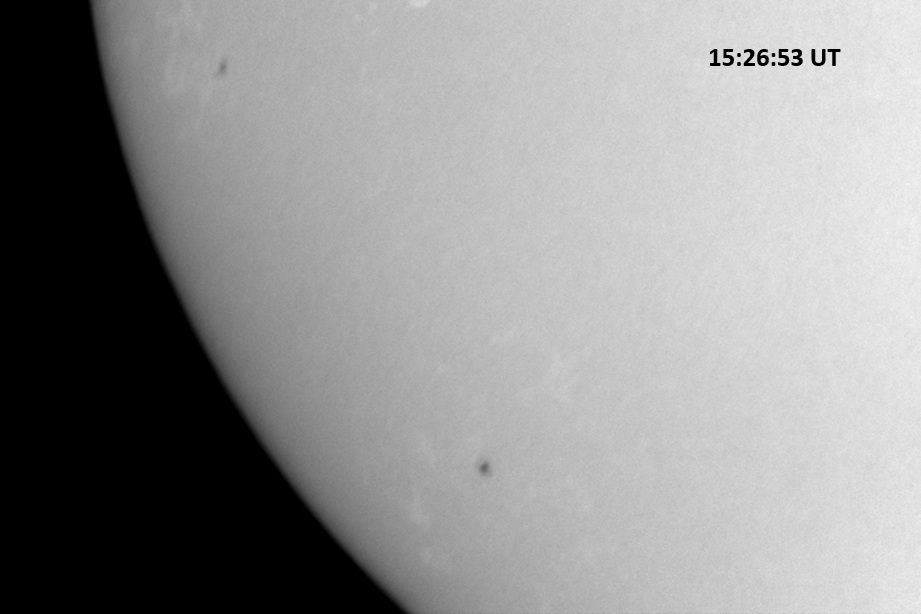 AR 14535 (top spot) and 14533 (bottom center in image) rotated into view this weekend. AR 14535 (top spot) and 14533 (bottom center in image) rotated into view this weekend. |
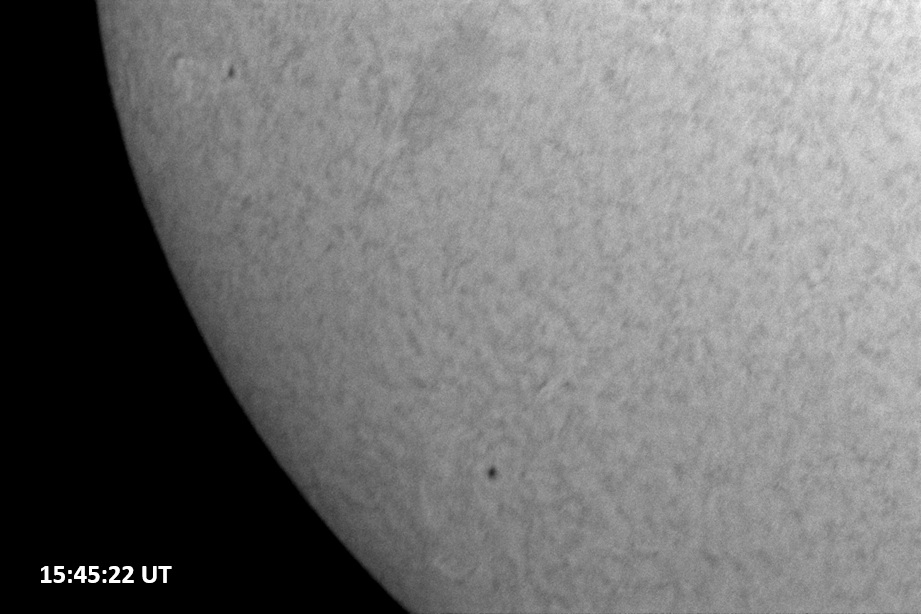 The same regions as depicted left are seen here, along with a fluffy filament (top center of image). The same regions as depicted left are seen here, along with a fluffy filament (top center of image). |
Solar activity is expected to be at low levels, with a slight chance for M-class flares through 23 September.
September 18, 2026
Solar activity continues to be at very low levels, with only isolated low-level B-class flaring from unnumbered plage regions. There are no spotted active regions on the visible solar disk, making this the first spotless day since February 22 to 24, 2026.
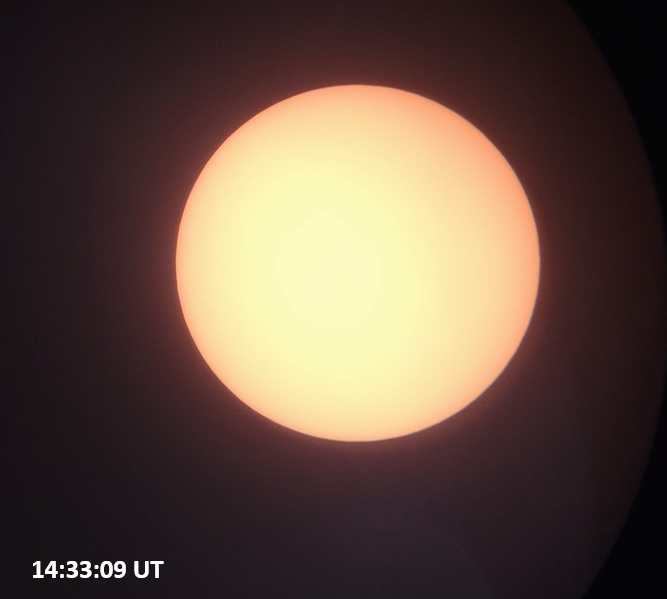
The smartphone image (1/250 second exposure at 200 ISO, 4.5-inch f/8 reflector with white light solar filter and a 25 mm eyepiece providing 36.6x magnification) taken during this morning’s sunspot count shows the spotless disk of the Sun. Solar north is approximately up, west right in this image.
Prior to this three day period, there was a string of approximately 1,355 consecutive days with visible sunspots that began after June 8, 2022. The spotless days in February as well as today mark the start of the quiet declining phase of Solar Cycle 25, after its peak in October, 2024.
The first image below (upper left corner) is a red continuum image, 0.09 sec exposure; and the next three frames host H-alpha line center images, each 0.15 sec exposure and enhanced slightly to bring out detail. Each of the images covers 7.8’x11.4′ on the sky. Celestial north is up, west is right in each image.
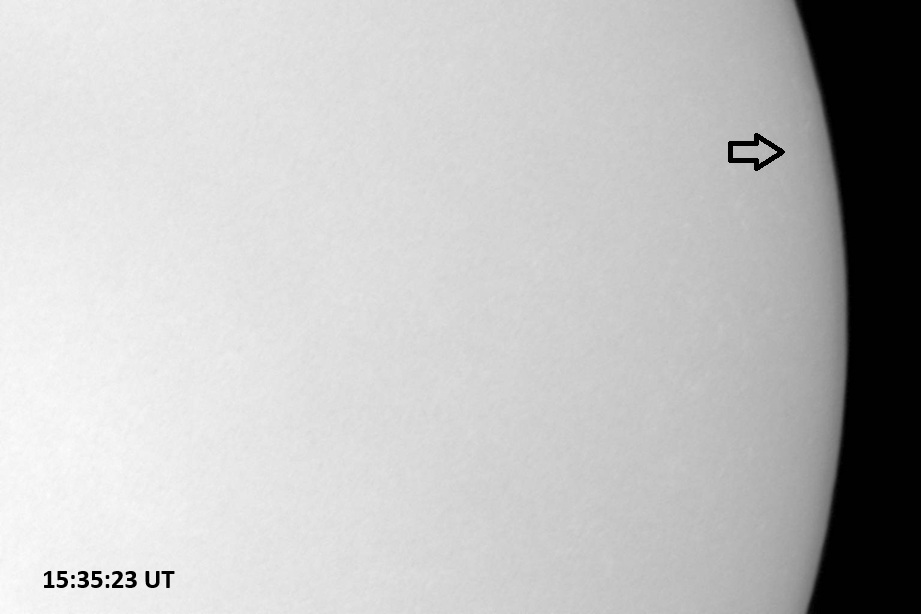 Red continuum image showing the approximate location of AR 14528, the last spot to rotate over the west limb. Red continuum image showing the approximate location of AR 14528, the last spot to rotate over the west limb. |
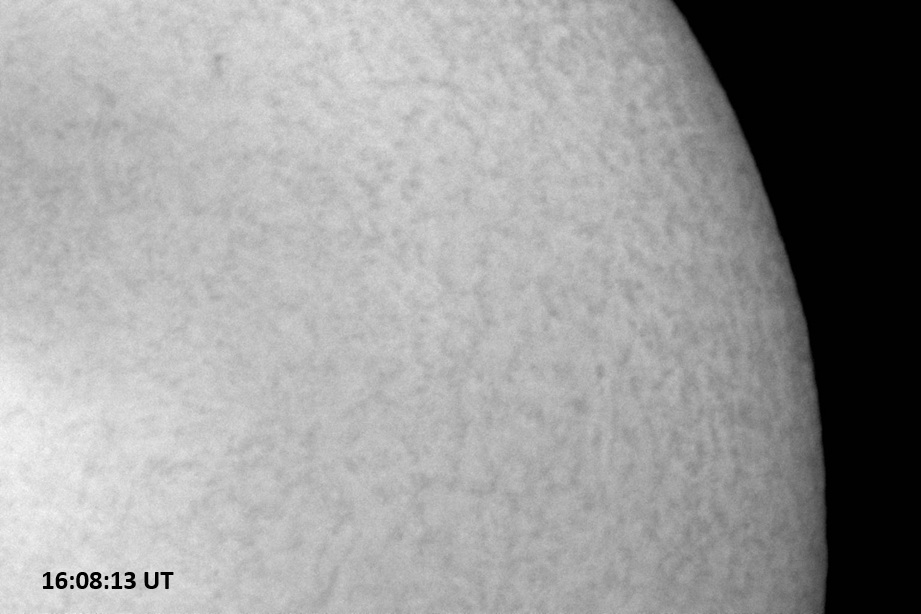 Nearly the same zone of the Sun in H-alpha showing the H-alpha chromospheric network and little more. Nearly the same zone of the Sun in H-alpha showing the H-alpha chromospheric network and little more. |
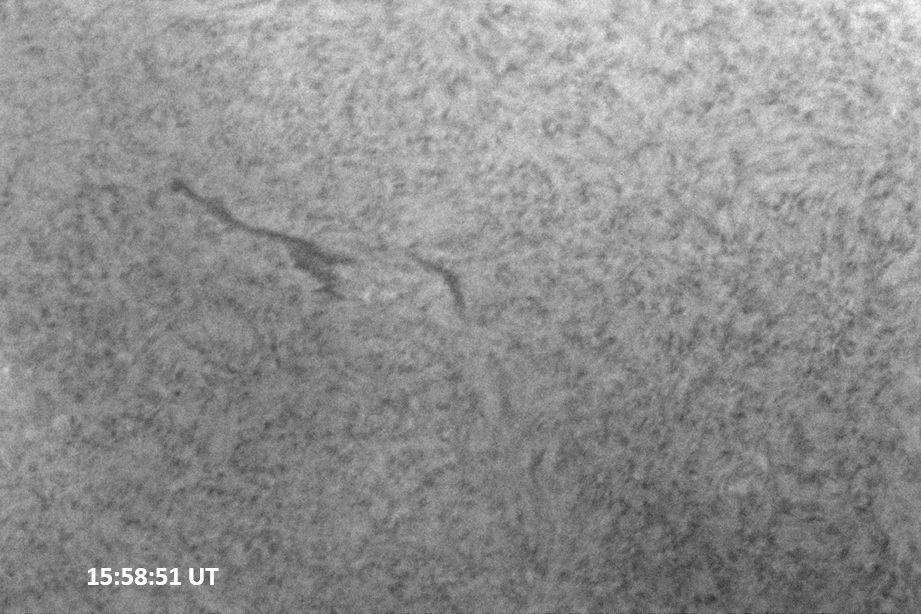 A single filament is visible near the solar disk center. A second was nearby two days ago, but it has since disappeared. A single filament is visible near the solar disk center. A second was nearby two days ago, but it has since disappeared. |
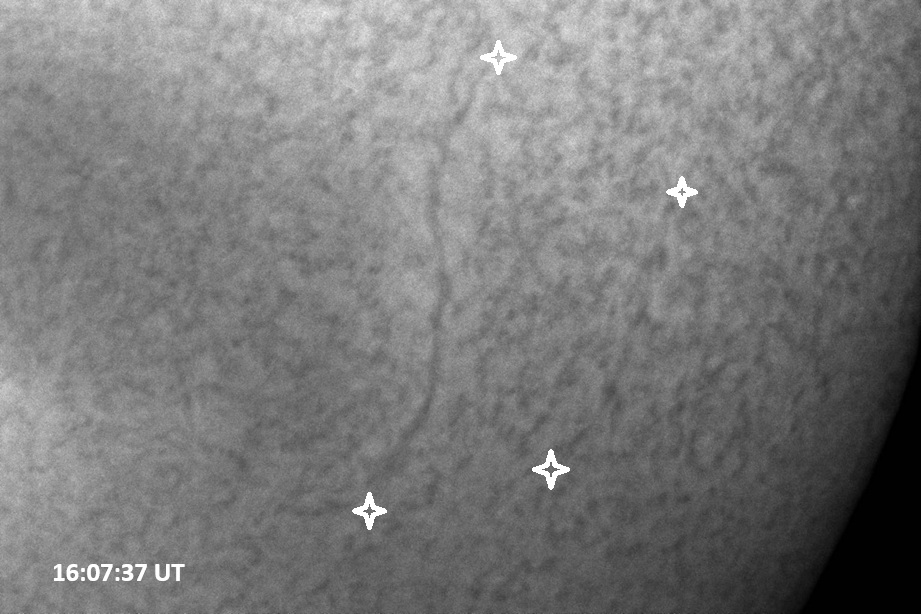 Two filaments in the southwestern quadrant of the Sun, the endpoints are marked with stars. This image was taken through a thin cirrus cloud. Two filaments in the southwestern quadrant of the Sun, the endpoints are marked with stars. This image was taken through a thin cirrus cloud. |
Solar activity is expected to remain at very low levels, with a low chance for isolated C-class flares through 20 September.
September 16, 2026
Solar activity continues to be at very low levels, with only an occasional B-class flare or two from unnumbered plage regions. AR 14529 has re-emerged as a single spot, and the other small spots or groups that were noted to appear yesterday morning, including AR 14531, have all decayed. There is one potential large active region on the solar far side, which should rotate into view in a few days. There are now three spotted regions, each consisting of single spots, that are about to rotate over the western limb, potentially leaving behind a blank solar disk.
The first image below is a red continuum image, 0.09 sec exposure; and the next two frames host H-alpha line center images, each 0.15 sec exposure and enhanced slightly to bring out detail. Each of the images covers 7.8’x11.4′ on the sky. Celestial north is up, west is right in each image.
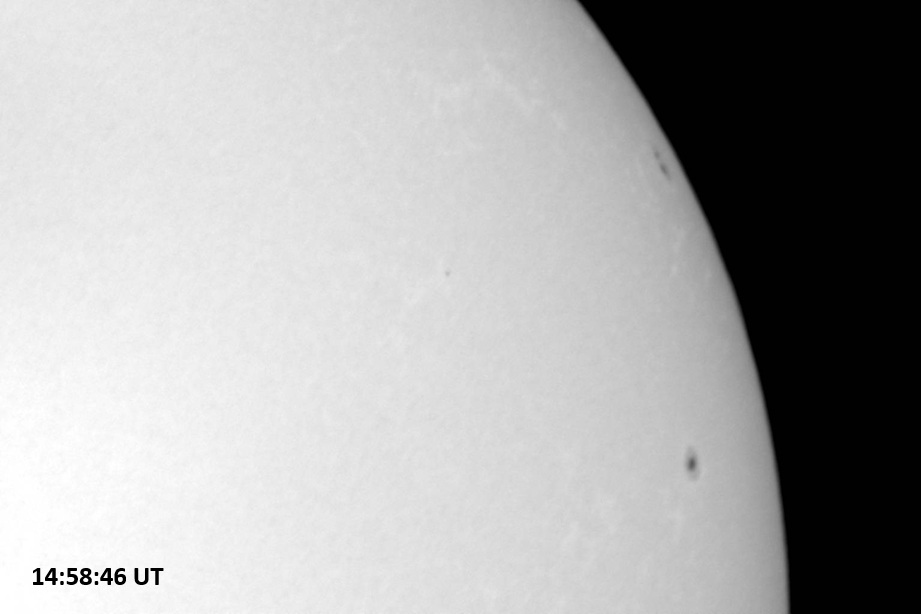 AR 14527 (top spot), 14529 (near image center) and 14528 (bottom spot) as they prepare to rotate out of view. AR 14527 (top spot), 14529 (near image center) and 14528 (bottom spot) as they prepare to rotate out of view. |
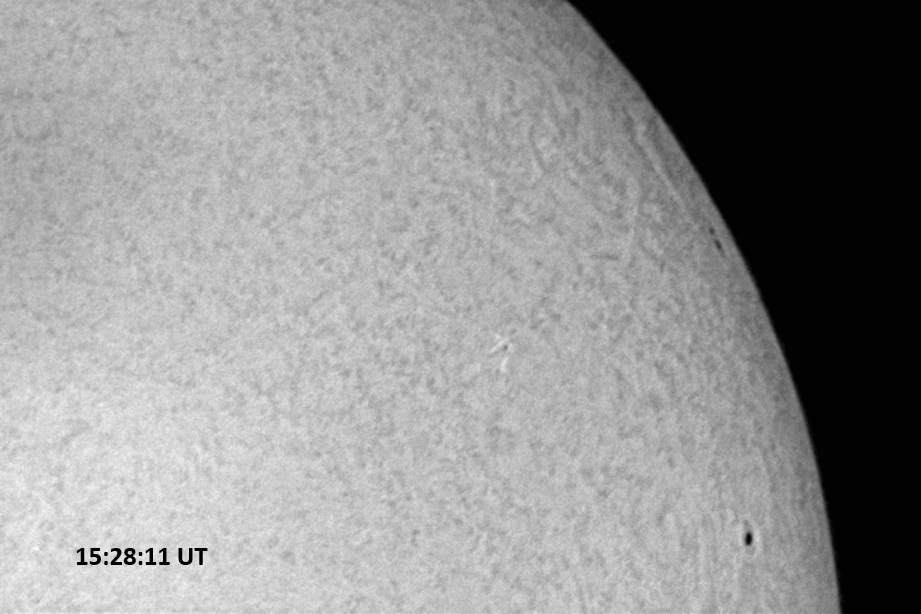 This region remains quiet in H-alpha as well. The rest of the Sun is similarly quiet. This region remains quiet in H-alpha as well. The rest of the Sun is similarly quiet. |
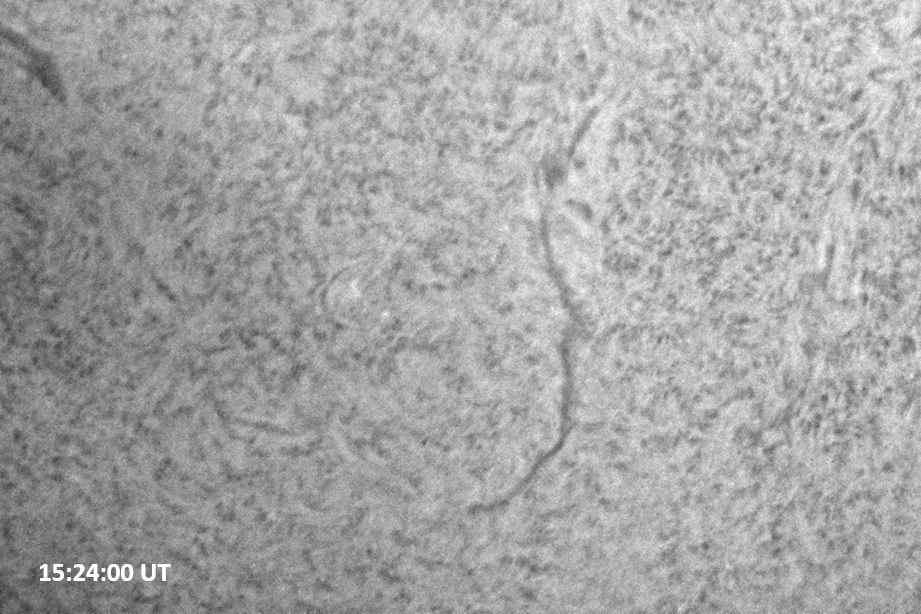 One of several filaments that grace the solar disk. This was imaged yesterday as well as we monitor its progress. One of several filaments that grace the solar disk. This was imaged yesterday as well as we monitor its progress. |
Solar activity is expected to remain at very low levels, with a chance for isolated C-class flares through 18 September.
September 15, 2026
Solar activity continues to be at very low levels. There have only been occasional B-class mini-flares. There are four numbered sunspot groups on the visible solar disk, three of which are single spots. The newly-emerged AR 14531 consisted of a pair of tiny spots. Two additional single spots were noted during this morning’s sunspot counts; these were in the eastern part of the solar disk.
The first column below includes red continuum images, each 0.09 sec exposure; and the second column hosts H-alpha line center images, each 0.15 sec exposure and enhanced slightly to bring out detail. Each of the images covers 7.8’x11.4′ on the sky. Celestial north is up, west is right in each image.
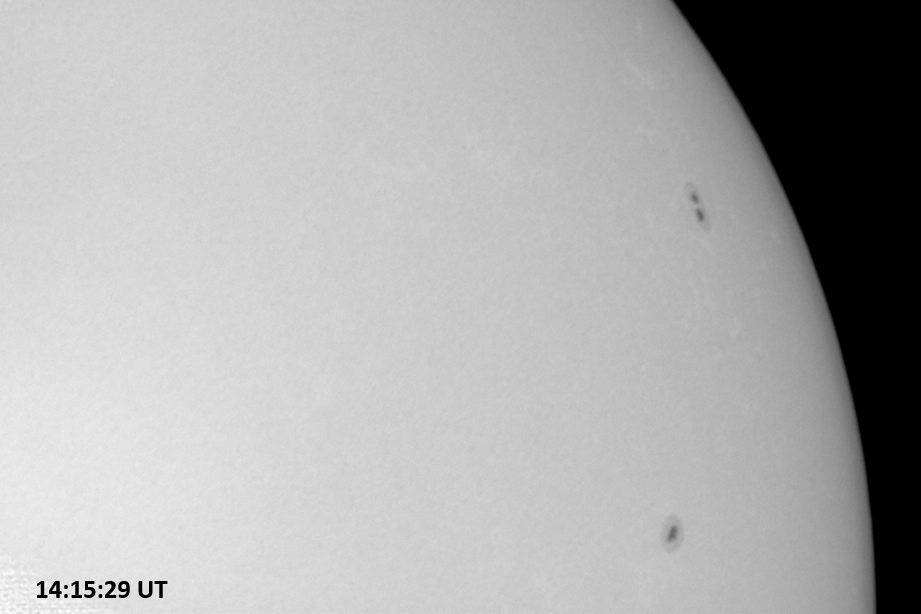 AR 14527 (top) and 14528 (bottom) are set to rotate over the solar limb. AR 14529 had become invisible during this morning’s sunspot count. AR 14527 (top) and 14528 (bottom) are set to rotate over the solar limb. AR 14529 had become invisible during this morning’s sunspot count. |
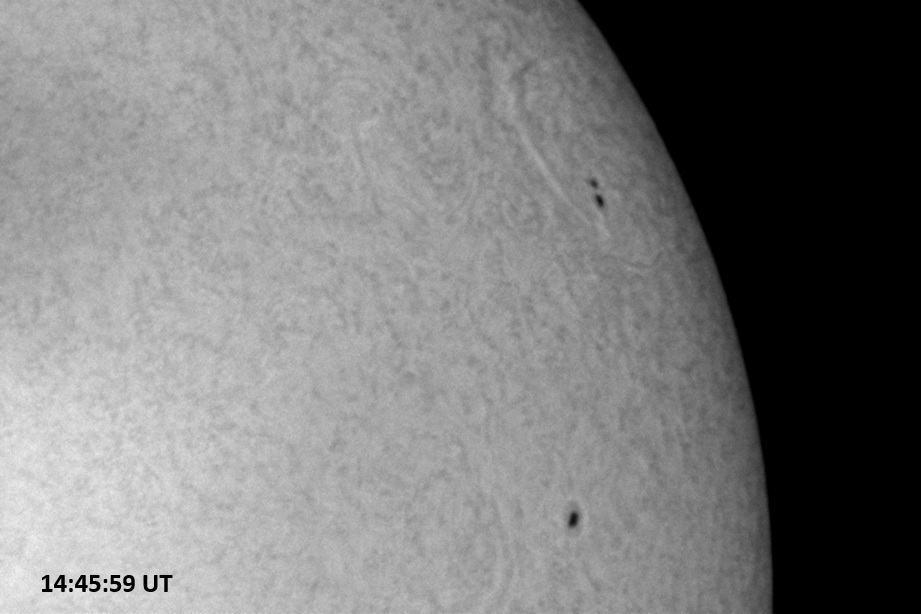 This zone of the sun has been very quiet. The active regions remain dormant as they approach the western limb of the Sun. This zone of the sun has been very quiet. The active regions remain dormant as they approach the western limb of the Sun. |
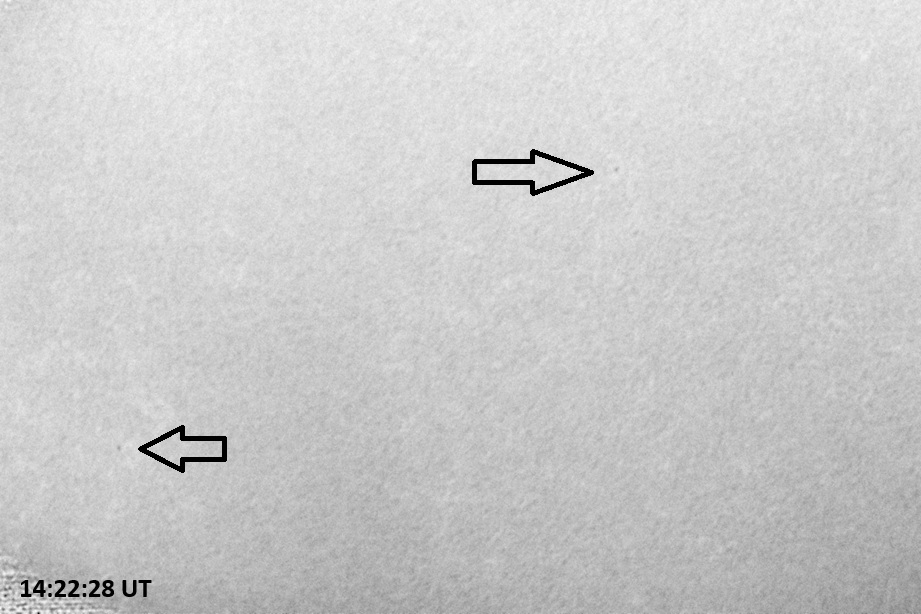 AR 14531 (top, arrowed) emerged yesterday. A single spot (lower left, arrowed) appeared this morning and is unnumbered. AR 14531 (top, arrowed) emerged yesterday. A single spot (lower left, arrowed) appeared this morning and is unnumbered. |
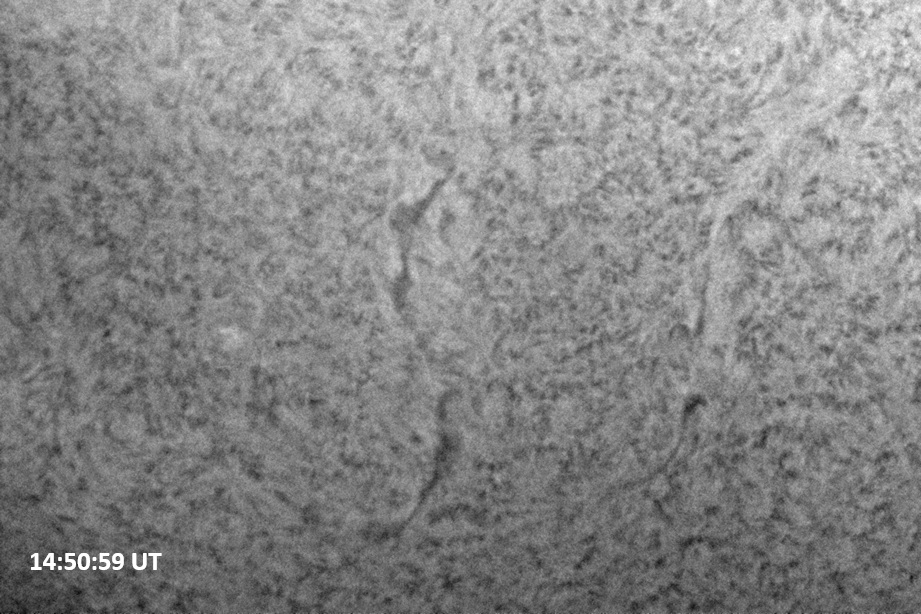 When the sunspots go quiet and/or are scarce, there are often plenty of filaments to watch. The small bright spot left is a potential new active region. A filament runs up the image center, and a filament channel (upper right, the light band) is also visible. When the sunspots go quiet and/or are scarce, there are often plenty of filaments to watch. The small bright spot left is a potential new active region. A filament runs up the image center, and a filament channel (upper right, the light band) is also visible. |
Solar activity is expected to persist at very low levels, with a decreasing chance for isolated C-class flares through 17 September.
September 14, 2026
Solar activity dropped to very low levels today after briefly increasing to low levels yesterday. From 18:41 to 19:51 UTC, 13 September, an 8 degree long, north-south oriented filament centered just southwest of the disk center (celestial coordinates) lifted off the Sun’s disk. This resulted in a long-duration C1.4 flare, which was the only C-class flare yesterday (and today, 14 September, through 21:31 UT). This event launched a coronal mass ejection, which was first observed by satellite at approximately 19:48 UT yesterday. This cloud of charged solar particles may make a minor glancing blow of the Earth’s magnetic field early on 17 September.
All of the visible, numbered active regions are stable or in decay. Four of these are currently visible, with a new pair of spots emerging (to make 5 spot groups) near S08 E10 (heliocentric coordinates, or just southeast of disk center).
The first column below includes red continuum images, each 0.09 sec exposure; and the second column hosts H-alpha line center images, each 0.15 sec exposure and enhanced slightly to bring out detail. Each of the images covers 7.8’x11.4′ on the sky. Celestial north is up, west is right in each image.
 These active regions (spotted and unspotted) are about to rotate out of view. These active regions (spotted and unspotted) are about to rotate out of view. |
 AR 14529 (near image center) produced the largest flare today, a B9.7. Everything else was quiet. AR 14529 (near image center) produced the largest flare today, a B9.7. Everything else was quiet. |
 More regions about to rotate out of view. The three visible spot groups (labeled) trail the other and will be visible a few more days. More regions about to rotate out of view. The three visible spot groups (labeled) trail the other and will be visible a few more days. |
 AR 12528 (just right of image center) and this entire region of the solar disk, had been quiet all day. AR 12528 (just right of image center) and this entire region of the solar disk, had been quiet all day. |
Solar activity is expected to remain at very low levels, with a chance for isolated C-class flares through 16 September.
September 11, 2026
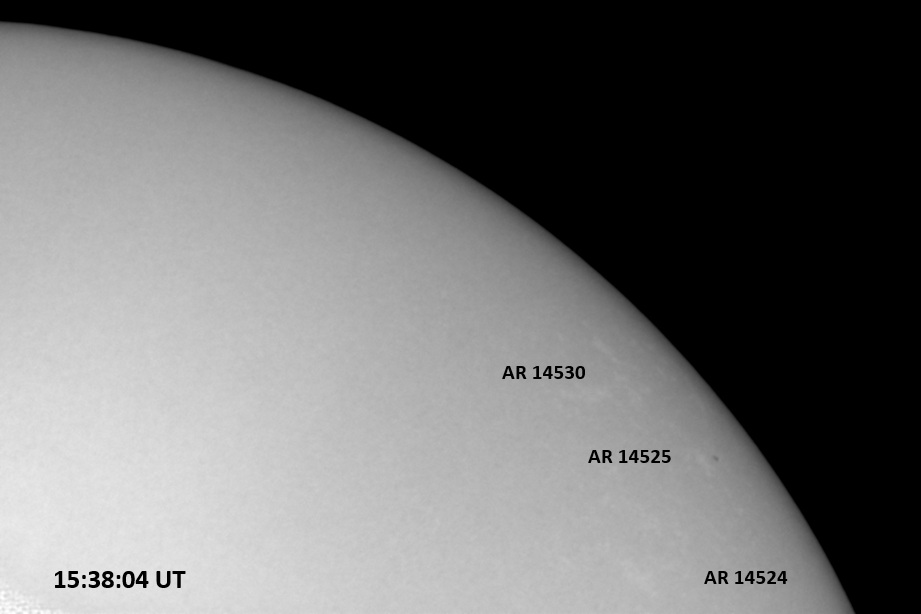
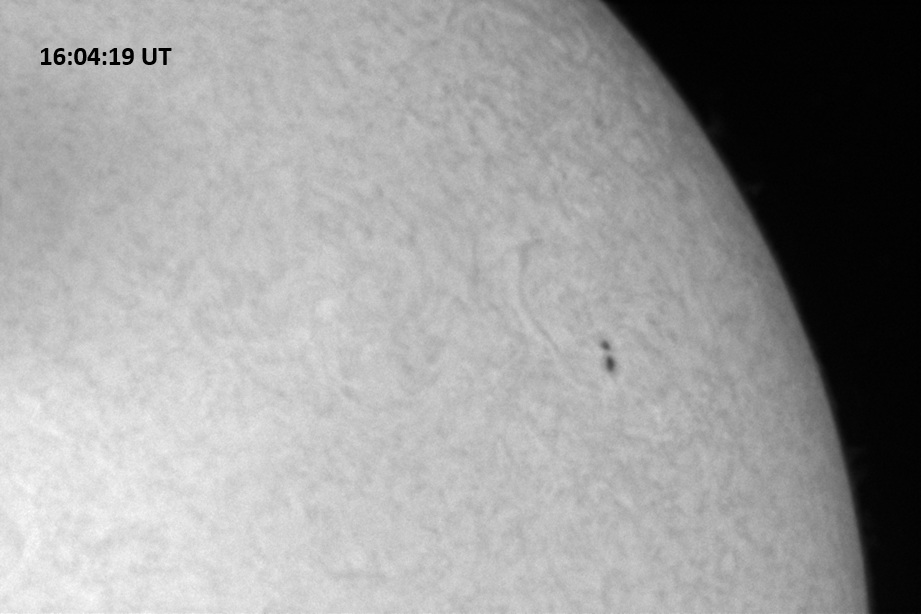
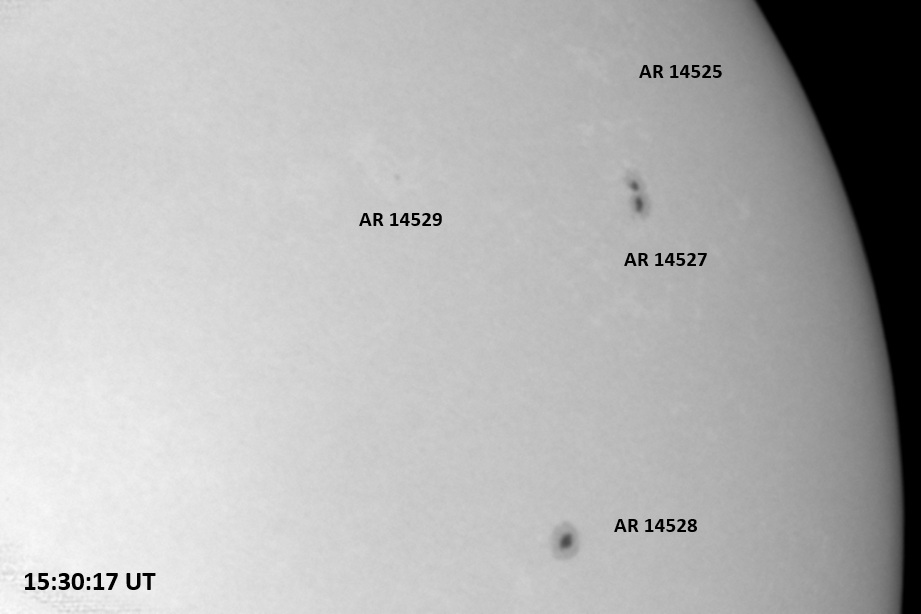
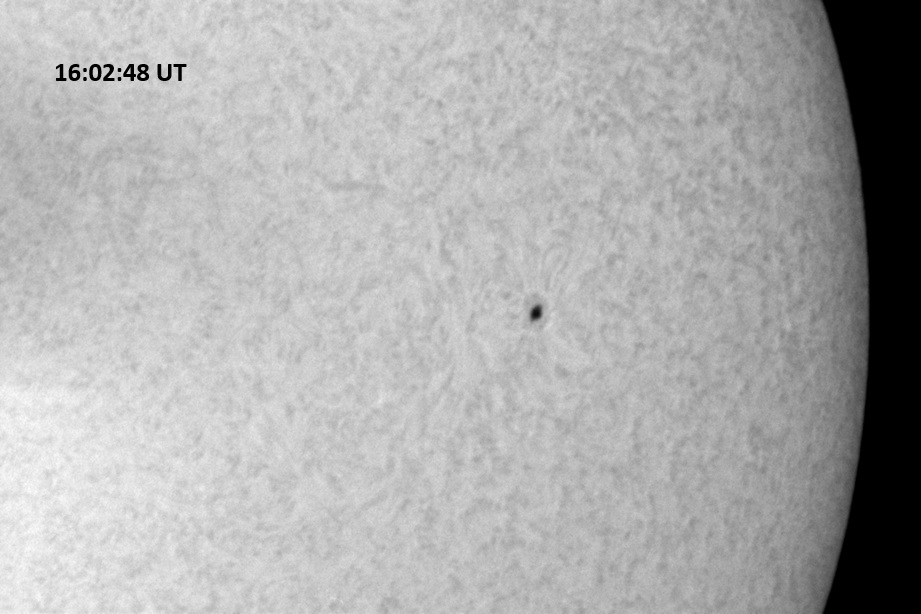
Solar activity dropped to very low levels today. The last C-class flare was a C1.6 at 17:12 UT yesterday, 10 September. Since then, and through 21:45 UT today (11 Sept.), there had only been minor B-level enhancements. There are seven spotted active regions on the visible solar disk and data from the far side of the Sun indicates nothing significant in that hemisphere either. AR 14523 decayed to plage, AR 14525 started to decay slightly, and AR 14530 showed some small growth and mild magnetic complexity. The rest of the spotted regions were mostly unchanged.
The first column below includes red continuum images, each 0.09 sec exposure; and the second column hosts H-alpha line center images, each 0.15 sec exposure and enhanced slightly to bring out detail. Each of the images covers 7.8’x11.4′ on the sky. Celestial north is up, west is right in each image.
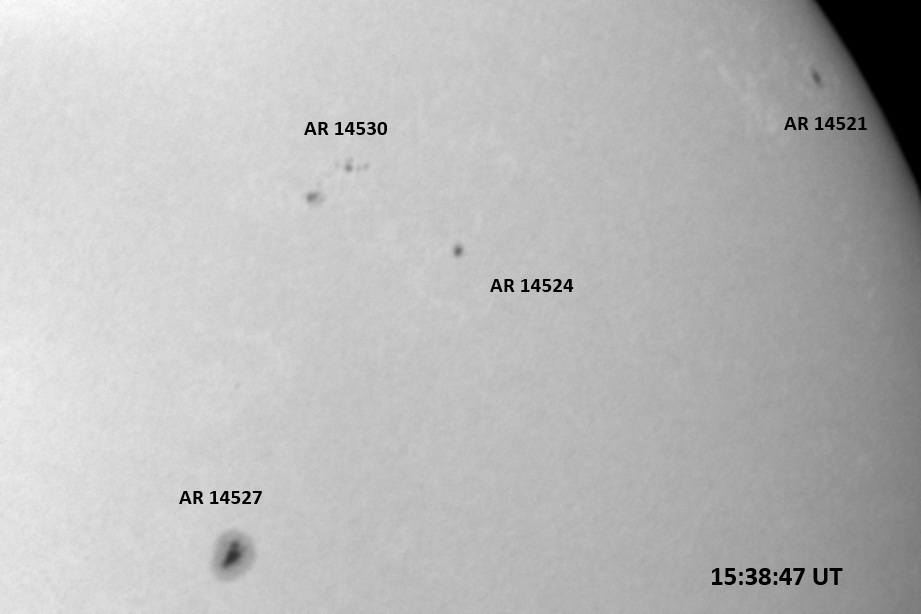 These regions continue to rotate westward, with AR 14521 about to rotate out of view. These regions continue to rotate westward, with AR 14521 about to rotate out of view. |
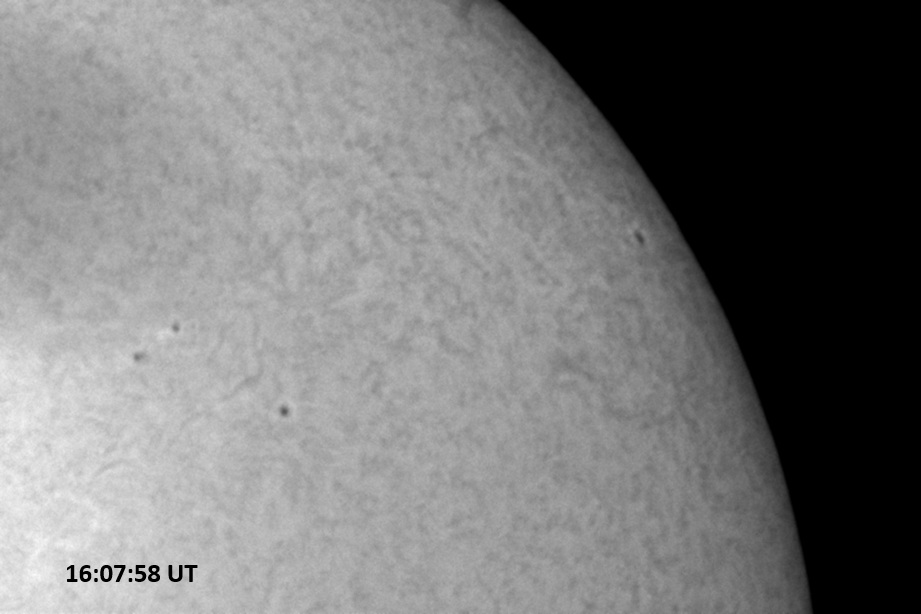 AR 14521 produced two B5 enhancements today, otherwise everything remained quiet. AR 14521 produced two B5 enhancements today, otherwise everything remained quiet. |
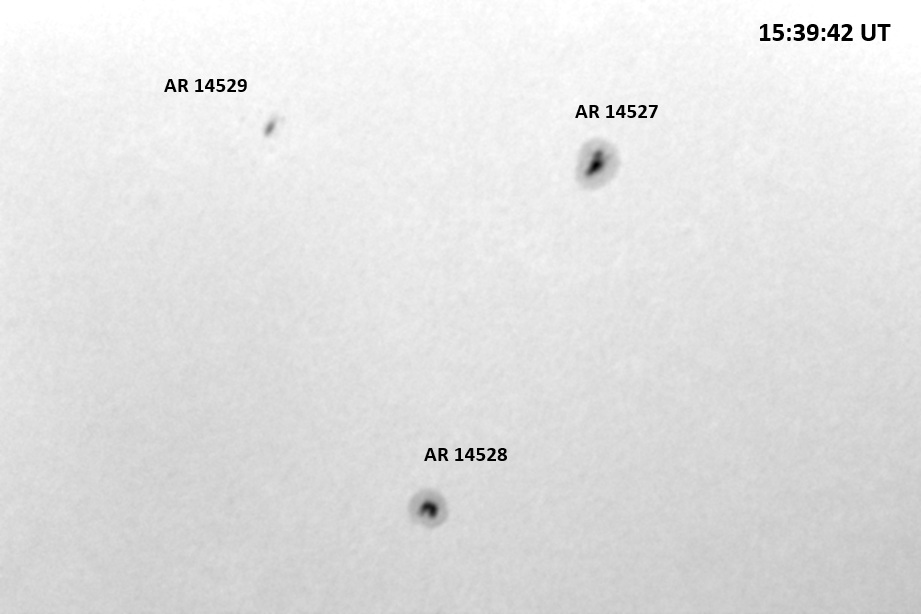 A trio of simple spots forming a triangle near the center of the solar disk. A trio of simple spots forming a triangle near the center of the solar disk. |
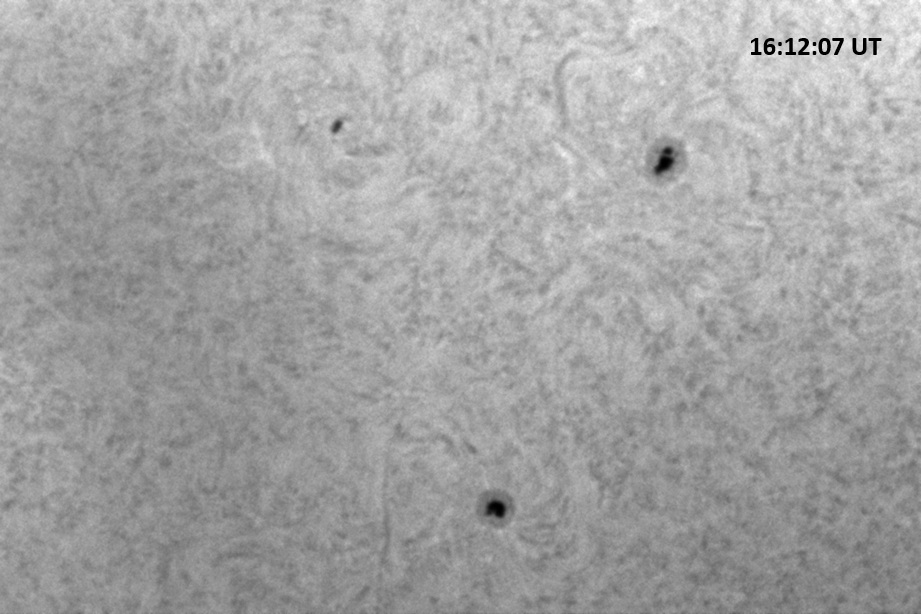 These spots were entirely quiet today. These spots were entirely quiet today. |
Solar activity is likely to remain at low levels with a slight chance for a low-level M-class flare through 13 September.
September 10, 2026
Solar activity was at low levels. So far today, there had been only two C-class flare events. AR 14524 produced both of them: a C1.4 at 0:51 UT today (10 September), and a C1.6/SF (with parallel flare ribbons) at 17:12 UT today. A 5 degree long filament erupted yesterday from the north central disk region, associated with a C3.4 flare from AR 14524. This sent a possible slow-moving CME (observed starting at 16:38 UT, 9 September, through the ST A COR 2 coronagraph), which is likely to arrive at Earth by late 14 September to early 15 September. Another filament erupted today around 3:30 UT. It was an approximately 10 degree long filament in the southwest quadrant of the disk. The eruption was first seen in coronagraph imagery at 7:30 UTC and has taken the form of a slow moving CME.
There are eight numbered active regions on the visible solar disk today, although one is about to disappear (AR 14523). All of them are unremarkable. AR 14530 showed some magnetic complexity, while the remaining regions were either stable or in decay.
The first column below includes red continuum images, each 0.09 sec exposure; and the second column hosts H-alpha line center images, each 0.15 sec exposure and enhanced slightly to bring out detail. Each of the images covers 7.8’x11.4′ on the sky. Celestial north is up, west is right in each image.
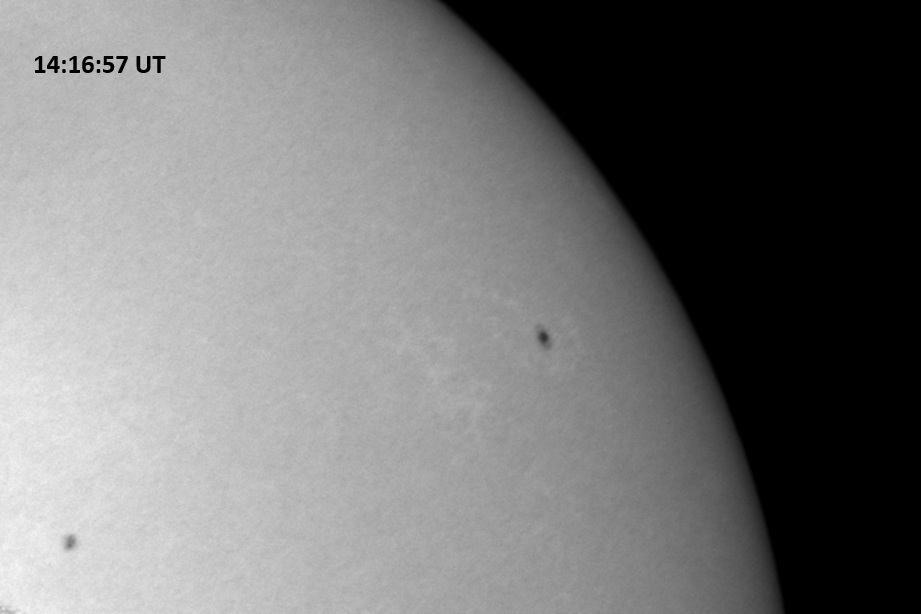 AR 14521 (just right of image center) is about to rotate out of view. AR 14521 (just right of image center) is about to rotate out of view. |
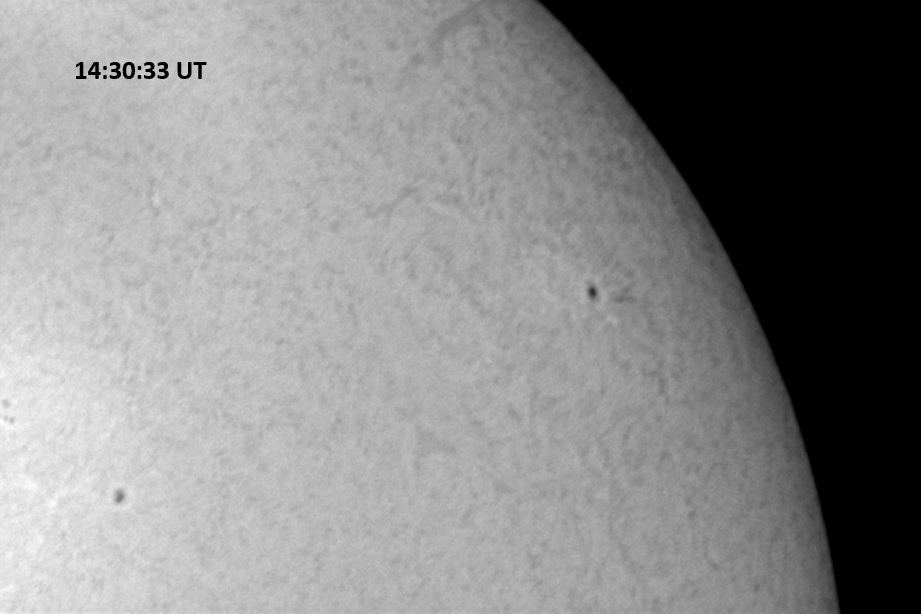 This part of the solar disk has been quiet. This part of the solar disk has been quiet. |
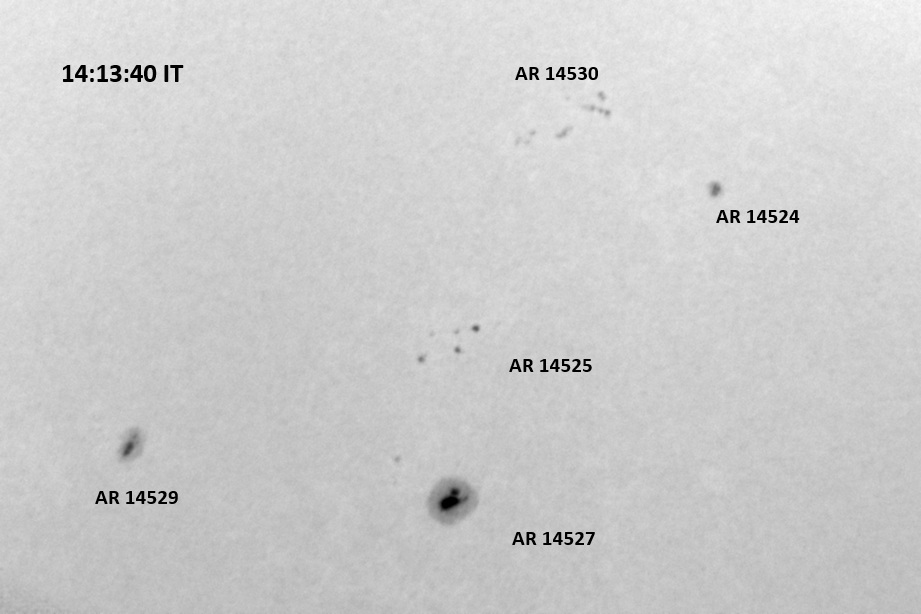 Six of the eight regions visible are shown in this image. AR 14529 is off the bottom edge of this image, and is a simple spot. Six of the eight regions visible are shown in this image. AR 14529 is off the bottom edge of this image, and is a simple spot. |
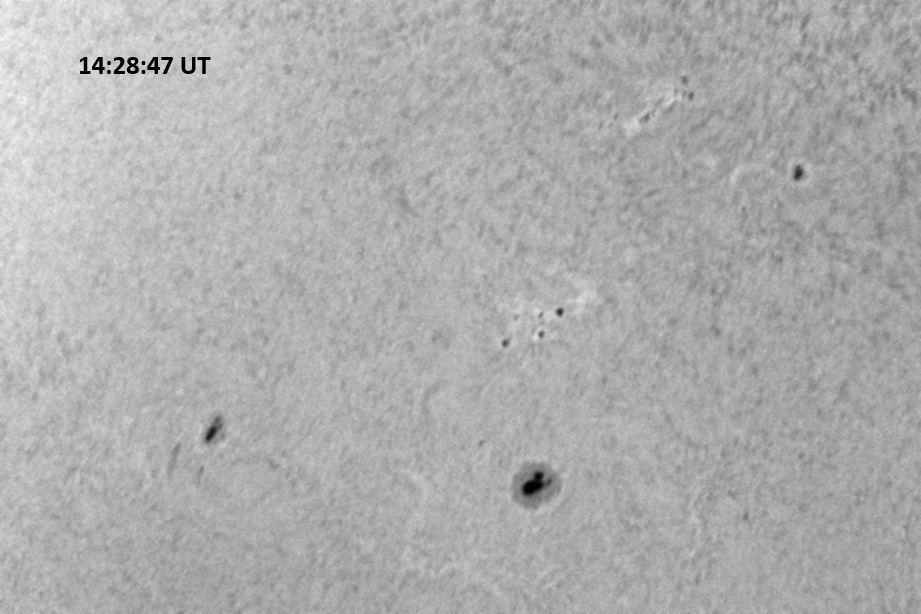 AR 14524 was the most active region in this area of the Sun today, with two C1 flares. AR 14524 was the most active region in this area of the Sun today, with two C1 flares. |
Solar activity is likely to remain at low levels due to occasional C-class flares; there is a slight chance for M-class flares through 12 September.
September 9, 2026
Solar activity remains at low levels. Isolated C-class flare activity was the norm for both yesterday and today. AR 14528 produced a C3.4 flare at 23:39 UT on 8 September; and AR 14524 produced a C3.4 flare today (9 September) at 9:23 UT. These were the largest flares for both yesterday and today (so far). There were three C-class flares early today before the Sun’s X-ray flux levels “flatlined”, starting at 15:30 UT and continuing through at least 23:00 UT.
The first column below includes red continuum images, each 0.09 sec exposure; and the second column hosts H-alpha line center images, each 0.15 sec exposure and enhanced slightly to bring out detail. Each of the images covers 7.8’x11.4′ on the sky. Celestial north is up, west is right in each image.
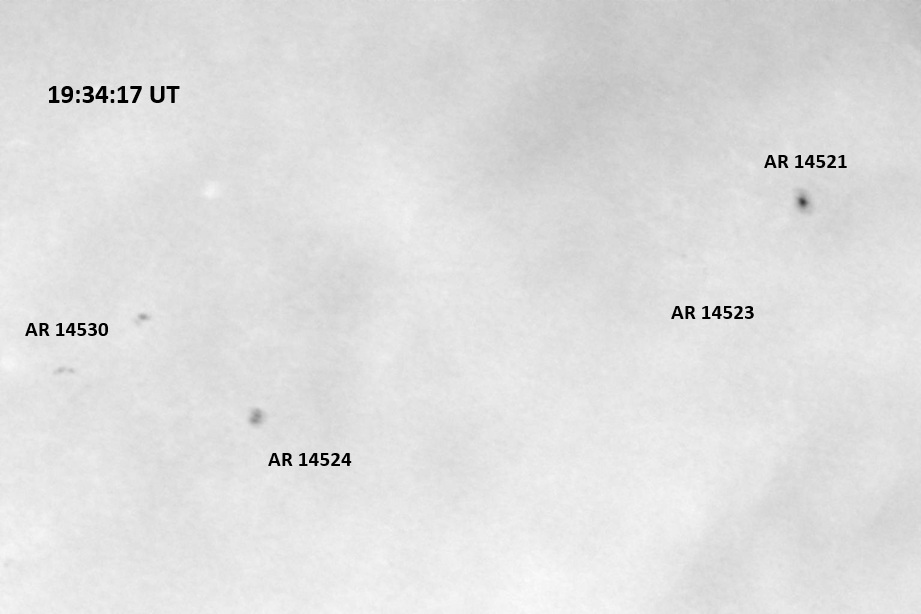 This image, made through persistent clouds, show four of the eight visible active regions currently on the visible solar disk. This image, made through persistent clouds, show four of the eight visible active regions currently on the visible solar disk. |
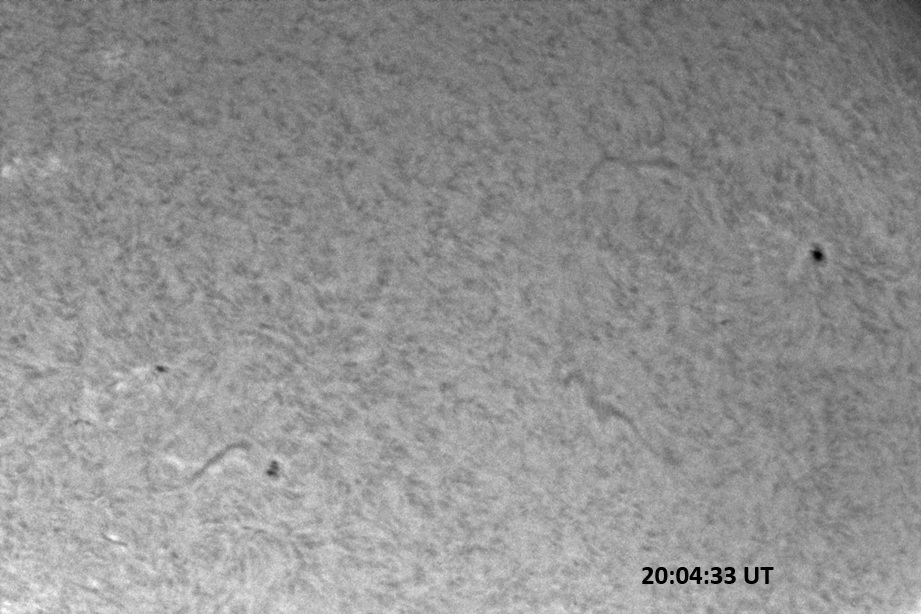 This image was made through clear skies. ARs 14521 and 14524 each produced a single C3 flare today. Everything else was quiet. This image was made through clear skies. ARs 14521 and 14524 each produced a single C3 flare today. Everything else was quiet. |
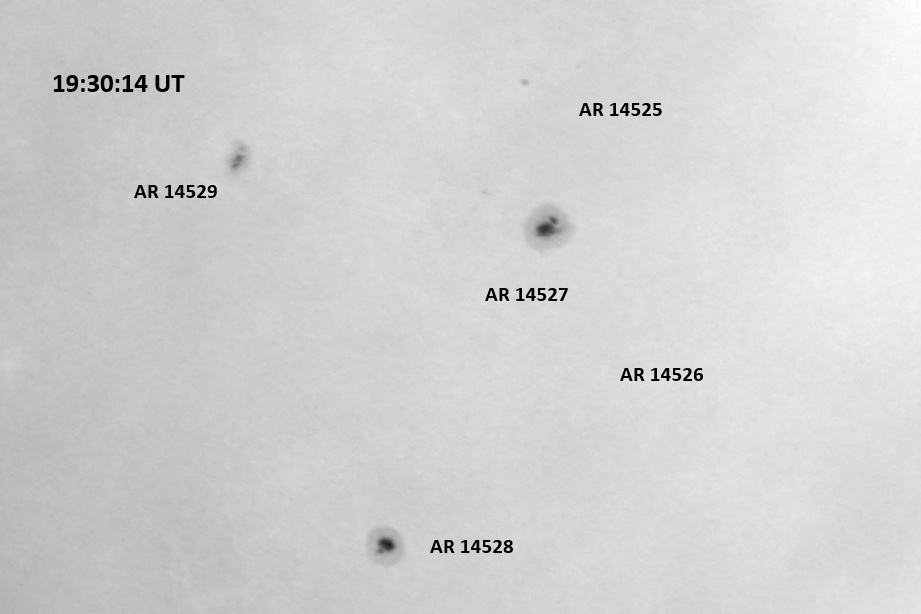 The other four active regions are seen in this image, taken through persistent cloud. The other four active regions are seen in this image, taken through persistent cloud. |
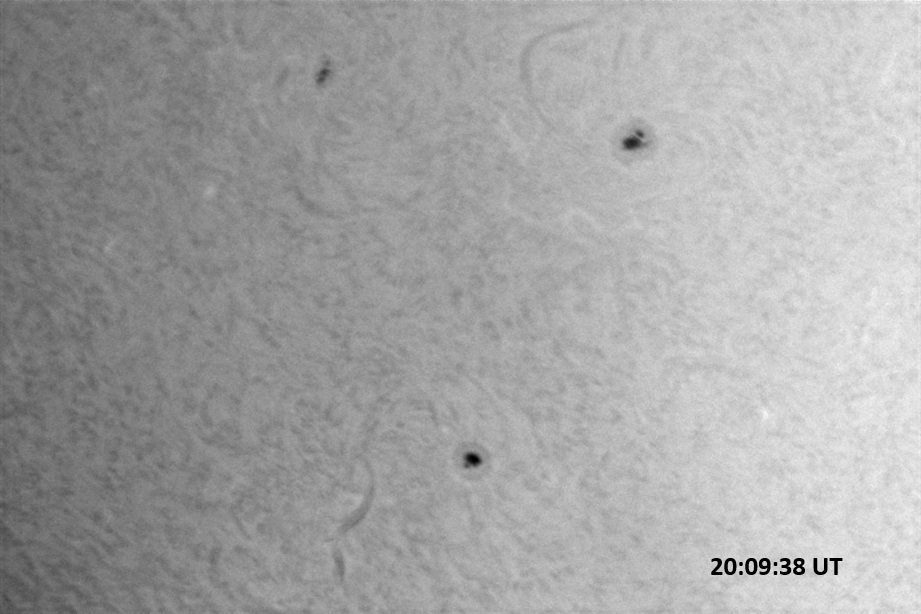 AR 14528 (bottom) produced a single C1.5 event today. Otherwise this region, imaged through clear skies, was quiet. AR 14528 (bottom) produced a single C1.5 event today. Otherwise this region, imaged through clear skies, was quiet. |
Solar activity is likely to remain at low levels due to occasional C-class flares; there is a slight chance for M-class flares through 11 September.
September 8, 2026
Solar activity is at low levels with only C-class flaring. AR 14530 emerged rapidly yesterday and is showing potential for contributing to elevated solar activity via an increasingly complex magnetic field. AR 14524 produced a long duration C2.1 flare that peaked at 9:01 UT on 7 September. This produced a relatively narrow CME, which became visible in SOHO LASCO C2 coronagraph imagery starting at 9:36 UTC on 7 September. Most of this CME material is likely to miss the Earth entirely.
The largest event over the last 7 days was an M3.0 at 19:20 on 2 September. The most recent M-class flare was on 5 September at 15:15 UTC. Since then, the sun has remained at low activity levels, with occasional C-class flares. There are eight spotted active regions on the visible solar disk today. Of these, AR 14521 was the only source of flares today, producing two C2 flares (the largest of which was a C2.8 at 17:43 UT), and an optical sub-flare. A C2.6 erupted at 22:24 UT today but it is not yet clear where this came from as GONG images were not available at the time of the flare peak. All of the other regions are quiet.
The first column below includes red continuum images, each 0.09 sec exposure; and the second column hosts H-alpha line center images, each 0.15 sec exposure and enhanced slightly to bring out detail. Each of the images covers 7.8’x11.4′ on the sky. Celestial north is up, west is right in each image.
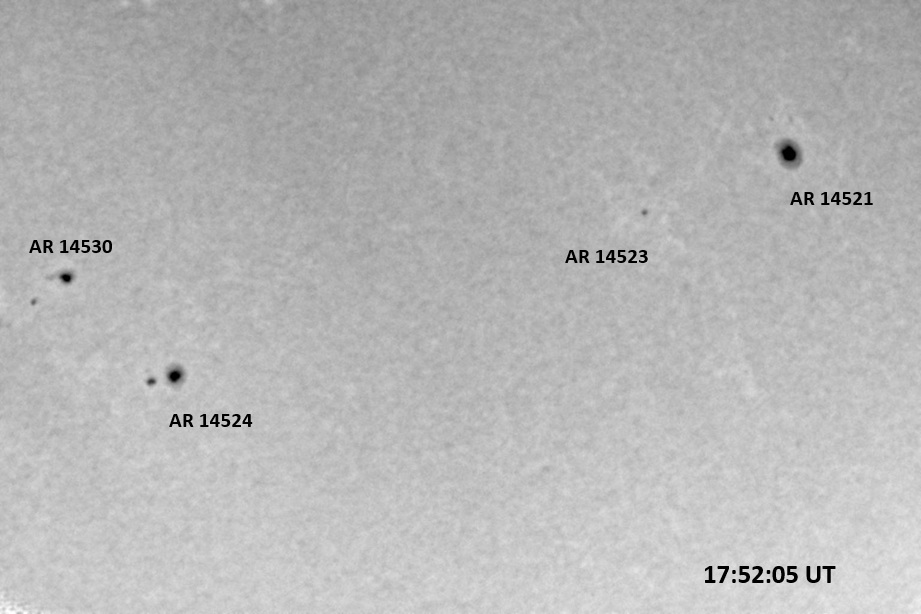 Four spotted active regions (labeled) are visible in this image centered near the center of the solar disk. Four spotted active regions (labeled) are visible in this image centered near the center of the solar disk. |
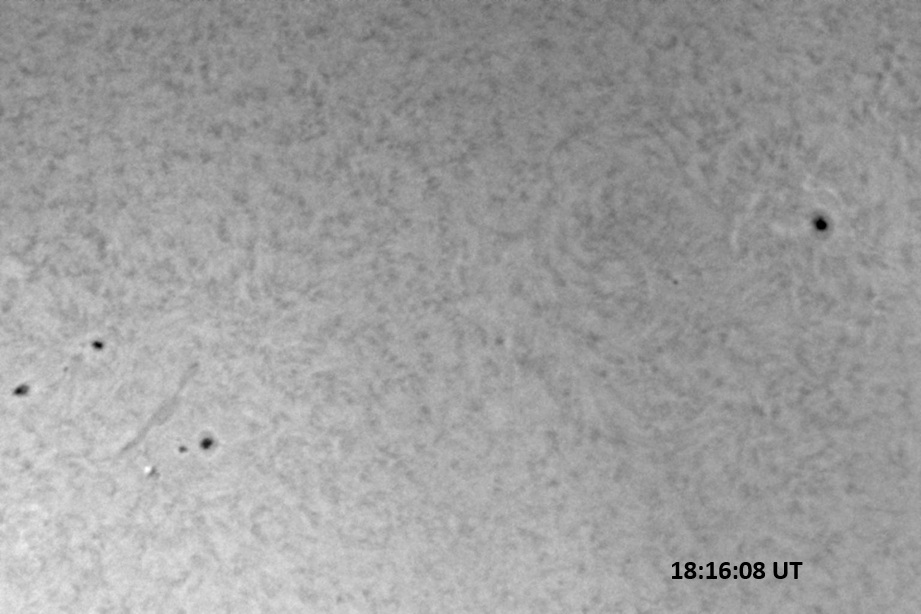 Of these groups/individual spots, only AR 14521 (upper right) displayed some signs of activity today. Of these groups/individual spots, only AR 14521 (upper right) displayed some signs of activity today. |
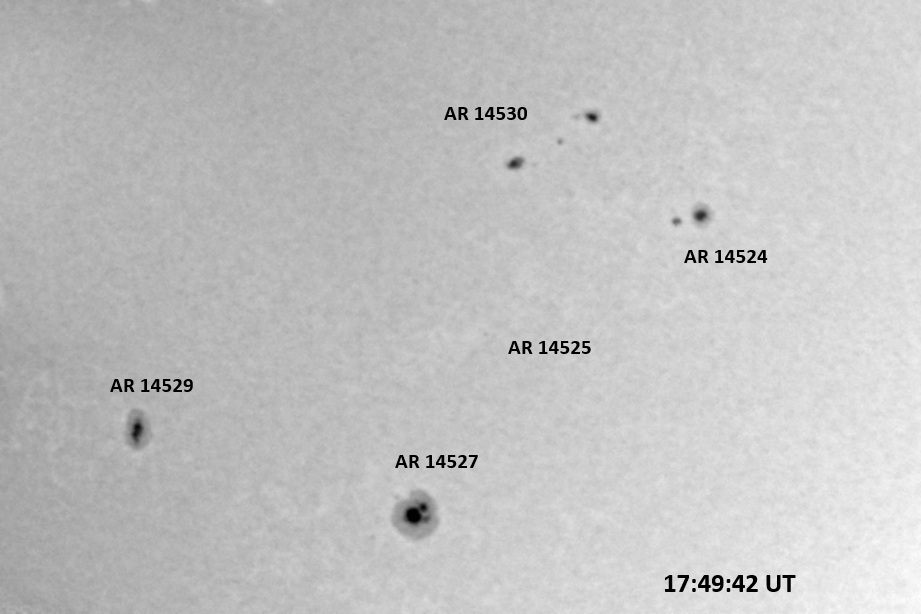 More active regions. Not shown is AR 14528, below and left of AR 14527, More active regions. Not shown is AR 14528, below and left of AR 14527, |
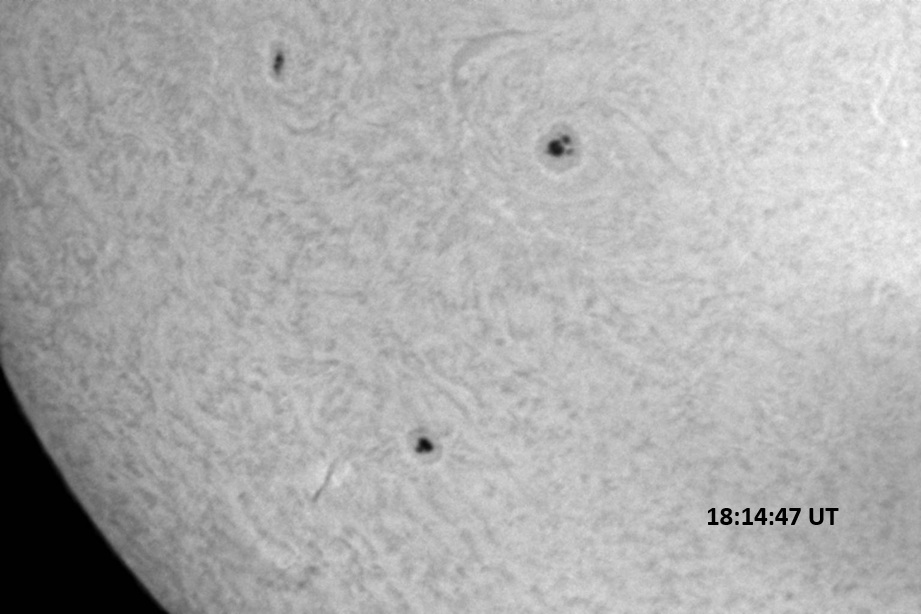 The trio of spots: AR 14529 (upper left), 14526 (upper right) and 14528 (bottom center). All of these have been quiet today. The trio of spots: AR 14529 (upper left), 14526 (upper right) and 14528 (bottom center). All of these have been quiet today. |
Solar activity is likely to remain at low levels due to occasional C-class flares; there is a slight chance for M-class flares through 10 September.
__________________________________________________________________
August 6, 2026
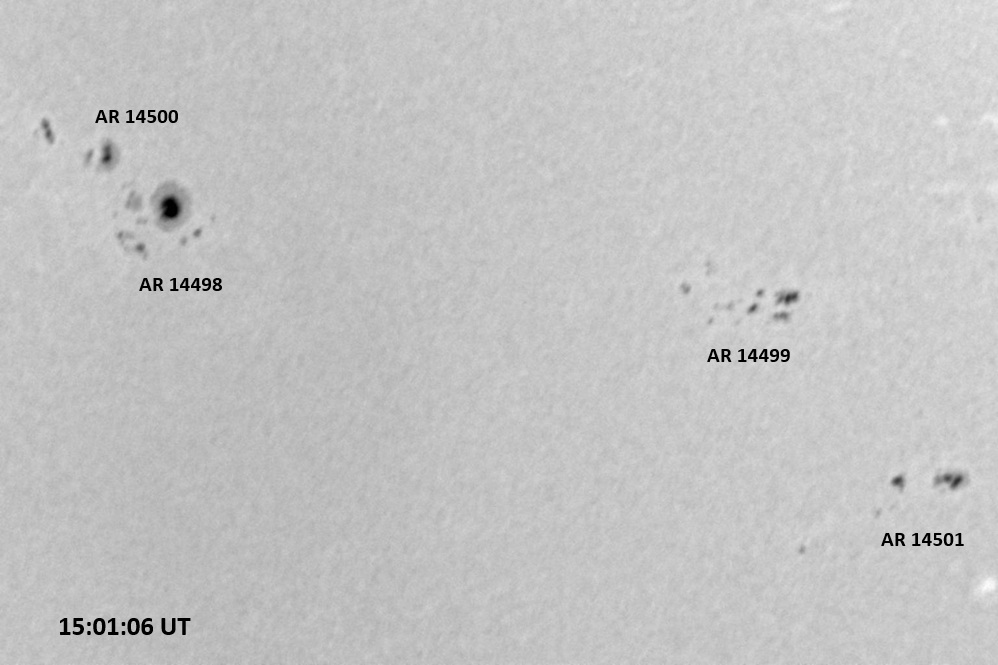
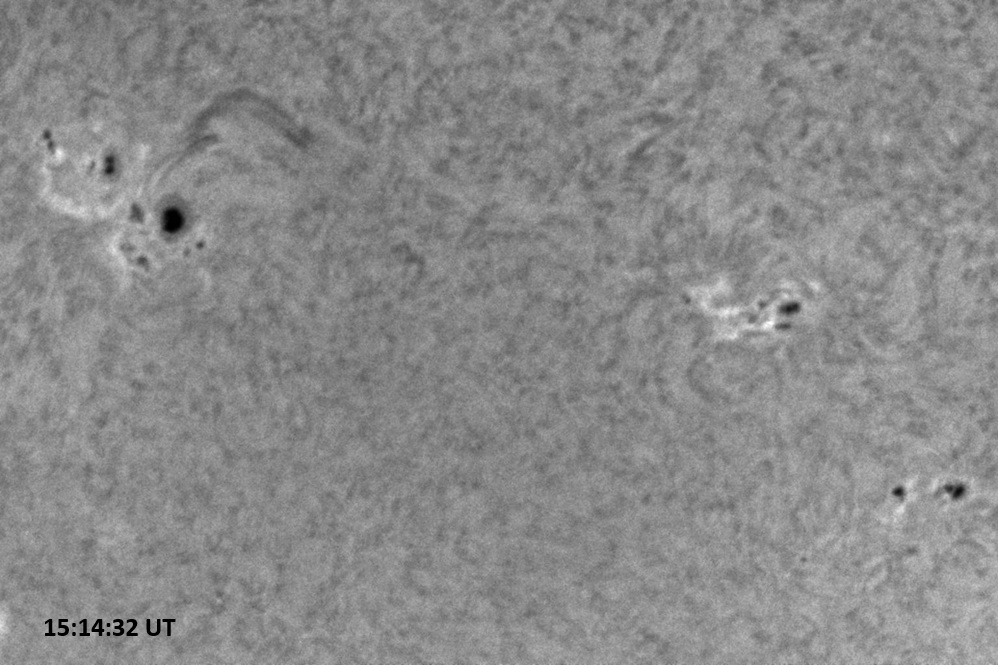
Solar activity is now at very low levels, with the four remaining ARs (14498, 14500, 14502, and 14503) all stable and quiet. There appears to be another tiny spot following AR 14503 but it has not been numbered yet.
The first column below includes red continuum images, each 0.09 sec exposure; and the second column hosts H-alpha line center images, each 0.15 sec exposure and enhanced slightly to bring out detail. Each of the images covers 7.8’x11.4′ on the sky. Celestial north is up, west is right in each image.
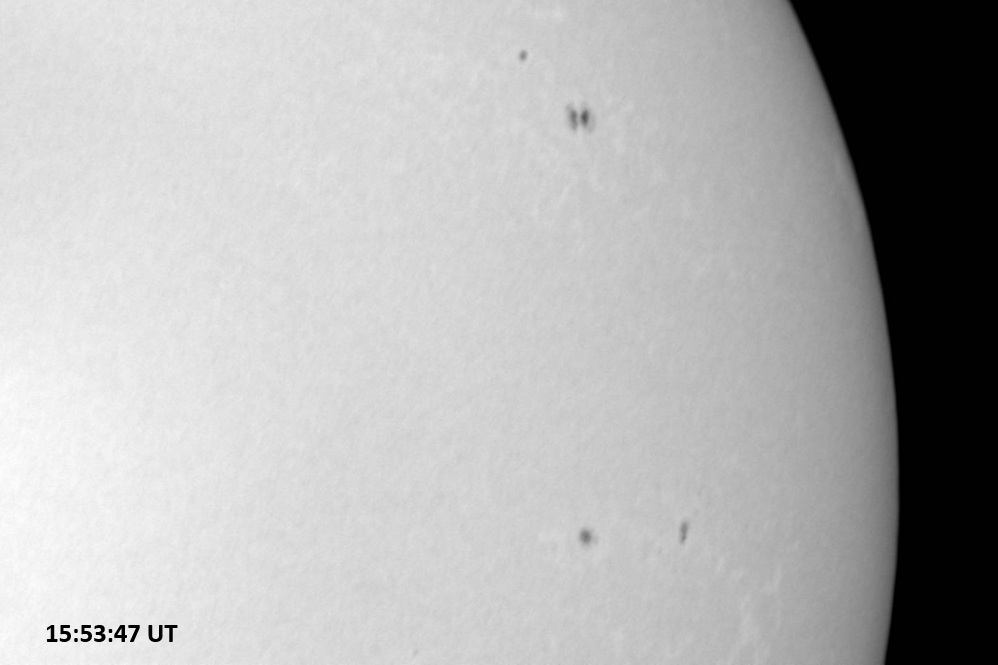 Two groups have rotated out of view, with these groups soon to follow. Two groups have rotated out of view, with these groups soon to follow. |
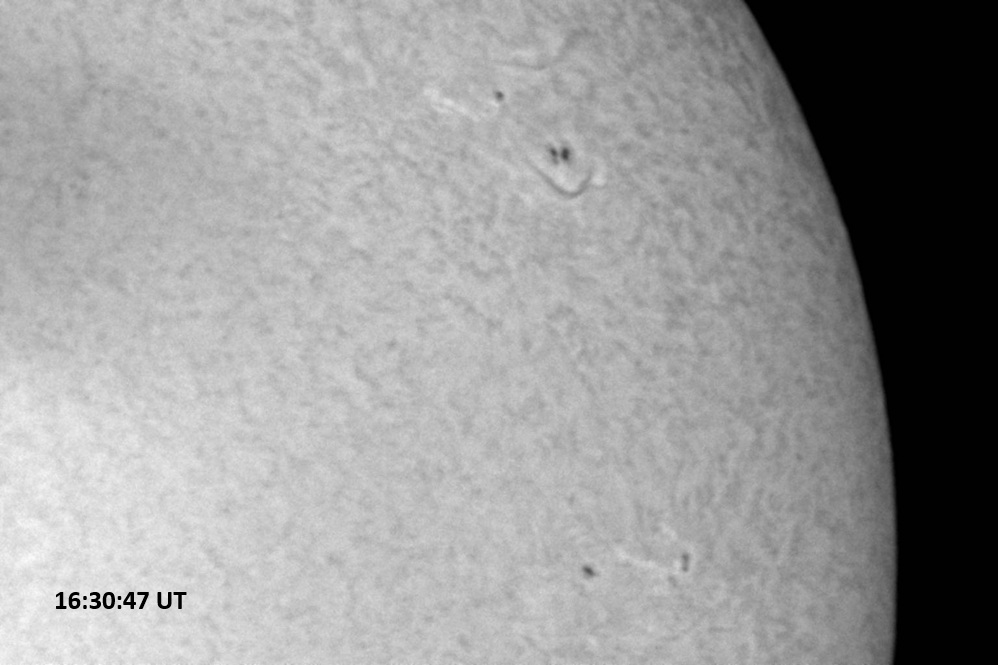 This zone of the Sun has been completely quiet all day today. This zone of the Sun has been completely quiet all day today. |
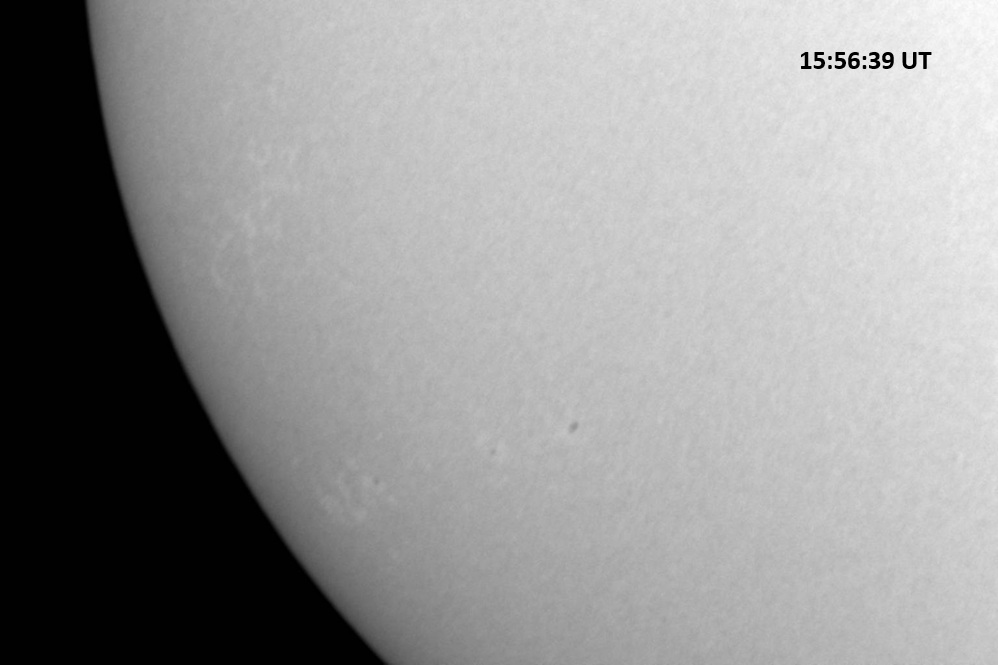 The eastern limb is all quiet except for AR 14503, bottom center. The eastern limb is all quiet except for AR 14503, bottom center. |
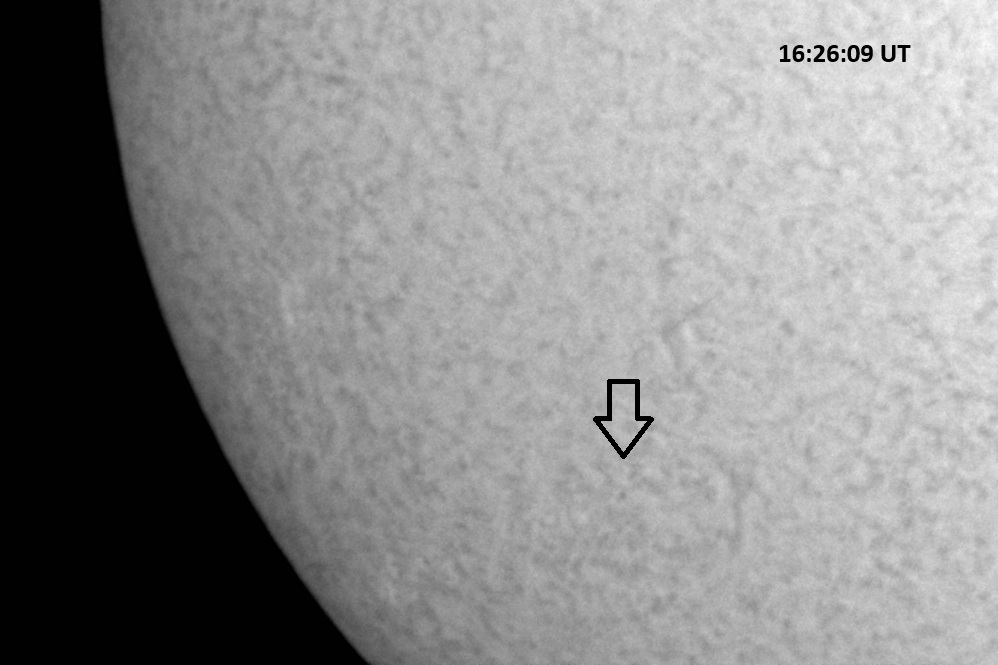 AR 14503 (arrowed) nearly disappears in this H-alpha view. AR 14503 (arrowed) nearly disappears in this H-alpha view. |
Solar activity is expected to be low to very low through 8 August, with a slight chance (10%) for M-class flares. Solar Orbiter HMI imagery indicates that there is no significant returning active regions for the next few days, so this may become an extended period of low solar activity.
PROGRAM NOTE: This will be the last entry for a month to six days due to preparations for the start of another academic year / Fall 2026 semester.
August 5, 2026
Solar activity continues at low levels. The largest flare of the past three days (through 22:20 UT today) was a C1.6 from AR 14502 at 6:22 UT today (5 August). There are six spotted and numbered active regions on the solar disk, but two of them are about to rotate out of view (AR 14499 and 14501). ARs 14498 and 14499 have decayed some and AR 14502 is simplifying in terms of its spot structure. AR 14501 is also gradually decaying but it did produce a C1.1 flare at 15:34 UT on 4 August. AR 14503 produced a C1.0 at 14:08 UT on 4 August.
The first column below includes red continuum images, each 0.15 sec exposure; and the second column hosts H-alpha line center images, each 0.20 sec exposure and enhanced slightly to bring out detail. Each of the images covers 7.8’x11.4′ on the sky. Celestial north is up, west is right in each image.
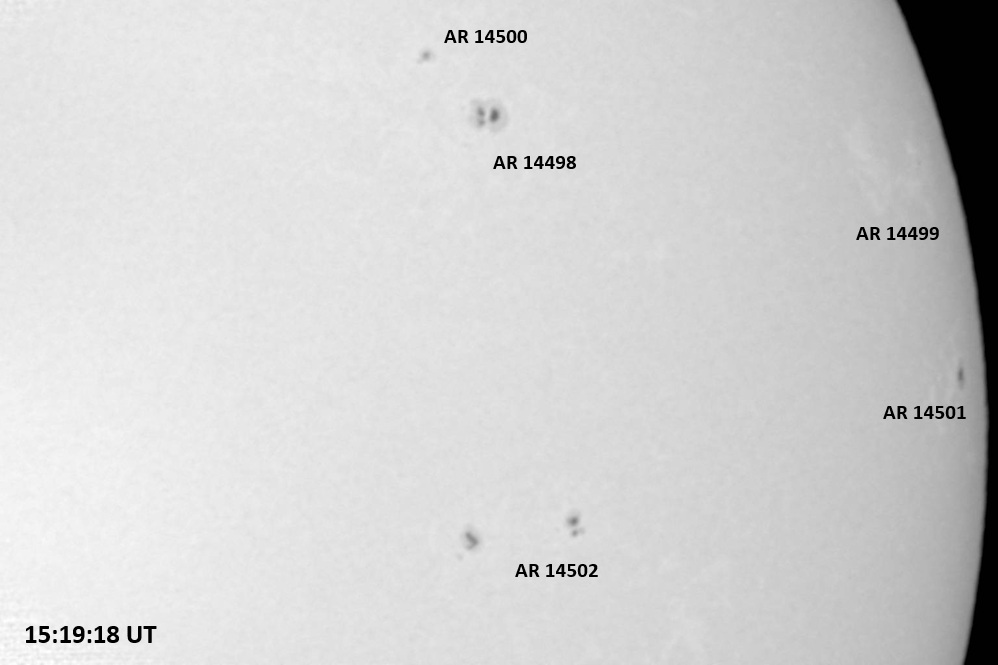 Active regions (numbered) in the western solar disk. Active regions (numbered) in the western solar disk. |
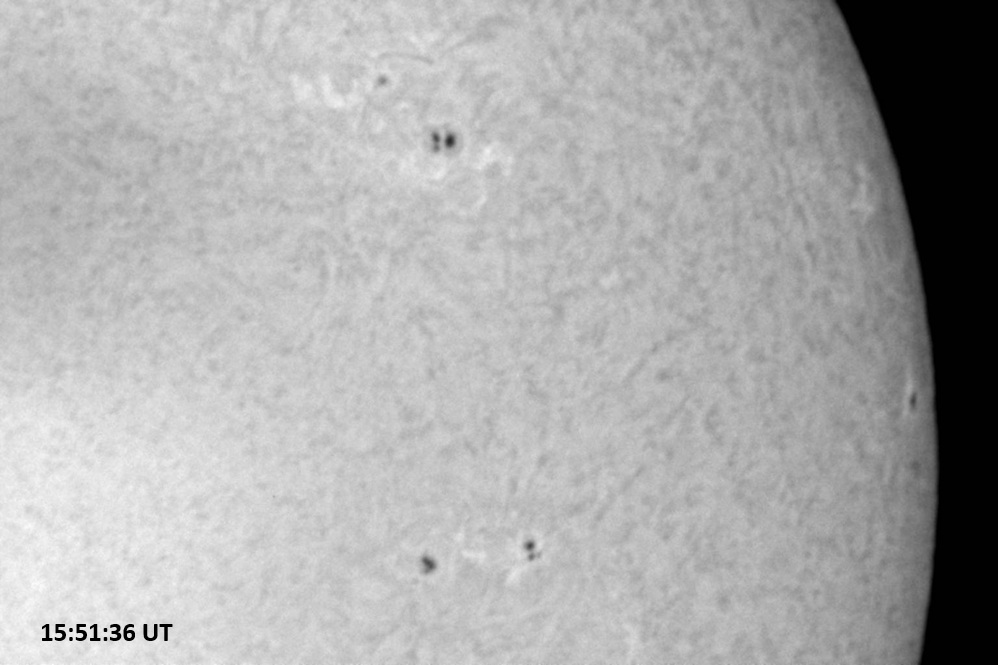 Of these regions, only AR 14498 and 14502 produced small flares, a B9.2 and a C1.6, respectively. Of these regions, only AR 14498 and 14502 produced small flares, a B9.2 and a C1.6, respectively. |
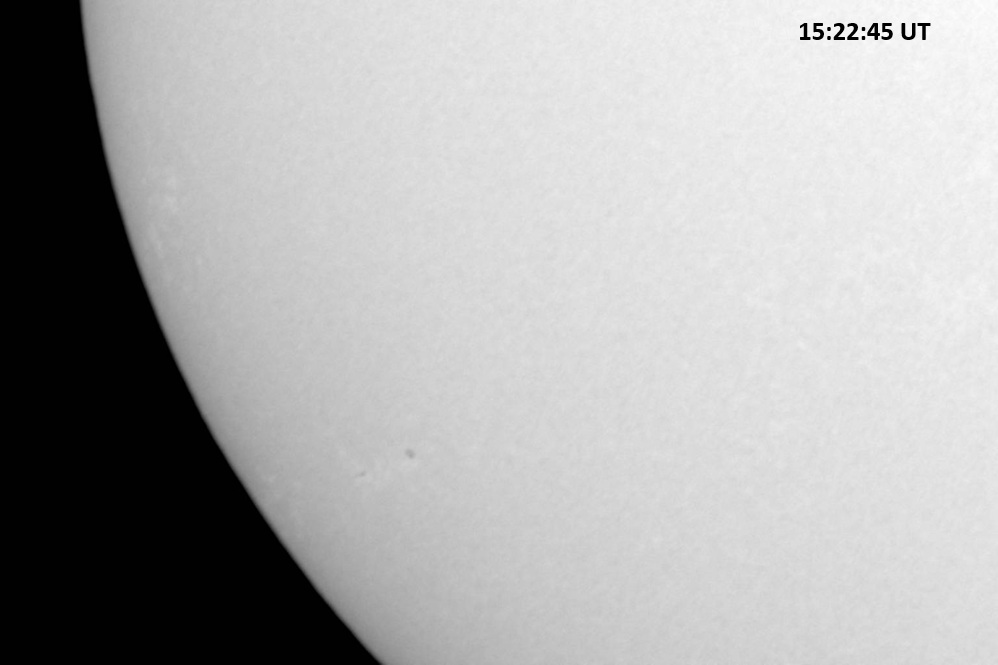 Most of the Sun’s disk looks like this: blank. There is a small spot group below and left of center, designated AR 14503. Most of the Sun’s disk looks like this: blank. There is a small spot group below and left of center, designated AR 14503. |
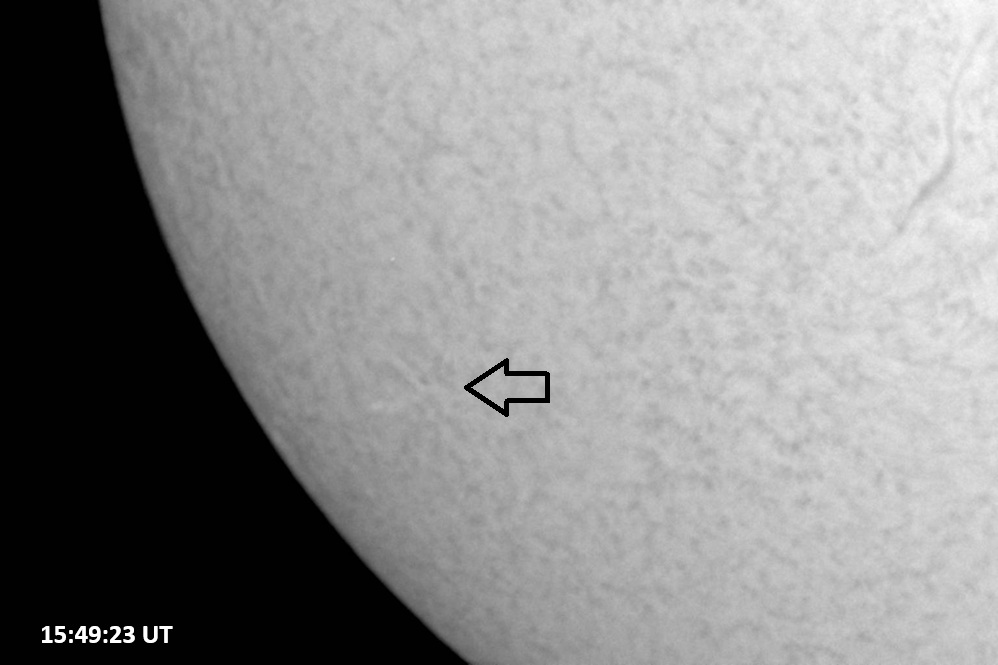 AR 14503 almost disappears in the H-alpha network, so its location is numbered here. Also visible is at least one filament, upper right part of the picture. AR 14503 almost disappears in the H-alpha network, so its location is numbered here. Also visible is at least one filament, upper right part of the picture. |
Solar activity is expected to be low through 7 August, with a slight chance for M-class flares.
August 4, 2026
Solar activity continues at low- to very-low levels. AR 14498, 14499, and 14501 are in slow decay and were quiet. AR 14496 is rotating out of view. AR 14502 is developing a bit but remained quiet. The only reported flare event so far attributed to an active region was a C1.2/SF at 11:58 UT today from a tiny spot that just rotated into view over the southeastern limb of the Sun – AR 14503. Otherwise, the Sun appears to be clearing its disk of spots as the rest of the active regions are in the western half of the disk.
The first column below includes red continuum images, each 0.09 sec exposure; and the second column hosts H-alpha line center images, each 0.15 sec exposure and enhanced slightly to bring out detail. Each of the images covers 7.8’x11.4′ on the sky. Celestial north is up, west is right in each image.
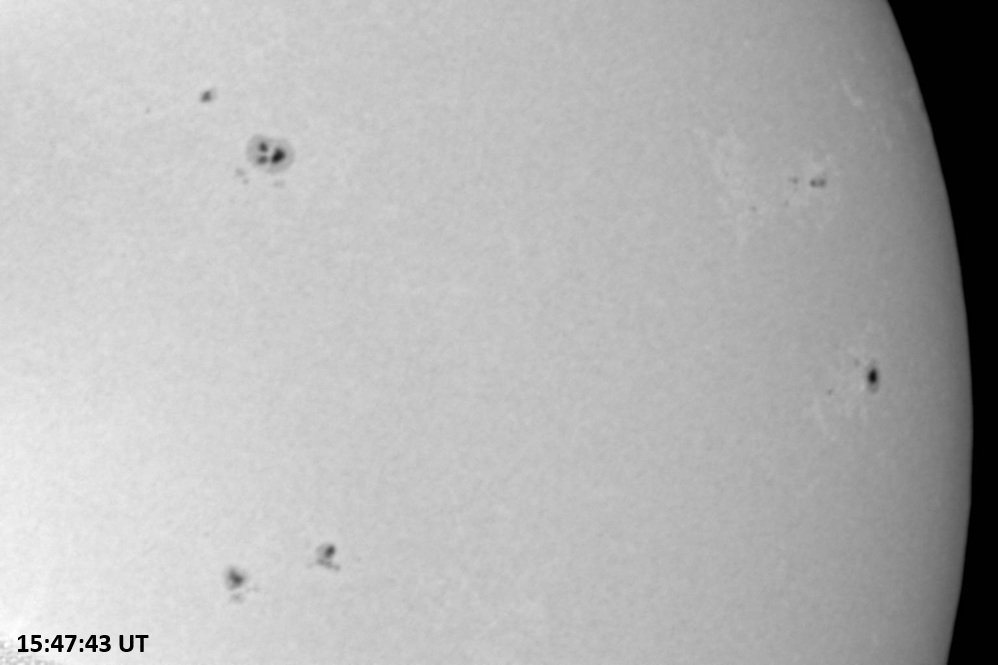 Almost all the spot groups are in the western part of the disk. They are, clockwise from upper left: AR 14500, 14498, 14499, 14496 (on the very edge right and above 14499), 14501, and 14502. Almost all the spot groups are in the western part of the disk. They are, clockwise from upper left: AR 14500, 14498, 14499, 14496 (on the very edge right and above 14499), 14501, and 14502. |
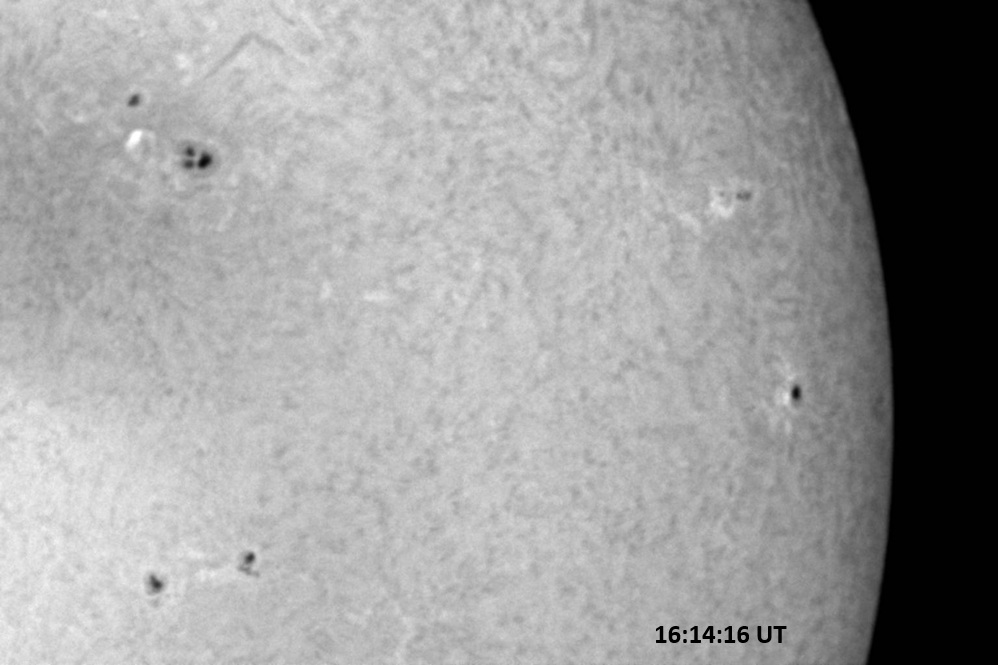 A flare spot, from a B9.4 enhancement that was happening while this image was taken, is visible just below AR 14500. Otherwise this part of the Sun remains mainly quiet. A flare spot, from a B9.4 enhancement that was happening while this image was taken, is visible just below AR 14500. Otherwise this part of the Sun remains mainly quiet. |
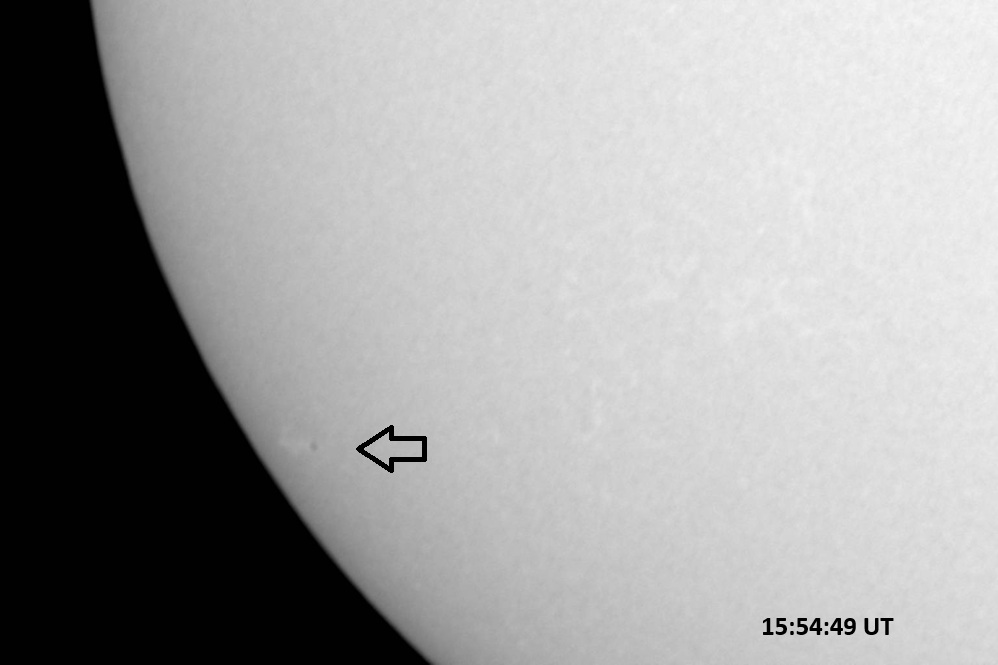 The arrow points to new AR 14503, that rotated into view. The arrow points to new AR 14503, that rotated into view. |
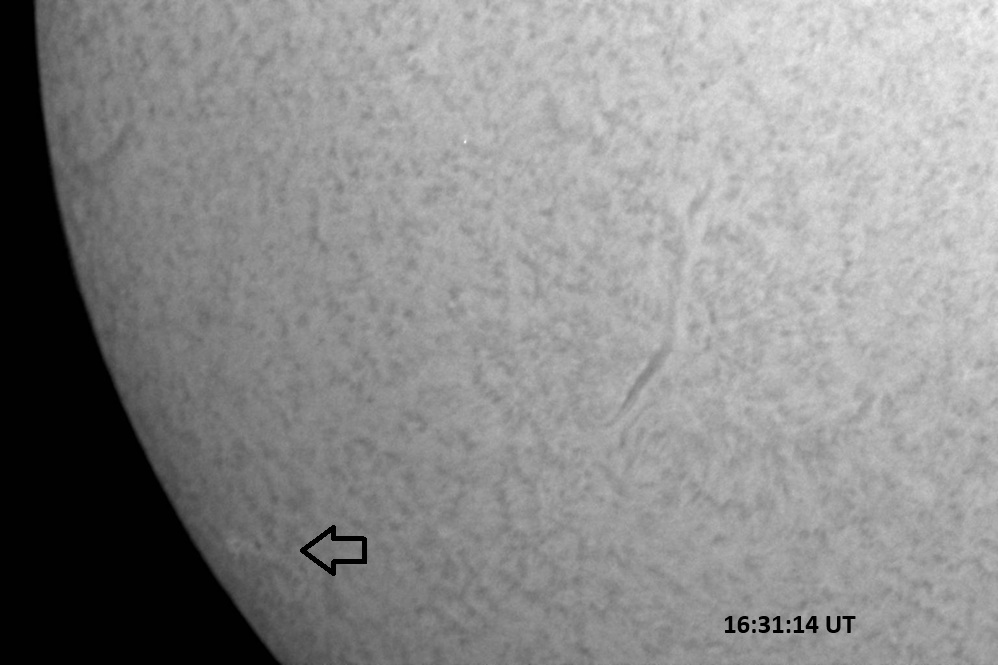 The single spot (arrowed) is responsible for at least two C1 flares earlier today. At least two filaments are also visible in this image. The single spot (arrowed) is responsible for at least two C1 flares earlier today. At least two filaments are also visible in this image. |
Solar activity is expected to be low through 6 August, with a slight chance for M-class flares.
August 3, 2026
Solar activity persists at low level, with only very few low-level C-class flares occurring. AR 14502 emerged over the weekend and was the only region that showed growth; the rest of the six visible regions remained unchanged. AR 14498 was the only region that flared: 3 C1 flares and 1 B8 flare so far today.
The first image below is a red continuum image, 0.09 sec exposure; and the second is an H-alpha line center image, a 0.15 sec exposure and enhanced slightly to bring out detail. Each image covers 7.8’x11.4′ on the sky, with celestial north is up, west right.
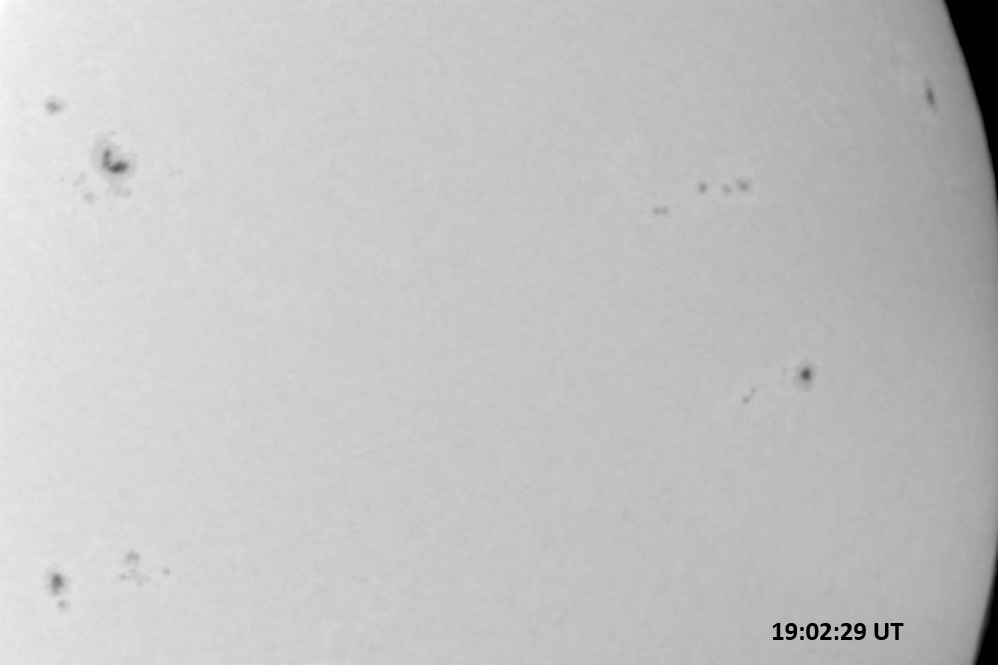 Clockwise from upper right, these are: AR 14500, 14498, 14499, 14496, 14501, 14502. Clockwise from upper right, these are: AR 14500, 14498, 14499, 14496, 14501, 14502. |
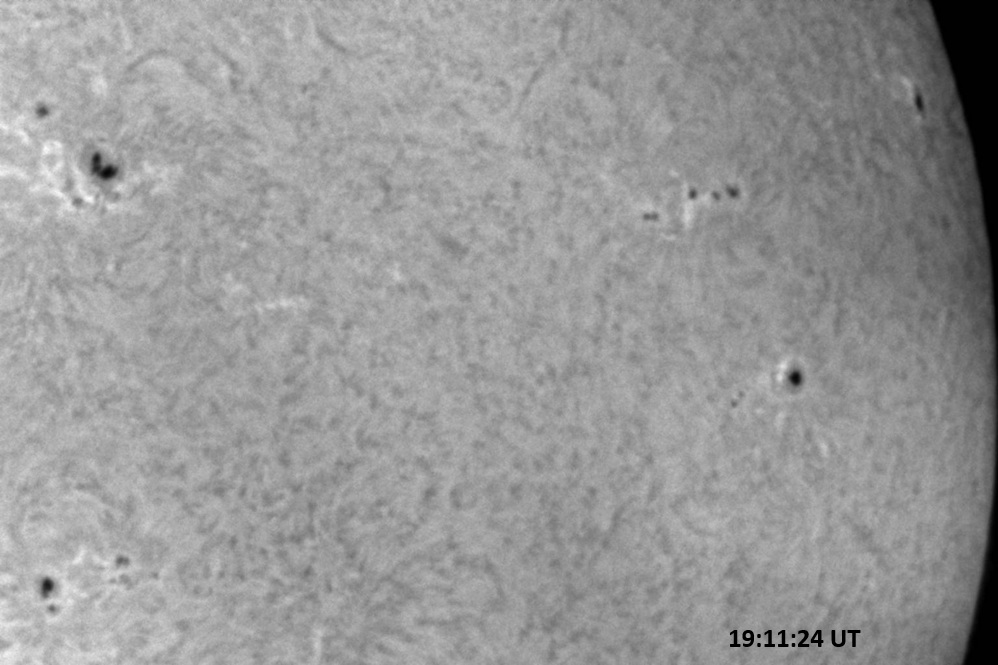 All of these regions were quiet except for AR 14498, which was the source for a few low-level C-class flares today. All of these regions were quiet except for AR 14498, which was the source for a few low-level C-class flares today. |
Solar activity is expected to be low through 5 August, with a slight chance for an M-class flare.
July 31, 2026
Solar activity returned to low levels. Only low-level C-class flares have occurred since yesterday’s M1.9 flare. At the time of the flare, an 8-degree long filament erupted and launched a CME, along with the flare itself. The CME is predicted to arrive at Earth early 2 August. Since this event, the largest event so far (through 21:35 UT) was a C3.9 at 11:47 UT from AR 14499. In fact, this region has produced nine low-level C-class flares so far today. AR 14498 produced a C3.1 at 3:16 UT, and AR 14500 produced a C1.8 at 1:29 UT. Both (and all the other regions) have been quiet since. ARs 14496, 14498, and 14500 have grown a bit over the last day, with the remaining spotted groups staying about the same.
The first column below includes red continuum images, each 0.09 sec exposure; and the second column hosts H-alpha line center images, each 0.15 sec exposure and enhanced slightly to bring out detail. Each of the images covers 7.8’x11.4′ on the sky. Celestial north is up, west is right in each image.
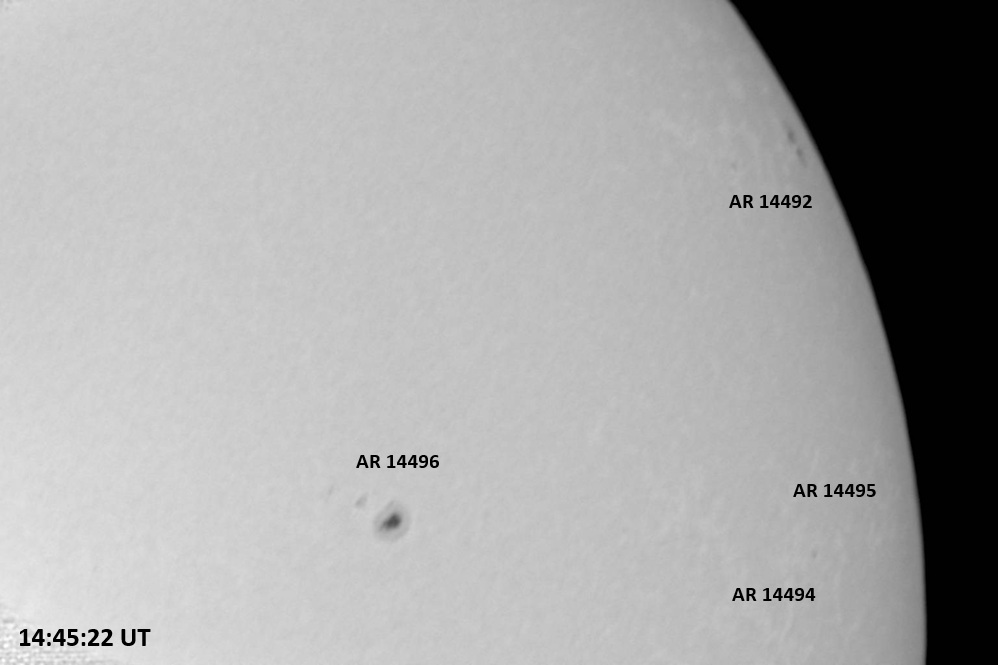 ARs 14492, 14495, 14496, and 14497 are about to rotate out of view. ARs 14492, 14495, 14496, and 14497 are about to rotate out of view. |
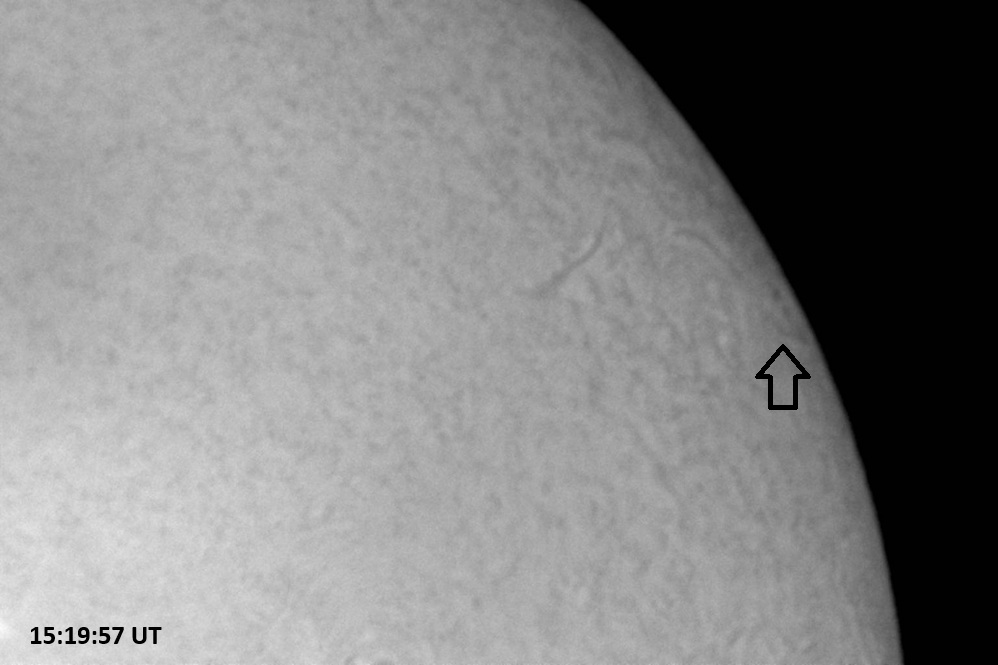 This image centers on AR 14492 (arrowed) and the filaments still left after yesterday’s M1.9 flare. This image centers on AR 14492 (arrowed) and the filaments still left after yesterday’s M1.9 flare. |
 These active regions continue to “march” across the solar disk, carried along by the Sun’s rotation. These active regions continue to “march” across the solar disk, carried along by the Sun’s rotation. |
 AR 14499 has been the most active spot group today, with the rest of these regions largely quiet. AR 14499 has been the most active spot group today, with the rest of these regions largely quiet. |
Solar activity is expected to be low through 2 August, with a chance for M-class flares.
July 30, 2026
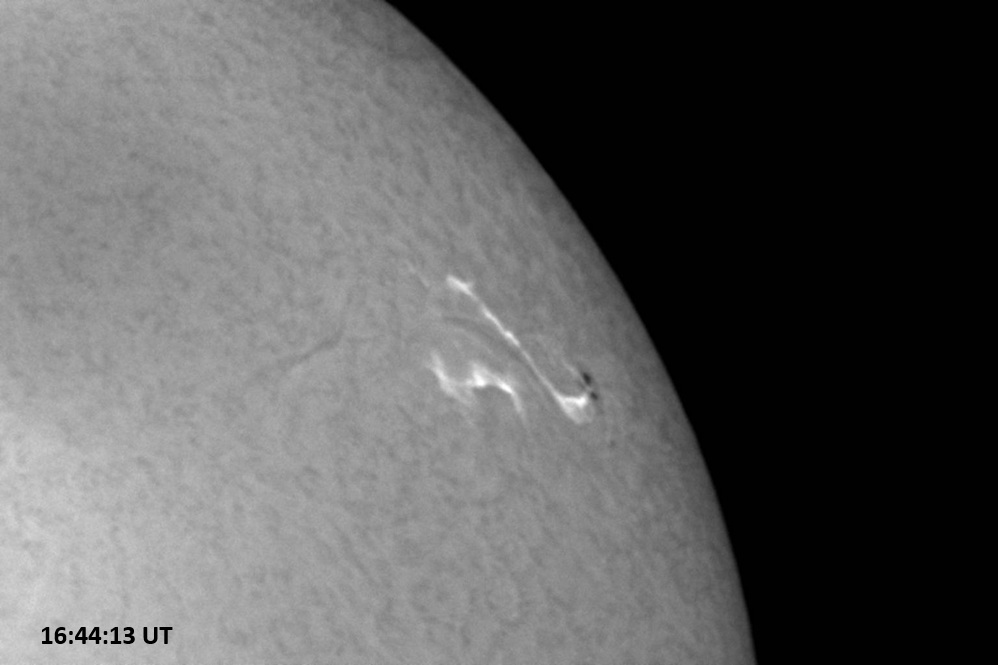
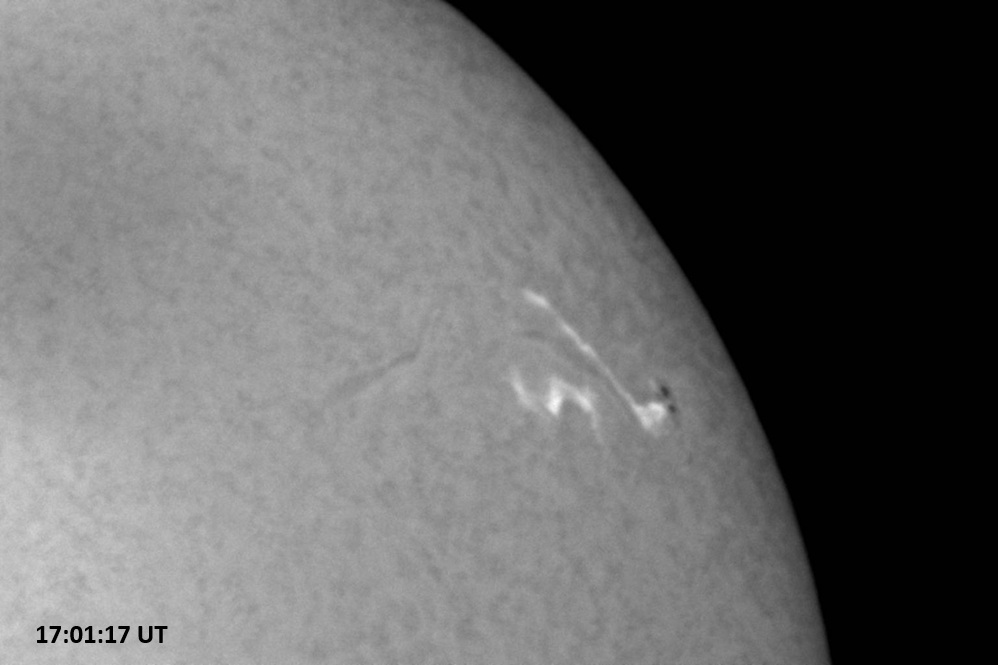
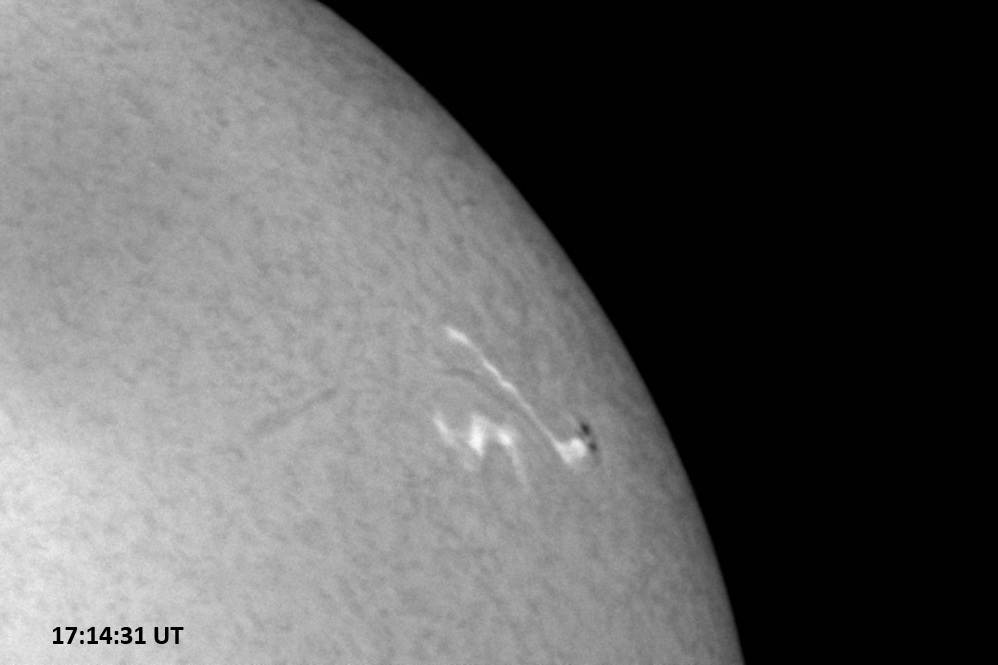
Solar activity elevated to moderate today with a long-duration M1.9 flare from AR 14492–while we were watching. This event is an example of a solar particle event, due to the high flux of protons and other charged particles that came from this event, as indicated on the GOES proton flux, and peaked at 20:45 UT today. While this results in a radiation storm at Earth, it is considered weak, an S1, and there is no danger to humans or technology, on the surface, in the air, or in orbit.
Prior to this event, the largest (and only other) flare to occur was a C3.8/SF at 6:06 UT on 30 July from AR 14498. There were only minor changes in AR 14498 since yesterday. AR 14499 grew slightly since yesterday, and all the other spot groups were either stable or in decay.
An approximately 20 degree long filament erupted from the north central part of the solar disk yesterday. This event began at 20:00 UT on 29 July, about one hour before we observed the region. This event produced a narrow CME directed northward, which is expected to miss the Earth entirely.
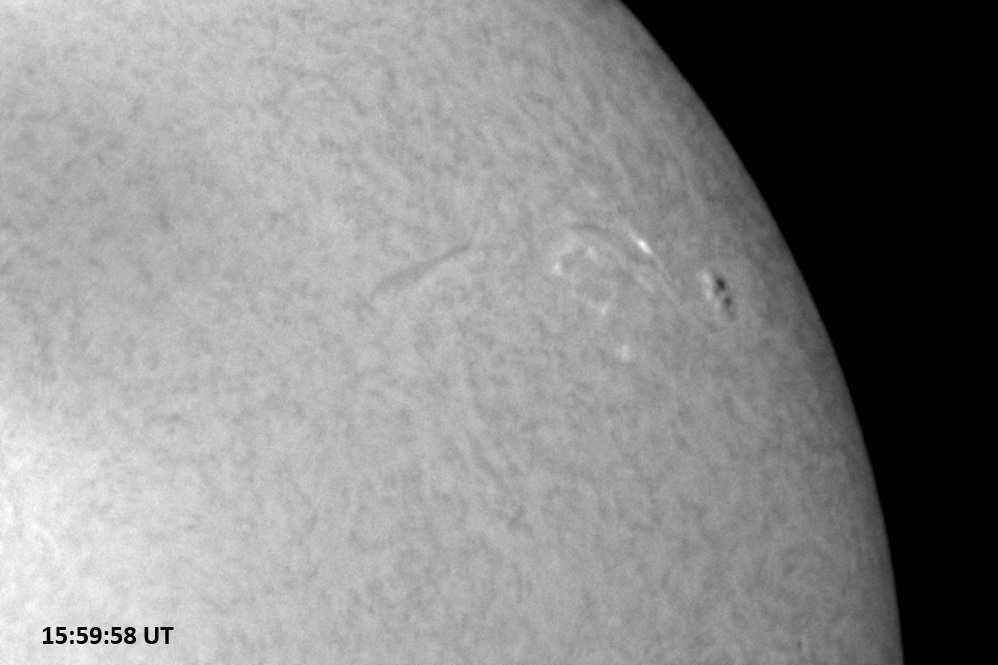
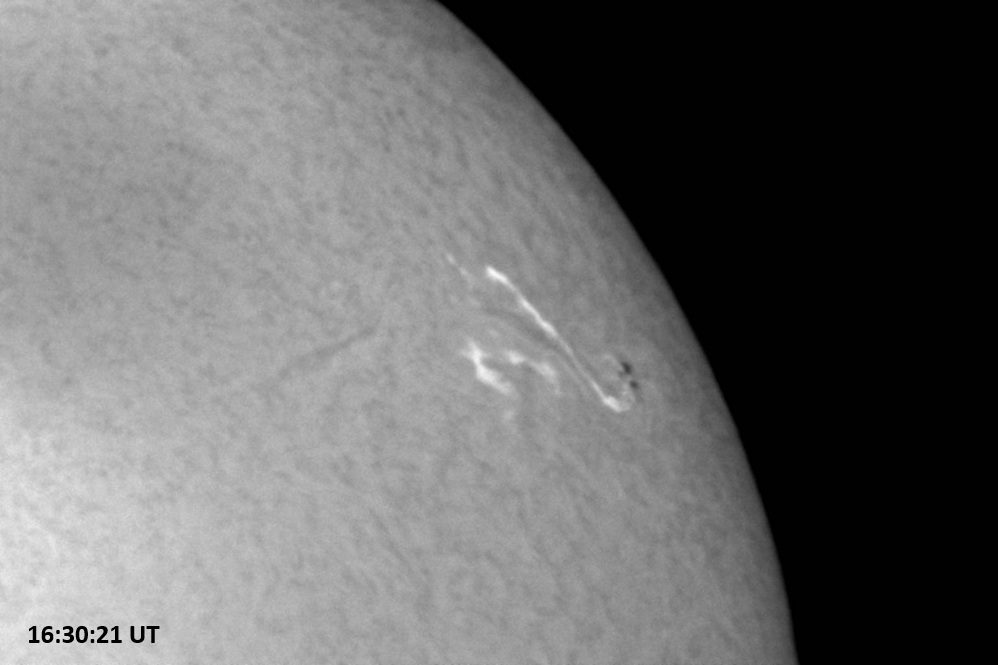
Six frames of today’s M1.9 flare are shown next. Each image is a 0.15 second exposure, with some enhancement to bring out finer details. The images each cover 7.8’x11.4′ on the sky, with celestial north up, west right. The time of each image, in Universal Time, is indicated in the lower left corner of each. The X-ray maximum of the flare was at 17:00 UT. It began at roughly 15:15 UT and ended about 20:00 UT.
 |
 |
 |
 |
 |
 |
The first column below includes red continuum images, each 0.09 sec exposure; and the second column hosts H-alpha line center images, each 0.15 sec exposure and enhanced slightly to bring out detail. Each of the images covers 7.8’x11.4′ on the sky. Celestial north is up, west is right in each image.
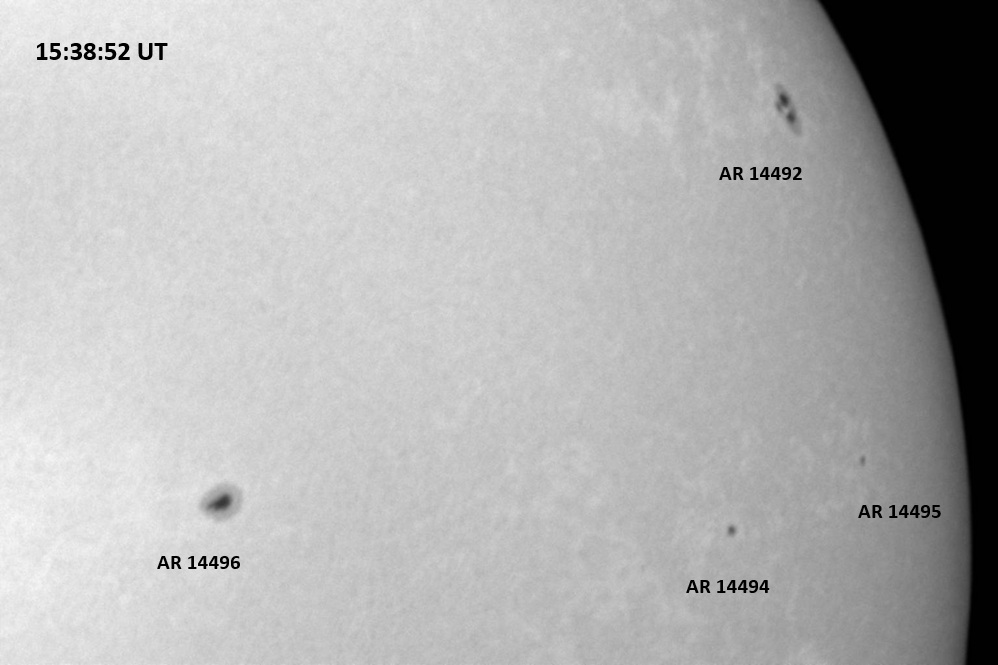 Four spotted regions are imaged. I did not visually see AR 14497 (below the bottom right edge) during this morning’s sunspot counts. Four spotted regions are imaged. I did not visually see AR 14497 (below the bottom right edge) during this morning’s sunspot counts. |
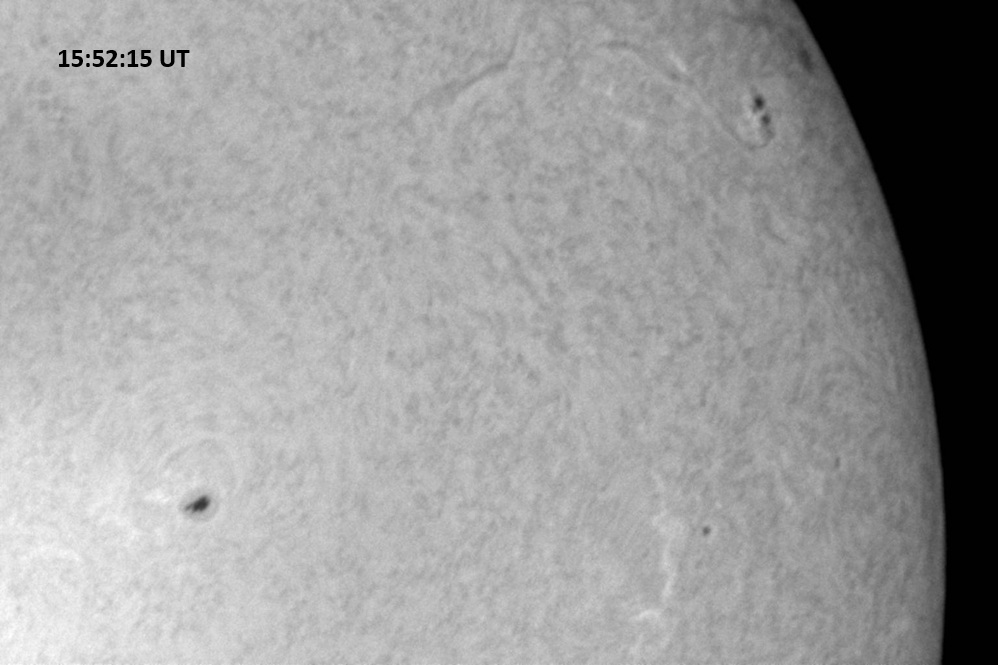 This zone of the Sun, prior to the M1.9 flare that is described above. Other than this event, it has been entirely quiet here. This zone of the Sun, prior to the M1.9 flare that is described above. Other than this event, it has been entirely quiet here. |
 |
 |
Solar activity is expected to be low through 1 August, with a chance for M-class flares.
July 29, 2026
Solar activity continues to be at low levels, with only a few low-level C-class flares, most of which came from AR 14498. ARs 14498 and 14499 grew slightly, and ARs 14500 and 14501 emerged since yesterday (although 14500 was visible on yesterday’s images). The rest of the spotted regions were either stable or in slow decay; there are currently nine spotted active regions on the Sun, with possibly another emerging just west of AR 14499.
There was a CME first observed in satellite imagery at 23:48 UT, 27 July that appears to be related to a C3.3 flare that came from AR 14494 two days ago. This follows CMEs released on 26 and 27 July; the earlier ones are expected to arrive tomorrow with possibly a weak or glancing blow to the Earth’s magnetic field; and the most recent may arrive at Earth on 1 August, with minimal impacts.
The first column below includes red continuum images, each 0.09 sec exposure; and the second column hosts H-alpha line center images, each 0.15 sec exposure and enhanced slightly to bring out detail. Each of the images covers 7.8’x11.4′ on the sky. Celestial north is up, west is right in each image.
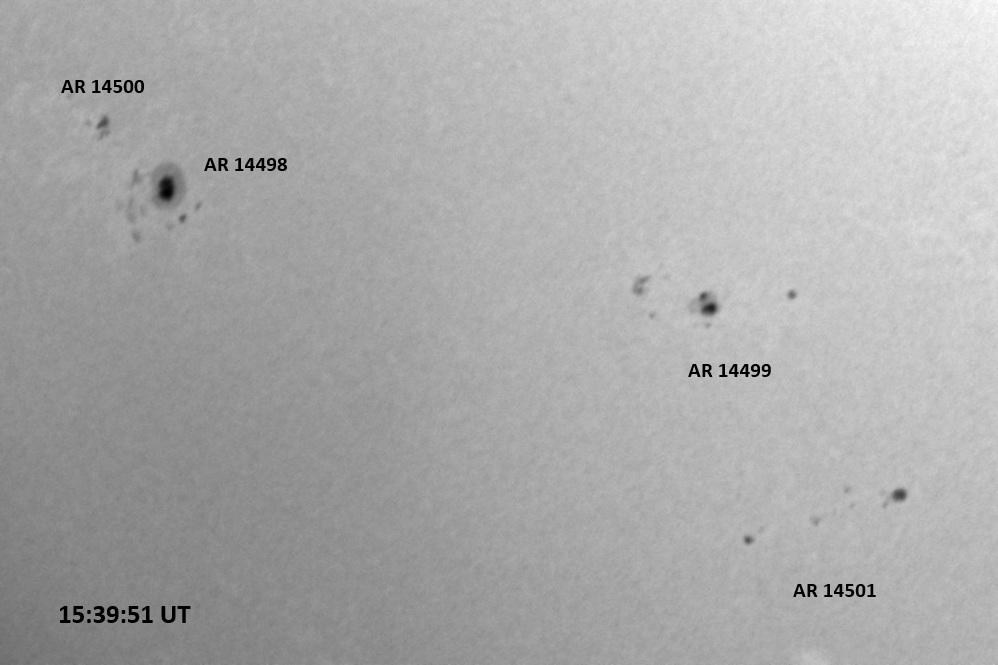
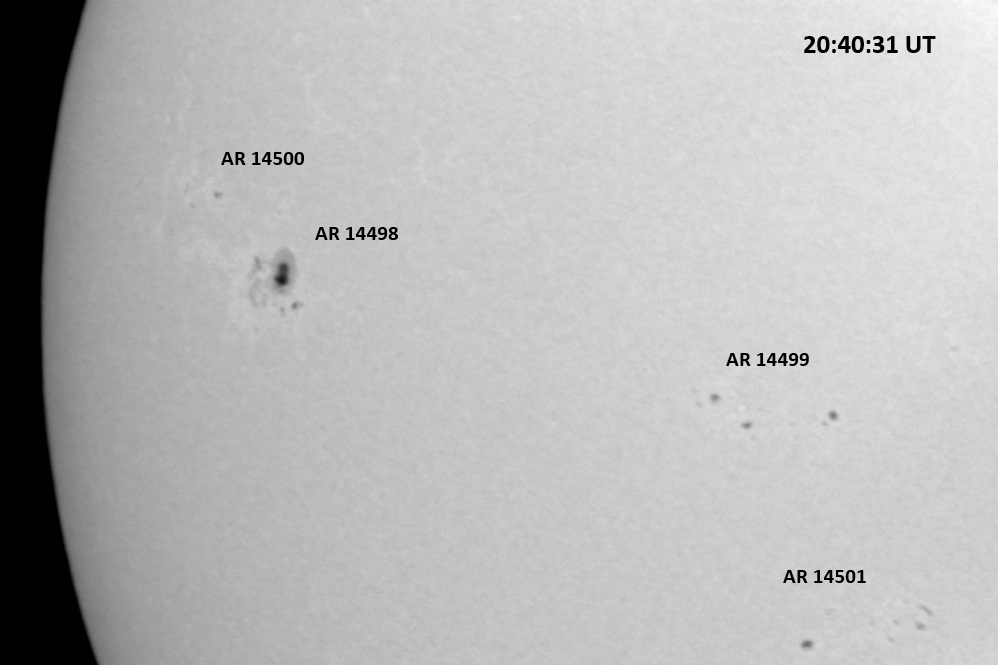
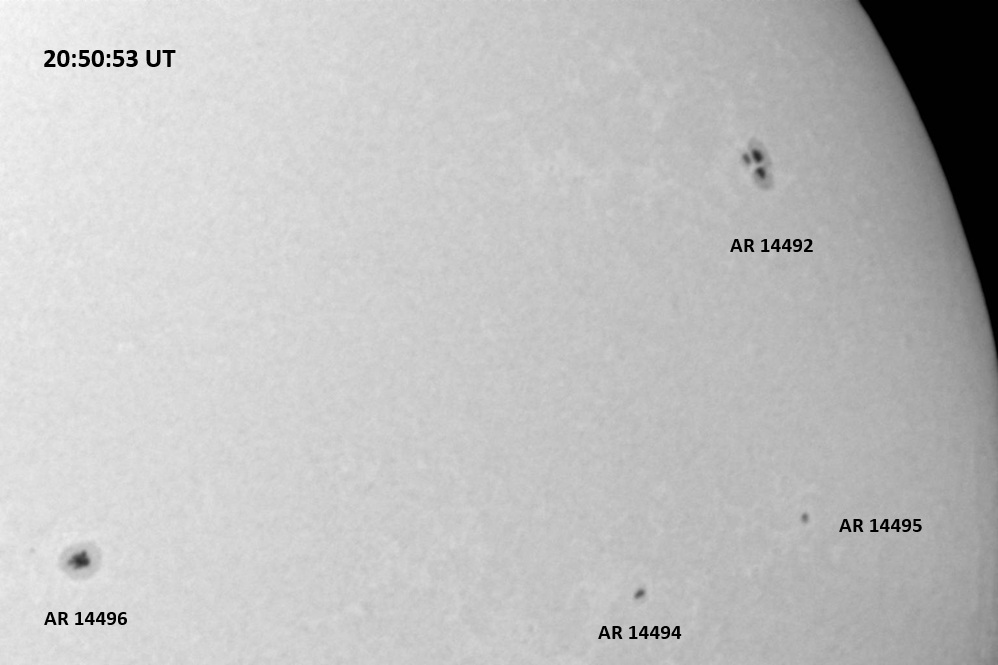 This region of the Sun includes four numbered active regions (labeled), plus AR 14497, out of view below the right corner of the image. This region of the Sun includes four numbered active regions (labeled), plus AR 14497, out of view below the right corner of the image. |
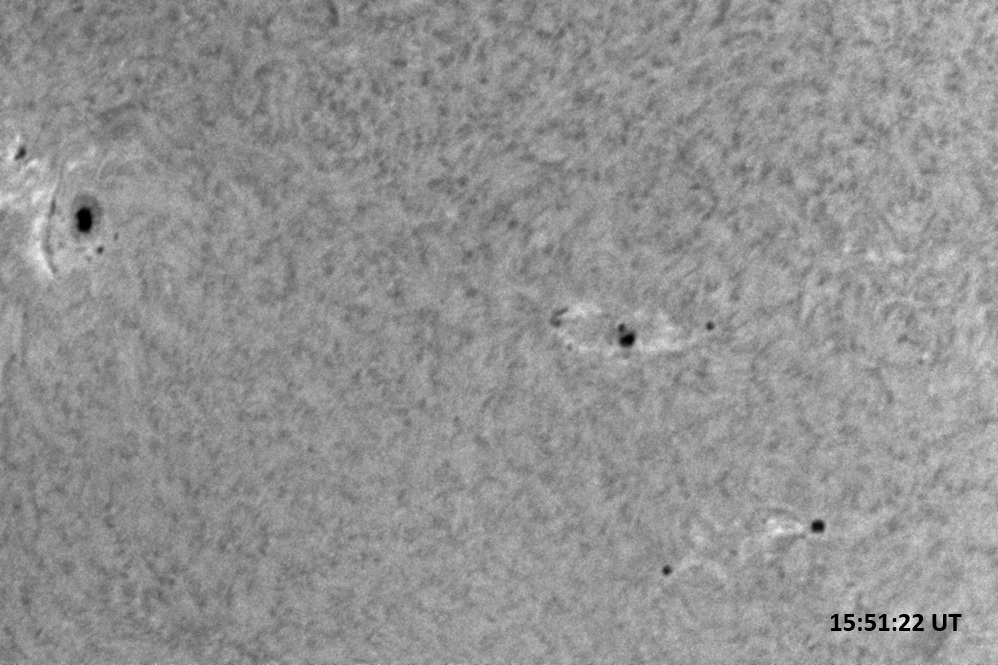
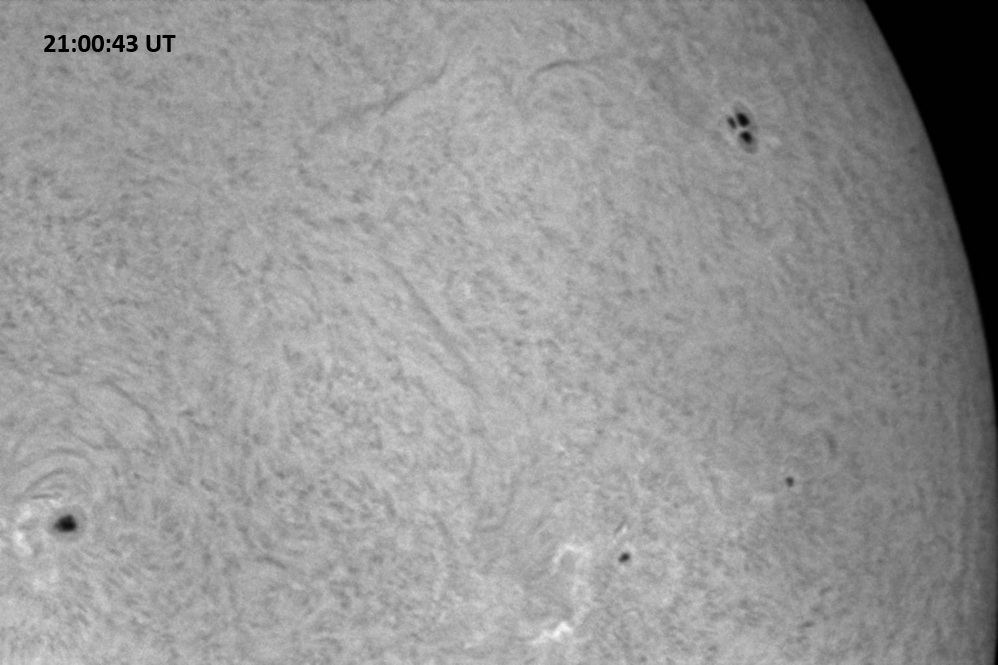 No flares have been observed from this part of the Sun so far today (through 22:25 UT), as all of these active regions have become quiet. Several filaments are visible in this image. No flares have been observed from this part of the Sun so far today (through 22:25 UT), as all of these active regions have become quiet. Several filaments are visible in this image. |
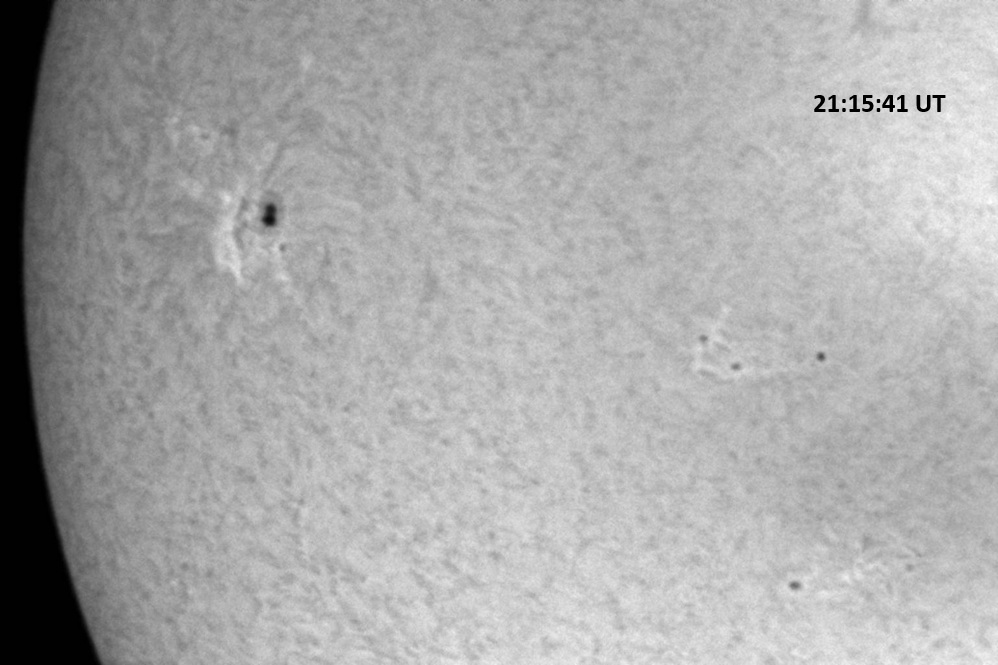
 Active regions are emerging in this region of the Sun, and another may be about to do so west of AR 14499 (the single spot right next to image’s edge). Active regions are emerging in this region of the Sun, and another may be about to do so west of AR 14499 (the single spot right next to image’s edge). |
 Each of these active regions, except AR 14500, produced at least one C1 flare today. AR 14498 produced two early today, but has been quiet since. Each of these active regions, except AR 14500, produced at least one C1 flare today. AR 14498 produced two early today, but has been quiet since. |
Solar activity is expected to be low through 31 July, with a chance for M-class flares.
July 28, 2026
Solar activity is low. The largest flare today was a C5.1/SF at 3:19 UTC from AR 14494. ARs 14494 and 14495 decayed slightly. The rest of the spotted active regions (there are seven, total) were stable or decaying slightly.
The first column below includes red continuum images, each 0.09 sec exposure; and the second column hosts H-alpha line center images, each 0.15 sec exposure and enhanced slightly to bring out detail. Each of the images covers 7.8’x11.4′ on the sky. Celestial north is up, west is right in each image.
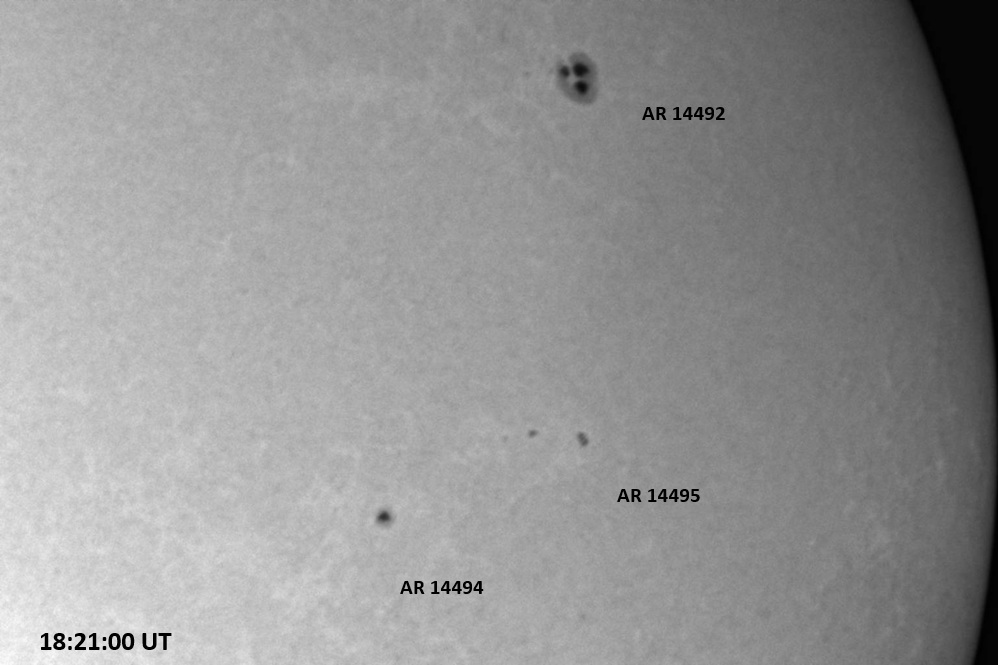 Four lone spots or spot groups are visible in the western part of the solar disk. Not shown is AR 14497, located off frame below and right of AR 14495. Four lone spots or spot groups are visible in the western part of the solar disk. Not shown is AR 14497, located off frame below and right of AR 14495. |
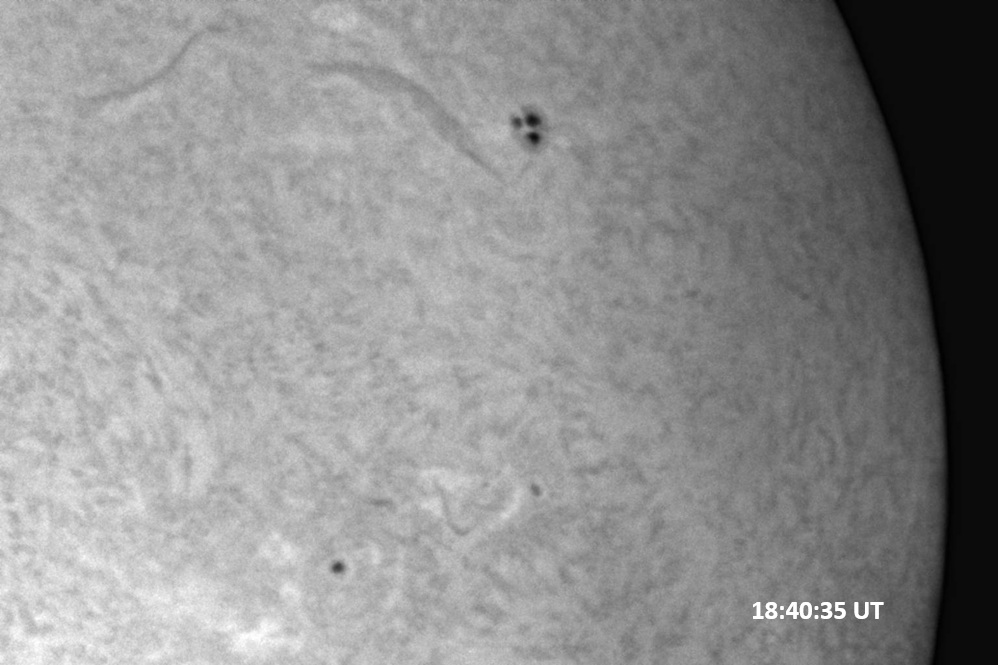 All of these active regions were quiet today except that AR 14494 was the source of a C5.1 flare early today. AR 14495 also produced a C1.5 flare later in the day. All of these active regions were quiet today except that AR 14494 was the source of a C5.1 flare early today. AR 14495 also produced a C1.5 flare later in the day. |
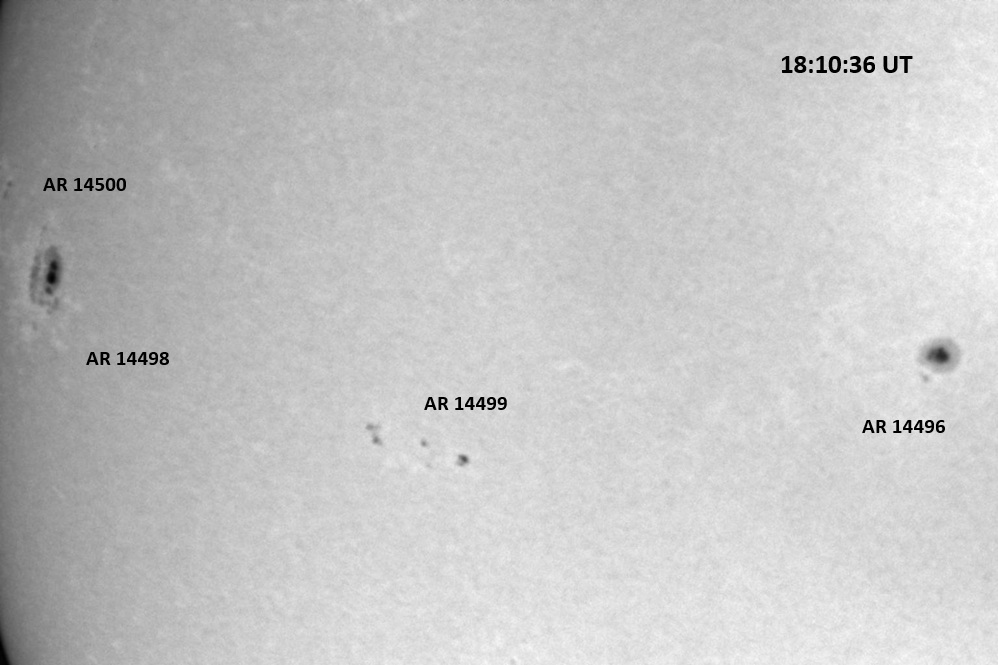 These spot groups found in the eastern half of the Sun’s disk (labeled). These spot groups found in the eastern half of the Sun’s disk (labeled). |
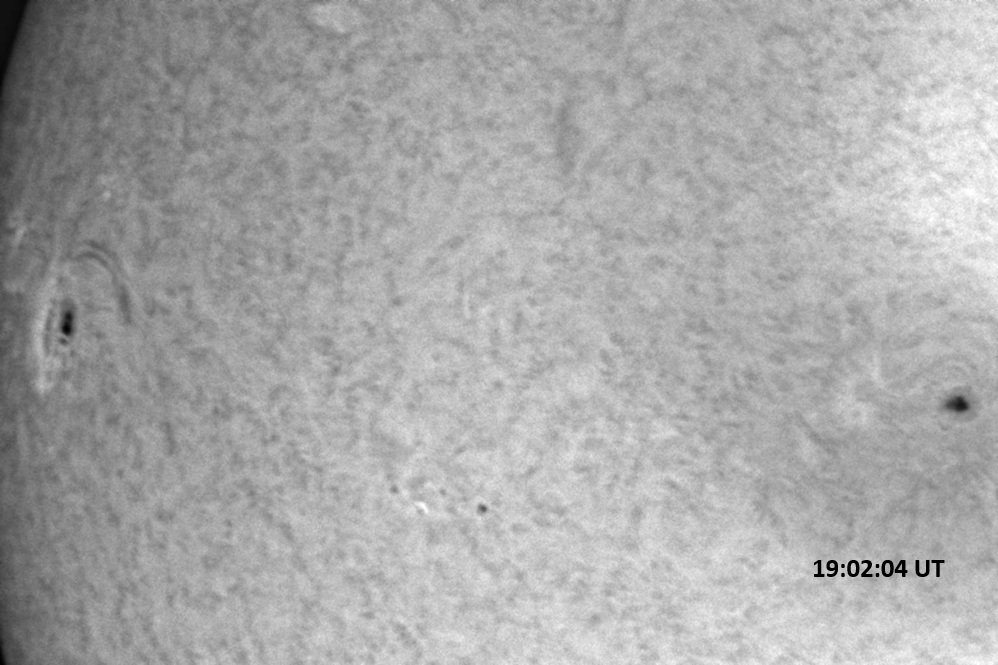 AR 14498 and 14496 each produced one low-level C-class flare: a C1.4 and a C1.8, respectively. AR 14498 and 14496 each produced one low-level C-class flare: a C1.4 and a C1.8, respectively. |
Solar activity is expected to be low through 30 July, with a chance for an M-class flare.
July 27, 2026
Solar activity became moderate after two flares from AR 14494: an impulsive M3.2 at 15:28 UT on 26 July; and an M1.0/SF at 2:43 UT on 27 July. The M3.2 event launched a CME, which may arrive at Earth late on July 30. ARs 14493, 14494, and 14495 are decaying, while the rest of the spotted regions remain stable or in decay. After the M1.0 flare, solar activity dropped back down to low levels, with only occasional low-level C-class flares later in the day. A 15 degree long filament erupted in the northern part of the solar disk at 2:20 UT on 27 July. This also generated a CME, which may graze the Earth’s magnetic field on July 30.
The first column below includes red continuum images, each 0.09 sec exposure; and the second column hosts H-alpha line center images, each 0.15 sec exposure and enhanced slightly to bring out detail. Each of the images covers 7.8’x11.4′ on the sky. Celestial north is up, west is right in each image.
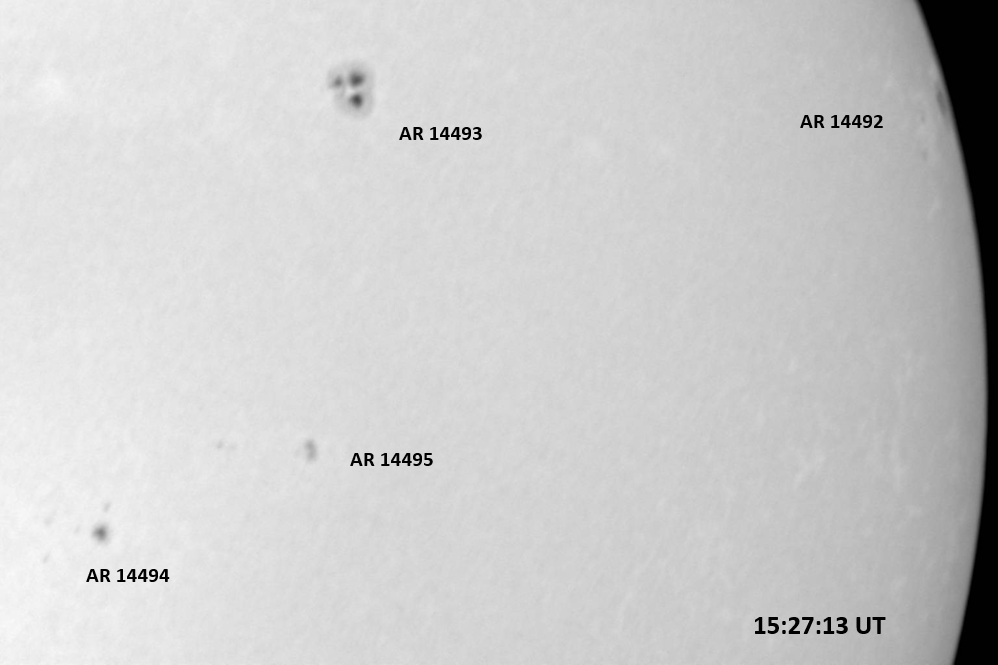 The western half of the active latitudes of the solar disk, with several small groups visible. The western half of the active latitudes of the solar disk, with several small groups visible. |
 These regions have been generally quiet, except for the largest, AR 14494, with two M-class, and several C-class flares. These regions have been generally quiet, except for the largest, AR 14494, with two M-class, and several C-class flares. |
 The eastern half of the active latitudes of the solar disk, AR 14498 is the spot near the edge, 14499 is below and left of center, and 14496 is toward the right. The eastern half of the active latitudes of the solar disk, AR 14498 is the spot near the edge, 14499 is below and left of center, and 14496 is toward the right. |
 This part of the Sun has been quiet. Three spotted regions and at least two filaments are visible in this view. This part of the Sun has been quiet. Three spotted regions and at least two filaments are visible in this view. |
Solar activity is expected to be low through 29 July, with a chance for an M-class flare.
July 24, 2026
Solar activity continues at low levels and the frequency of low-level C-class events has decreased markedly. Two such events have occurred so far today from AR 14494, and one from AR 14493; the largest of these was a fourth event from an unspecified location, a C2.4 at 4:27 UT today. Since about 10:00 UT today, the Sun has essentially “flatlined” in terms of the X-ray flux. AR 14493 has decayed a bit and has simplified in terms of its magnetic field. AR 14494 has grown slightly as has AR 14496, which had just rotated into view two days ago. Everything else was quiet.
The first column below includes red continuum images, each 0.09 sec exposure; and the second column hosts H-alpha line center images, each 0.15 sec exposure and enhanced slightly to bring out detail. Each of the images covers 7.8’x11.4′ on the sky. Celestial north is up, west is right in each image.
 AR 14493 (top center) and 14489 (right near Sun’s edge). AR 14493 (top center) and 14489 (right near Sun’s edge). |
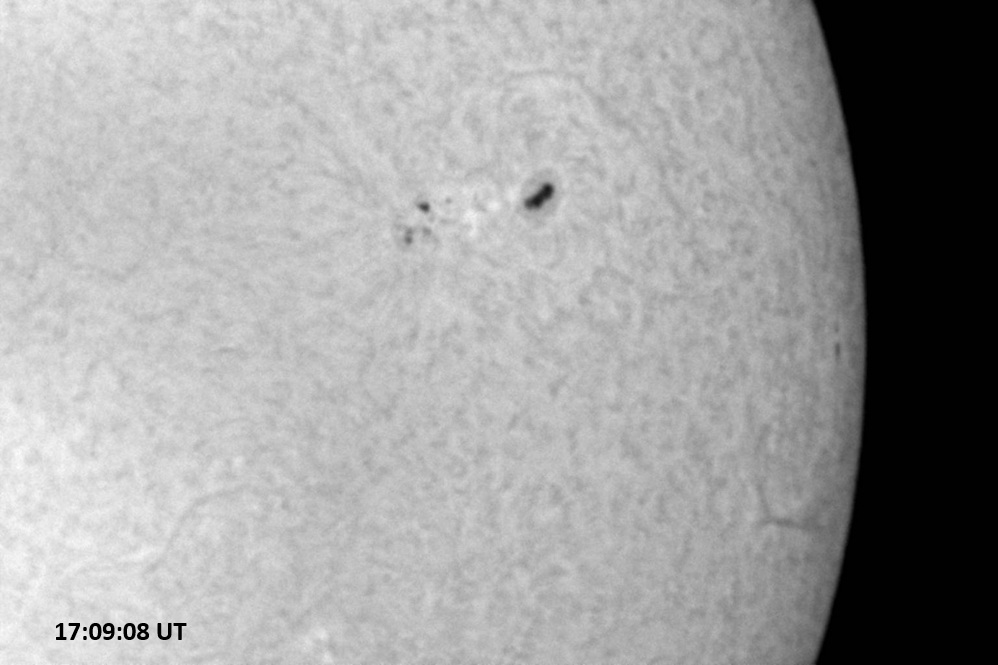 AR 14493 has quieted down dramatically, while AR 14489 is about to rotate out of view. AR 14493 has quieted down dramatically, while AR 14489 is about to rotate out of view. |
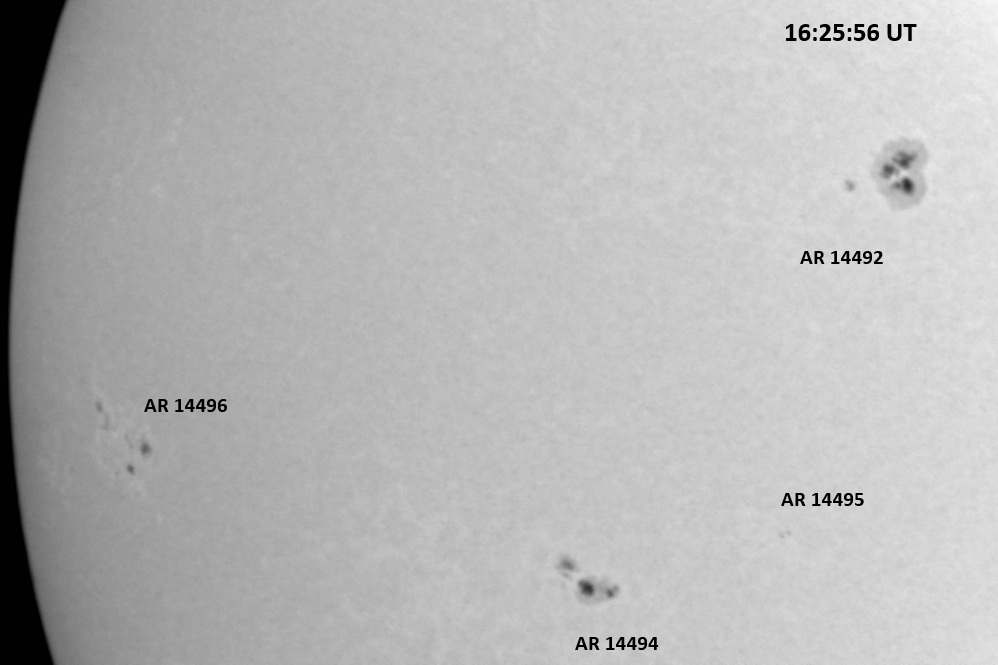 Four (labeled) of the six visible spotted groups are seen in this image. Four (labeled) of the six visible spotted groups are seen in this image. |
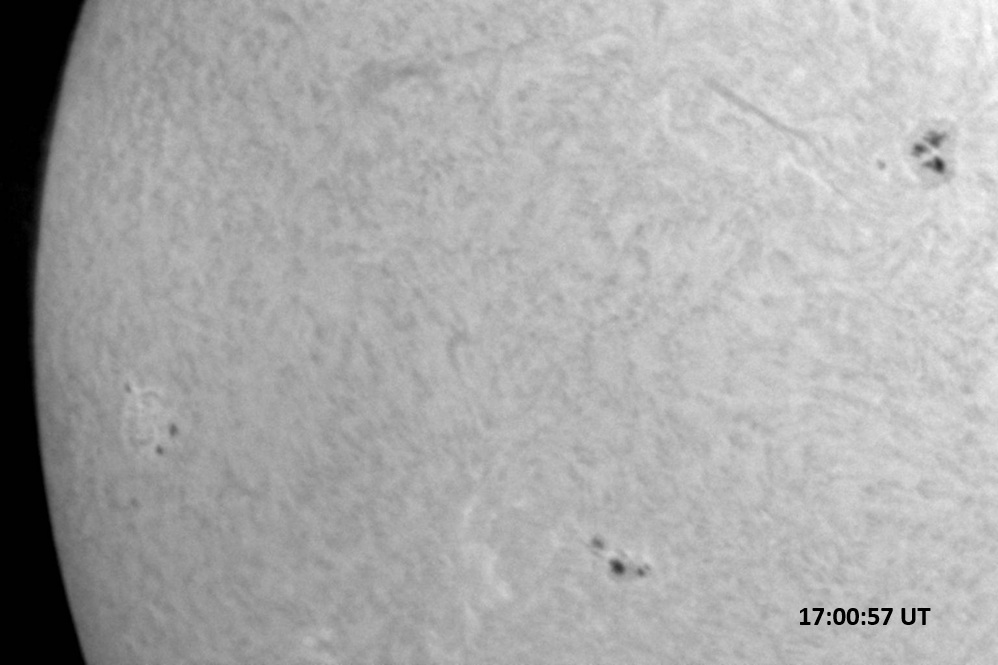 AR 14494 (upper right) is starting to become more active as it grows a bit. Several filaments remain visible in this image. AR 14494 (upper right) is starting to become more active as it grows a bit. Several filaments remain visible in this image. |
Solar activity is expected to be low through 26 July, with a 45% probability of an M-class flare from either AR 14493 or 14494.
July 23, 2026
Solar activity dropped back to low levels and has been so since the M3 flare from AR 14493 early yesterday (UT, 22 July). AR 14493 produced most of the C-class flares yesterday and today, but AR 14494 has started to flare, with a C1.3 flare at 6:44 UT today. AR 14493 still has a complex magnetic configuration and has grown slightly. There are six total spotted active regions and, except for AR 14493, have all remained quiet. A CME erupted yesterday as a result of a filament eruption in the southwestern disk of the Sun.
Due to a thin shield of cirrostratus from Tropical Storm Bertha, the exposures of the images were lengthened. The first column below includes red continuum images, each 0.15 sec exposure; and the second column hosts H-alpha line center images, each 0.25 sec exposure and enhanced slightly to bring out detail. Each of the images covers 7.8’x11.4′ on the sky. Celestial north is up, west is right in each image.
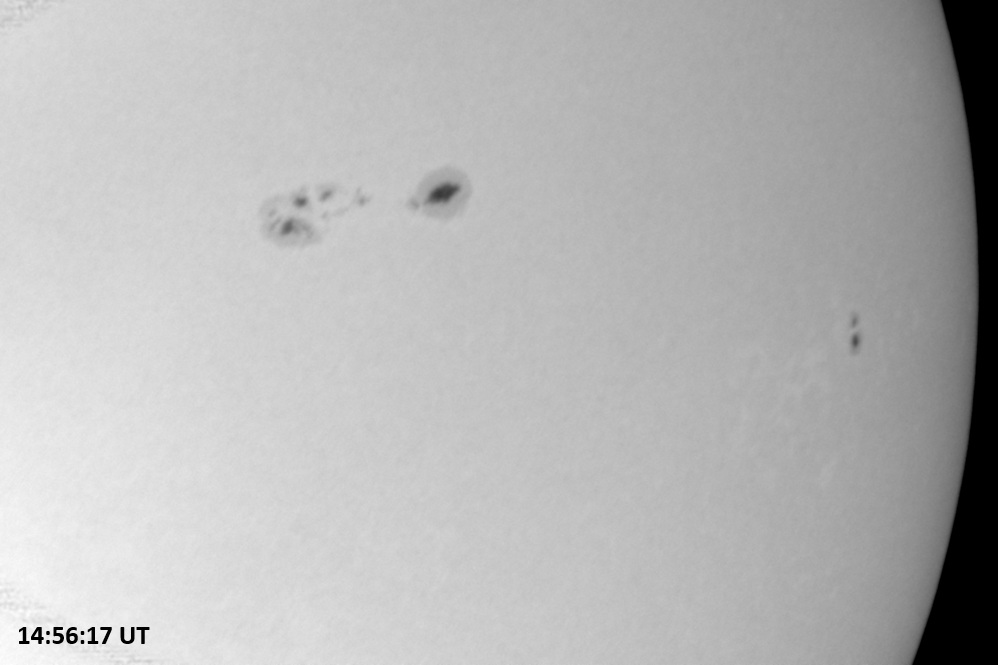 AR 14493 (top left) and 14489 (right). AR 14493 (top left) and 14489 (right). |
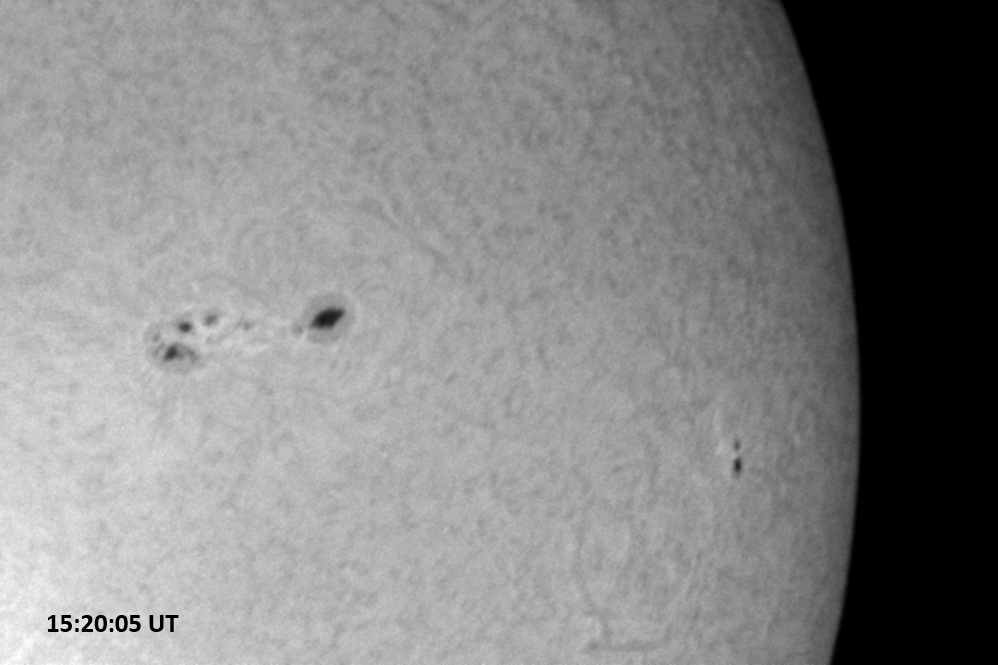 AR 14493 continues to produce minor flaring, while 14489 remains totally quiet. AR 14493 continues to produce minor flaring, while 14489 remains totally quiet. |
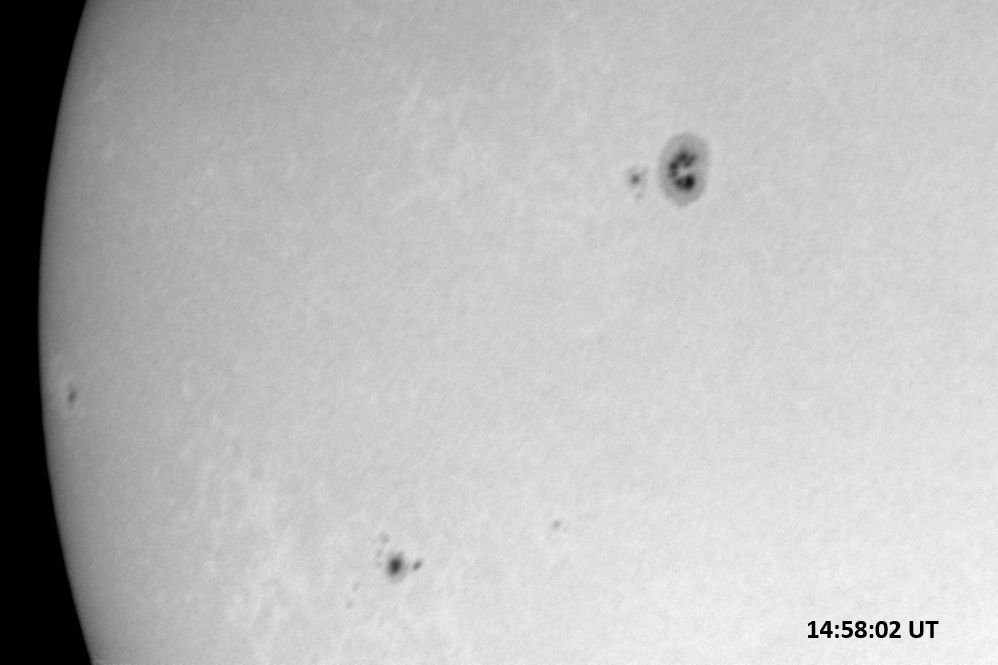 AR 14492 (top) is the largest of this part of the Sun. From left to right along the bottom of the image, the spot groups are AR 14496, 14494, and 14495. AR 14492 (top) is the largest of this part of the Sun. From left to right along the bottom of the image, the spot groups are AR 14496, 14494, and 14495. |
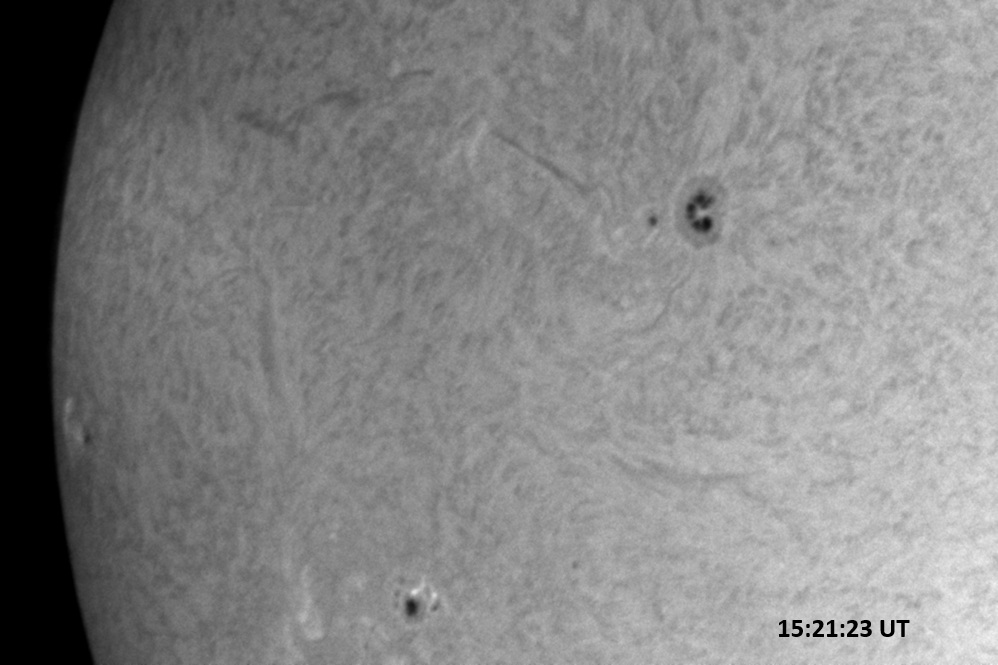 AR 14494 has started to produce some minor C-class flares, but has been quiet otherwise. The other regions are quiet, and many filaments remain visible. AR 14494 has started to produce some minor C-class flares, but has been quiet otherwise. The other regions are quiet, and many filaments remain visible. |
Solar activity is expected to be low through 25 July, with more M-class flares likely from AR 14493.
July 22, 2026
Solar activity remains at moderate levels as AR 14493 produced an M3.6 flare today at 6:35 UT. This region continues to grow while maintaining magnetic complexity in the form of delta magnetic configurations. Since this event, it has only produced three C-class flares. AR 14492 is mostly stable, with some spot migration within the complex; AR 14494 grew slightly; and AR 14489 was in decay as it started to approach the western limb. A filament erupted NW of AR 14493 prior to observations yesterday (the event happened at 10:45 UT). This produced a faint coronal mass ejection, which was observed by satellite at 14:12 UT, 21 July. It also appears, based on GOES 19/CCOR-1 (a new satellite with coronagraph that images the solar corona) imagery around 18:00 UT that a larger CME has launched as a result of the M3.6 flare and is headed toward Earth.
The first column below includes red continuum images, each 0.09 sec exposure; and the second column hosts H-alpha line center images, each 0.15 sec exposure and enhanced slightly to bring out detail. Each of the images covers 7.8’x11.4′ on the sky. Celestial north is up, west is right in each image.
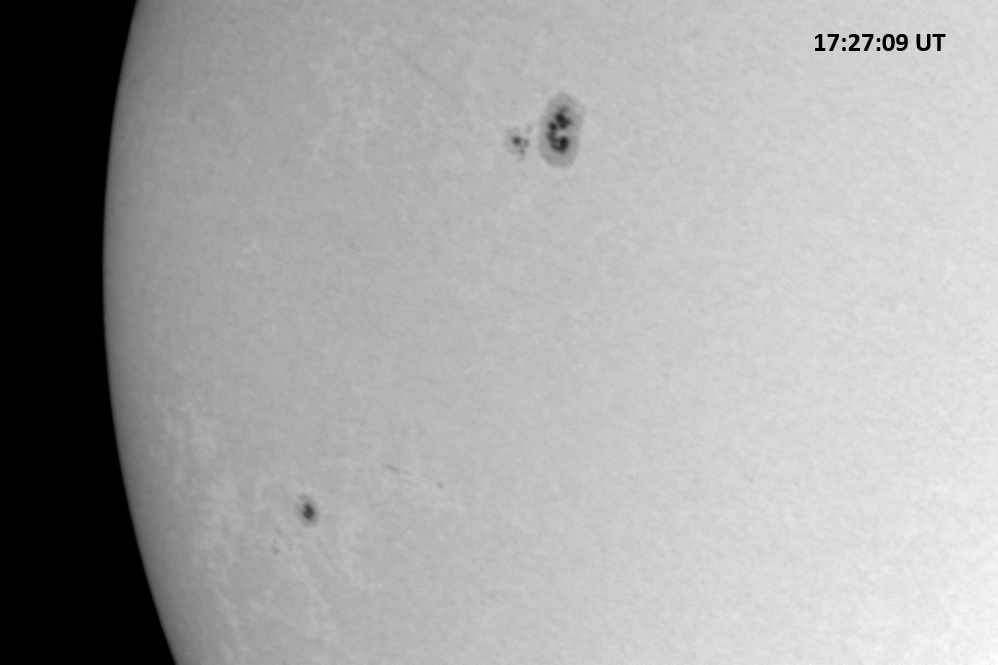
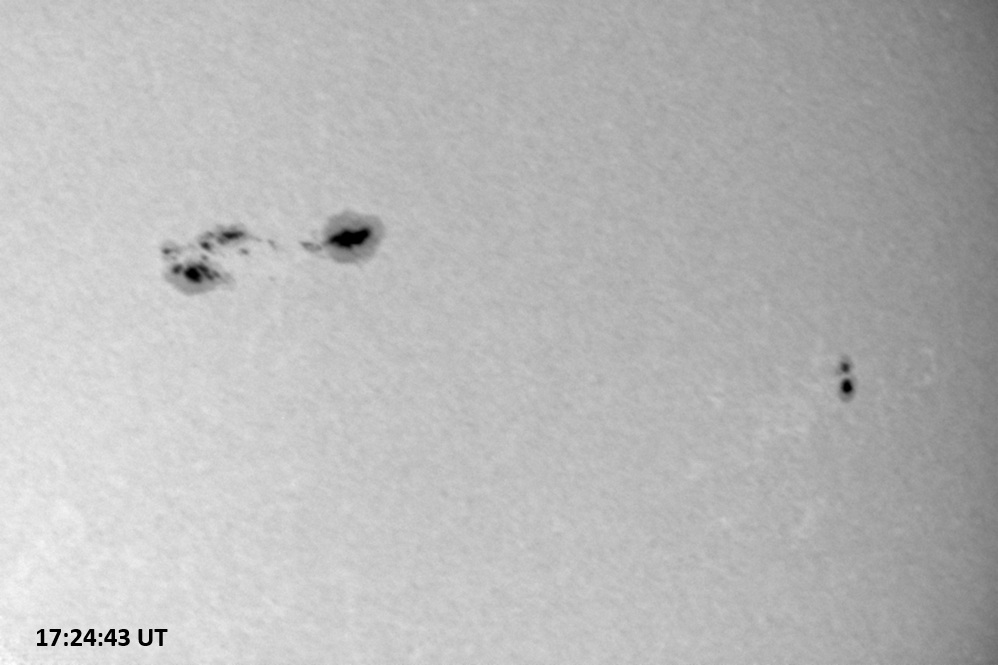 AR 14493 (left) and 14489 (right) as they appear in red continuum. AR 14493 (left) and 14489 (right) as they appear in red continuum. |
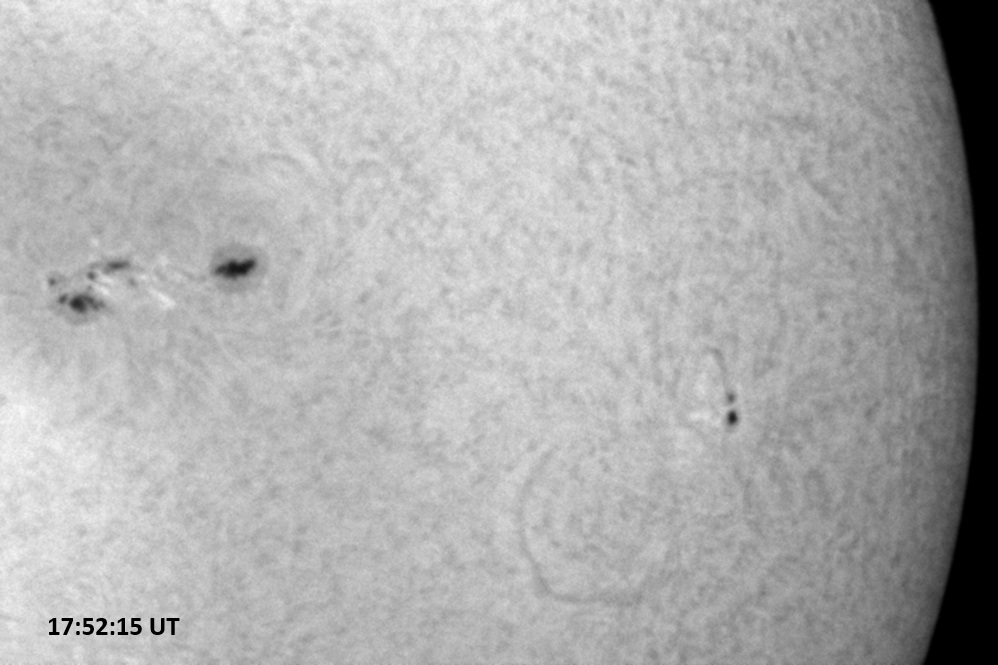 AR 14493 continues to be the most active spotted group on the Sun. AR 14493 continues to be the most active spotted group on the Sun. |
 AR 14492 (top) and 14494 (bottom). The diagonal line left of 14492 is real, it is a filament lifting up with a velocity at least 51 miles/second (82 km/sec.). AR 14492 (top) and 14494 (bottom). The diagonal line left of 14492 is real, it is a filament lifting up with a velocity at least 51 miles/second (82 km/sec.). |
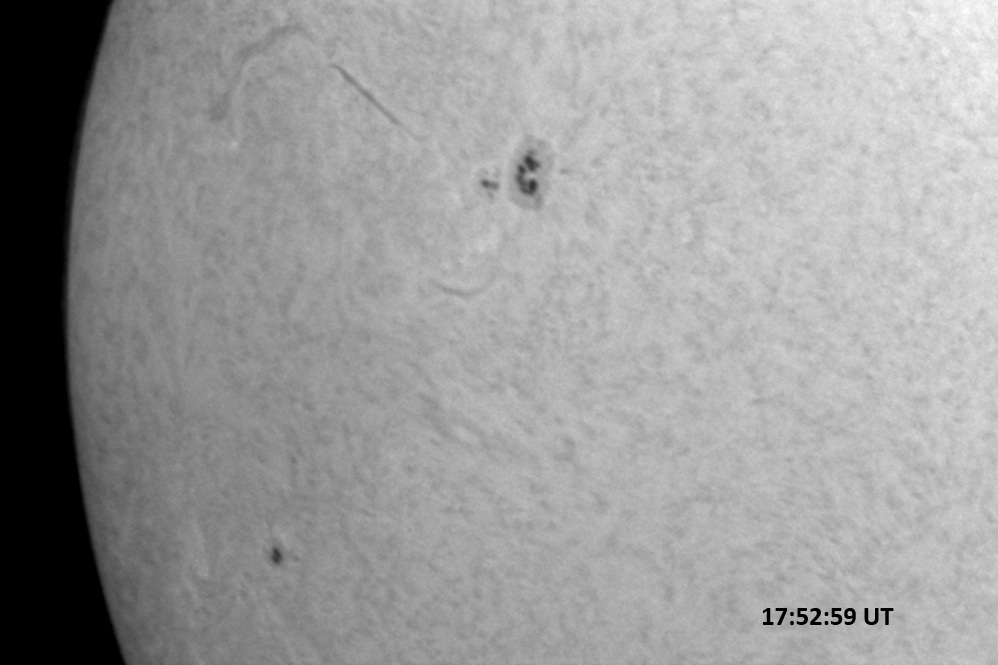 AR 14492 and 14494 as seen in H-alpha, along with a handful of filaments. AR 14492 and 14494 as seen in H-alpha, along with a handful of filaments. |
Solar activity is expected to be low through 24 July, with more M-class flares likely from AR 14493.
July 21, 2026
Solar activity remains at moderate levels as AR 14493 continues to produce M-class flares regularly: an M2.5 at 14:36 UT, 20 July; an M1.1 at 19:20 UT, 20 July; an M3.4 flare at 22:25 UT, 20 July; and an M1.9 at 17:27, 21 July. We observed the last one in full. AR 14493 also produced numerous C-class flares both yesterday and today. AR 14493 experienced rapid magnetic flux emergence leading to the formation of many additional spots; it also developed complex magnetic delta configurations. AR 14492 was mostly quiet, with only a few low-level C-class flares (but none today so far). This region grew slightly since yesterday, but it remains stable. The other three visible spotted regions were stable and quiet.
The first column below includes red continuum images, each 0.09 sec exposure; and the second column hosts H-alpha line center images, each 0.15 sec exposure and enhanced slightly to bring out detail. Each of the images covers 7.8’x11.4′ on the sky. Celestial north is up, west is right in each image.
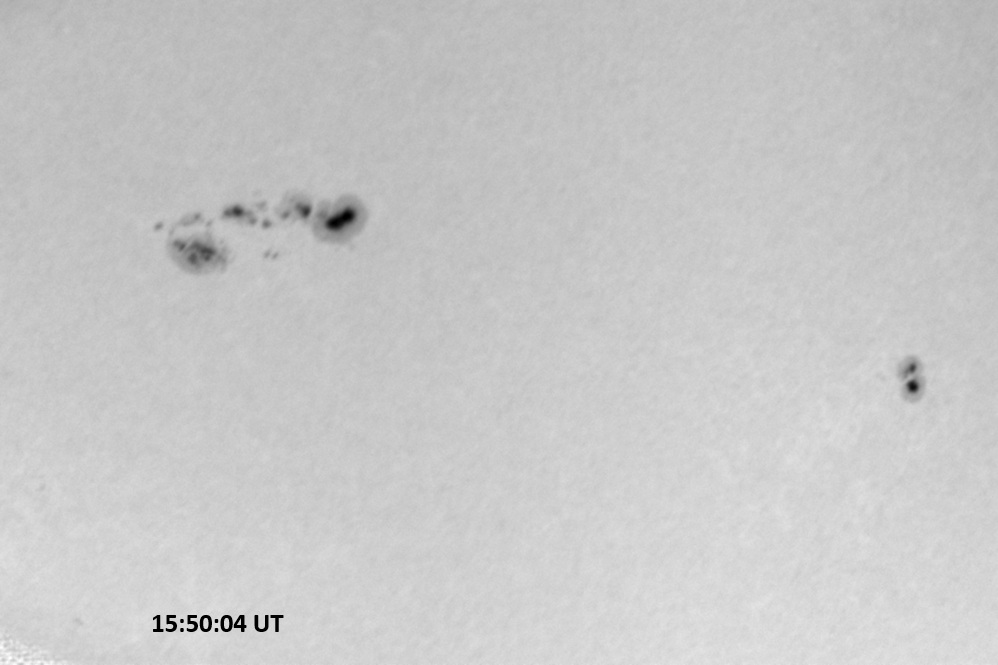 AR 14493 (upper left) and 14489 (lower right). The single spot that was AR 14491 dissipated completely. AR 14493 (upper left) and 14489 (lower right). The single spot that was AR 14491 dissipated completely. |
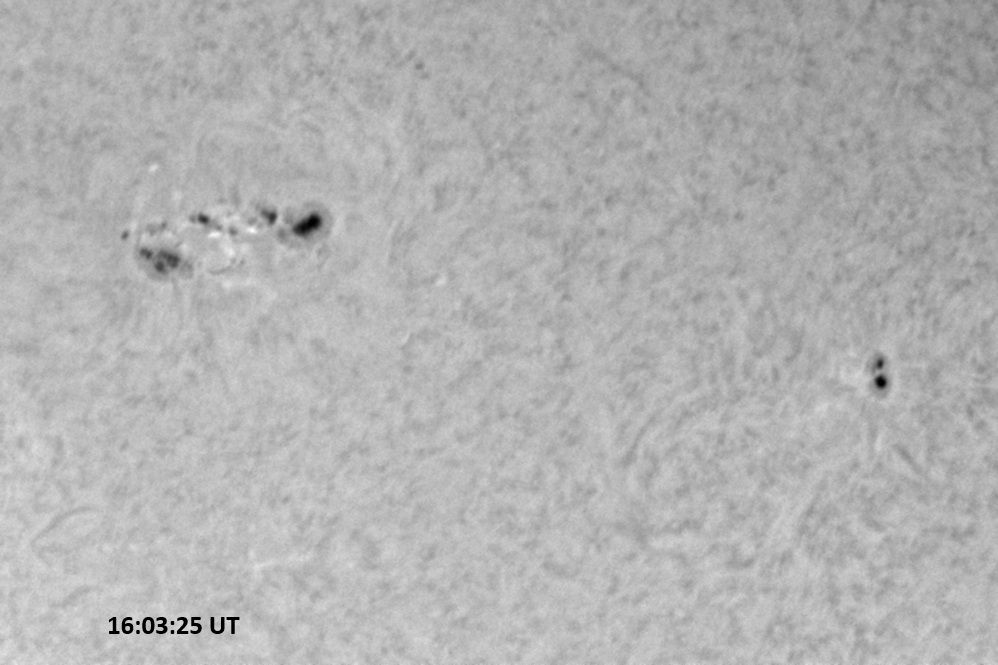 AR 14493 was responsible for all the activity so far today, with 12 C-class flares and 1 M-class flare through 20:00 UT today. AR 14493 was responsible for all the activity so far today, with 12 C-class flares and 1 M-class flare through 20:00 UT today. |
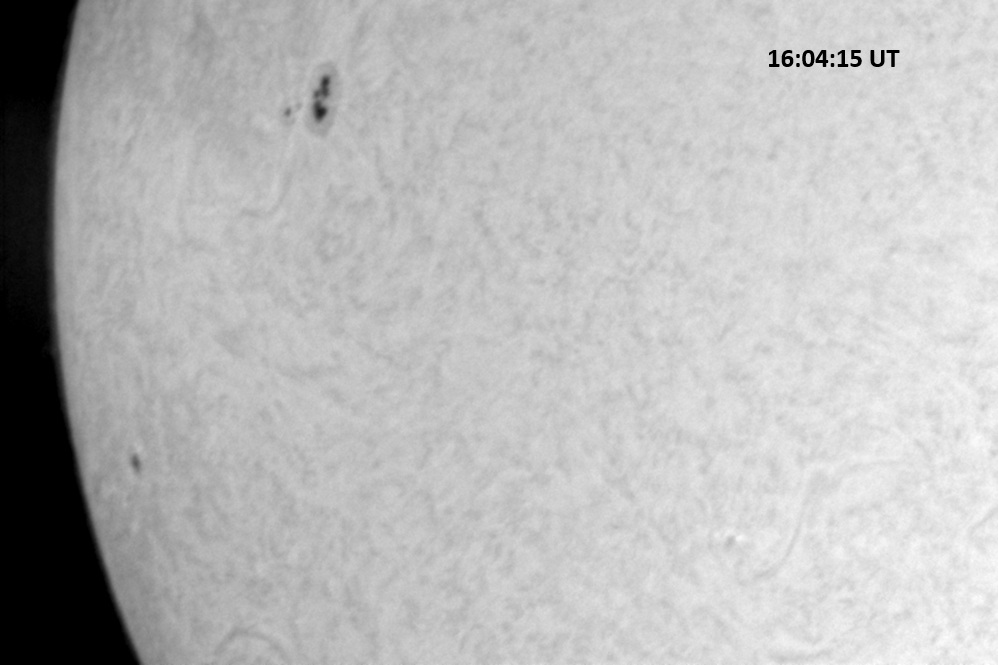
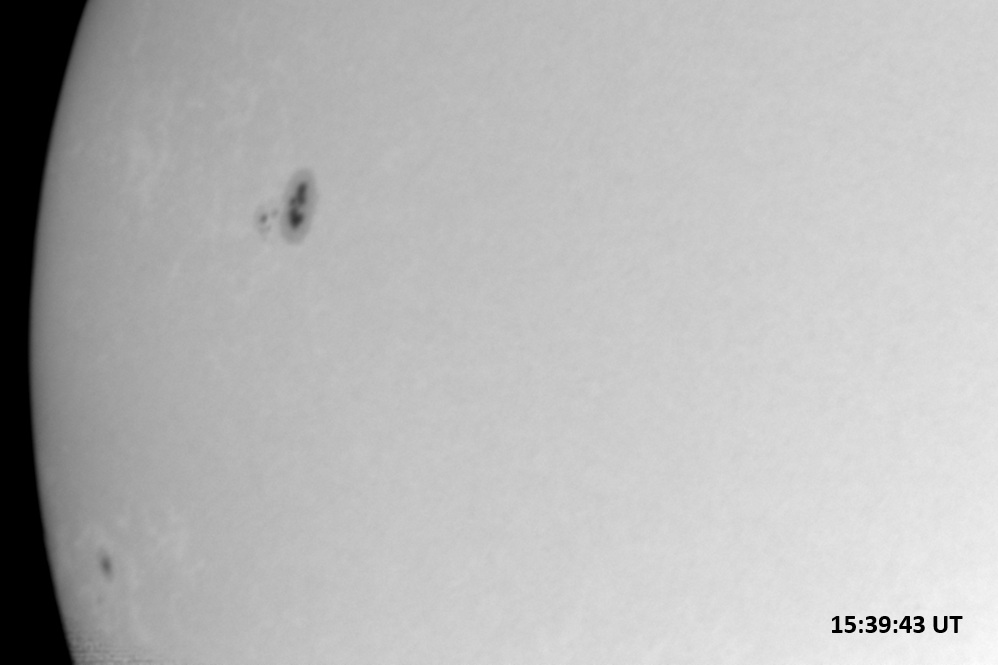 AR 14492 (top left) and 14494 (lower left) rotate further onto the solar disk. AR 14492 (top left) and 14494 (lower left) rotate further onto the solar disk. |
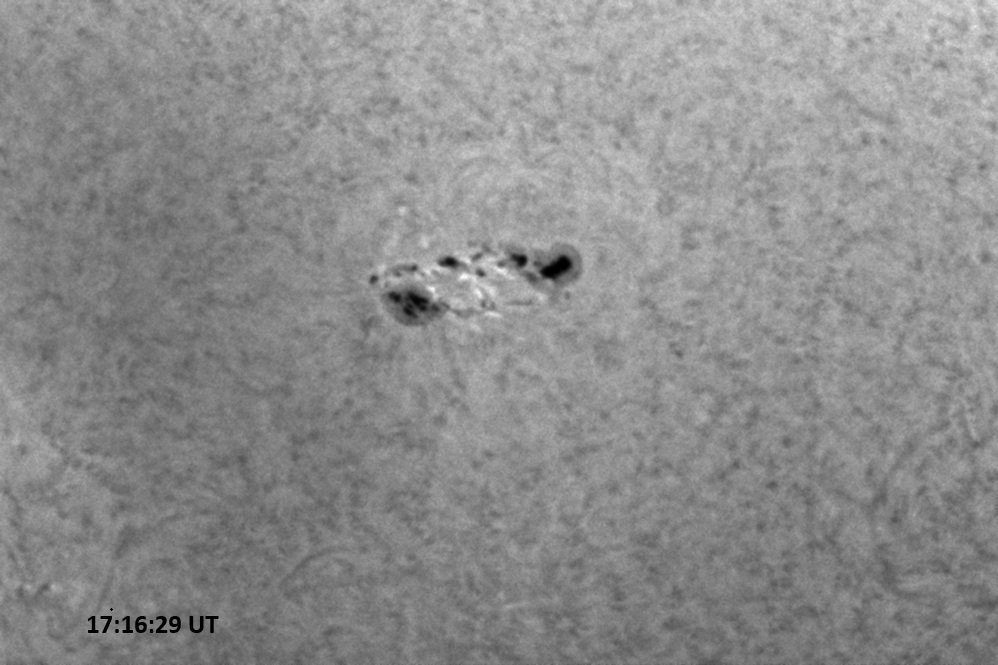
 This zone of the Sun was quiet all day, with no reported events from either region. This zone of the Sun was quiet all day, with no reported events from either region. |
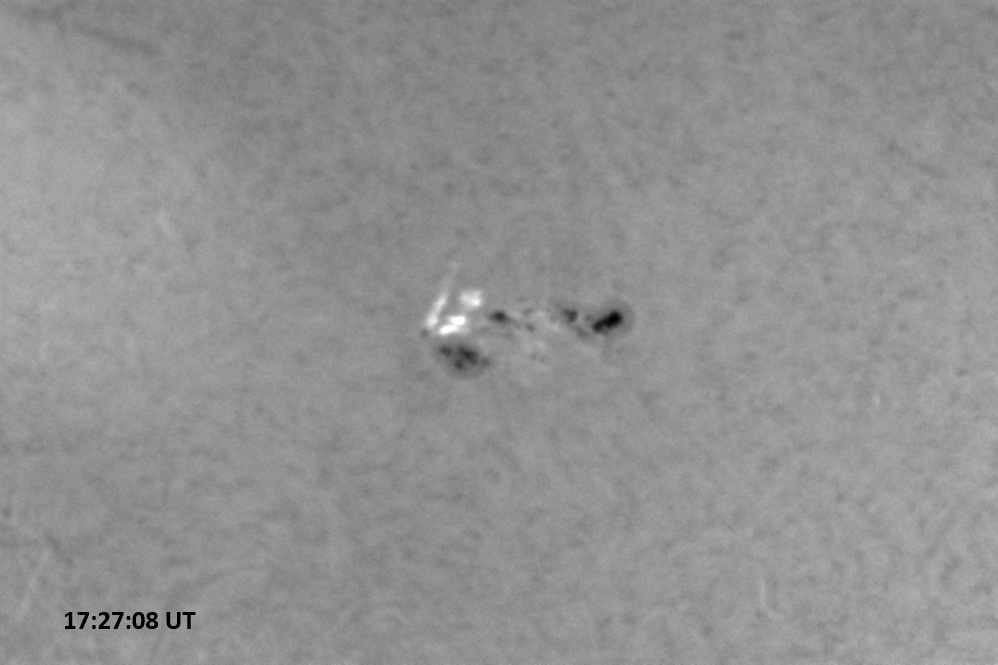
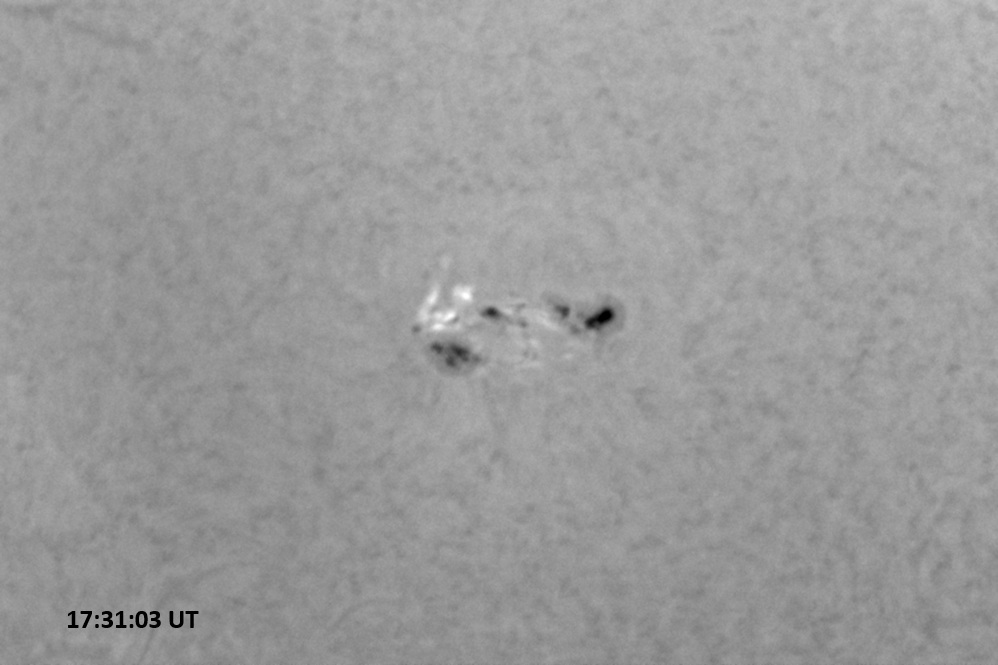
The following three images captured the evolution of today’s M1.9 flare at the start of X-ray output (left), near the X-ray peak (center) and at the end of X-ray output (right). The flare appears to still be bright in this instance because space weather prediction center defines the end of an X-ray event as the point in time when the X-ray flux reaches half of the peak flux.
 The X-ray start of the flare, shortly before the optical start of the event. The X-ray start of the flare, shortly before the optical start of the event. |
 This was imaged near X-ray maximum; the optical maximum usually differs by a few minutes. This was imaged near X-ray maximum; the optical maximum usually differs by a few minutes. |
 The flare near X-ray end (as defined above), the optical flare lasts considerably longer. The flare near X-ray end (as defined above), the optical flare lasts considerably longer. |
Solar activity is expected to be low through 23 July, with more M-class flares likely from AR 14493.
July 20, 2026
Solar activity returned to moderate levels today. A large active region rotated into view over the weekend, while another large active region emerged over the last 24 hours. It’s this second region, AR 14493, which has been the source of almost all the activity yesterday and today, including two M-class flares today: an M2.5 at 14:36 UT and an M1.1 at 19:20 UT. AR 14493 emerged rapidly and produced all this activity, while AR 14492, the region that rotated into view yesterday, was mainly quiet, even though it had increased in magnetic field complexity. The other two regions (four total) have been quiet and stable.
The first column below includes red continuum images, each 0.09 sec exposure; and the second column hosts H-alpha line center images, each 0.15 sec exposure and enhanced slightly to bring out detail. Each of the images covers 7.8’x11.4′ on the sky. Celestial north is up, west is right in each image.
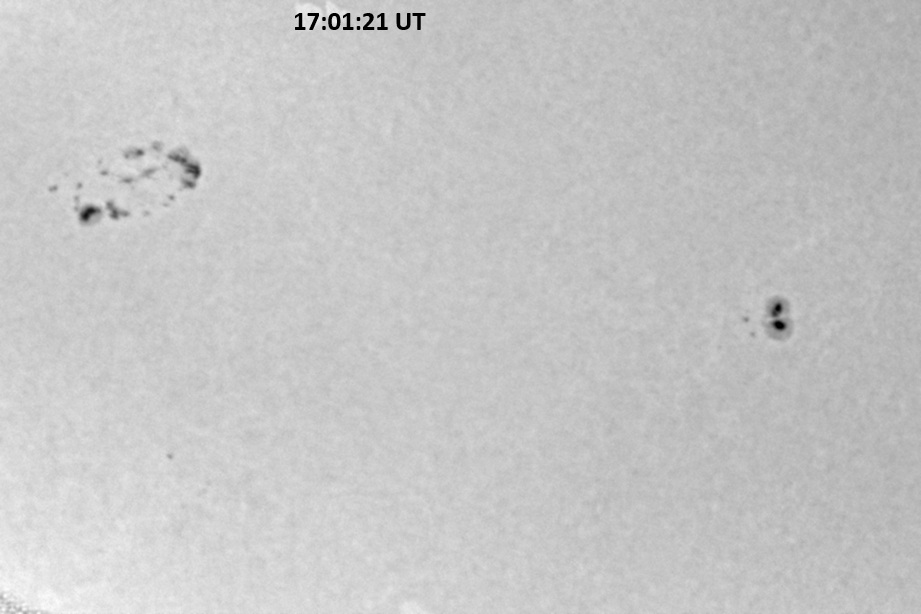 AR 14493 (upper left), 14489 (right, center), and 14491 (single dark dot directly below 14493 in lower left part of image) are three of the four visible active regions. AR 14493 (upper left), 14489 (right, center), and 14491 (single dark dot directly below 14493 in lower left part of image) are three of the four visible active regions. |
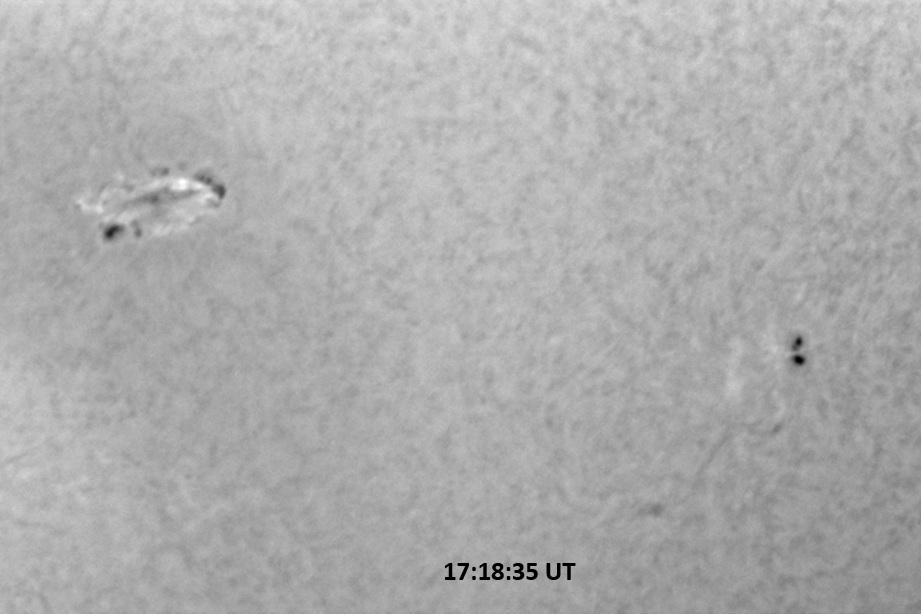 AR 14493 (upper left) appears complex in this H-alpha image, and it has supplied nearly all the flares that have occurred so far today. AR 14493 (upper left) appears complex in this H-alpha image, and it has supplied nearly all the flares that have occurred so far today. |
 AR 14492 (left) and 14493 (right). About 24 hours prior to this image acquisition time, AR 14493 was not visible AR 14492 (left) and 14493 (right). About 24 hours prior to this image acquisition time, AR 14493 was not visible |
 AR 14492 (left) produced one optical sub-flare at 12:34 UT today but has remained quiet otherwise. AR 14492 (left) produced one optical sub-flare at 12:34 UT today but has remained quiet otherwise. |
Solar activity is expected to be low through 22 July, with a chance for M-class flares.
July 17, 2026
Solar activity continues at low to very-low levels. There was an “almost-M-flare”, a C8.9, at 21:50 UT, 15 July. Since this event, the largest flare was a C5.2 at 21:35 UT on 16 July, from an active region just over the SE solar limb. AR 14490 was a pair of spots the last few days, but the spots have disappeared as of this morning’s sunspot counts. The other three regions were largely stable.
The first image below is a red continuum image, 0.15 sec exposure; and the second image is an H-alpha line center image, 0.25 sec exposure and enhanced slightly to bring out detail. Each of the images covers 7.8’x11.4′ on the sky. Celestial north is up, west is right in each image.
 This image includes all of the visible sunspot groups on the disk presently. The largest is AR 14489, upper right, and the one toward the left is AR 14491. An unnumbered spot group sits between the two, near image center. This image includes all of the visible sunspot groups on the disk presently. The largest is AR 14489, upper right, and the one toward the left is AR 14491. An unnumbered spot group sits between the two, near image center. |
 The same zone on the Sun as imaged in H-alpha. There are several filaments visible on the solar disk today, and one of these sits just southeast of AR 14489. None of these regions pose any threat for significant flares. The same zone on the Sun as imaged in H-alpha. There are several filaments visible on the solar disk today, and one of these sits just southeast of AR 14489. None of these regions pose any threat for significant flares. |
Solar activity is expected to remain low through 19 July, with a chance for M-class flares.
July 13, 2026
Solar activity dropped back to low levels. After an M1.1 flare from AR 14485 at 8:10 UT on 12 July, the Sun has quieted down considerably. Since this event, the largest flare was a C2.6 at 13:58 UT on 12 July from AR 14485. The region has rotated over the west limb and is no longer visible from the ground. Since then, there were a fair number of high-B and low-C class flares, including a C1.5 at 17:47 UT from AR 14485; and a C1.3 at 18:22 from AR 14489. Prior to these, the background X-ray level had dropped as low as B4. There are three spotted active regions on the visible disk of the Sun presently.
The first column below includes red continuum images, each 0.15 sec exposure; and the second column hosts H-alpha line center images, each 0.15 sec exposure and enhanced slightly to bring out detail. Each of the images covers 7.8’x11.4′ on the sky. Celestial north is up, west is right in each image.
 AR 14482 (large spot bottom center) and 14487 (small spot above image center). AR 14482 (large spot bottom center) and 14487 (small spot above image center). |
 AR 14482 and 14487 have been quiet the last several days. Over the weekend, north of 14487 was AR 14488, which formed then dissipated in a matter of a couple days. AR 14482 and 14487 have been quiet the last several days. Over the weekend, north of 14487 was AR 14488, which formed then dissipated in a matter of a couple days. |
 AR 14489 has just rotated into view and looks like a simple spot. AR 14489 has just rotated into view and looks like a simple spot. |
 AR 14489 is simple and quiet overall. AR 14489 is simple and quiet overall. |
Solar activity is expected to be low through 15 July, with a slight chance for M-class flares.
July 9, 2026
Solar activity began the UT day at moderate levels but has dropped back to low level. AR 14482 produced an impulsive M1.5/1N flare we observed yesterday, peaking at 17:56 UT, 8 July. It was the source of an M1.1/SF event at 2:27 UT, 9 July. Since then, and through 18:00, there have been no further M-class flares, only low level C-class. AR 14485 has been producing frequent B- and low-level C-class flares today, and it looks more interesting in images this morning than AR 14482. The largest flare since the M1 was a C2.7/SF at 7:13 UT today (9 July). This may have generated an eruption, but more analysis is needed to obtain more information.
There are still five numbered spot groups on the visible disk, three of which are small and simple. AR 14482 simplified magnetically and no longer shows the capacity for X-class flares; AR 14485 is growing and is adding spots and magnetic complexity. AR 14487, due north of 14482, has shown some growth, but remains simple and unremarkable, like AR’s 14481 and 14486. AR 14483, currently a spotless plage region on the west solar limb, has made itself visible as a bright spot on the limb.
The first column below includes red continuum images, each 0.15 sec exposure; and the second column hosts H-alpha line center images, each 0.15 sec exposure and enhanced slightly to bring out detail. Each of the images covers 7.8’x11.4′ on the sky. Celestial north is up, west is right in each image.
 Three spot groups: AR 14482 (largest group, lower left), AR 14487 (upper left) and 14481 (upper right). Three spot groups: AR 14482 (largest group, lower left), AR 14487 (upper left) and 14481 (upper right). |
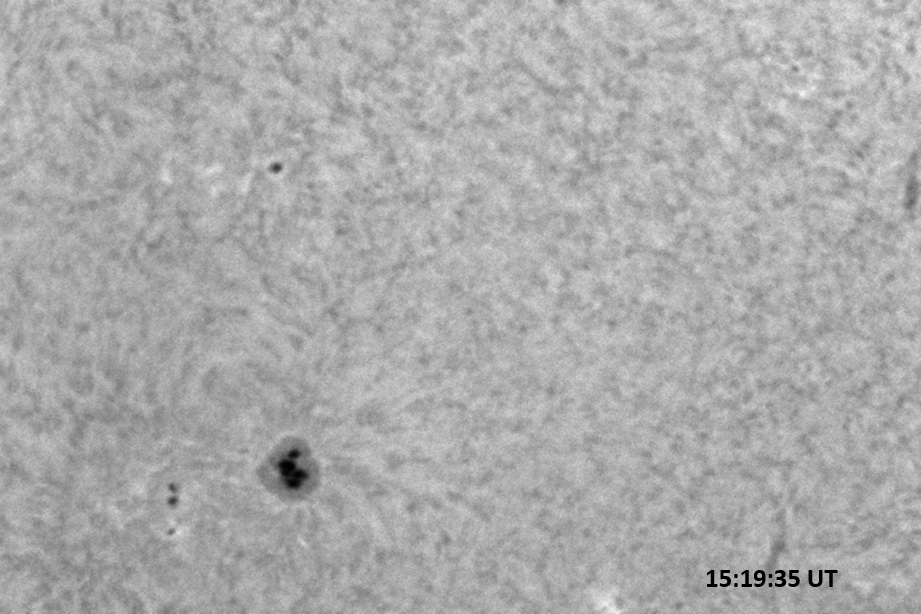 Since the M1 flare at 2:27 UT, this part of the Sun has remained quiet for much of the day. Since the M1 flare at 2:27 UT, this part of the Sun has remained quiet for much of the day. |
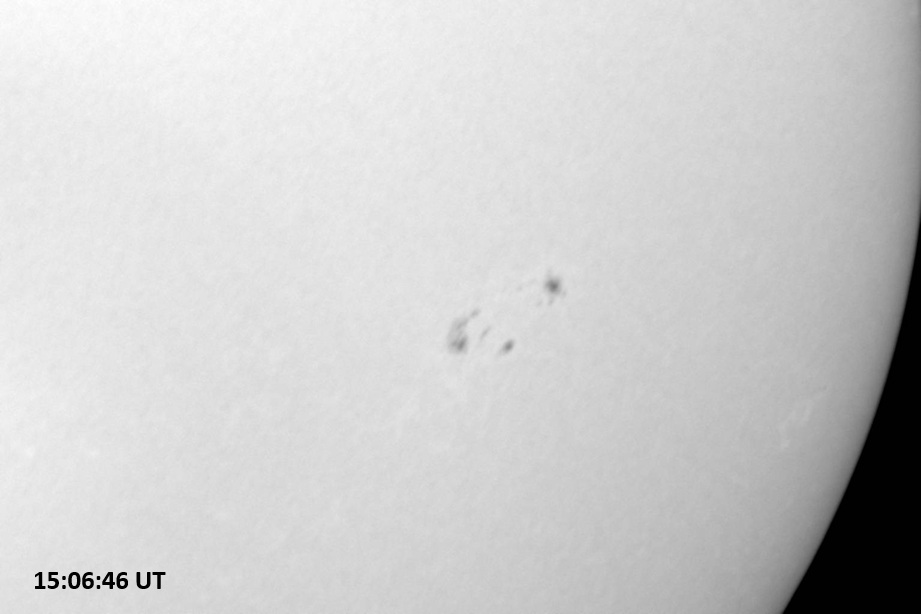 AR 14485 continues to grow in size and spot number. The bright spots in the lower right are AR 14486; its single spot is barely visible. AR 14485 continues to grow in size and spot number. The bright spots in the lower right are AR 14486; its single spot is barely visible. |
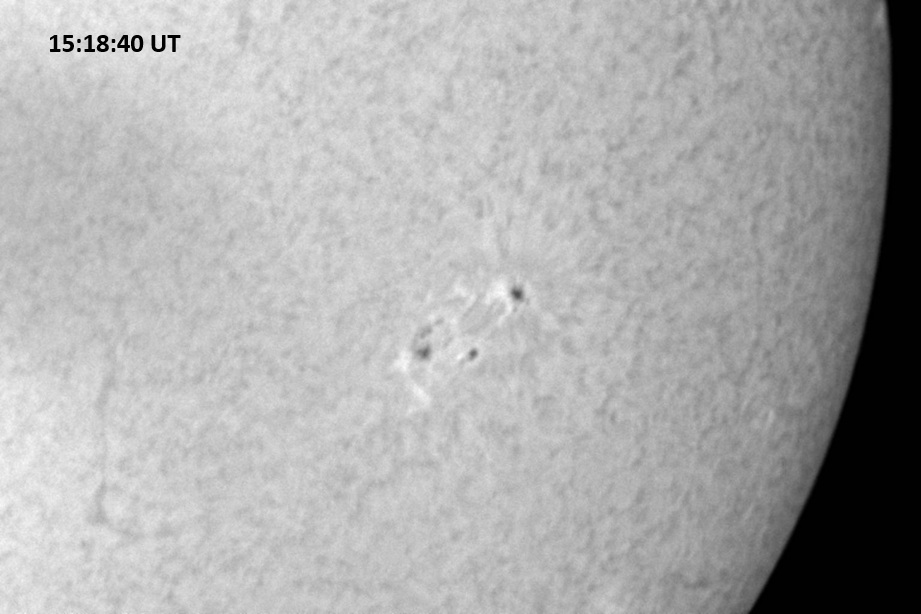 AR 14485 seems to be increasing in complexity and flare potential. The small bright spot at upper right, on solar edge and near picture edge, is AR 14483. AR 14485 seems to be increasing in complexity and flare potential. The small bright spot at upper right, on solar edge and near picture edge, is AR 14483. |
Solar activity is expected to be low through 11 July, with a chance for M-class flares and a slight chance for X-class flares.
July 8, 2026
Solar activity returned to moderate levels today with an M1.4/1B flare from AR 14482, peaking at 17:56 UT. Five other low-level C-class flares (4 C1’s and 1 C2) occurred so far today. AR 14482 also produced an M4.0/1B flare yesterday at 14:19 UT. Since then, only occasional B- and C-class flares occurred, which includes a C1.8 flare from AR 14485 at 22:49 UT, 7 July.
The M4.0 flare produced a faint CME, which was observed via satellite imagery starting at 15:00 UT, 7 July. However most of the ejected material (which we observed yesterday post-flare in the red continuum) was reabsorbed into the Sun. A large 15 degree filament in the east northeast part of the Sun erupted, beginning around 21:!6 UT, 7 July. This was the spectacular hedgerow prominence seen two days earlier along the eastern limb of the Sun.
The visible solar disk displays five numbered active regions, the largest of which is AR 14482, which continues to grow and increase in magnetic complexity. AR 14485 has also grown considerably since yesterday, but has been mainly quiet today. The three other small spot groups were quiet and otherwise unremarkable.
The first column below includes red continuum images, each 0.15 sec exposure; and the second column hosts H-alpha line center images, each 0.15 sec exposure and enhanced slightly to bring out detail. Each of the images covers 7.8’x11.4′ on the sky. Celestial north is up, west is right in each image.
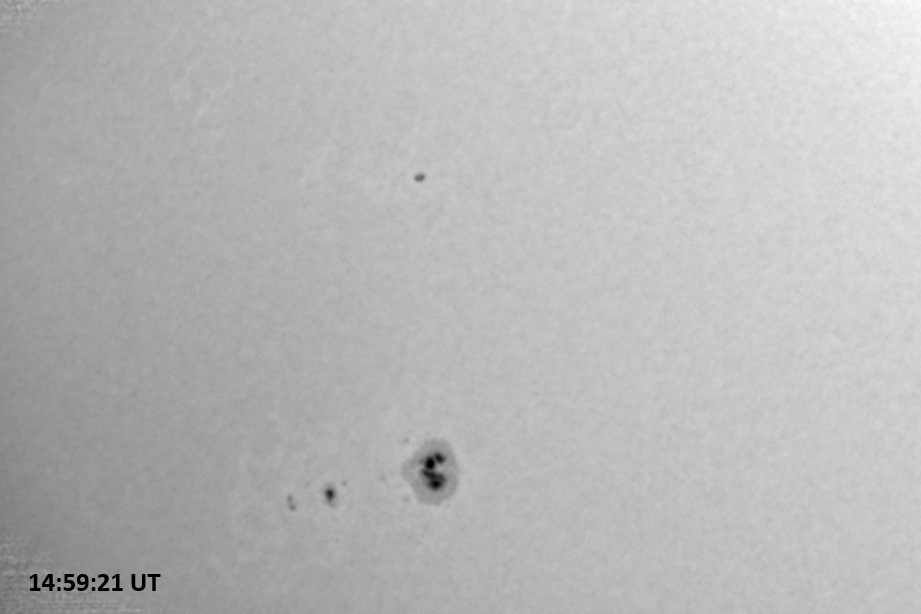 AR 14482 (bottom) and 14487 (top) as seen in red continuum imaging. AR 14482 (bottom) and 14487 (top) as seen in red continuum imaging. |
 AR 14482 has been the most active spot group on the visible disk today. AR 14482 has been the most active spot group on the visible disk today. |
 AR 14485 has added some spots and has grown some since yesterday. AR 14485 has added some spots and has grown some since yesterday. |
 AR 14485 is seen with at least three filaments. AR 14485 is seen with at least three filaments. |
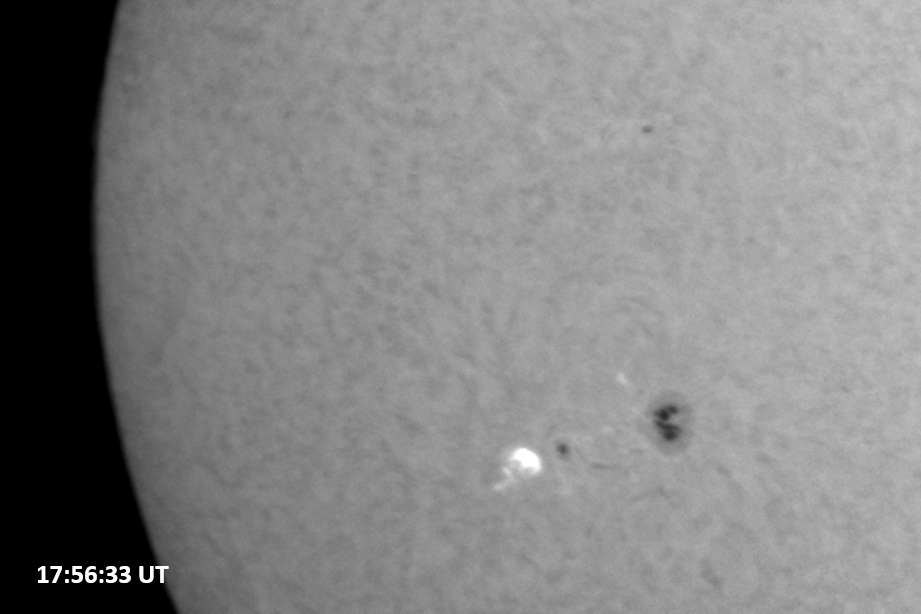
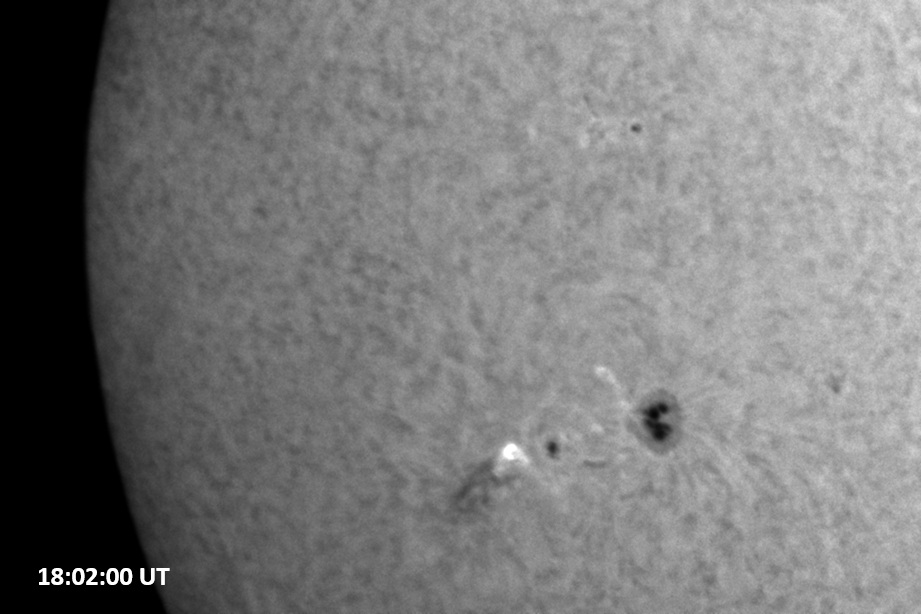
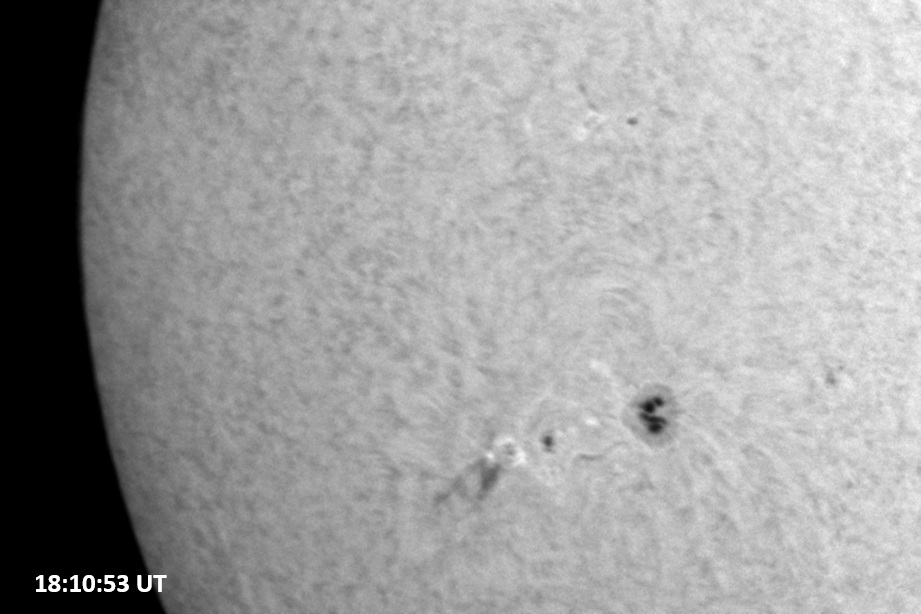
Four images from the image sequence of the M4.0 flare. Each H-alpha image is 0.15 second exposure.
 The very start of the X-ray flare. A short, dark filament is visible left of the smaller secondary spot. The very start of the X-ray flare. A short, dark filament is visible left of the smaller secondary spot. |
 This filament erupts and quickly brightens, reaching peak X-ray intensity near the time of this image. This filament erupts and quickly brightens, reaching peak X-ray intensity near the time of this image. |
 During the decay phase of the event, a dark surge of material is visible, which is cooler plasma seen in absorption. During the decay phase of the event, a dark surge of material is visible, which is cooler plasma seen in absorption. |
 Near the end of the event, some filaments of the cooler ejected material are still present. Near the end of the event, some filaments of the cooler ejected material are still present. |
Solar activity is expected to be low to moderate through 10 July. There is a high chance of M-class flares and a slight chance of an X-class flare during this period because of the nature of AR 14482.
July 7, 2026
Solar activity returned to moderate levels this morning with an impulsive M4.0 flare from AR 14482 at 14:19 UT. We were in the middle of the red continuum sequence when this occurred but were able to get some of the “debris” from the event from 12 to 30 minutes post event. The flare curve shows a hump, which may be a second flare from another region due north of the main AR. The hump peaked at C5.3 at 14:30 UT. Since this event, the X-ray flux has been steadily decreasing, dropping into the “B” range by 17:15 UT.
Prior to this, there were two C1 events, one at 3:40 UT from AR 14478 on the solar limb, and a second at 12:12 UT from an unspecified location. For much of the day yesterday, only low-level C-class events took place, mainly events from just behind the west limb of the Sun, along with occasional flares from AR 14482. There are currently three numbered spotted active regions and two unnumbered regions that have just emerged. AR 14482 had grown over the last two days, in terms of size, length, and spot number. AR 14485 is displaying some new flux emergence, appearing as a small cluster of tiny dark spots.
The first column below includes red continuum images, each 0.09 sec exposure; and the second column hosts H-alpha line center images, each 0.15 sec exposure and enhanced slightly to bring out detail. Each of the images covers 7.8’x11.4′ on the sky, unless otherwise indicated. Celestial north is up, west is right in each image.
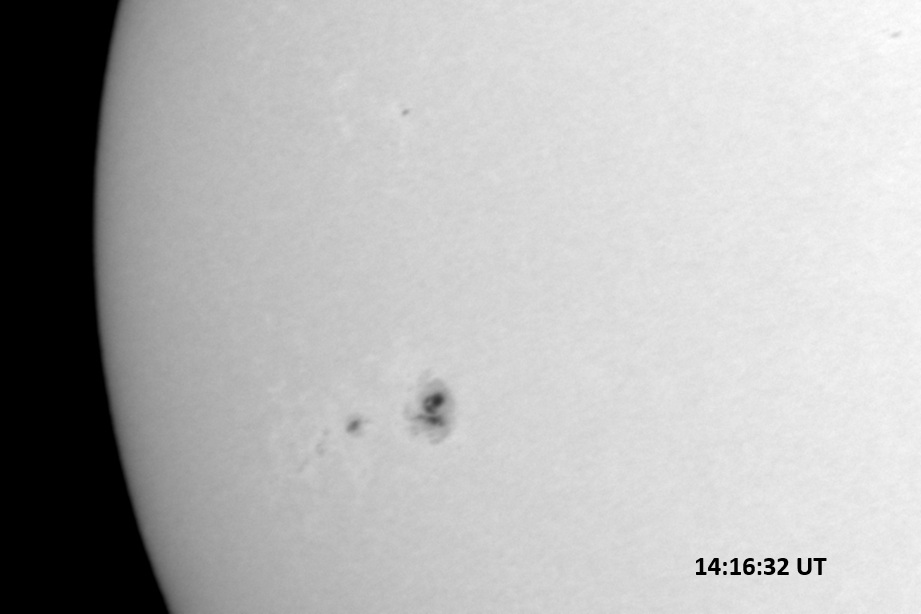 AR 14482 (bottom center) and an undesignated spot (top center). AR 14482 (bottom center) and an undesignated spot (top center). |
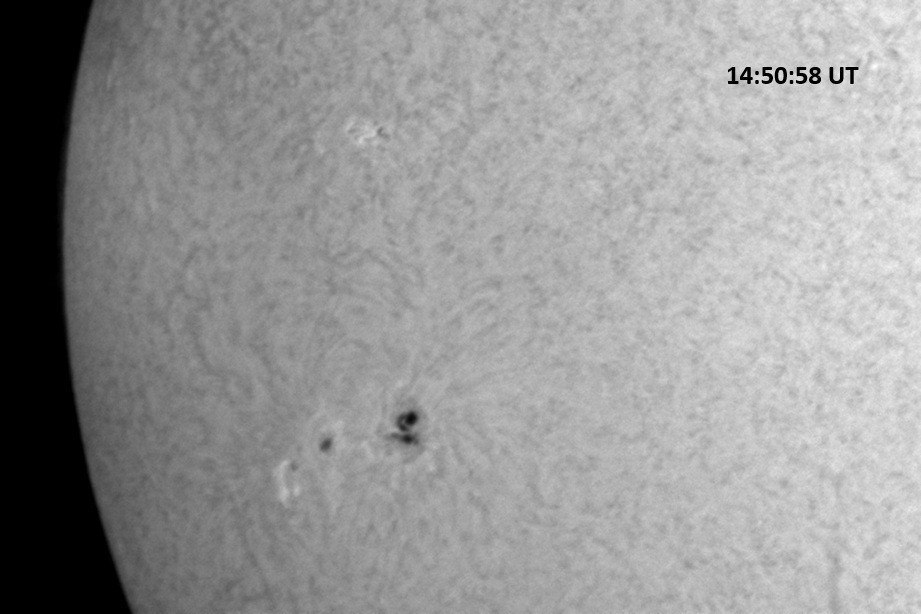 AR 14482 after the M4.0 event of 31 minutes prior to this image. AR 14482 after the M4.0 event of 31 minutes prior to this image. |
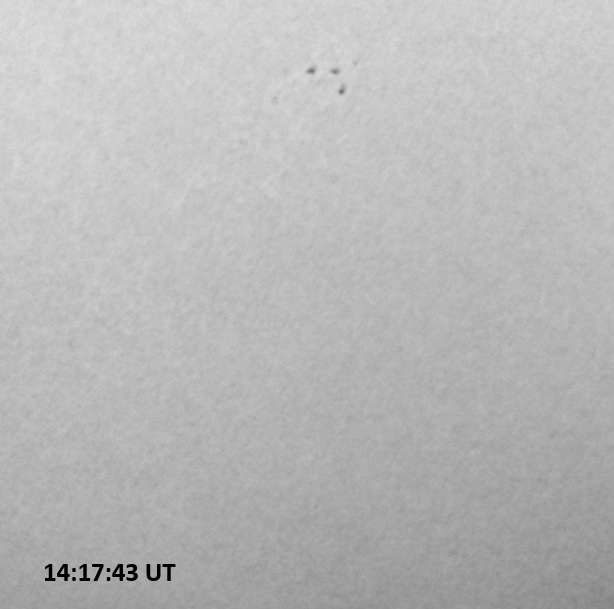 A frame from the mosaic sequence shows AR 14485 near top center. It seems to be growing slowly. This image covers 7.8’x7.8′. A frame from the mosaic sequence shows AR 14485 near top center. It seems to be growing slowly. This image covers 7.8’x7.8′. |
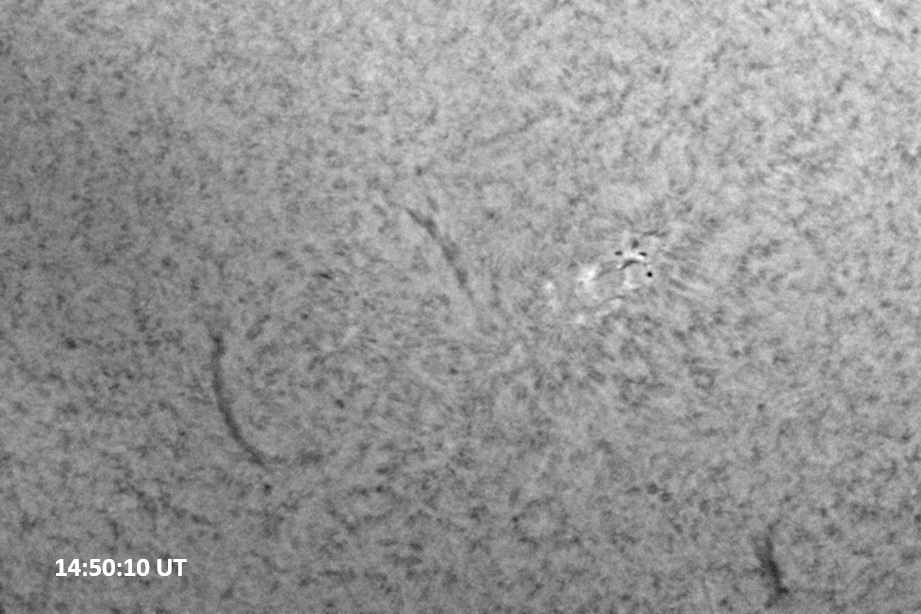 AR 14485 (right of center), accompanied by at least three filaments. The bright plage (bright spots) indicate this region is in growth phase. AR 14485 (right of center), accompanied by at least three filaments. The bright plage (bright spots) indicate this region is in growth phase. |
Solar activity is expected to be low to moderate through 9 July. The overall trend is decreasing activity overall as ARs 14478 and 14479 continue to move further beyond the western limb.
July 6, 2026
Solar activity had been high for the three days prior to today (that is 3, 4, and 5 July). There were some 25 M-class flares and 1 X-class flare during this period. Nearly all of these came from AR 14479 as it rotated out of view. There were five M-class flares yesterday alone, the most recent being 21:22 UT, 5 July, but today, solar activity has dropped back to low levels. There was an X1.3 at 20:40 UT on 4 July from newly revealed AR 14482. Yesterday’s (and today’s through 21:00 UT) largest was an M5.3 at 17:57 UT, 5 July, from AR 14479 as it crossed over the western limb. The M1.4 event at 16:45 UT on 5 July had a CME that launched off the WNW limb of the Sun. AR 14478 and 14482 have produced low-level C-class flares yesterday, but, aside from a couple recent low-level C-class flares, AR 14482 has become quiet today. The only reported flares for today, so far, came from AR 14479. AR 14482 is the only active region to show growth, while the rest of the visible active regions remained the same or decayed slightly.
The first column below includes red continuum images, each 0.09 sec exposure; and the second column hosts H-alpha line center images, each 0.15 sec exposure and enhanced slightly to bring out detail. Each of the images covers 7.8’x7.8′ on the sky, unless otherwise indicated. Celestial north is up, west is right in each image.
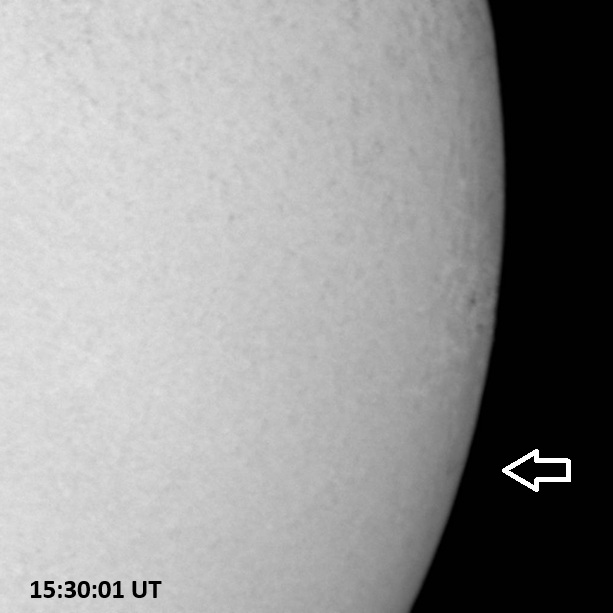 AR 14478 rotating out of view (center near curved edge). The arrow approximately indicates where AR 14480 rotated out of view. AR 14478 rotating out of view (center near curved edge). The arrow approximately indicates where AR 14480 rotated out of view. |
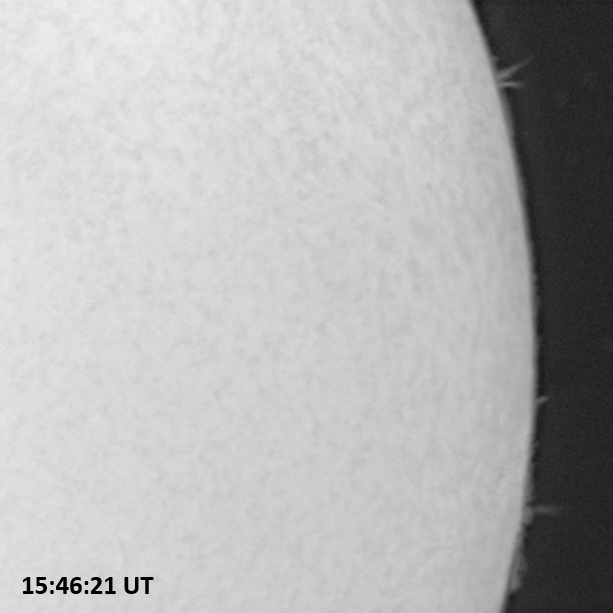 Watching the spikes and other limb activity reveals what is going on with otherwise invisible active regions. AR 14478 is near the bottom, and the “V” shaped structure near top is likely from AR 14479. Watching the spikes and other limb activity reveals what is going on with otherwise invisible active regions. AR 14478 is near the bottom, and the “V” shaped structure near top is likely from AR 14479. |
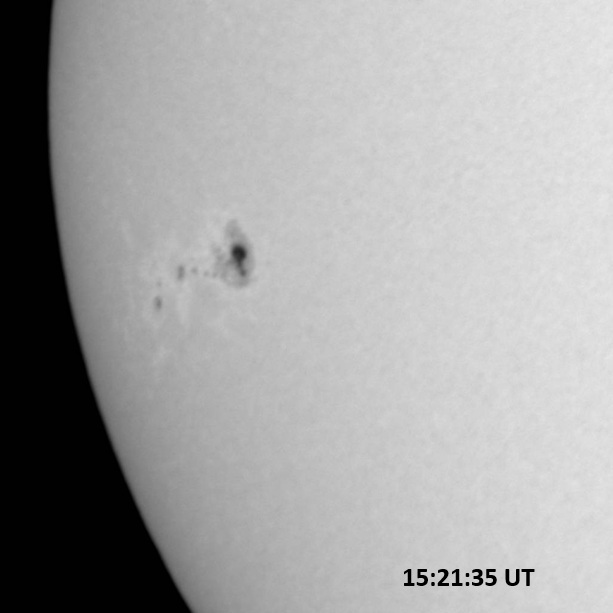 AR 14482 rotates into better view. AR 14482 rotates into better view. |
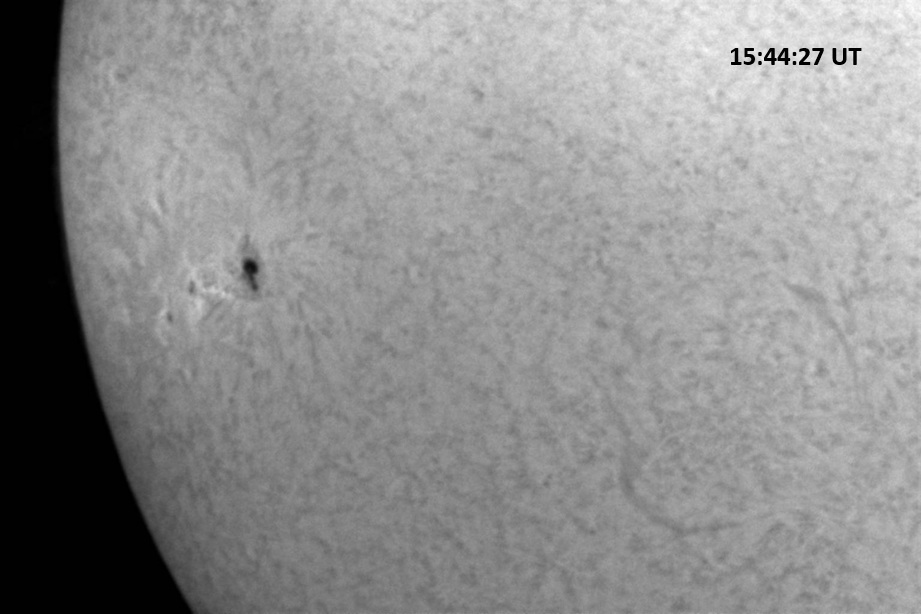 AR 14482 is the only significant active region in this part of the Sun. There are at least two filaments visible in the right half of the image, which covers 7.8’x11.4′ on the sky. AR 14482 is the only significant active region in this part of the Sun. There are at least two filaments visible in the right half of the image, which covers 7.8’x11.4′ on the sky. |
Solar activity is expected to remain moderate with a slight chance for X-class flares, through 7 July. Then on 8 July, activity is expected to drop to low levels with a slight chance for an M-class flare, as AR’s 14478, 14479, and 14480 rotate further behind the Sun.
July 2, 2026
Solar activity returned to moderate levels after being at elevated levels yesterday going into today with a series of M-class flares, The majority of these came from AR 14479, which also produced the largest flare yesterday (and today so far, as of 21:00 UT, 2 July), an M8.7 at 23:09 UT on 1 July. There was a long duration M4.2 flare from AR 14479 today at 1:56 UT, which produced a coronal mass ejection (CME), observed in satellite imagery around 2:36 UT today. There was another CME that was observed by satellite starting at 14:00 UTC yesterday, 1 July, which came from an M1.3 flare at 10:08 UT, 1 July. The later CME will catch up with the earlier CME and both are estimated to arrive on late 5 July or early 6 July.
The first column below includes red continuum images, each 0.09 sec exposure; and the second column hosts H-alpha line center images, each 0.15 sec exposure and enhanced slightly to bring out detail. Each of the images covers 7.8’x11.4′ on the sky. Celestial north is up, west is right in each image.
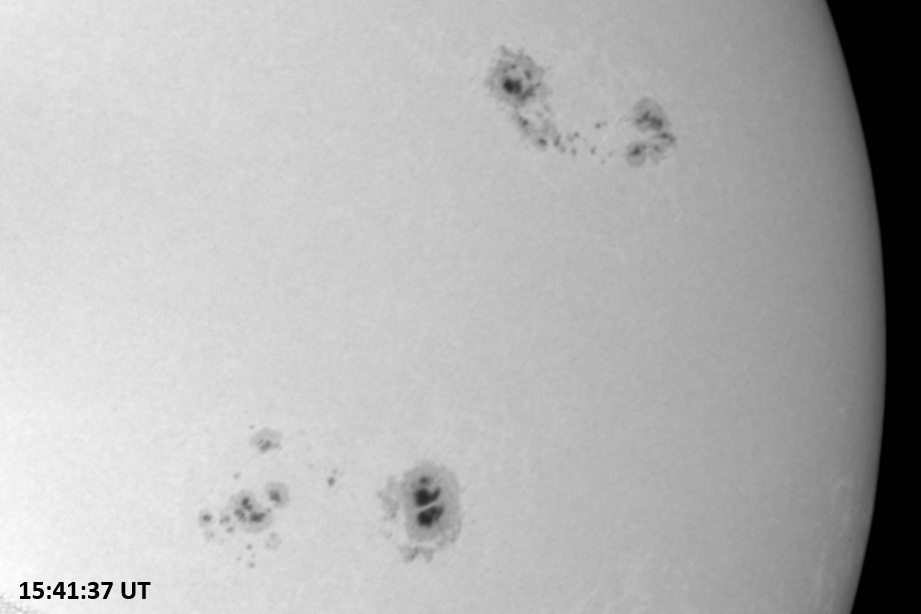 AR 14478 (lower left) and 14479 (upper right) start to approach the western solar limb. There are no visible spots east of these regions. AR 14478 (lower left) and 14479 (upper right) start to approach the western solar limb. There are no visible spots east of these regions. |
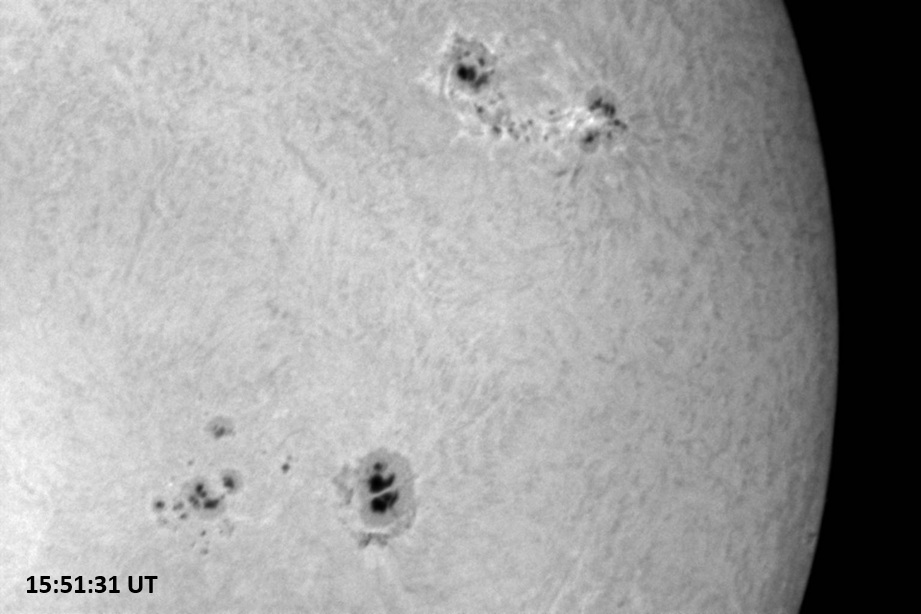 AR 14478 continues to be quiet, and AR 14479 has quieted down since yesterday’s activity. AR 14478 continues to be quiet, and AR 14479 has quieted down since yesterday’s activity. |
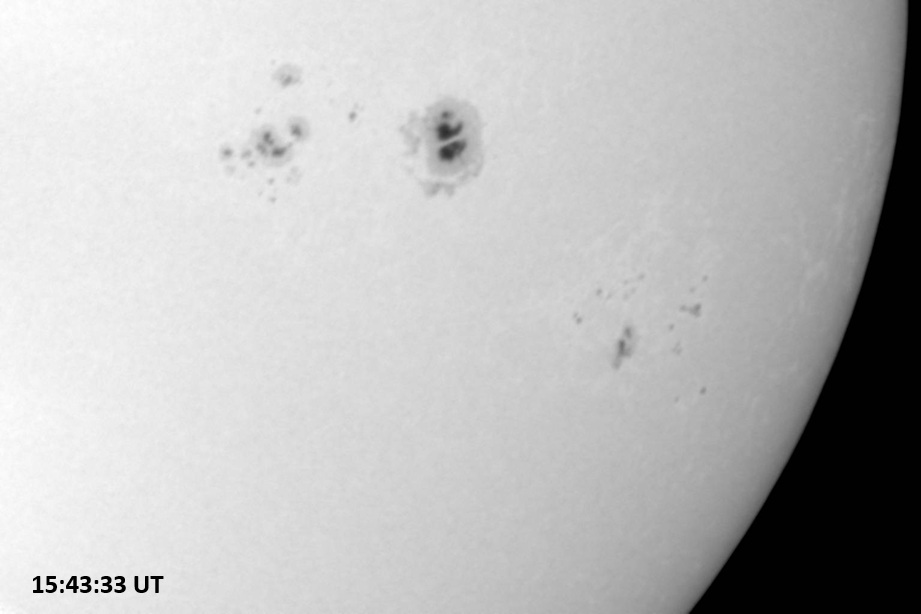 AR 14478 (top center) and 14480 (lower right) approach the western limb. AR 14478 (top center) and 14480 (lower right) approach the western limb. |
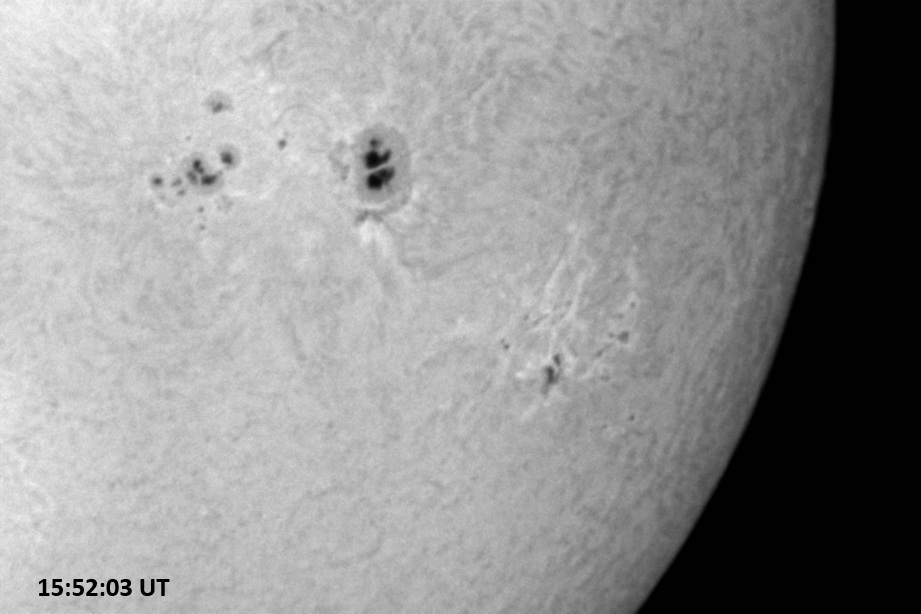 This part of the Sun has been quiet all day, with little activity. This part of the Sun has been quiet all day, with little activity. |
Solar activity is likely to remain moderate with a slight chance for X-class flares, through 4 July.
July 1, 2026
Solar activity increased to high levels and it maintained a high level of activity throughout the day today. AR 14479 produced an X1.1 flare yesterday, 30 June, at 20:50 UT (see image just below). In addition, the region produced seven M-class flares today, with the largest being an M2.6 at 14:54 UT. There was an M3.5 at 19:43 which may be attributed to AR 14479, but the X-ray background was buoyed up by a decaying flare event at 14480, which peaked at M1.3 at 19:17 before continuing to rise due to the AR 14479 event. Then AR 14479 generated the eighth M-class flare at 20:22 UT, an M1.8. We are following as much of this as we can from the Solar Observatory
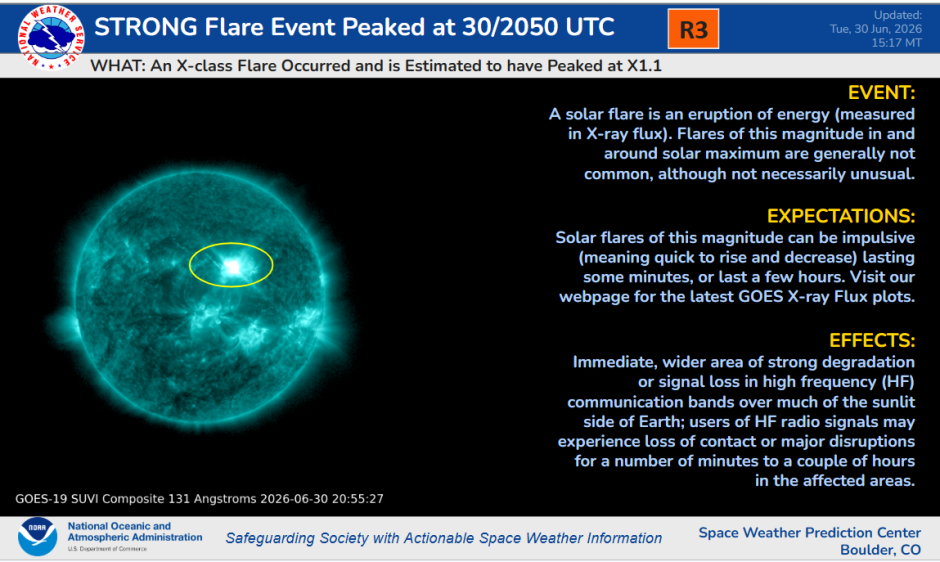
AR 14478 produced a C9.1 flare at 19:58 UT on 30 June, and has not been very active either yesterday or today. It only produced a C7.6 today at 4:56 UT, then five optical subflares. ARs 14475, 14478, and 14479 appear to be in growth phase; AR 14480 seems to have grown some today as well. This region produced the M1 flare mentioned above, along with a handful of sub-flares. The X1 flare event launched a full halo CME, first seen in satellite imagery at 21:45 UT on 30 June. It is expected to impact Earth 3-4 July.
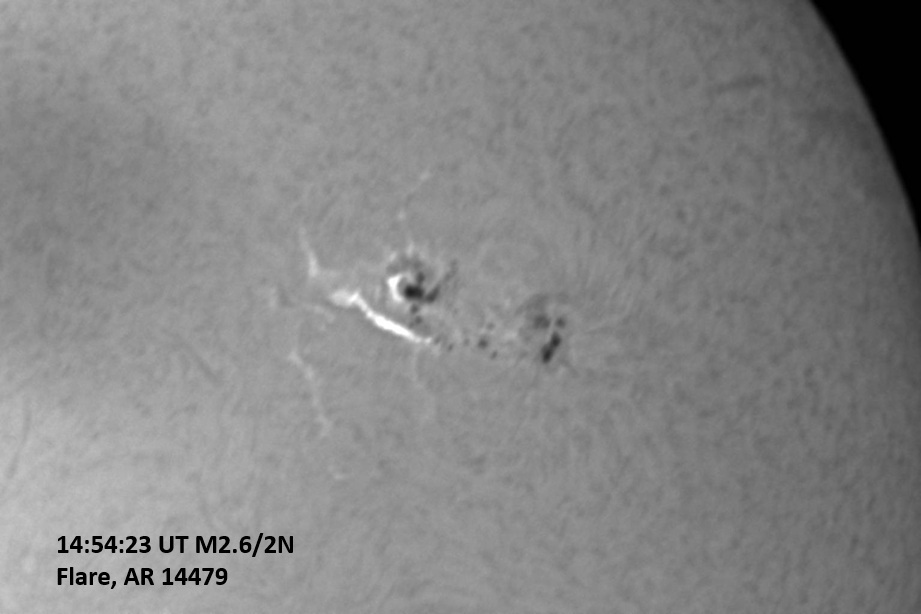
The first column below includes red continuum images, each 0.09 sec exposure; and the second column hosts H-alpha line center images, each 0.15 sec exposure and enhanced slightly to bring out detail. Each of the images covers 7.8’x11.4′ on the sky. Celestial north is up, west is right in each image.
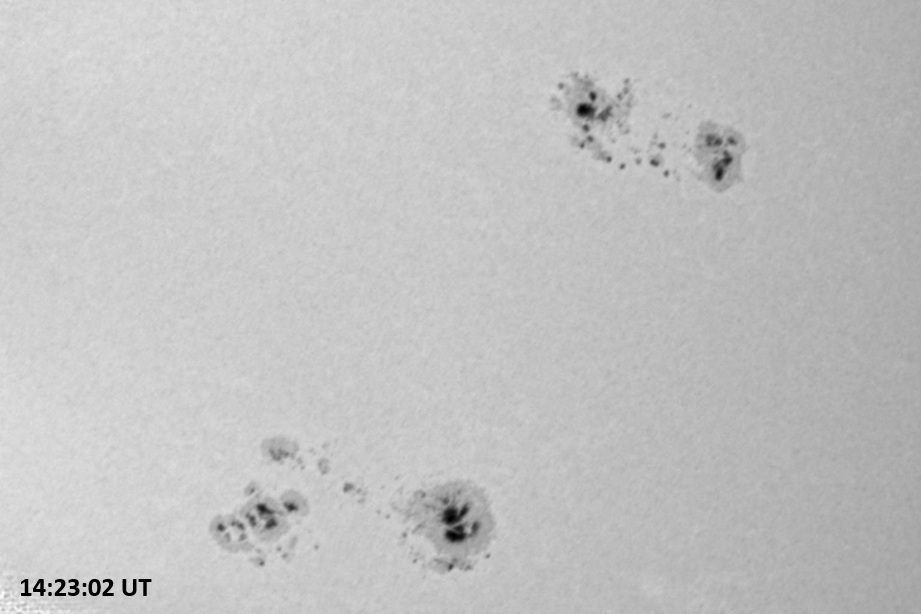 AR 14478 (bottom) and 14479 (top) are both visible to the protected, unaided eye, they are so large. AR 14478 (bottom) and 14479 (top) are both visible to the protected, unaided eye, they are so large. |
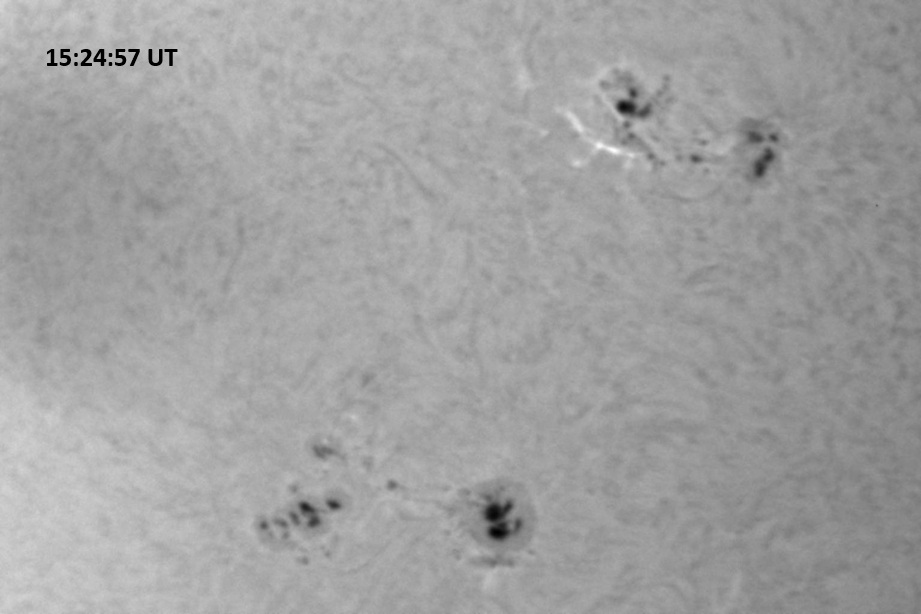 AR 14478 has been mostly quiet, and 14479 has been mostly active, with the “afterglow” of the M2 flare visible. AR 14478 has been mostly quiet, and 14479 has been mostly active, with the “afterglow” of the M2 flare visible. |
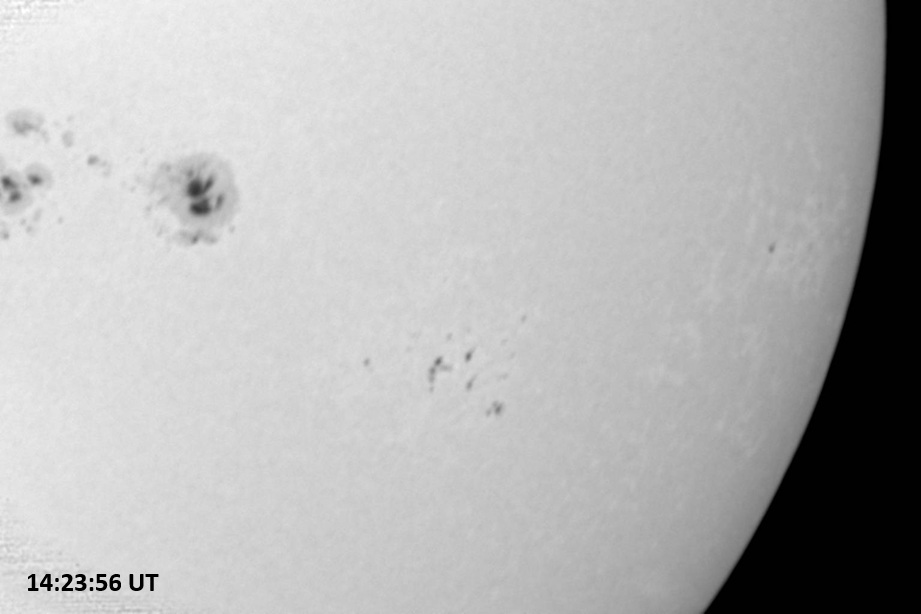 AR 14478 (left), 14480 (below image center) and 14475 (right edge). AR 14478 (left), 14480 (below image center) and 14475 (right edge). |
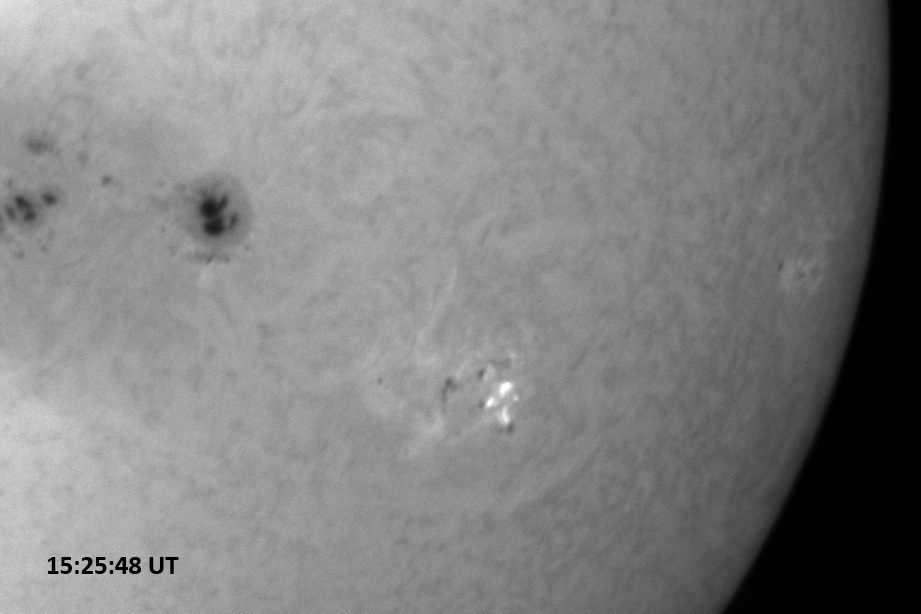 AR 14480 in the middle of an M1.1 event (the X-ray flux elevated by a simultaneous event at AR 14479). AR 14480 in the middle of an M1.1 event (the X-ray flux elevated by a simultaneous event at AR 14479). |
Solar activity is likely to remain moderate with a slight chance for X-class flares through 3 July. This is due to the flare potential of Active Regions 14475, 14478, and 14479.
June 30, 2026
Solar activity increased to moderate levels with an M1.4 flare at 21:40 UT yesterday, 29 June, from AR 14479. This region grew rapidly, but has still been sparse on its flare production otherwise. It produced four optical sub-flares today and a C5.0 flare, observed at PVSO at 17:26 UT. AR 14475 grew some more and produced an M1.3 flare at 1:16 UT today, 30 June. It, along with AR 14478 and 14479, combined to produce an M5.8 flare at 12:57 UT today (see graphic immediately below from spaceweather.gov).
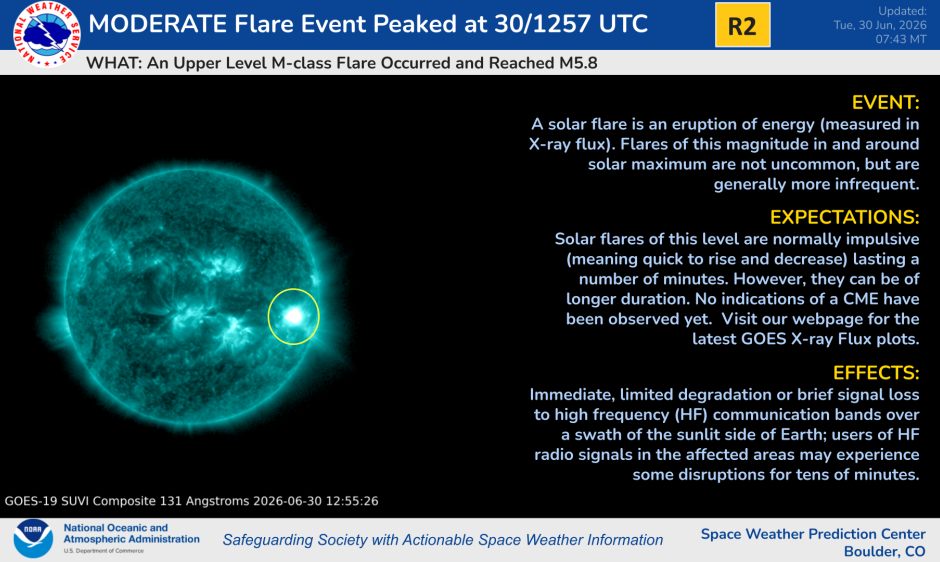
AR 14475 contributed most of the flaring activities today, including a C4.9 at 18:48 UT; AR’s 14477, 14478, 14479, and 14480 also contributed flares. So all five of the visible spotted active regions were active to an extent today. The filament disappearance that we observed yesterday from AR 14475 during a C3.5 flare at 17:30 UT had not (yet) produced a coronal mass ejection. At 19:55 UT today, AR 14475 produced another C-flare, at C6.2; while this was underway, AR 14478 flared a bit in its leading region, boosting the X-ray to C9.1 at 19:58 UT before coming down rapidly again.
Solar activity returned to high levels this afternoon with an X1.1 from AR 14479 at 20:50 UT (observation was not possible here due to the many rain showers that have popped up around our location). It occurred at the same location as the C5 that we observed earlier today.
East of the AR 14478/14479 pair, the solar disk is completely blank, and with each passing day, the solar rotation carries these toward the western solar limb, giving the impression that the Sun is clearing itself of spots. We observed this on several occasions earlier in this solar cycle.
The first column below includes red continuum images, each 0.09 sec exposure; and the second column hosts H-alpha line center images, each 0.15 sec exposure and enhanced slightly to bring out detail. Each of the images covers 7.8’x11.4′ on the sky. Celestial north is up, west is right in each image.
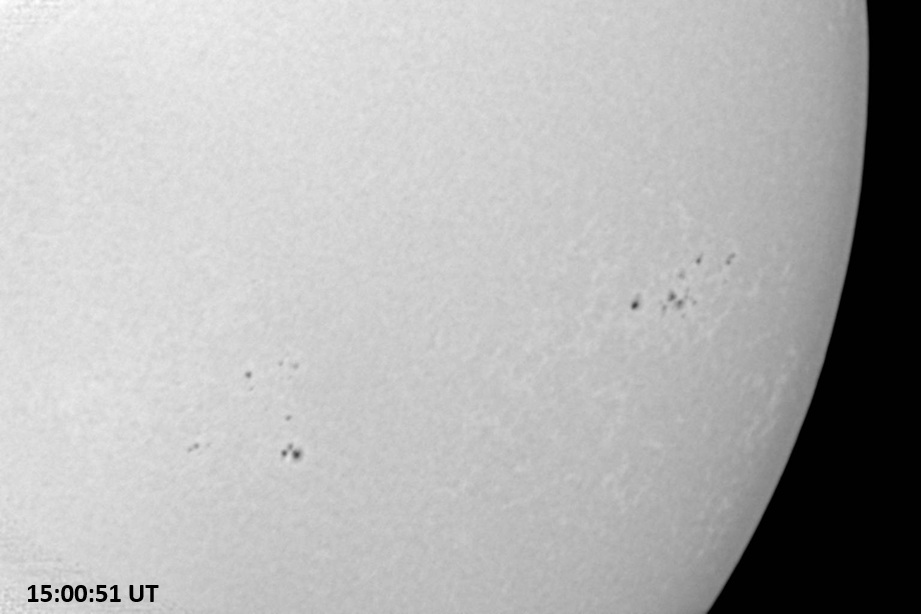 AR 14475 is the cluster of spots right of image center, AR 14480 is most of the spots below and left of image center, and AR 14477 is a single tiny spot left of image center. AR 14475 is the cluster of spots right of image center, AR 14480 is most of the spots below and left of image center, and AR 14477 is a single tiny spot left of image center. |
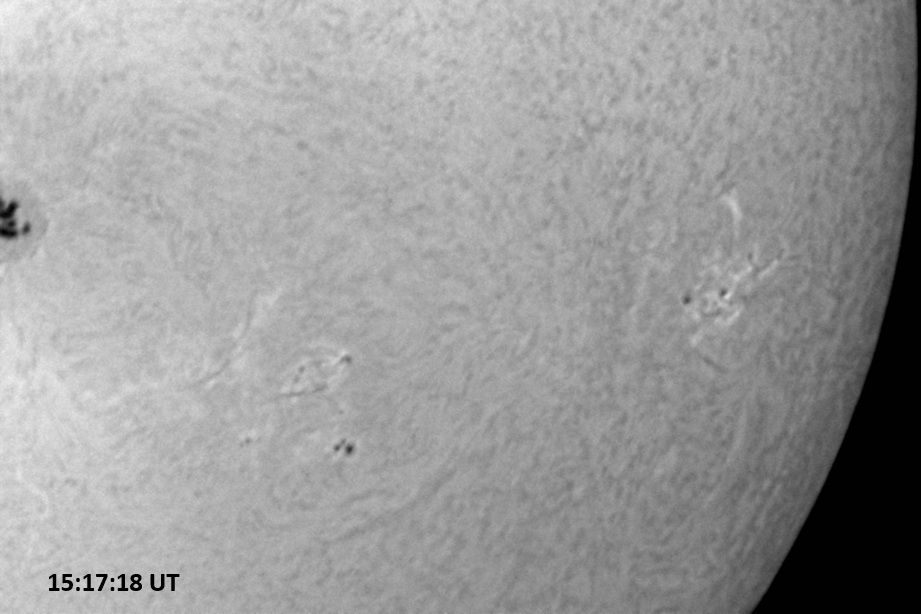 In spite of the unremarkable appearance of this zone of the Sun, it has been the most active over the last two days or so. AR 14478 begins to edge into the image (left edge) In spite of the unremarkable appearance of this zone of the Sun, it has been the most active over the last two days or so. AR 14478 begins to edge into the image (left edge) |
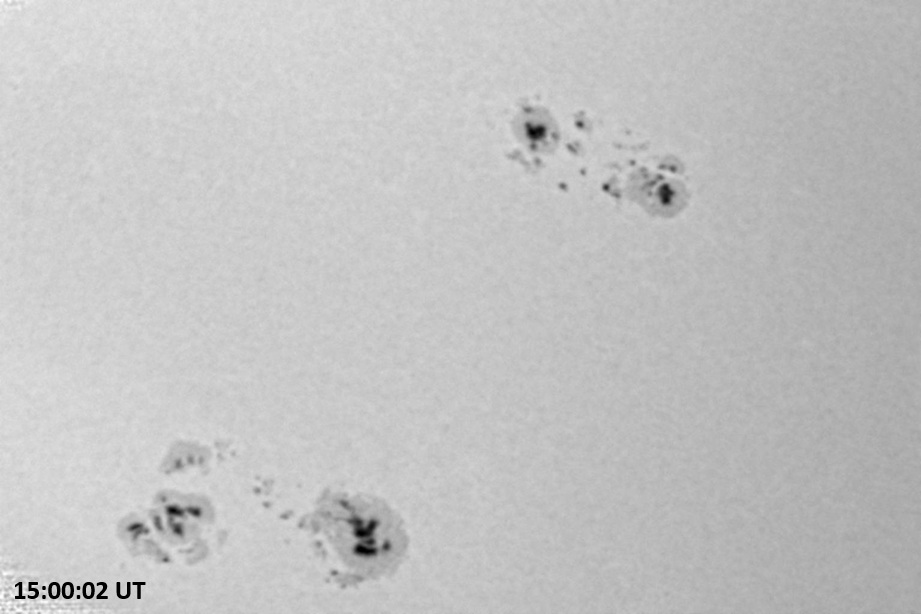 AR 14478 (lower left) and 14479 (upper right) are the two largest spot groups on the solar disk, at 1300 and 480 MSH, respectively. AR 14478 (lower left) and 14479 (upper right) are the two largest spot groups on the solar disk, at 1300 and 480 MSH, respectively. |
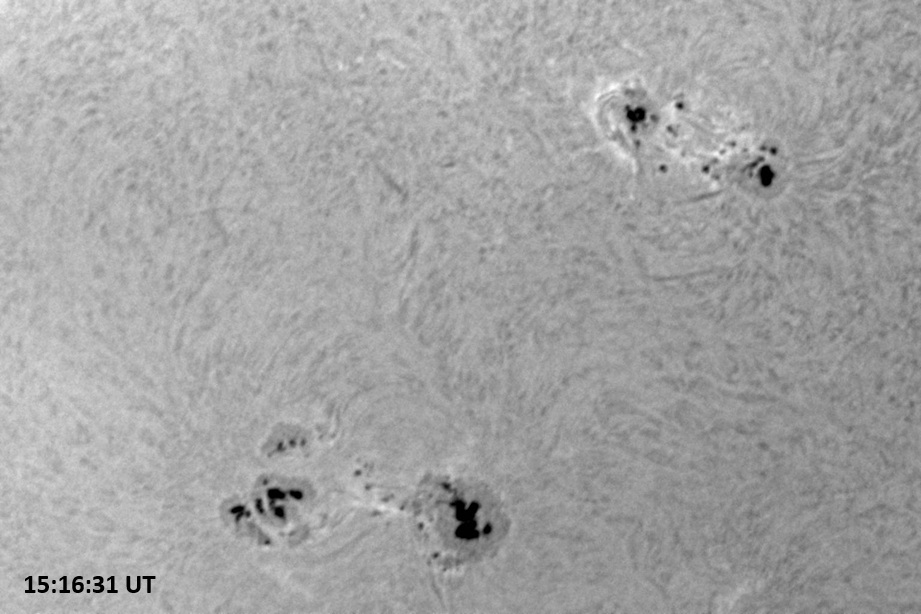 In spite of their impressive sizes and appearances, these regions have been mostly quiet all day. In spite of their impressive sizes and appearances, these regions have been mostly quiet all day. |
The following two images are the two flares observed during today’s session. Each image is in H-alpha and is a 0.15 second exposure with celestial north up, east left.
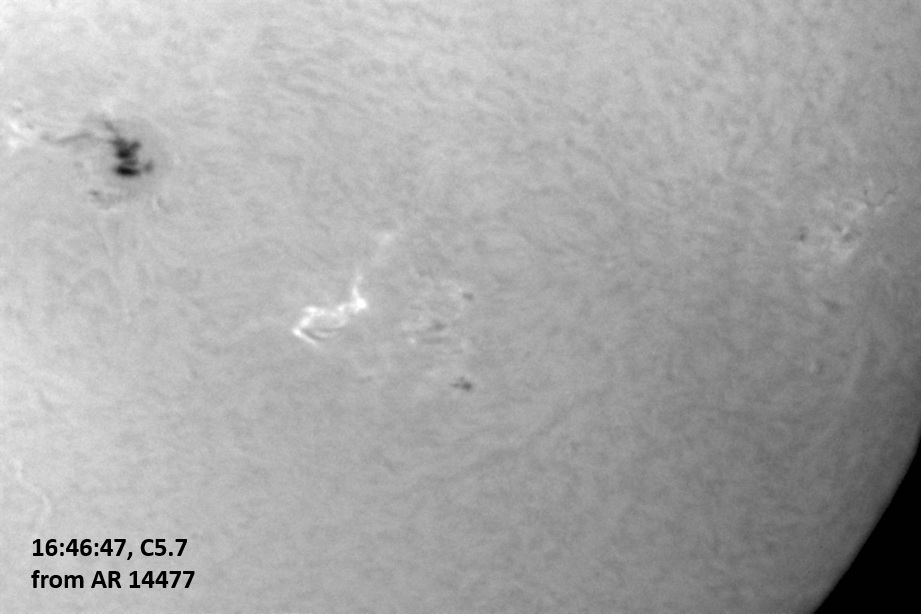 |
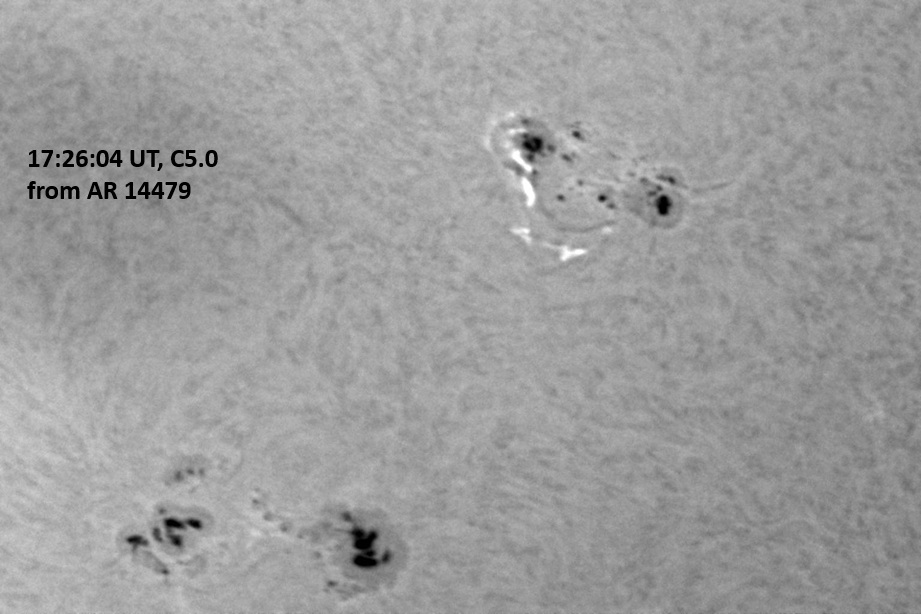 |
| Flare from AR 14477, a single-spotted active region that has nearly completely decayed to plage. | Flare from AR 14479. This was one of a handful of such small flares produced by this large active region |
Solar activity is expected to increase to moderate levels, with isolated M-class flares likely, and a slight chance for X-class flares, through 2 July.
June 29, 2026
Solar activity remains at low levels, despite the impressive appearance of two large spot groups, AR 14478 and 14479, each with complex magnetic configurations. AR 14475 produced a C9.5 at 21:17 UTC on 28 June, the largest since at least 23 June and the largest of yesterday and today (so far, through 21:15 UT). It also produced a C3.0 at 2:50 UT today and a C6.2 at 18:19 UT today. AR 14478 only produced a C4.1 flare at 3:40 UT today, 29 June. AR 14479 developed significantly over the last two days and produced many flares, including a C8.7 at 21:59 UT on 28 June, a C6.5/SF at 7:58 UT today, a C8.1/SF at 8:28 UT, and a long-duration C4.1 at 17:40 UTC today. This last event was observed during today’s session and was associated with an active region filament eruption or disappearance. AR 14479 also produced many low- and mid-level C-class flares over the last two days.
The other regions on the visible solar disk (there are five total) were inactive as they decayed.
The first column below includes red continuum images, each 0.15 sec exposure (due to haze); and the second column hosts H-alpha line center images, each 0.25 sec exposure (more haze) and enhanced slightly to bring out detail. Each of the images covers 7.8’x11.4′ on the sky. Celestial north is up, west is right in each image.
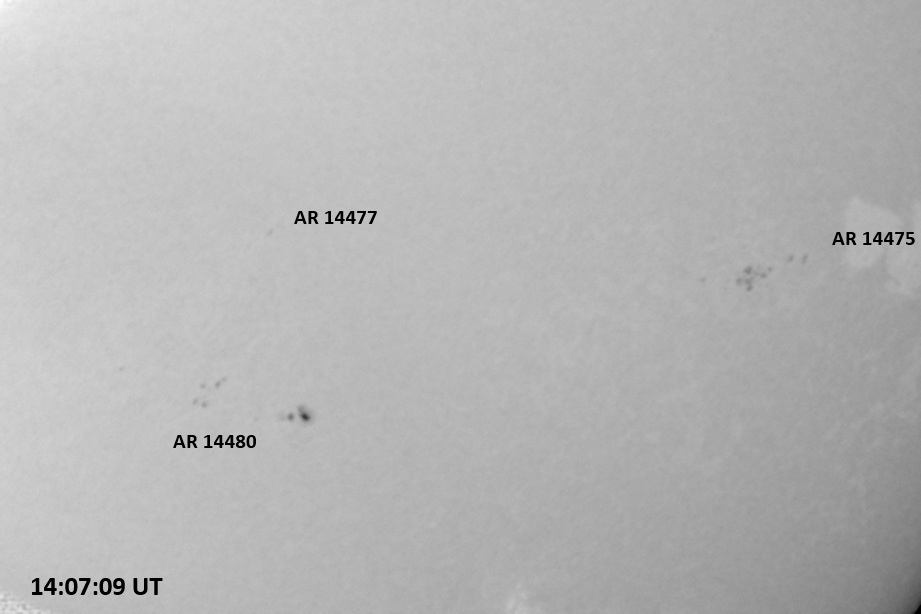 AR 14475 (right) developed significantly over the weekend but has since decayed considerably. AR 14475 (right) developed significantly over the weekend but has since decayed considerably. |
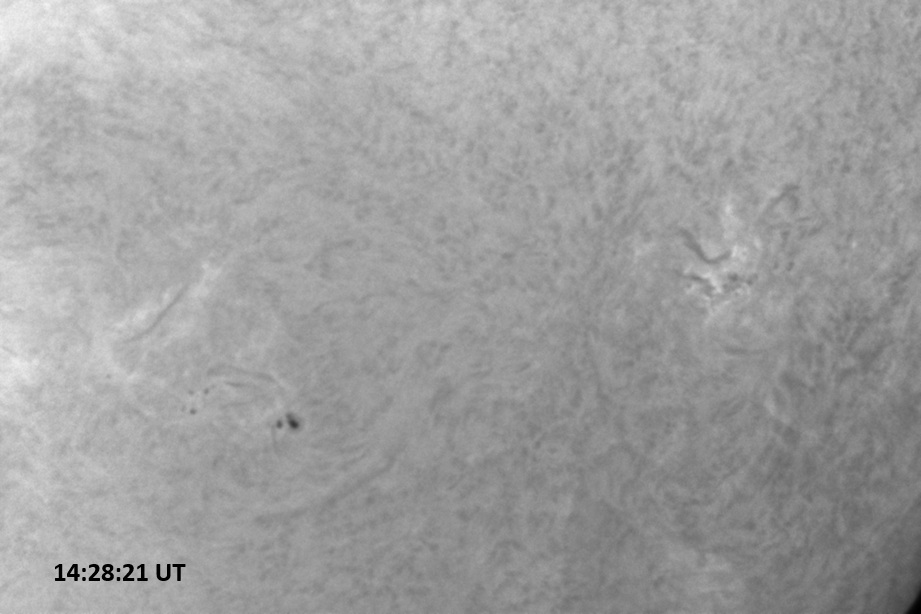 Aside from the C1 observed today and a few optical sub-flares, this part of the Sun was quiet. Aside from the C1 observed today and a few optical sub-flares, this part of the Sun was quiet. |
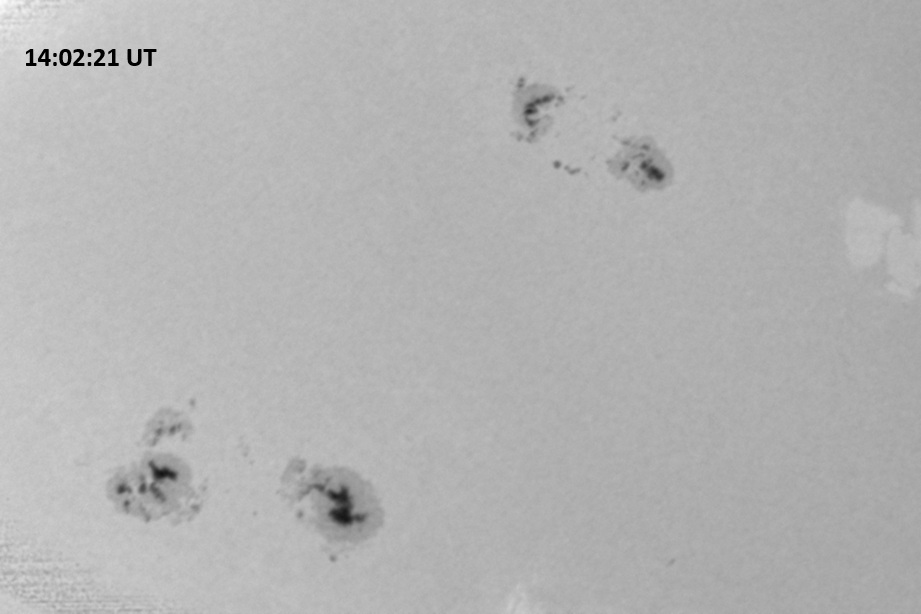 AR 14478 (lower left) is the largest region on the solar disk, at nearly 1200 MSH. AR 14479 is growing and is about half the size. The white spot at right is a processing artefact. AR 14478 (lower left) is the largest region on the solar disk, at nearly 1200 MSH. AR 14479 is growing and is about half the size. The white spot at right is a processing artefact. |
 One of the many C-class flares produced by AR 14479 (upper right) appear in this image. This region has been quite active the last two days. AR 14478 is the quiet giant here. One of the many C-class flares produced by AR 14479 (upper right) appear in this image. This region has been quite active the last two days. AR 14478 is the quiet giant here. |
Solar activity is expected to remain at low levels, with a likely chance for isolated M-class flares, and a slight chance for X-class flares, through 1 July.
June 25, 2026
Solar activity remained at low levels, with frequent C-class flares in the SE quadrant of the disk. The largest of these for both yesterday and today (through 23:15 UT) was a C6.6/1N at 15:03 UT from AR 14478. Most of these flares came from this region, but a few small C-class flares did come from AR 14475. AR 14472 and 14473 continue their decay. Neighboring region AR 14477 produced a C4.3 at 0:22 UT and a C2.4 at 15:27 UT (both today); and AR 14475 was the source of a C2.4 at 5:47 UT today. Aside from these, all the other C-class activity happening today came from AR 14478.
There was frequent high B-class and low C-class flare activity, mostly coming from the east limb. The largest of these (and the largest since the M6.9) was a C8.7 that was partially blocked by the solar disk. This occurred at 23:25 UT on 23 June. AR 14472 and 14473 decayed significantly, and AR 14470 is nearly spotless at present.
The first column below includes red continuum images, each 0.20 sec exposure (due to smoke); and the second column hosts H-alpha line center images, each 0.15 sec exposure (less smoke) and enhanced slightly to bring out detail. Each of the images covers 7.8’x11.4′ on the sky. Celestial north is up, west is right in each image.
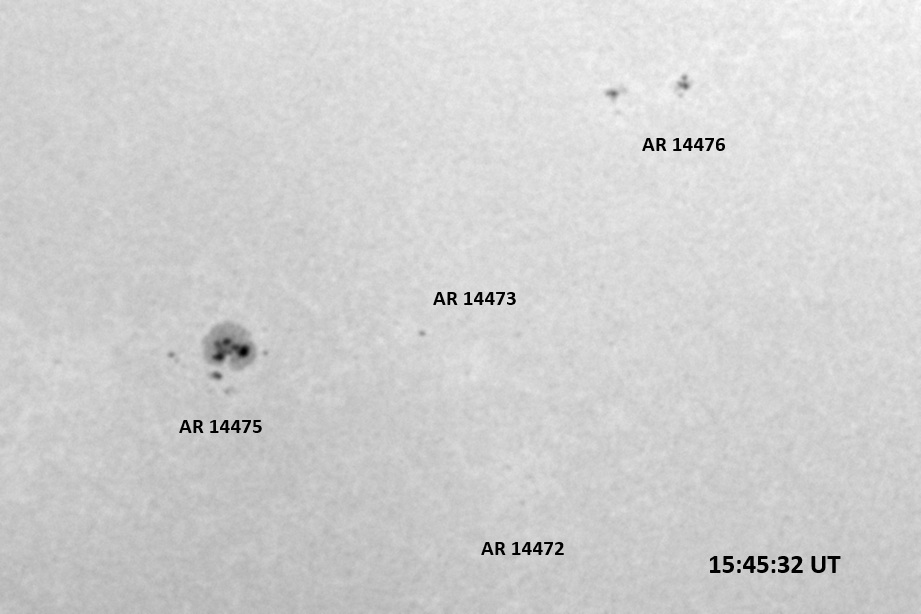 Four active regions (labeled), two of which are about to go spotless. Four active regions (labeled), two of which are about to go spotless. |
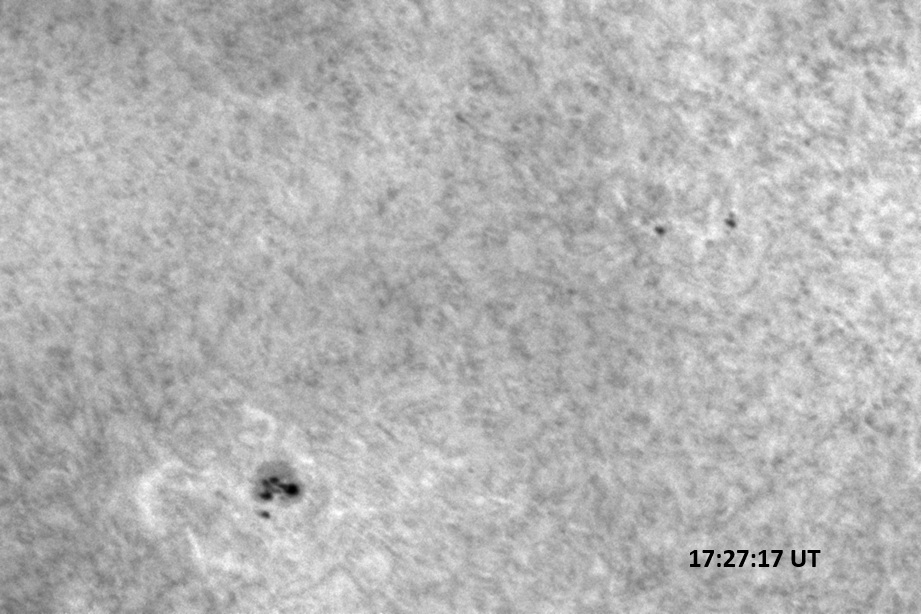 Aside from a flare from AR 14475, this area of the Sun has been quiet. Aside from a flare from AR 14475, this area of the Sun has been quiet. |
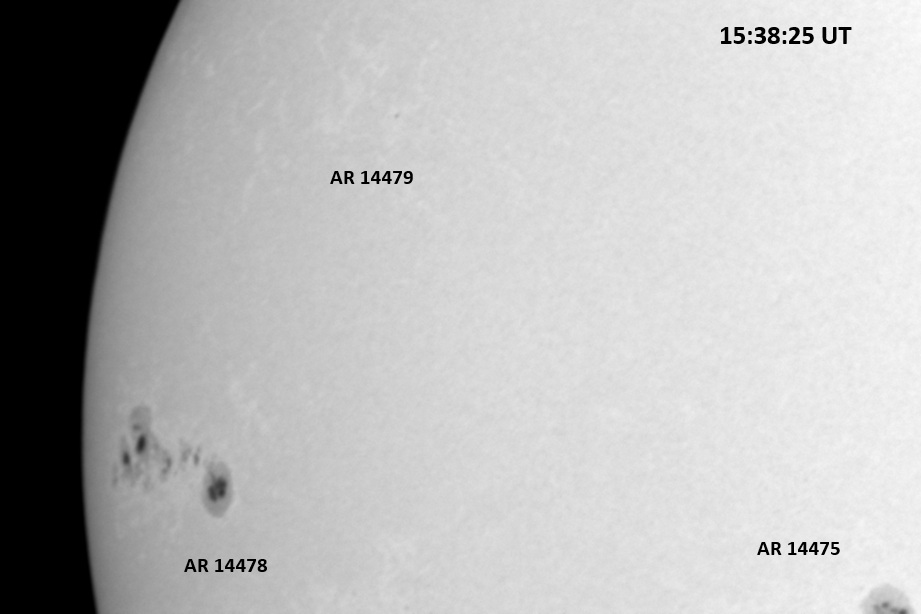 AR 14478 continues to rotate into better view. AR 14478 continues to rotate into better view. |
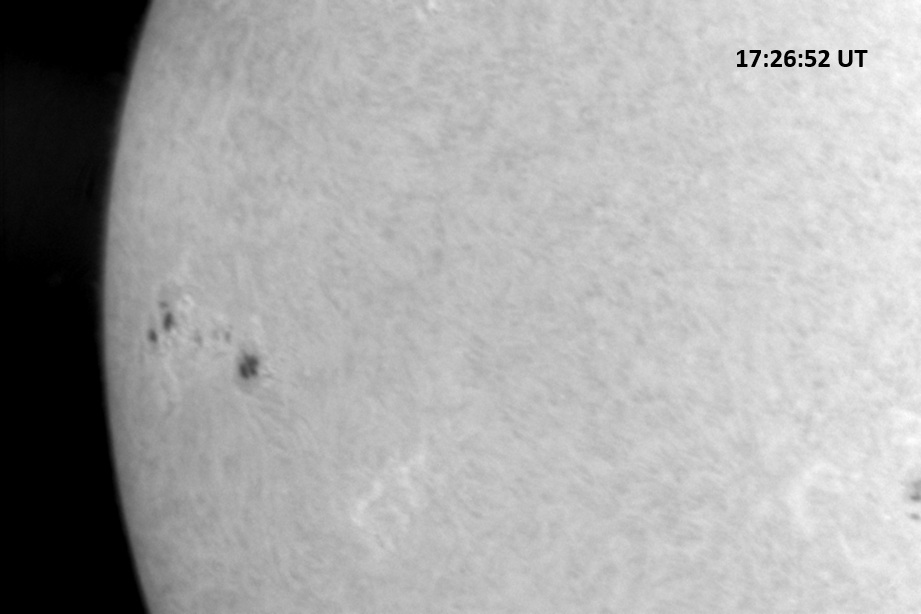 AR 14478 continues to be the most productive flare producer on the visible solar disk, but it has yet to produce a major one. AR 14478 continues to be the most productive flare producer on the visible solar disk, but it has yet to produce a major one. |
Solar activity is expected to remain at low levels, with a good chance for M-class flares, and a slight chance for X-class flares, through 27 June.
June 24, 2026
Solar activity returned to low levels. From 1:00 UT on 20 June through 21:00 UT on 21 June, it had reached moderate to high levels, with four M-class flares. The largest of these was an M6.9 at 19:29 UT, 21 June. All of these came from AR 14473, which had rotated onto the solar disk several days ago. An even larger active region, AR 14478, is rotating into view. This was monitored by far side imagery from the Solar Orbiter satellite.
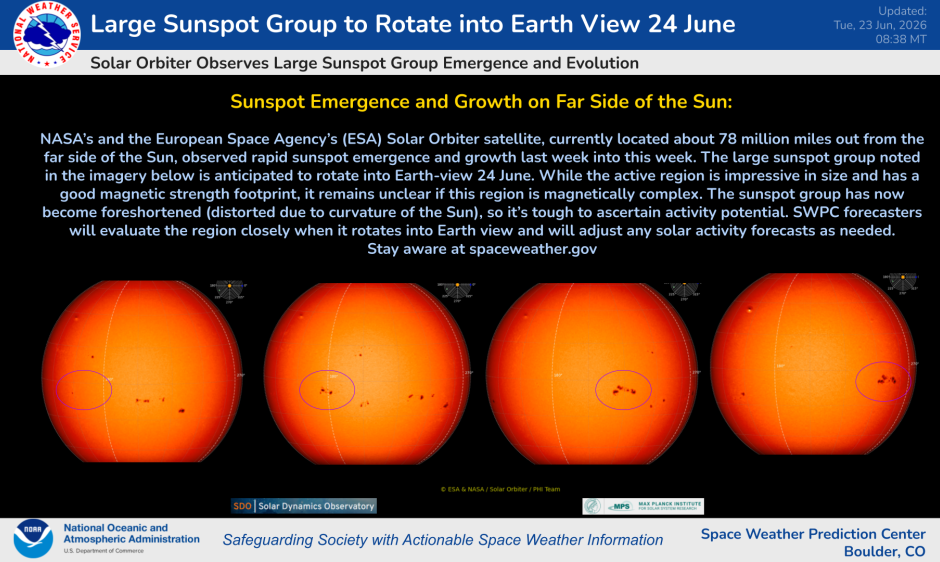
There was frequent high B-class and low C-class flare activity, mostly coming from the east limb. The largest of these (and the largest since the M6.9) was a C8.7 that was partially blocked by the solar disk. This occurred at 23:25 UT on 23 June. AR 14472 and 14473 decayed significantly, and AR 14470 is nearly spotless at present.
The first column below includes red continuum images, each 0.15 sec exposure; and the second column hosts H-alpha line center images, each 0.20 sec exposure and enhanced slightly to bring out detail. Each of the images covers 7.8’x11.4′ on the sky. Celestial north is up, west is right in each image.
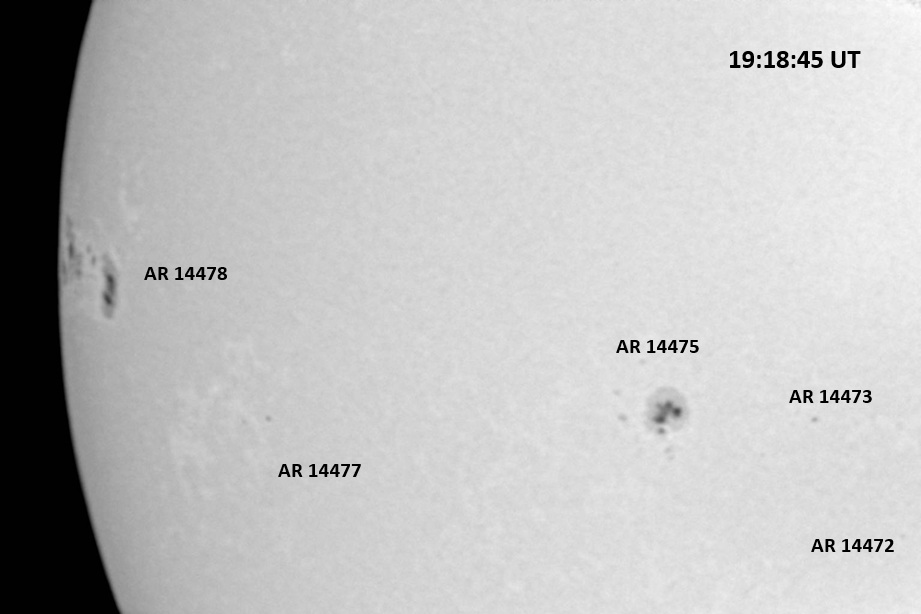 The large farside spot complex is rotating into view. The large farside spot complex is rotating into view. |
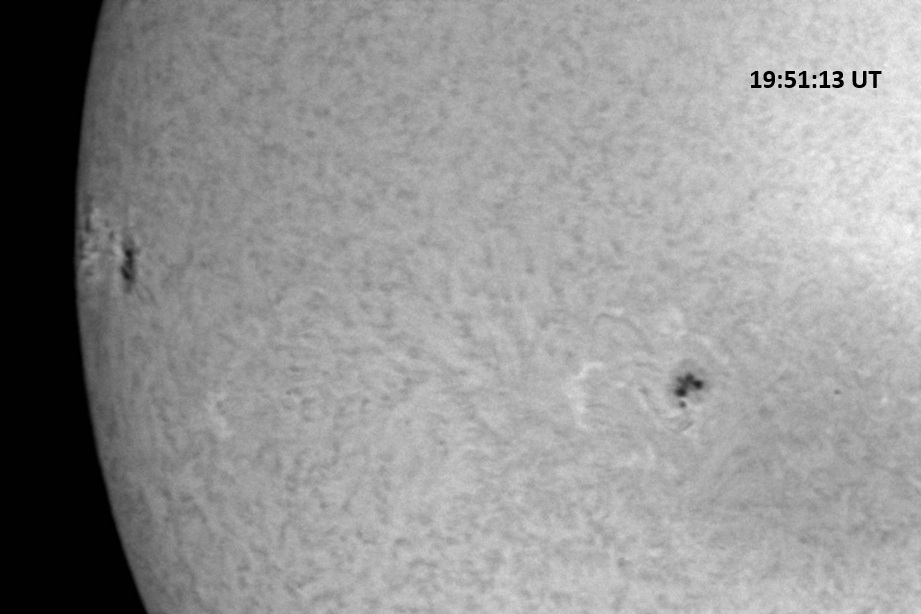 This zone of the Sun has largely been quiet, with several regions contributing to B- and C-class flaring. This zone of the Sun has largely been quiet, with several regions contributing to B- and C-class flaring. |
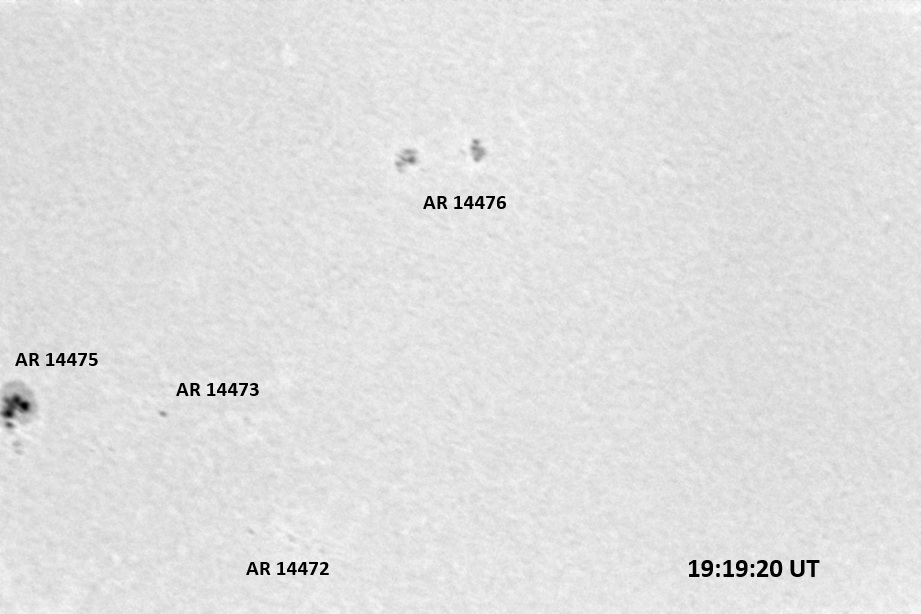 The zone near the center of the solar disk, with visible active regions labeled. The zone near the center of the solar disk, with visible active regions labeled. |
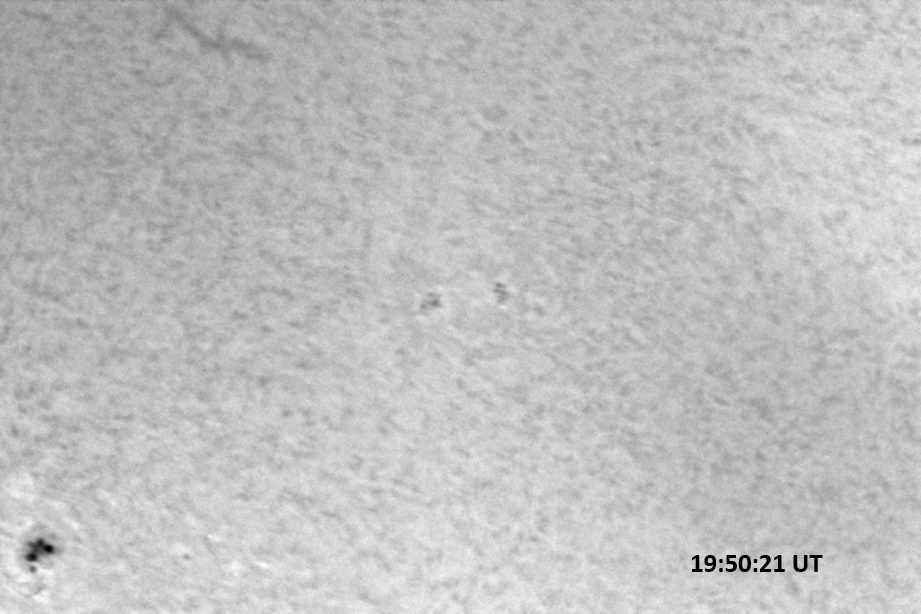 This zone of the Sun has been mainly quiet. AR 14475 (lower left) had produced more than half the reported flares so far. This zone of the Sun has been mainly quiet. AR 14475 (lower left) had produced more than half the reported flares so far. |
Solar activity is expected to remain at low levels, with a slight (but increasing) chance for M-class flares, through 26 June.
June 18, 2026
Solar activity was low. There was only C-class flare activity, with the largest event (through 22:00 UT) being a C1.8 at 11:56 UT, from AR 14470. There was only one other C-flare, a C1.0 at 7:46 UT, from the same region. AR 14465 continues to decay as it approaches the western solar limb. AR 14471 was also inactive.
The first column below includes red continuum images, each 0.15 sec exposure; and the second column hosts H-alpha line center images, each 0.15 sec exposure and enhanced slightly to bring out detail. Each of the images covers 7.8’x11.4′ on the sky. Celestial north is up, west is right in each image.
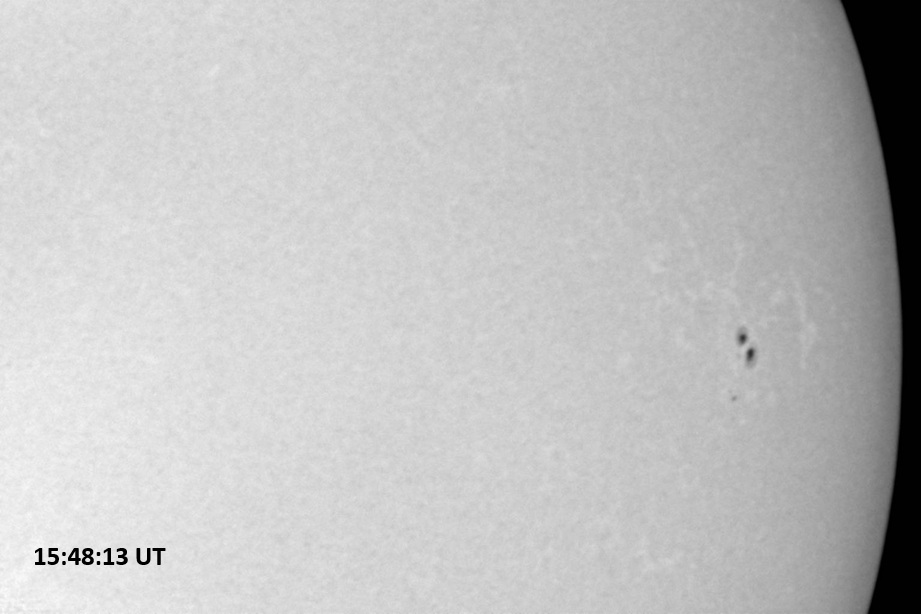 AR 14465 approaching the west limb. AR 14465 approaching the west limb. |
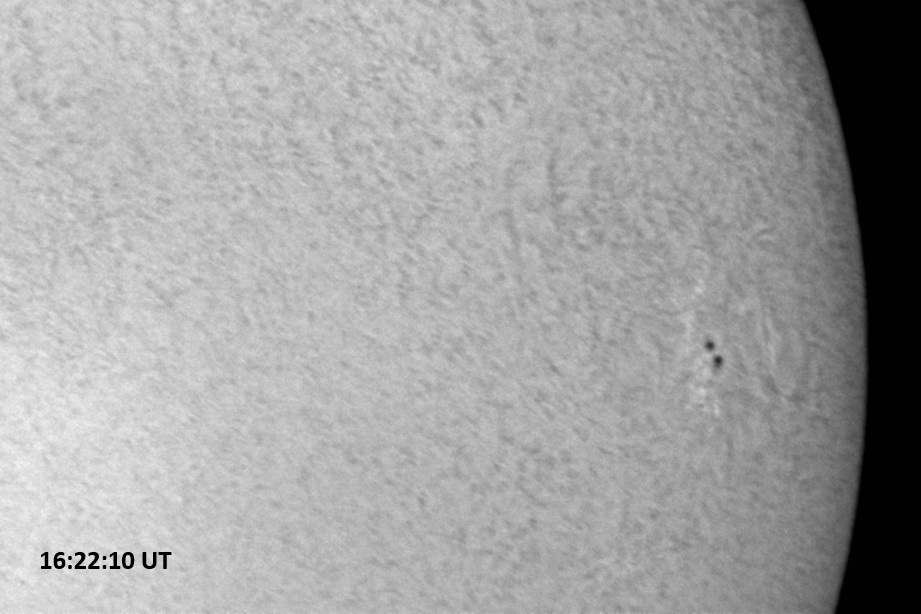 AR 14465 continues to decay, as it has only produced a B8 enhancement or two so far. AR 14465 continues to decay, as it has only produced a B8 enhancement or two so far. |
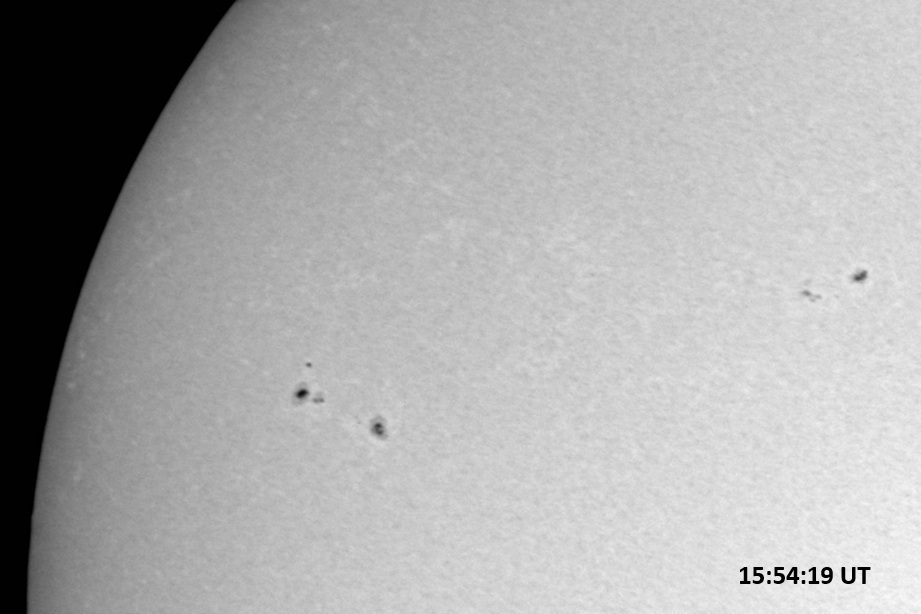 AR 14470 (lower left), and 14471 (right center near image edge). The latter has grown some since yesterday. AR 14470 (lower left), and 14471 (right center near image edge). The latter has grown some since yesterday. |
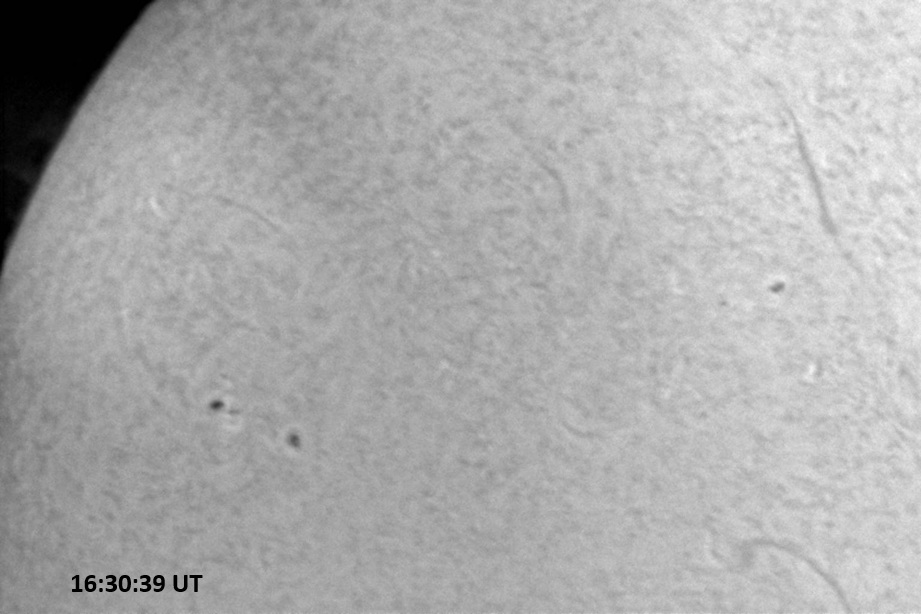 So far, AR 14470 has produced two C1 flares today; AR 14471 continues to remain quiet. There are several filaments visible in this image. So far, AR 14470 has produced two C1 flares today; AR 14471 continues to remain quiet. There are several filaments visible in this image. |
Solar activity is expected to remain at low levels, with a slight chance of M-class flares, through 20 June.
June 17, 2026
Solar activity was at very low to low levels. ARs 14469 and 14470 produced C1 flares at 15:32 UTC, 16 June; and 5:20 UTC, 17 June. AR 14465 is in decay. There are only three visible spotted regions on the disk this afternoon, including newly emerged AR 14471. AR 14464, on the west limb of the Sun, produced the largest flare of the day, a C2.5, at 15:06 UTC.
Prior to today’s imaging session, delayed until late afternoon due to persistent clouds, we imaged the Moon/Venus pair shortly after the latter emerged from behind the former. This is an example of a lunar occultation, where the Moon covers up, or occults, another celestial body. The sky was overcast at the time of the disappearance at 19:25 UT, but the clouds had broken up by the time of the 20:35 reappearance. Unfortunately a single large slow-moving cloud blocked that view. The image below is a 0.09 second exposure at full 16-inch aperture with a 0.9 Neutral Density Filter reducing the glare (except for Venus, as can be seen by the downward spike, which is an artefact of the setup).
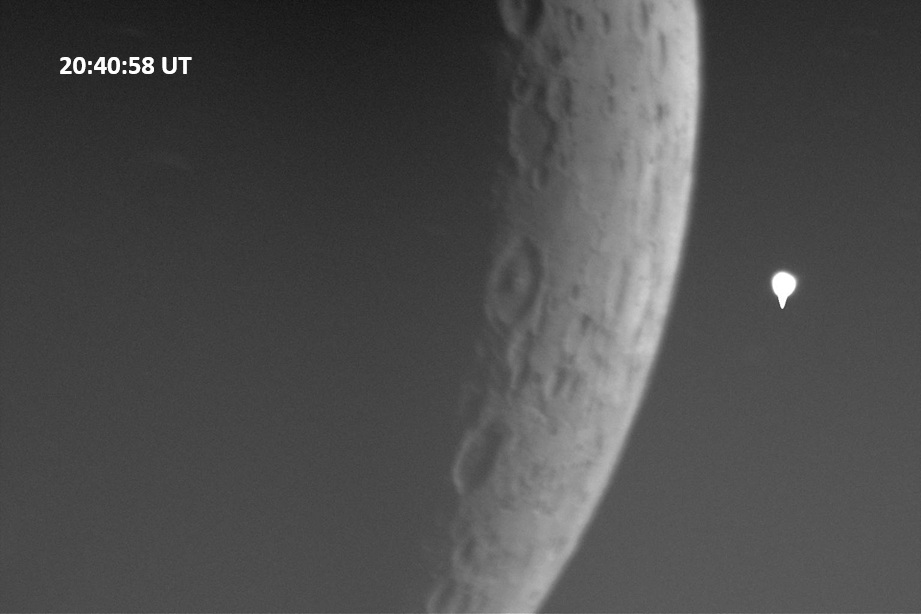
The first column below includes red continuum images, each 0.09 sec exposure; and the second column hosts H-alpha line center images, each 0.15 sec exposure and enhanced slightly to bring out detail. Each of the images covers 7.8’x11.4′ on the sky. Celestial north is up, west is right in each image.
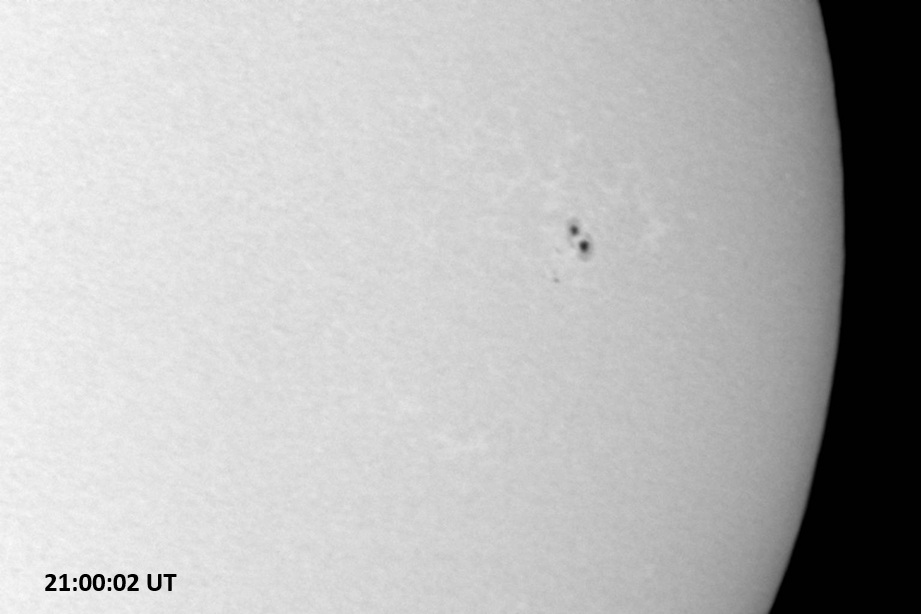 AR 14465 is the lone spot group in this image today. AR 14465 is the lone spot group in this image today. |
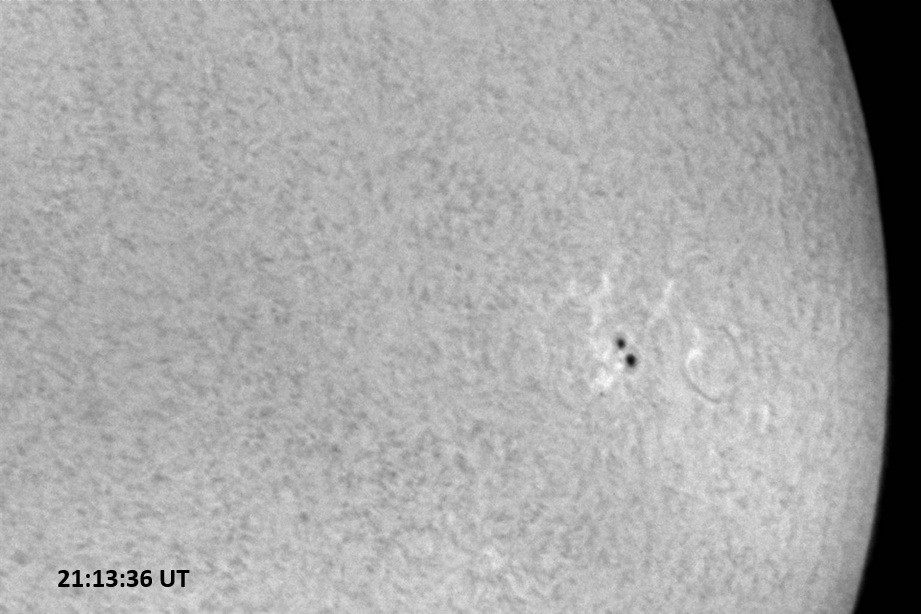 AR 14465 had been the source of a few low-level flares, but there’s not much significant activity in this decaying group. AR 14465 had been the source of a few low-level flares, but there’s not much significant activity in this decaying group. |
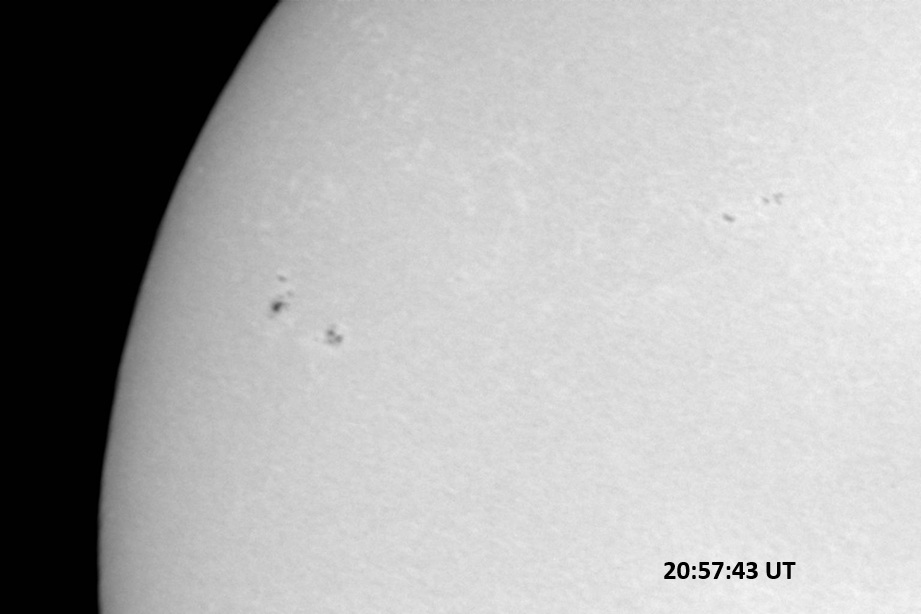 AR 14470 (left of image center) and 14471 (upper right) are the only other spot groups on the visible solar disk currently. AR 14470 (left of image center) and 14471 (upper right) are the only other spot groups on the visible solar disk currently. |
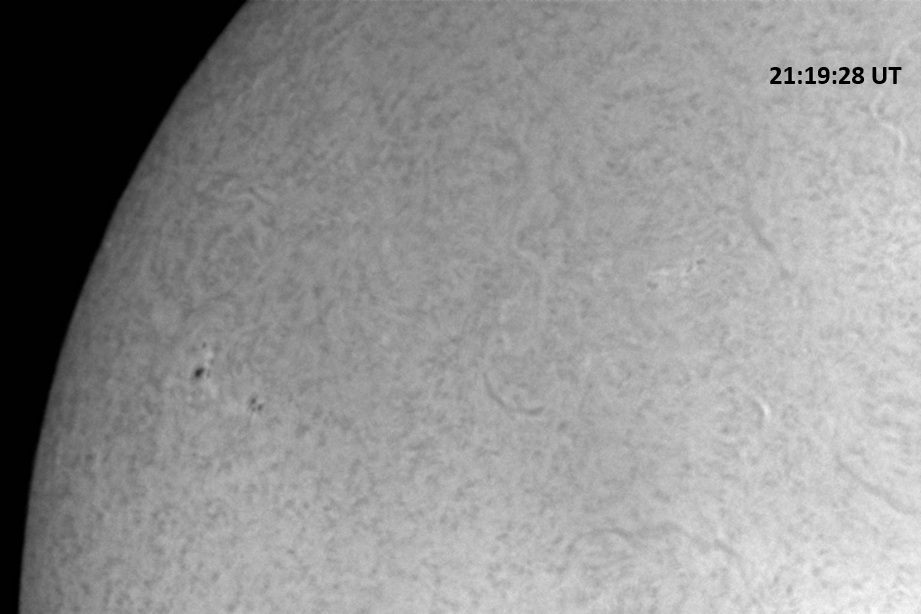 AR 14470 had produced an occasional low-level C-class flare, but 14471 has been quiet. Several filaments are visible in the image. AR 14470 had produced an occasional low-level C-class flare, but 14471 has been quiet. Several filaments are visible in the image. |
Solar activity is expected to remain at low levels, with a slight chance of M-class flares, through 19 June.
June 11, 2026
Solar activity continues to persist at low levels. AR 14465 was the source of most of the flares over the last two days, including a long-duration C6.7/1F flare that peaked at 0:02 UT, 11 UT. Then it produced a C9.0 flare at 8:28 UT, 11 June, the largest of the day so far (through 22:35 UT).
The number of spotted active regions continues to decrease as it seems the overall activity level is decreasing in the short term. This is normal during a solar cycle, whereas the overall activity level rises and falls within the 11 year cycle, on time scales of weeks the Sun will have periods of elevated activity and periods of depressed activity. There are five spotted active regions visible on the disk today, with AR 14465 being the largest and most complex of them all. It has experienced some growth and increasing magnetic complexities. The C6.7 produced a CME that was first observed 51 minutes after the peak of the event. This may glance the Earth’s magnetic field on 13-14 June.
The first column below includes red continuum images, each 0.09 sec exposure; and the second column hosts H-alpha line center images, each 0.15 sec exposure and enhanced slightly to bring out detail. Each of the images covers 7.8’x11.4′ on the sky. Celestial north is up, west is right in each image.
 These active regions are in the process of slowly decaying. These active regions are in the process of slowly decaying. |
 AR 14456 (now just over the edge of the Sun past where the filament lies) managed to release a C1.3 at 11:36 UT today. AR 14456 (now just over the edge of the Sun past where the filament lies) managed to release a C1.3 at 11:36 UT today. |
 AR 14464. It has changed spot configuration since yesterday. AR 14464. It has changed spot configuration since yesterday. |
 AR 14464 has not produced any reported flares so far today. It remains generally quiet. AR 14464 has not produced any reported flares so far today. It remains generally quiet. |
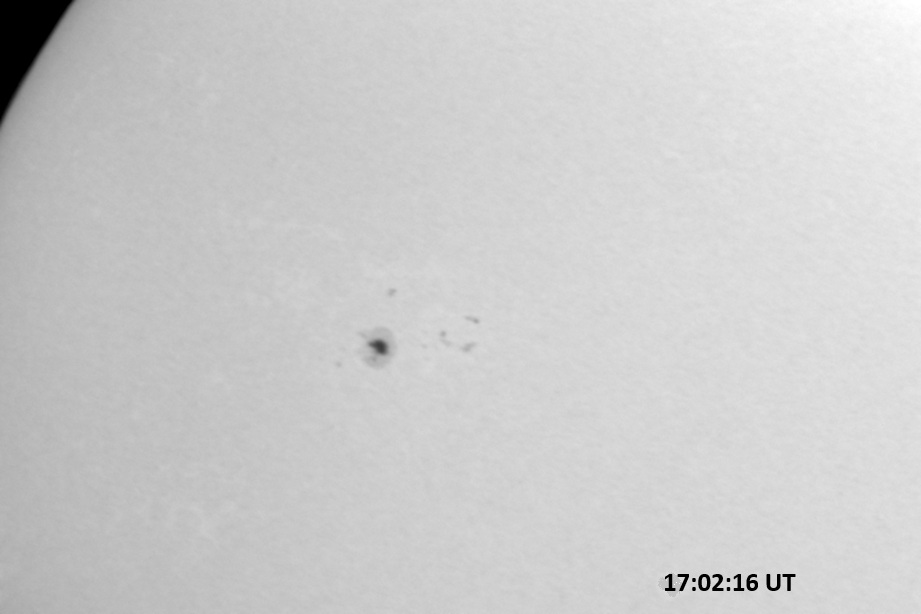 Of the eight reported flares so far today, seven came from this region, AR 14465. Of the eight reported flares so far today, seven came from this region, AR 14465. |
 This is a C1.4 flare (bright semi-circle) at its X-ray peak. This region remains mildly active. This is a C1.4 flare (bright semi-circle) at its X-ray peak. This region remains mildly active. |
Solar activity is expected to remain at low levels through 13 June. There is a chance for M-class flares primarily from AR 14464 and/or 14465.
June 10, 2026
Solar activity remains at low levels today. Most of the C-class flares came from AR 14465 yesterday until 1:33 UT today, then its activity ceased for the day. AR’s 14466 and 14456 each produced a minor event, but the last flaring event came from the latter at 13:26 UT, a C1.5. Aside from some enhancements into the upper B-range and C1.0 range between 14:55 and 16:55, there have been no further flares (through 22:20 UT today. There are now six spotted active regions on the visible disk: AR 14467 briefly formed yesterday near 14464 but went spotless; and AR 14456 rotated out of view. The filament that was observed disappearing/erupting yesterday around 16:00 UT produced a weak CME that was observed with SOHO around 16:30 UT in the northwest quadrant. The CME is expected to deliver a weak impact on Earth’s magnetic field on 14 June.
The first column below includes red continuum images, each 0.09 sec exposure; and the second column hosts H-alpha line center images, each 0.15 sec exposure and enhanced slightly to bring out detail. Each of the images covers 7.8’x11.4′ on the sky. Celestial north is up, west is right in each image.
 Four small regions (labeled), with 14456 being on the solar limb. Four small regions (labeled), with 14456 being on the solar limb. |
 AR 14456 produced a C1.5 at 13:26UT as it departed; AR 14466 is growing a bit and produced an optical sub-flare at 5:16 UT. AR 14456 produced a C1.5 at 13:26UT as it departed; AR 14466 is growing a bit and produced an optical sub-flare at 5:16 UT. |
 AR 14463 (top), 14466 (right edge) and 14464 (bottom). AR 14463 (top), 14466 (right edge) and 14464 (bottom). |
 Despite the flare potential, AR 14464 failed to produce anything significant today. Despite the flare potential, AR 14464 failed to produce anything significant today. |
 AR 14465 is the lone region in this image looking toward the east edge of the Sun. AR 14465 is the lone region in this image looking toward the east edge of the Sun. |
 Aside from a couple of low level C-class flares very early today (UT), this region has been quiet all day. Aside from a couple of low level C-class flares very early today (UT), this region has been quiet all day. |
Solar activity is likely (but not likely…) to be moderate with a slight chance for an X-class flare through 12 June. ARs 14464 and 14465 would be the potential sources.
June 9, 2026
Solar activity remains at low levels today. There were numerous C-class flares (mostly low-level) from ARs 14456, 14464, and 14465 yesterday through early today. Since 0h UT today, AR 14465 has been the source of all but five flares, AR 14464 had one and 14455 had two as it departs over the west limb, and two later events are mentioned below. The largest so far today (through 23:00 UT) was a C4.5/SF at 4:23 UT (9 June). There are 9 sunspot groups on the visible solar disk (not including AR 14455, which is now out of view), eight of which are numbered. The lone unnumbered region is a small developing sunspot group just northwest of AR 14464. Most of the regions are stable or slowly decaying.
We observed a filament disappear, the last traces of it were observed just before 16:05 UT. This is located just east (left) of AR 14463, which is visible in the image below. There may be a hint of a CME in the SOHO LASCO C2 image from 17:00 but this will need to await confirmation from the SWPC.
Later in the day, spotless region 14461 produced a C2.3/1F parallel ribbon flare event, possibly associated with a filament eruption. This event peaked at 19:18. This was followed by a C1.6/SF at 19:43 UT from emerging region AR 14466.
The first column below includes red continuum images, each 0.09 sec exposure; and the second column hosts H-alpha line center images, each 0.15 sec exposure and enhanced slightly to bring out detail. Each of the images covers 7.8’x11.4′ on the sky. Celestial north is up, west is right in each image.
 A string of small active regions (labeled) are viewed on the western part of the solar disk. A string of small active regions (labeled) are viewed on the western part of the solar disk. |
 At least 3 or 4 filaments are visible in this image. This part of the sun has been quiet the entire day, except for a pair of C1 flares early on from AR 14455 (now over the limb). At least 3 or 4 filaments are visible in this image. This part of the sun has been quiet the entire day, except for a pair of C1 flares early on from AR 14455 (now over the limb). |
 Four numbered active regions along with a fifth emerging just northwest of AR 14464, are visible in this continuum image. Four numbered active regions along with a fifth emerging just northwest of AR 14464, are visible in this continuum image. |
 AR 14464 and 14466 are seen in this image. AR 14464 produced one C1.3/SF event so far today. AR 14464 and 14466 are seen in this image. AR 14464 produced one C1.3/SF event so far today. |
 AR 14465 (left) and 14463 (right) are visible in this continuum image. AR 14465 (left) and 14463 (right) are visible in this continuum image. |
 AR 14465 was the source of the majority of activity today (so far). The dark streak just left of AR 14463 (on the right edge of the image) disappeared completely less than an hour after this image was taken. AR 14465 was the source of the majority of activity today (so far). The dark streak just left of AR 14463 (on the right edge of the image) disappeared completely less than an hour after this image was taken. |
Solar activity is expected to be at low with a likely chance for isolated M-class flares, along with a slight chance for X-class flares, through 11 June. This is primarily from AR’s 14456, 14462. 14464, and 14465.
June 8, 2026
Solar activity was at low levels today. It did reach moderate levels on Saturday, 6 June, with a long-duration M1.8 flare from AR 14461, which peaked at 14:00 UT. This region has almost completely decayed to plage today. Since then there have only been mostly low-level C-class flares from various regions. AR 14455 is in the process of rotating over the solar limb today; this region is decaying and has remained quiet (not a single flare was recorded from this region so far today). AR 14456 started to decay a bit after its dramatic return last week. AR 14462 and 14464 each have grown, added spots to their spot numbers, and produced C-class flares. AR 14465 has just rotated into view and produced the largest flare so far today (as of 20:30 UT), and the largest since the M1.8 on Saturday.
The first column below includes red continuum images, each 0.15 sec exposure; and the second column hosts H-alpha line center images, each 0.15 sec exposure and enhanced slightly to bring out detail. Each of the images covers 7.8’x11.4′ on the sky. Celestial north is up, west is right in each image.
 Several small active regions adorn this part of the solar disk. Several small active regions adorn this part of the solar disk. |
 AR 14455 is in the process of rotating off disk, to be followed by AR 14458. AR 14455 is in the process of rotating off disk, to be followed by AR 14458. |
 Three regions found near the center of the solar disk. Small white spots are artefacts of the image processing. Three regions found near the center of the solar disk. Small white spots are artefacts of the image processing. |
 Each of these regions contributed one C1 flare (so far) today, but were otherwise quiet. Each of these regions contributed one C1 flare (so far) today, but were otherwise quiet. |
 AR 14463 (just right of image center) and 14465 (left edge, are visible on the northeastern part of the solar disk. AR 14463 (just right of image center) and 14465 (left edge, are visible on the northeastern part of the solar disk. |
 AR 14465 started the (UT) day active but went quiet after 5:10 UT. AR 14463 has not produced a single flare so far today AR 14465 started the (UT) day active but went quiet after 5:10 UT. AR 14463 has not produced a single flare so far today |
Solar activity is expected to be at low with a chance for isolated M-class activity through 10 June. This is primarily from AR’s 14455, 14456. 14458, 14462, and 14465.
June 5, 2026
Solar activity is still at low levels. There had only been low-level C-class flares coming from many regions today: 14455, 14457, 14458, 14459, and 14462. Currently, nine spotted active regions (eight numbered) are visible on the solar disk. AR 14455 continues to be magnetically complex, with the “anti-Hale” magnetic configuration, which is slowly simplifying. AR 14458 is slowly growing and maintaining a complex magnetic field configuration. AR 14457 showed growth along with new magnetic flux emergence as it rotates over the west southwestern solar limb. All the other regions, except for the re-emerged AR 14456, were stable or in decay. The largest solar flare today (through 22:30 UT) was a C4.5/SF from AR 14455, observed briefly during this morning’s observation session.
Our local weather had been unsettled for most of this past week, but there had been substantial periods of clear enough skies to allow for imaging. This was especially the case for 3, 4, and 5 June, with 5 June being the least favorable weather for observing this week. Most of the images were taken through thin veils of cloud.
The first column below includes red continuum images, each 0.15 sec exposure; and the second column hosts H-alpha line center images, each 0.15 sec exposure and enhanced slightly to bring out detail. Each of the images covers 7.8’x11.4′ on the sky. Celestial north is up, west is right in each image.
 AR 14455 (upper right), 14456 (top center), and 14458 (bottom center). AR 14455 (upper right), 14456 (top center), and 14458 (bottom center). |
 AR 14455 with C4 flare (two bright spots). This region, and later 14458, produced C-class flares today. AR 14455 with C4 flare (two bright spots). This region, and later 14458, produced C-class flares today. |
 AR 14458 (top) and 14457 (arrowed) as the latter rotates out of view. AR 14458 (top) and 14457 (arrowed) as the latter rotates out of view. |
 AR 14457 shown with flare (on solar edge at right). This would peak as a C4.0 flare at 15:13 UT, two minutes after this image. AR 14457 shown with flare (on solar edge at right). This would peak as a C4.0 flare at 15:13 UT, two minutes after this image. |
 A string of active regions. From left to right: AR 14463, 14462, and 14459. A string of active regions. From left to right: AR 14463, 14462, and 14459. |
 These regions were mostly quiet, but AR 14462 and 14459 had produced low-level C-class flares today. These regions were mostly quiet, but AR 14462 and 14459 had produced low-level C-class flares today. |
Solar activity is expected to be at low to moderate levels through 7 June, with a good chance for M-class flares and a slight chance for X-class flares. The active regions most likely to do this are 14455, 14458, and 14459.
June 4, 2026
Solar activity continued at low levels. The largest flare that had occurred since the X1.0 was a C5.1 at 23:43 UT on 3 June from AR 14459. There have only been low-level C-class flares since (through 21:30 UT today). Many different active regions contributed to today’s flares: ARs 14442, 14446, 14451, 14455, 14457, and 14458. AR 14455 has only (so far) produced a single C1.5 flare at 12:58 UT today. This region remains complex, displaying new magnetic complexity (a “delta structure”), but the rate of flux emergence had slowed, which could be why it has been so quiet the last two days. AR 14458 and 14459 continued to grow, and 14462 spots are separating. The other four spotted active regions (8 total are visible on the solar disk) are stable or in decline.
A coronal mass ejection (CME) became visible in satellite imagery at approximately 4:25 UT today, and this appears to be tied to a C2.5 flare (3:57 UT, 4 June) from AR 14457. This CME appears likely to miss Earth entirely. The cannibal CME mentioned yesterday is expected to strike this evening (North American time) or early on 5 June. This could spark considerable geomagnetic storming and roughly half of the United States may see aurora tonight.
The first column below includes red continuum images, each 0.15 sec exposure; and the second column hosts H-alpha line center images, each 0.15 sec exposure and enhanced slightly to bring out detail. Each of the images covers 7.8’x11.4′ on the sky. Celestial north is up, west is right in each image.
 A group of three spotted active regions (lower right) are rotating out of view. AR 14458 (upper left) has moved into this field of view. A group of three spotted active regions (lower right) are rotating out of view. AR 14458 (upper left) has moved into this field of view. |
 This zone of the Sun has largely been quiet, but each of these active regions (except for 14460 on the very edge) contributed one weak C-class flare so far today. This zone of the Sun has largely been quiet, but each of these active regions (except for 14460 on the very edge) contributed one weak C-class flare so far today. |
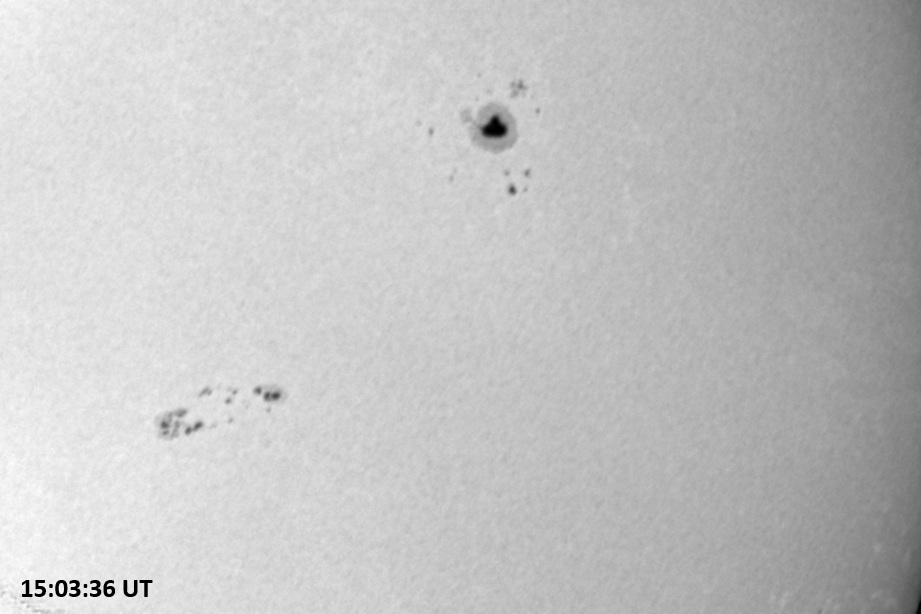 AR 14455 (above image center) and 14458 (lower left) are the dominant regions on the visible solar disk. AR 14455 (above image center) and 14458 (lower left) are the dominant regions on the visible solar disk. |
 Despite the complexities of these active regions, each only produced a single low-level C-class flare so far today. Despite the complexities of these active regions, each only produced a single low-level C-class flare so far today. |
 AR 14459 (just below image center) appears to be growing, with AR 14461 (left) following. AR 14459 (just below image center) appears to be growing, with AR 14461 (left) following. |
 AR 14459 has been completely quiet so far today, and AR 14461 had a single flare. Just beyond the two a large single spot appears to be rotating into view. AR 14459 has been completely quiet so far today, and AR 14461 had a single flare. Just beyond the two a large single spot appears to be rotating into view. |
Solar activity is expected to be at moderate to high levels through 6 June, with M-class flares likely and a slight chance for an X-class flare. The active regions most likely to do this are 14455, 14458, and 14459.
June 3, 2026
Solar activity reached high levels. There were three major flares over an 11 hour period. AR 14455 was the source of these flares: an M9.3/SF at 1:36 UT today (3 June), an M7.7/2B at 7:00 UT, and an X1.0 at 11:28 UT. The first flare produced a CME that was visible by satellite imagery by 2:15 UTC. The second flare also produced a CME that became visible in satellite imagery by 7:50 UT. The X1.0 also produced a faint CME. At least two of these may combine to generate a “cannibal CME event”, whereby a faster CME catches up with a slower one to produce a larger, more powerful CME, which should arrive late on June 4.
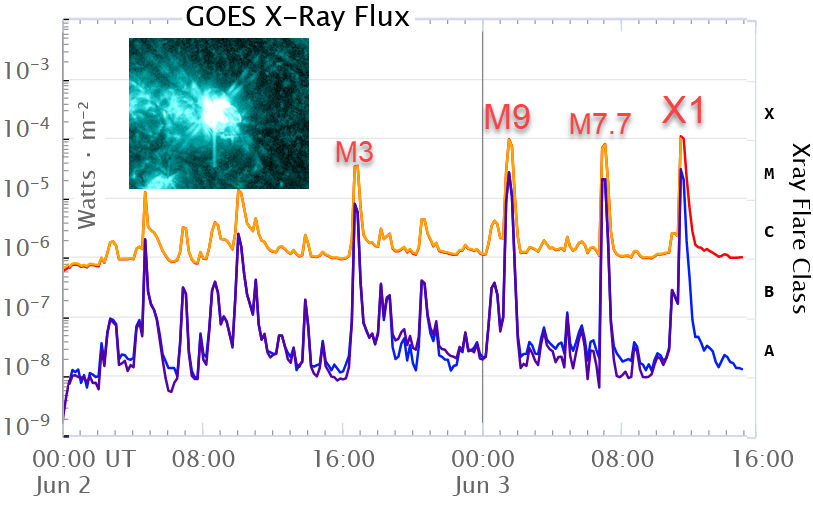 (spaceweather.com)
The M3.3/2B flare that was observed at 16:50 UT yesterday from AR 14455 coincided with a large, far-sided solar eruption. The CME from the latter became visible in satellite imagery by 17:00 UT on 2 June. The M3 flare apparently did not generate a substantial CME. A large filament erupted from the SW part of the Sun happened earlier on 2 June, and this may be swept up by the faster CME’s produced by the M9 and M7 flares mentioned earlier.
Currently, there are eight numbered spotted active regions on the visible solar disk. The active region 14455 is the largest and most complex, displaying a so-called anti-Hale magnetic configuration. This means that the magnetic polarity is reversed from other northern solar hemisphere sunspots and this occurs in an estimated 3% of sunspots. Anti-Hale spots are twice as likely to flare as their more “normal” counterparts. AR 14458, 14459, 14460, and 14461 have each shown rapid growth. Each of these regions have been quiet flare-wise, as AR 14455 had produced nearly all of the solar flares so far today.
The first column below includes red continuum images, each 0.15 sec exposure; and the second column hosts H-alpha line center images, each 0.15 sec exposure and enhanced slightly to bring out detail. Each of the images covers 7.8’x11.4′ on the sky. Celestial north is up, west is right in each image.
 AR 14446 (largest spot right, just below center), 14452 (above and left of 14446), and 14450 (pair of spots, bottom), are about to rotate out of view. AR 14446 (largest spot right, just below center), 14452 (above and left of 14446), and 14450 (pair of spots, bottom), are about to rotate out of view. |
 Aside from a C1 and a SF from now spotless region 14449 (directly above 14446, right of 14452), this zone of the Sun has been quiet the whole day. Aside from a C1 and a SF from now spotless region 14449 (directly above 14446, right of 14452), this zone of the Sun has been quiet the whole day. |
 AR 14455 (just above image center) and 14458 (lower left). AR 14455 (just above image center) and 14458 (lower left). |
 AR 14455 had been active, but since 11:28 UT, it has only produced a C1/SF at 19:26 UT. AR 14455 had been active, but since 11:28 UT, it has only produced a C1/SF at 19:26 UT. |
 Two more potentially active sunspot groups include AR 14462 (near solar limb upper left) and 14459 (just right of image center). Two more potentially active sunspot groups include AR 14462 (near solar limb upper left) and 14459 (just right of image center). |
 Despite the rapid growth of these regions they have remained quiet all day long. AR 14462 does show some bright plage. Despite the rapid growth of these regions they have remained quiet all day long. AR 14462 does show some bright plage. |
Solar activity is expected to be at moderate levels through 5 June, with M-class flares likely and a slight chance for an X-class flare. The active regions most likely to do this are 14455, 14458, 14461, and 14462.
June 2, 2026
Solar activity reached moderate levels with several C-class flares and three M-class flares, all occurring since 2:00 UT today. AR 14455 produced an M1.2/1N at 10:05 UTC today (2 June) and an M3.3/2B flare at 16:50 UT today. The frequency of C-class flares has picked up since yesterday. There are ten numbered and one unnumbered active regions / sunspot groups on the visible solar disk. AR 14446 had some minor growth while AR 14449 fragmented in its leading sunspot area while experiencing some growth with new magnetic flux emergence. AR 14455 continues to fragment some but it had gotten more active in the last day. AR 14457 has grown and lengthened some, while new active regions (AR 14460 and 14461) rotated into view. AR 14459 emerged and grew some near the solar east limb.
The first image immediately below is today’s M3.3 flare near maximum brightness. The bright patches are the flare itself, and a dark surge is seen extending downward from the maim complex of flare. We watched as all this evolved over the next hour or so.
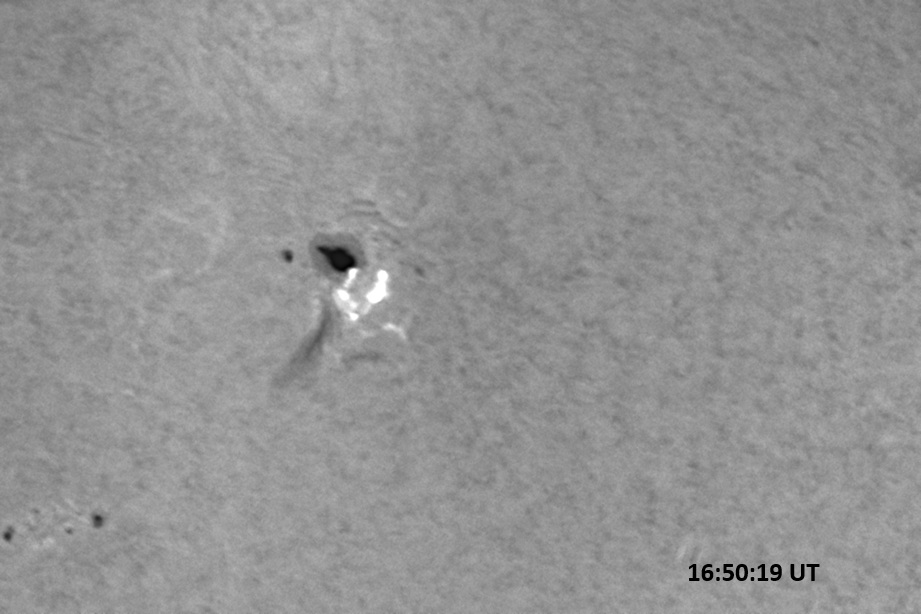
The first column below includes red continuum images, each 0.09 sec exposure; and the second column hosts H-alpha line center images, each 0.15 sec exposure and enhanced slightly to bring out detail. Each of the images covers 7.8’x11.4′ on the sky. Celestial north is up, west is right in each image.
 This part of the Sun remains quiet as these sunspot groups are about to rotate out of view. This part of the Sun remains quiet as these sunspot groups are about to rotate out of view. |
 While no flares have been recorded from this part of the Sun, these regions continue to contribute to an elevated chance of isolated M-class flares. While no flares have been recorded from this part of the Sun, these regions continue to contribute to an elevated chance of isolated M-class flares. |
 AR 14455 (upper right) with AR 14458 (lower left). AR 14455 (upper right) with AR 14458 (lower left). |
 AR 14455 has been the source of the majority of today’s flares, with 14458 contributing a few optical subflares. AR 14455 has been the source of the majority of today’s flares, with 14458 contributing a few optical subflares. |
Solar activity is expected to be low through 4 June with a continued chance for isolated M-class flares.
June 1, 2026
Solar activity continues to be low, with only weak C-class flare activity yesterday and into today. In fact, the only reported flare so far today (through 22:40 UT) was a C1.5/SF at 5:19 UT from AR 14448. The last M-class flare was an M1.1 at 7:05 UT on the 29th of May; the most recent X-flare happened on 24 April, an X2.5. So, overall, the Sun seems to be quieting down.
AR 14446 continues to decay while producing low-level C-class flare, but none have come from this region so far today. AR 14455 is also decaying, and AR 14456 became spotless late yesterday. There were two CMEs, one from the southwest observed at approximately 13:30 UT on 31 May. This event came from beyond the western limb of the Sun and will miss Earth. Another CME also came from the southwest disk of the Sun and was observed about 17:15 UT on 31 May. This likely came from AR 14447.
There are a total of nine spotted active regions on the visible solar disk today. Most seem to be in a state of decay but a few, such as AR 14458, have just emerged onto the visible solar disk. The X-ray flux background has been largely below the C1.0 level over the last three days; it is currently at B6.
The first column below includes red continuum images, each 0.09 sec exposure; and the second column hosts H-alpha line center images, each 0.15 sec exposure and enhanced slightly to bring out detail. Each of the images covers 7.8’x11.4′ on the sky. Celestial north is up, west is right in each image.
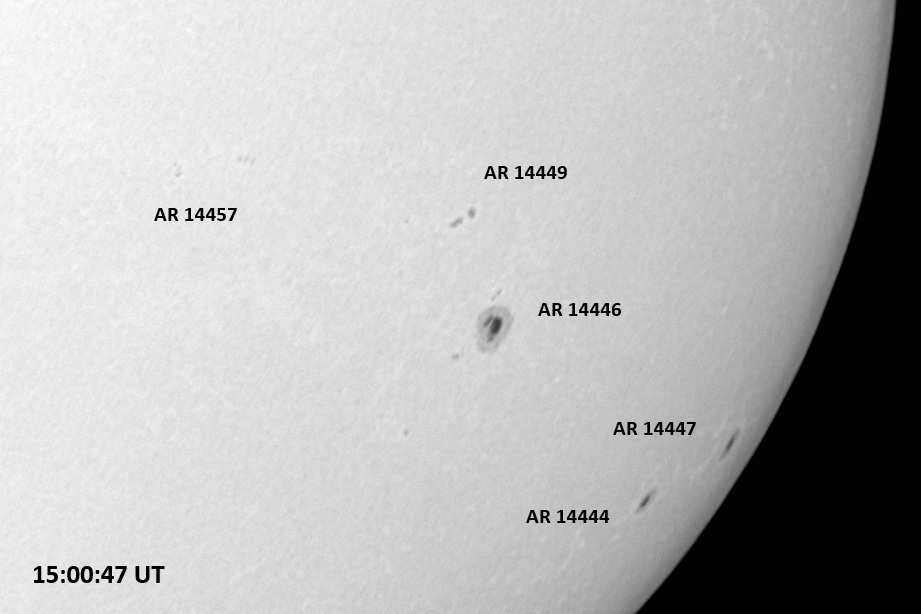 Five ARs (labeled) are visible in this image. Two of these are about to rotate out of view. Five ARs (labeled) are visible in this image. Two of these are about to rotate out of view. |
 This zone of the Sun has largely been quiet, except for a single C1 region from AR 14448 (not visible, near top center edge of image). This zone of the Sun has largely been quiet, except for a single C1 region from AR 14448 (not visible, near top center edge of image). |
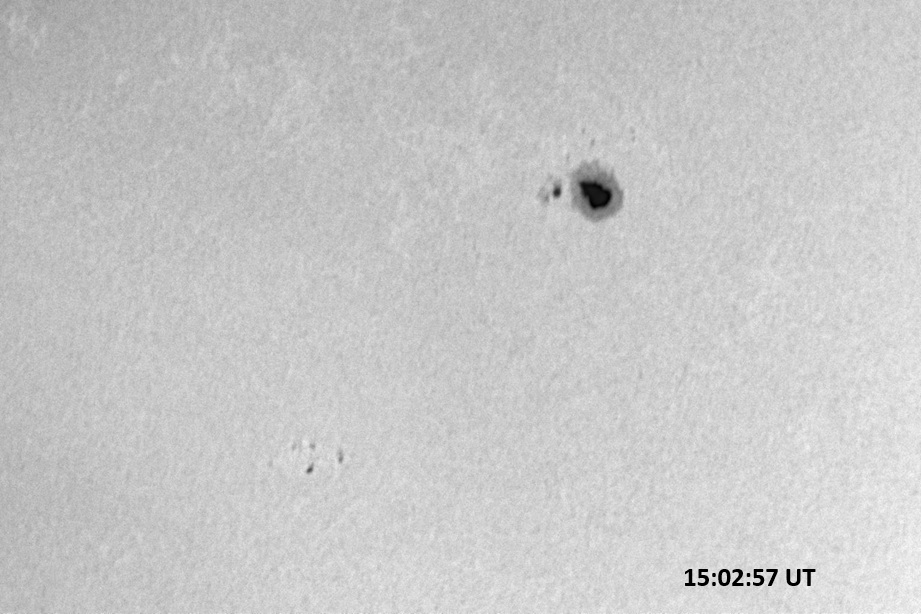 A 14455 (large spot upper right) and newly-emerged AR 14458 (lower left) grace the center of the solar disk. A 14455 (large spot upper right) and newly-emerged AR 14458 (lower left) grace the center of the solar disk. |
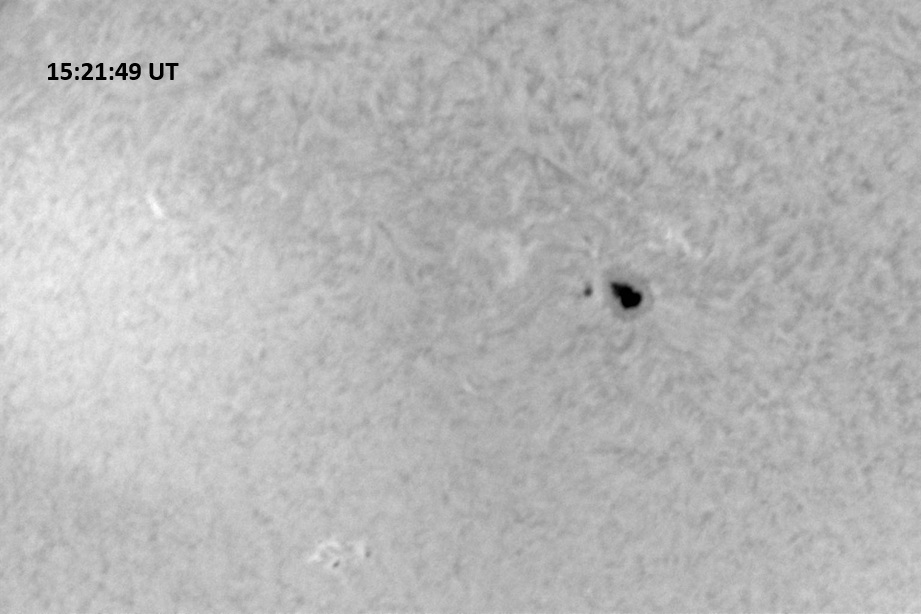 This zone has been largely quiet over the last two days or so. AR 14455 appears to be in decay, while 14458 develops. This zone has been largely quiet over the last two days or so. AR 14455 appears to be in decay, while 14458 develops. |
Solar activity is expected to be low to moderate through 2 June, with a chance for an isolated M-class flare. The probability for an M-class flare decreases further on 3 June as multiple potential source regions rotate over the western solar limb.
May 28, 2026
Solar activity continues to be at low levels. The largest event for both yesterday and today (so far, as of 23:00 UT) was a C3.4 flare from AR 14446 at 12:16 UT on 27 May. This was the only recorded flare from this region from both yesterday and today. AR 14455 continues to rotate into better view and has produced the occasional flare. Yesterday’s other two C-class flares came from AR 14454, and the reported events of today came from AR 14447 (C1.1 at 8:00 UT) and AR 14455 (C1.8 at 10:09 UT). AR 14452 produced today’s largest flare (so far), a C3.2 (15:16 UT) with a pair of optical subflares (15:15 and 15:18 UT).
AR’s 14455 and 14446 are the disk’s largest and second largest active region today, at 450 and 400 MSH (millionths of solar hemisphere). AR 14446 is the most magnetically complex region on the visible disk, with a “beta-gamma” magnetic type. AR 14455 has an “alpha” magnetic type. These are two of ten numbered active regions on the visible disk. One notable region is AR 14452, which had experienced growth and new flux emergence since yesterday. Two days ago it was a relatively simple, unnumbered bipolar spot group. AR 14445 decayed into plage but an unrelated spot has popped up near the plage. AR 14450 also decayed to plage and tinier pores re-emerged near its former location. The rest of the active regions were either stable or in slow decay.
There was a coronal mass ejection CME), a faint, narrow one which was first spotted via SOHO’s LASCO C2 coronagraph camera at approximately 23:00 UT on 27 May. The newer CCOR1 instrument “saw” it at 0:45 UT, 28 May. They have not been able to determine the source of this phenomenon, but it is expected to have minor impacts on 31 May. No other CME’s were noted.
The first image at left is a far side image of the sunspots taken on 17 May by Europe’s Solar Orbiter probe. The second is a GONG image showing the same spot groups eleven days later. One can see how the circled complex of spot groups/active regions (left) have decayed considerably. The long string of spots just right of image center (left image) decayed entirely; the feature on the right near its former location is an unrelated new spot group. Even AR 14455 (left edge of both images, above center) has shown some decay. It is interesting to follow the growths and decays of the various sunspot groups as they grace the solar disk. (Left image source: spaceweather.com)
The first column below includes red continuum images, each 0.09 sec exposure; and the second column hosts H-alpha line center images, each 0.15 sec exposure and enhanced slightly to bring out detail. Each of the six images covers 7.8’x11.4′ on the sky. Celestial north is up, west is right in each image.
 The active region complex seems to be decaying over time. The active region complex seems to be decaying over time. |
 This zone of the Sun had been relatively quiet over the last day or so. This zone of the Sun had been relatively quiet over the last day or so. |
 AR 14452 (right) is emerging and growing. The regions east of it have decayed with only transient pores emerging in their places. AR 14452 (right) is emerging and growing. The regions east of it have decayed with only transient pores emerging in their places. |
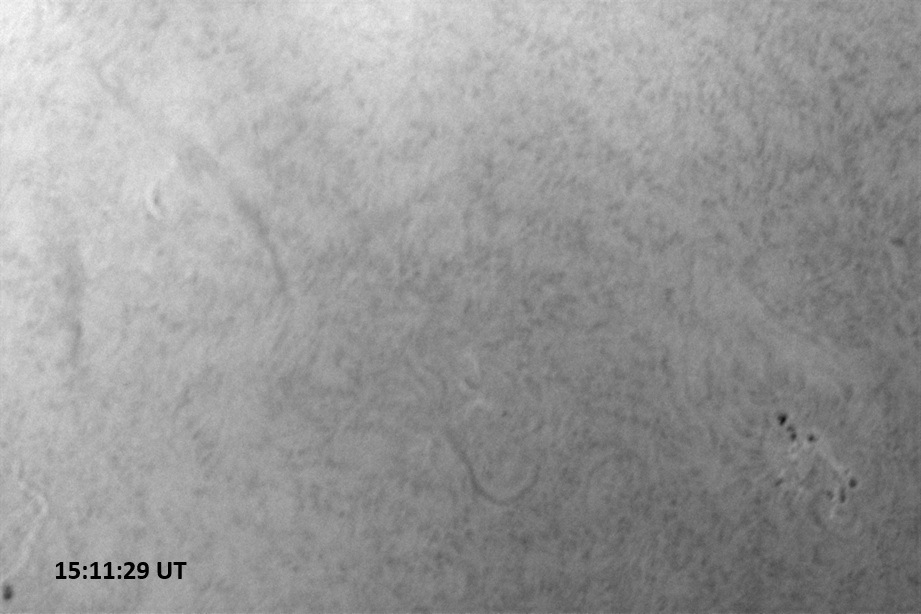 This image shows three filaments (two long ones left of center and a short one below image center), along with AR 14452. This image shows three filaments (two long ones left of center and a short one below image center), along with AR 14452. |
 AR 14455 continues to rotate into better view. It is a bipolar sunspot group. AR 14455 continues to rotate into better view. It is a bipolar sunspot group. |
 AR 14455 is mainly quiet, but has flared occasionally, including a C1.5/SF at 16:37 UT today. AR 14455 is mainly quiet, but has flared occasionally, including a C1.5/SF at 16:37 UT today. |
Solar activity is expected to be at low to moderate levels through 30 May, with a chance for isolated M-class flares.
May 26, 2026
Solar activity remains at low levels. The largest flaring event so far today and since yesterday was a C9.7 from AR 14446 at 12:38 UT today. The only other notable event today was a C2.4/SF from AR 14448 at 7:17 UT. An unnamed source produced a C1.6 flare at 14:00 UT today. From then until 20:00 UT, the background X-ray flux level has remained flat, hovering along the C1.0 level. There had been some weak C1-C2 activity since then (through 21:10 UT). There are eleven numbered and one unnumbered sunspot groups on the visible disk today. All these regions were largely stable or in a very slow decay process.
The first column below includes red continuum images, each 0.15 sec exposure; and the second column hosts H-alpha line center images, each 0.15 sec exposure and enhanced slightly to bring out detail. Each of the six images covers 7.8’x11.4′ on the sky. Celestial north is up, west is right in each image.
 The southwest part of the solar disk is mostly quiet, with only two small spotted regions preparing to rotate out of view. The southwest part of the solar disk is mostly quiet, with only two small spotted regions preparing to rotate out of view. |
 This part of the solar disk features some faint prominences and filaments in addition to small active regions. This part of the solar disk features some faint prominences and filaments in addition to small active regions. |
 Six of the twelve visible active regions (labeled) are visible in this image. Six of the twelve visible active regions (labeled) are visible in this image. |
 During the short observing session this zone on the sun was completely quiet. During the short observing session this zone on the sun was completely quiet. |
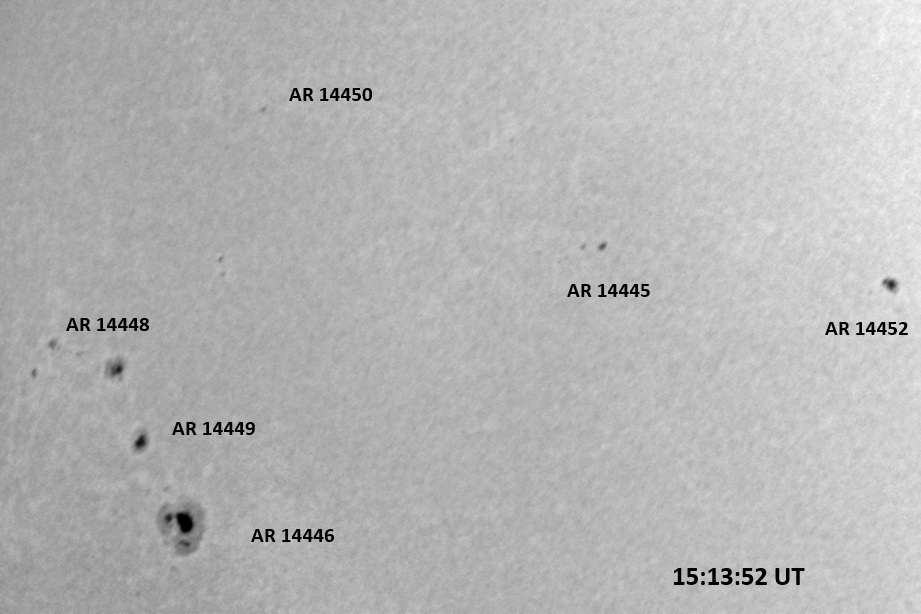 Moving the view just north of the above image, four small spot groups appear. Moving the view just north of the above image, four small spot groups appear. |
 These four small spot groups are largely hidden from view in the H-alpha image. These four small spot groups are largely hidden from view in the H-alpha image. |
Solar activity is expected to be at low to moderate levels through 28 May, with a chance for isolated M-class flares.
__________________________________________________________________
May 15, 2026
Solar activity remains at low levels but came very close to elevating to moderate levels. All three of the visible spotted active regions produced C-class flares the last two days, but AR 14435 produced the vast majority of them, the largest a near-M-class flare (C9.5/SF) that peaked at 16:14 UT as we started to observe that region. Then there was a long-duration C5.1/SF from AR 14436, which peaked at 18:21 UT on 14 May. This was the second peak of a complex flare that also included X-ray emissions from the west limb of the Sun. AR 14438 grew significantly and contributed to some of the B-class and C-class flares. All this activity launched multiple CMEs over the past 24 hours. One source was the “fluffy filament” in the northwest solar disk that we had been watching all week launched off the Sun around 12:30 UT yesterday; another lifted off the southwest part of the solar disk around 1:00 UT 15 May; a third filament disappeared after a C3.3 flare from AR 14436.
Since the C9 flare, the Sun had remained quiet through at least 22:00 UT today. The X-ray flux background has decreased over the last day or so with the active region AR 14432 rotating further over the solar horizon; it sits at B3.6 level as of 22:06 UT.
The first image below is a red continuum image, 0.09 sec exposure; the second and third images are H-alpha line center images, each 0.15 sec exposure and enhanced slightly to bring out detail. Each of the three images covers 7.8’x11.4′ on the sky. Celestial north is up, west is right in each image.
 There remains three spotted active regions, shown above. The rest of the solar disk is blank. There remains three spotted active regions, shown above. The rest of the solar disk is blank. |
 The spotted active regions are identified in this image, taken a few minutes after the peak of the C9 flare (two bright spots, right, near edge of Sun). The spotted active regions are identified in this image, taken a few minutes after the peak of the C9 flare (two bright spots, right, near edge of Sun). |
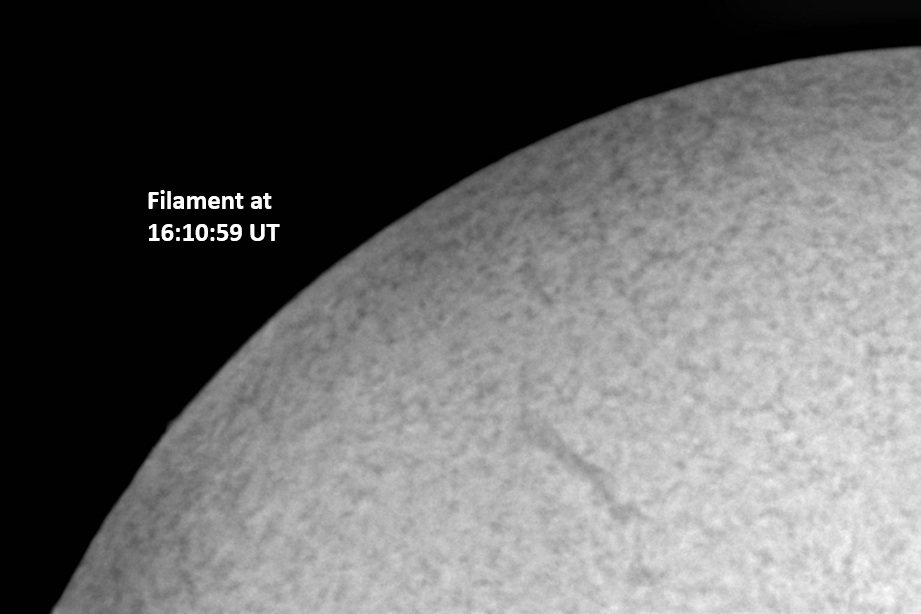 The rest of the solar disk is mostly blank with a few miscellaneous filaments, included the one shown above. The rest of the solar disk is mostly blank with a few miscellaneous filaments, included the one shown above. |
Solar activity is expected to remain low with a chance for M-class flares through 17 May.
May 14, 2026
Solar activity continues at low levels with only low-level C-class flares from ARs 14435. AR 14435 was the only region to show growth and was the source of the largest flare of the day so far: a C5.5/SF that peaked at 6:42 UT today (14 May). The largest flare (so far) was a C2.3 that peaked at 6:40 UT on 13 May. AR 14436 produced three minor C-class flares between 16:30 and 18:30 UT, 13 May. AR 14332 had rotated over the solar limb and was the likely source for two C-class flares: a C1.4 at 19:48 UT on 13 May, and a C1.6 at 2:12 UT on 14 May. The former produced a coronal mass ejection, first sighted by SOHO’s LASCO/C2 instrument at 23:00 UT on 13 May.
Today, AR 14435 produced almost all of the flares, nine in total from 0:00 to 16:00 UT today. A long duration C4.4 flare, peaking at 17:39 UT, beginning with a more “spikey” initial C2.4 event at 17:23 UT. This likely came from AR 14432. A continuation of this event through 20:00 UT, with a peak at C5.0 and 18:40 UT came from AR 14436.
The first column below includes red continuum images, each 0.09 sec exposure; and the second column hosts H-alpha line center images, each 0.15 sec exposure and enhanced slightly to bring out detail. Each of the six images covers 7.8’x11.4′ on the sky. Celestial north is up, west is right in each image.
 AR 14433 in the process of transitioning into spotless plage, visible as a tiny dark spot amidst the cluster of bright spots near the limb of the Sun. AR 14433 in the process of transitioning into spotless plage, visible as a tiny dark spot amidst the cluster of bright spots near the limb of the Sun. |
 The plage region of AR 14433 (arrowed) shows itself in H-alpha. It is about to rotate over the western limb. The plage region of AR 14433 (arrowed) shows itself in H-alpha. It is about to rotate over the western limb. |
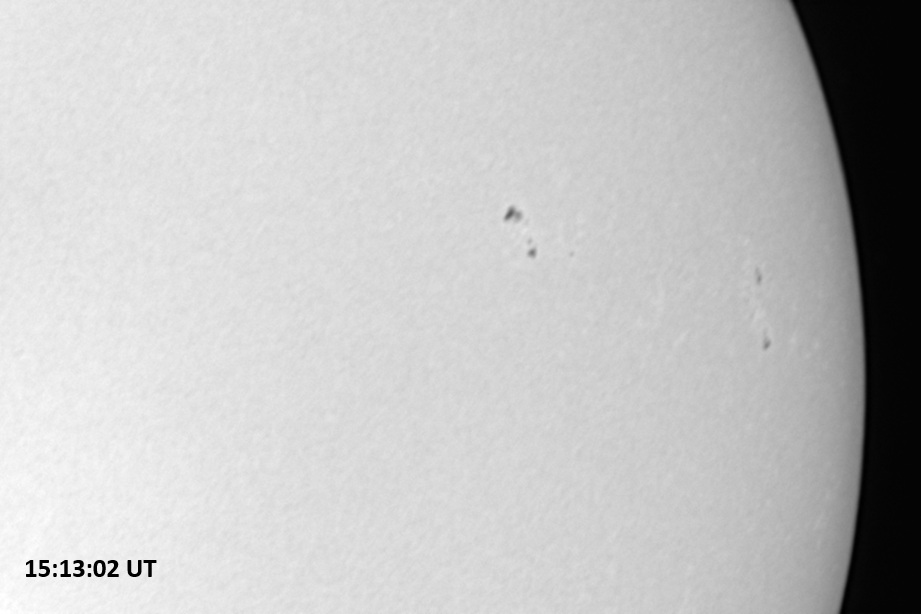 AR 14438 (just right of center) and 14435 (near the solar edge at right) show as pairs of spots each. AR 14438 (just right of center) and 14435 (near the solar edge at right) show as pairs of spots each. |
 AR 14435 (far right) has been active over the last day. It showed a B7.7 enhancement in brightness at 15:59 UT today. AR 14435 (far right) has been active over the last day. It showed a B7.7 enhancement in brightness at 15:59 UT today. |
 AR 14436 sits alone in a large blank region of solar disk, it has filled in a bit since yesterday. AR 14436 sits alone in a large blank region of solar disk, it has filled in a bit since yesterday. |
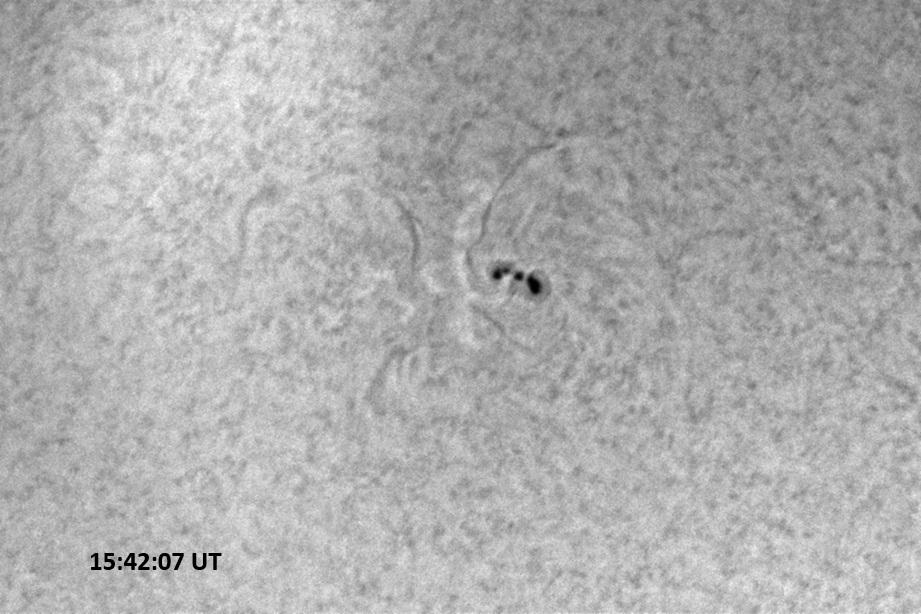 AR 14436 and its accompanying filaments. This region has been quiet since yesterday. AR 14436 and its accompanying filaments. This region has been quiet since yesterday. |
Solar activity is expected to remain at low levels through 16 May, with a chance for M-class flares.
May 13, 2026
Solar activity remained at low levels with low-level C-class flares from ARs 14432 (currently rotating off the disk), 14433, and 14436. The largest flare (so far) was a C2.3 that peaked at 6:40 UT on 13 May. Two new spotted groups emerged on the visible disk (AR 14437, about to rotate out of view over the western limb) and 14438 (east of 14435). There are a total of five numbered active regions on the visible solar disk.
Some activity among the filaments just east of AR 14436 (but included in its zone of influence) began shortly after the conclusion of today’s observing session. It was a series of 8 or 9 low level C-class flares, the first of which peaked at 16:54UT and the last at 18:25 UT. None of the accompanying filaments appear to be disturbed much by this activity.
The first column below includes red continuum images, each 0.09 sec exposure; and the second column hosts H-alpha line center images, each 0.15 sec exposure and enhanced slightly to bring out detail. Each of the six images covers 7.8’x11.4′ on the sky. Celestial north is up, west is right in each image.
 AR 14433 (the dark spot near top center) slowly approaches the edge of the Sun, carried along by the Sun’s rotation. AR 14433 (the dark spot near top center) slowly approaches the edge of the Sun, carried along by the Sun’s rotation. |
 AR 14433 is now near bottom center, allowing a view of the long thin filament north of it. AR 14433 is now near bottom center, allowing a view of the long thin filament north of it. |
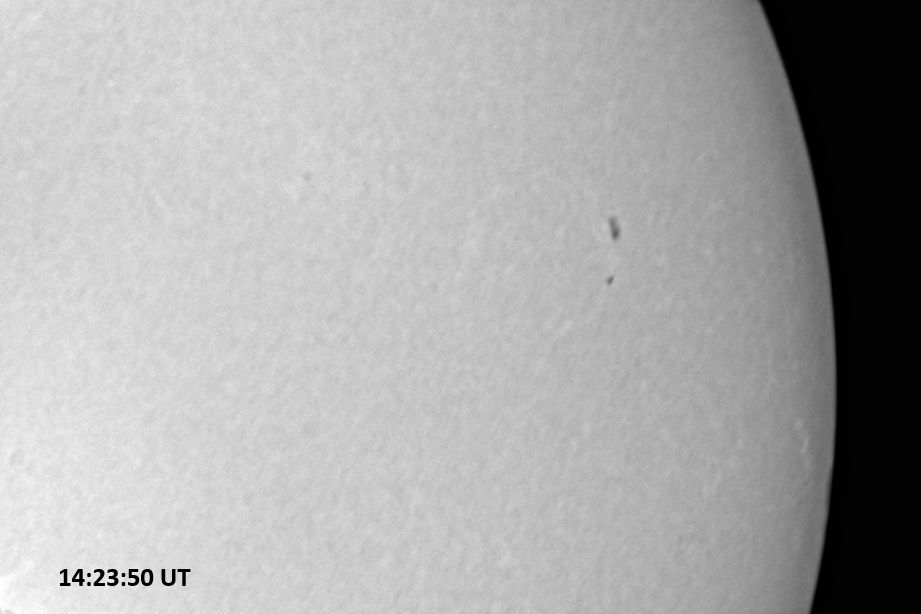 AR 14435 is the largest region easily seen in this image. AR 14432 is barely visible as an indentation in the sun’s edge at the lower right corner of the image. East (left) of 14435 is a small cluster of tiny spots, AR 14438. AR 14437 appear as an elongated bright patch near the edge of the Sun, lower right. AR 14435 is the largest region easily seen in this image. AR 14432 is barely visible as an indentation in the sun’s edge at the lower right corner of the image. East (left) of 14435 is a small cluster of tiny spots, AR 14438. AR 14437 appear as an elongated bright patch near the edge of the Sun, lower right. |
 All of the features, except for AR 14435, seem to disappear into the H-alpha field. This entire zone of the Sun appears very quiet. Space Weather Prediction Center still forecasts a slight chance of an X-class flare from AR 14432 on the limb of the Sun through the end of today (13 May). All of the features, except for AR 14435, seem to disappear into the H-alpha field. This entire zone of the Sun appears very quiet. Space Weather Prediction Center still forecasts a slight chance of an X-class flare from AR 14432 on the limb of the Sun through the end of today (13 May). |
 AR 14436 continues its steady pace across the disk of the Sun. AR 14436 continues its steady pace across the disk of the Sun. |
 AR 14436 and its environs. This region had been producing lots of low-level C-class flares recently. AR 14436 and its environs. This region had been producing lots of low-level C-class flares recently. |
Solar activity is expected to remain at low levels through 15 May, with a chance for M-class flares.
May 12, 2026
Solar activity returned to low levels. There has only been low-level C-class flare activity yesterday through today. Four minor C-class flares came from AR 14432 early today (UT), and two more weak C-class flares came from AR 14436 later today, at 12:49 and 17:17. The strongest event today was a C2.0 from AR 14436 at 12:49 UT. AR 14431 rotated over the western solar limb, leaving four visible spotted active regions. ARs 14432, 14433, and 14436 decayed while AR 14435 remained stable.
The first column below includes red continuum images, each 0.09 sec exposure; and the second column hosts H-alpha line center images, each 0.15 sec exposure and enhanced slightly to bring out detail. Each of the six images covers 7.8’x11.4′ on the sky. Celestial north is up, west is right in each image.
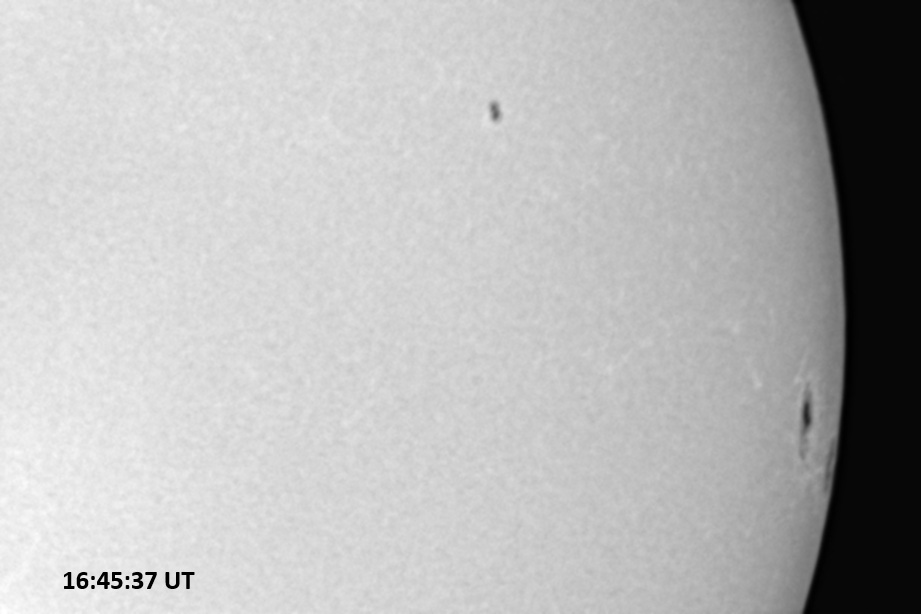 Large AR 14432 (lower right near edge) has begun to rotate out of view. AR 14435 (top center) is following behind. Large AR 14432 (lower right near edge) has begun to rotate out of view. AR 14435 (top center) is following behind. |
 This part of the Sun had been largely quiet. Some limb features (prominences) are visible just below departing spot 14432. This part of the Sun had been largely quiet. Some limb features (prominences) are visible just below departing spot 14432. |
 The single spot top center is AR 14433. It is the only spotted region left after AR 14431 rotated out of view. The single spot top center is AR 14433. It is the only spotted region left after AR 14431 rotated out of view. |
 This zone of the Sun also remains quiet. This zone of the Sun also remains quiet. |
 AR 14436 is the only sunspot group 1n the eastern half of the solar disk. AR 14436 is the only sunspot group 1n the eastern half of the solar disk. |
 AR 14436 as it appeared between an X-ray flare (peaked 15 minutes ago) and an optical sub flare (peaked at 18:00 UT). AR 14436 as it appeared between an X-ray flare (peaked 15 minutes ago) and an optical sub flare (peaked at 18:00 UT). |
Solar activity is expected to remain at low levels through 14 May. There is a slight chance for an isolated X-class flare through the end of 12 May due to AR’s 14432 and 14436, but this goes away as the former rotates over the western limb and the latter slowly decays. There is a decreasing chance (20% today then going down from there) of an M-class flare through 14 May.
May 11, 2026
With the technical issue seemingly resolved and the return of better weather, daily solar observations have resumed.
Solar activity had reached moderate levels yesterday with an M5.7/2B flare at 13:39 UT on 10 May from AR 14436. This region produced a rather large flare (an M2.6 at 15:10 UT on 7 May) just before it rotated into view last week. Yesterday’s event generated a partial halo coronal mass ejection that became visible at 13:48 UT in LASCO C2 imagery. The CME will pass west of the Sun-Earth line sometime around 0h UT on 13 May. AR 14432, which developed a few days ago, is the largest and most complex sunspot group on the visible solar disk but it is about to rotate over the west limb. It produced a few C1 type flare events. The other three active regions are unremarkable.
The first column below includes red continuum images, each 0.15 sec exposure; and the second column hosts H-alpha line center images, each 0.15 sec exposure and enhanced slightly to bring out detail. Each of the six images covers 7.8’x11.4′ on the sky. Celestial north is up, west is right in each image.
 AR 14432 (right edge) prepares to exit the visible solar disk, with AR 14435 (top center) remaining simple in appearance. AR 14432 (right edge) prepares to exit the visible solar disk, with AR 14435 (top center) remaining simple in appearance. |
 The two aforementioned regions in H-alpha. AR 14432 had produced a C1.8/SF flare event nearly two hours earlier, at 14:15 UT. The two aforementioned regions in H-alpha. AR 14432 had produced a C1.8/SF flare event nearly two hours earlier, at 14:15 UT. |
 AR 14433 (top center) and 14431 (right, near solar edge) as viewed in red continuum light. AR 14433 (top center) and 14431 (right, near solar edge) as viewed in red continuum light. |
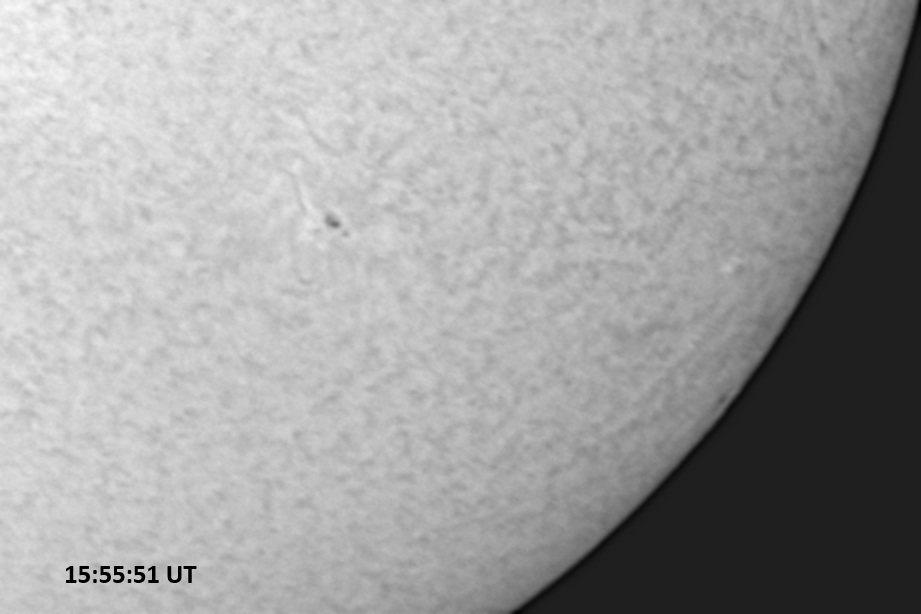 In H-alpha, AR 14431 nearly disappears, but AR 14433 remains easily visible. In H-alpha, AR 14431 nearly disappears, but AR 14433 remains easily visible. |
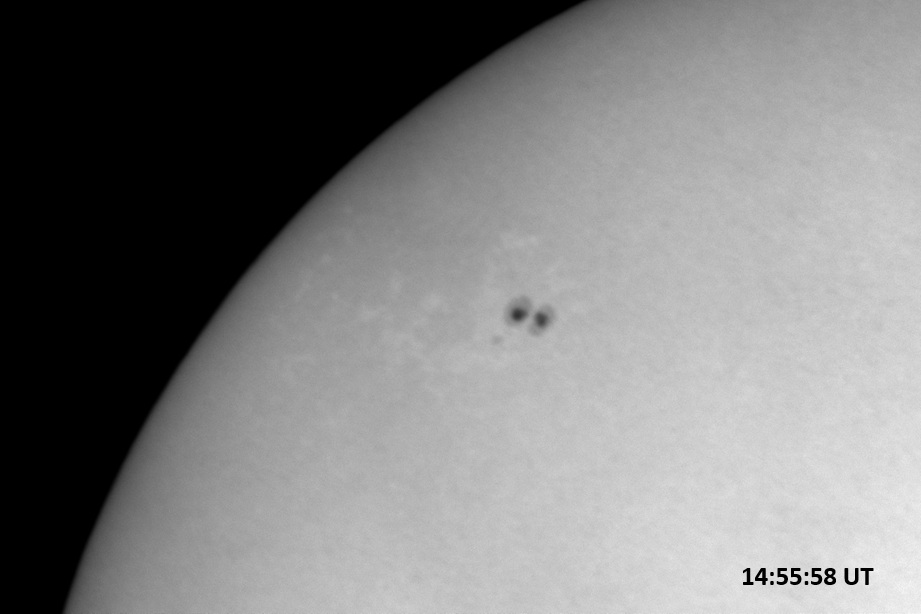 AR 14436 comes into better view, carried along by the solar rotation. It does not look too impressive. AR 14436 comes into better view, carried along by the solar rotation. It does not look too impressive. |

AR 14436 was the source of a B7.8 enhancement around 6:36 UT today, but has been entirely quiet all day |
Solar activity is expected to remain at low levels through 13 May. There is a fairly decent chance for an M-class flare and a slight chance for an X-class flare, from either AR 14432 or 14336.
May 4, 2026
While running some tests for an upgrade, we were able to get the system up and running long enough to capture a set of red continuum images and their calibration images. At the time of these images, the Sun had been quiet, with many sunspot groups visible on the solar disk. The Sun had been quiet for weeks, but on 23 April, AR 14419 produced two X-class flares within 7 hours of each other, an event known as “sympathetic flare pair”. The first was an X2.4 that peaked at 1:07 UT, and the second was an X2.5 that peaked at 8:13 UT. Aside from an M6 flare a day later, the Sun had become quiet once again and has been so to this day.
The weather had not been the best for solar observations for most of April and continuing into May. Uninterrupted sunny periods have been few and far between, so there had not been much opportunity to make many observations aside from routine visual sunspot counts.
Solar activity had returned to moderate levels today, with an M1.8 flare at 1:33 UTC on 4 May from AR 14424. This is one of nine spotted active regions on the visible disk of the Sun today. Of these, AR 14425, 14428, and 14431 showed signs of magnetic decay; while AR 14429 showed signs of growth by gaining additional small spots and consolidating its existing spots. The rest of the active regions were stable, quiet, and unremarkable.
Each of the images below are red-continuum images, each 0.15 sec exposure. Each covers 7.8’x11.4′ on the sky. Celestial north is up, west is right in each image. Communication failed and became unreliable before H-alpha observations were able to be made, then the skies clouded up by midday.
 |
. |
 |
 |
Solar activity is expected to be low, with a chance for M-class flares through 6 May.
The issues experienced over the last three months had been traced to a USB cable connecting computer with mount. The mount controls the telescope and camera. A search is underway for the spare cable, or a replacement will be ordered. Once this is completed, we should be able to resume observations while we work on upgrading the equipment.
February 26, 2026
Solar activity reached moderate levels yesterday (25 February) due to an M2.3 flare from AR 14379 at 15:59 UT. This region is coming into better view as the Sun’s rotation carries it around the east limb. It is actually two regions, the trailing region was designated AR 14380. Today’s strongest event was a C6.3 flare at 19:09 UTC from beyond the east limb. Currently, three designated active regions are visible on the solar disk, with a small pair os spots appearing in the northwest quadrant of the disk (it has not yet been numbered). A 15 degree long filament erupted from the southeastern limb/disk of the Sun.
Observations were again made under less-than-ideal conditions, with abundant cumulus cloud, persistent equipment problems, and limited observing time. We were not able to obtain H-alpha images, only white light images due to these factors. Each of the below images cover 7.8’x11.4′ on the sky, are 0.09 second exposures, and are set so that celestial north is up, west is right.
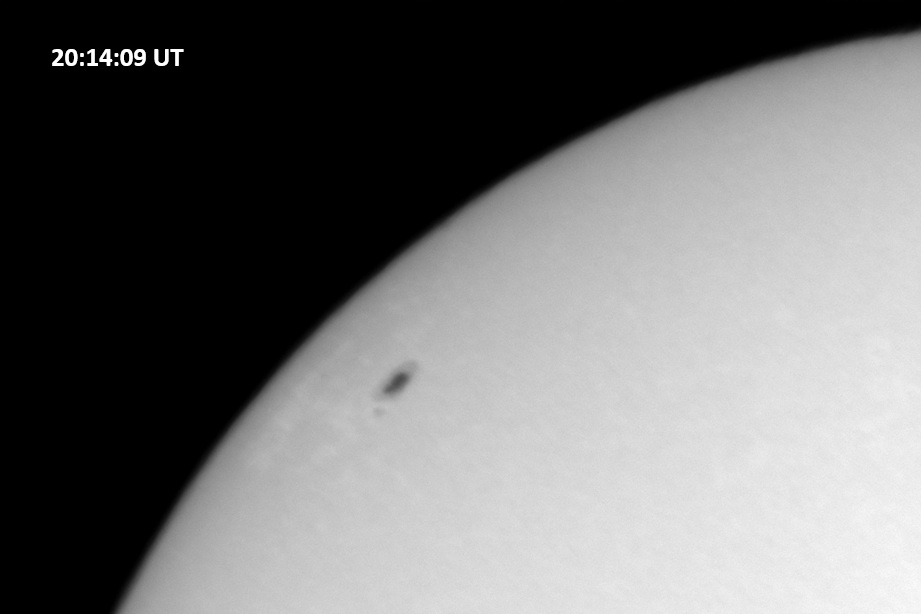 AR 14378 is the lone spot in the above image. It may be the leftover of AR 14366, which graced the Sun’s disk during the last rotation. AR 14378 is the lone spot in the above image. It may be the leftover of AR 14366, which graced the Sun’s disk during the last rotation. |
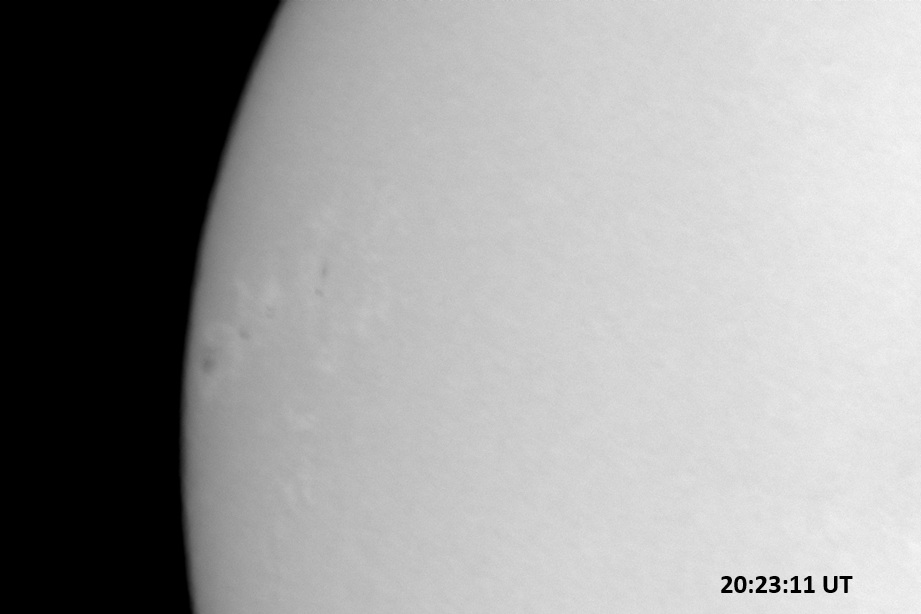 A string of spots is visible in this image. The leading pair, oriented vertically, is AR 14379. The remaining spots closer to the limb make up AR 14380. A string of spots is visible in this image. The leading pair, oriented vertically, is AR 14379. The remaining spots closer to the limb make up AR 14380. |
Solar activity is expected to be at low levels through 1 March with a chance for isolated M-class flare activity.
This will be the last posting as the observation program shuts down due to equipment issues and needed upgrades.
February 24, 2026
Solar activity was very low all day yesterday, with the background X-ray flux “flatlining” to as low as B2.9 level. It has since returned to low levels with a C1.0 flare today (24 February) at 7:33 UT, from an active region just beyond the SE limb, near latitude S21. The Sun returned to spotless today but some signs of change in the solar activity has been presenting itself, with a steadily increasing X-ray flux background. Since 7:33 UT, there had been a series of undulations taking on the form of five broad peaks and 9 shorter peaks in the C-class range of the X-ray flux plot. One peaked at C2.9 at 13:02UT; another at C4.5 (the largest of today so far, through 23:35 UT) at 17:12; and a series of 3 shorter peaks with the first one at 18:49 at C3.5. The X-ray background has been steadily decreasing since, but it has stayed above the C1.0 level all day.
The first column below includes red continuum images, each 0.09 sec exposure; and the second column hosts H-alpha line center images, each 0.15 sec exposure. Each of the four images covers 7.8’x11.4′ on the sky. Celestial north is up, west is right in each image.
 This frame is centered near the center of the solar disk, and only granulation is visible in this frame. There had been a small cluster of pores but they have since dissipated. This frame is centered near the center of the solar disk, and only granulation is visible in this frame. There had been a small cluster of pores but they have since dissipated. |
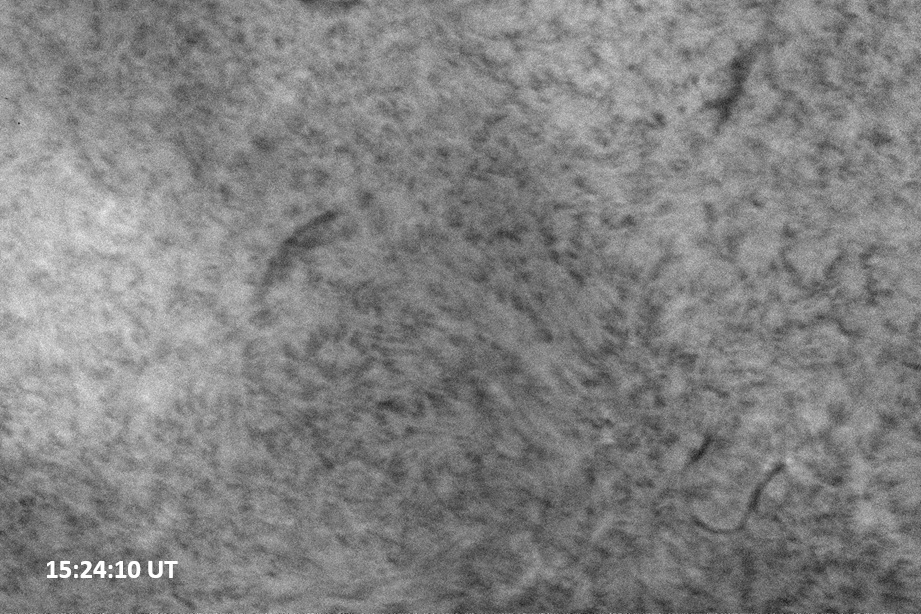 The same area of the Sun as depicted immediately left, reveals the overall H-alpha texture and several filaments. The bright patch along the left of the image is an artifact of the imaging system setup. The same area of the Sun as depicted immediately left, reveals the overall H-alpha texture and several filaments. The bright patch along the left of the image is an artifact of the imaging system setup. |
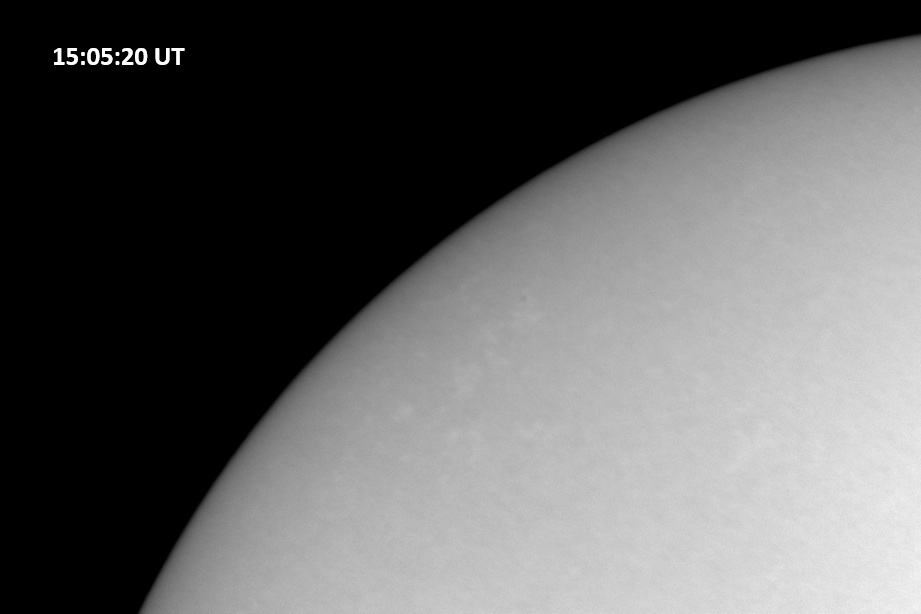 The ENE limb of the Sun shows possibly a pore along with several faculae (bright patches). The ENE limb of the Sun shows possibly a pore along with several faculae (bright patches). |
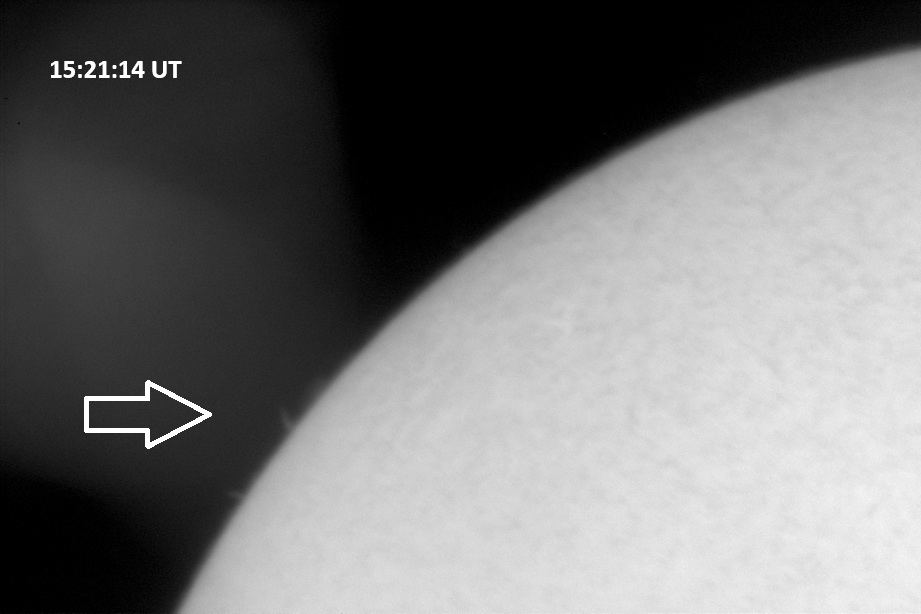 The arrow points to some limb activity in H-alpha that may be heralding the return of AR 14366. The bright patch is internal system reflection of H-alpha light. The arrow points to some limb activity in H-alpha that may be heralding the return of AR 14366. The bright patch is internal system reflection of H-alpha light. |
Solar activity is expected to be very low, with a chance for C-class flares and a very slight chance (1%) for an M-class flare through 26 February.
February 23, 2026
Solar activity continues to be at low levels as the Sun becomes spotless. That feat was actually achieved yesterday when the disk was virtually spotless. However, there were four low-level C-class flares yesterday. One was a long-duration C1.5 flare at 16:41 UTC on 22 February from an active region over the WSW limb. A 15 degree long prominence erupted off the SE limb at about 15:30 UTC on 22 February. The active regions that were expected to rotate into view by the end of last week never materialized. However, AR 14366 is expected to return in the next several days. It had been monitored (along with five additional much smaller spot groups) by the Mars Perseverance rover as the spot group crossed the far side of the Sun. Mars and the rover are on the far side of the Sun as seen from Earth. The below image, from spaceweather.com and NASA from 19 February.
Meanwhile today’s “nearside” solar image from the GONG (Global Oscillation Network Group) network of solar observatories reveals a much different picture:
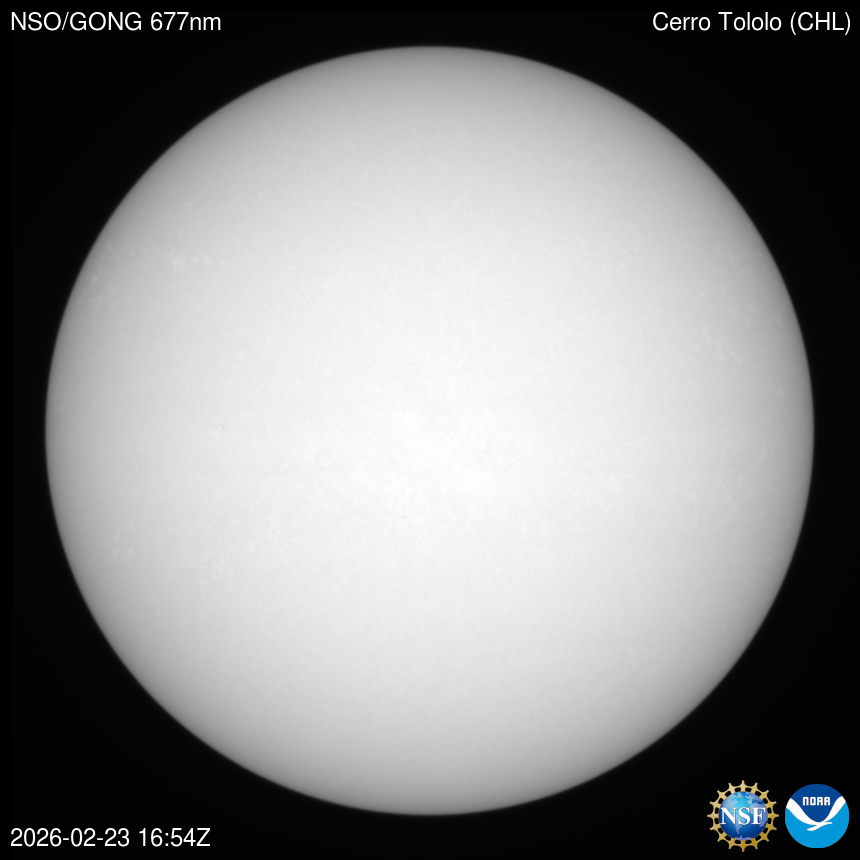
Solar activity is expected to be very low, with a chance for C-class flares and a slight chance for an M-class flare, through 25 February.
February 19, 2026
Solar activity continues to be at low levels as the Sun becomes more spotless. There are only three spotted active regions on the visible solar disk, a larger spot and two small spot groups. An unnumbered region of plage produced a C2.1 flare at 20:42 UT, mentioned below on 18 February. Another unnumbered plage region produced a C2.0 flare from near N20W48 (the northwest quadrant). AR 14374 produced a C1.0 at 10:15 UT today, 19 February. AR 14374 is simplifying some as is AR 14377; AR 14375 remained stable. A filament disappeared in the northwest quadrant of the solar disk at approximately 21:00 UT on 18 February. Most of the material likely fell back to the solar surface.
Observations were again made under less-than-ideal conditions, with haze, abundant cumulus cloud, and limited observing time. Exposures were lengthened due to the presence of haze. The first column below includes red continuum images, each 0.15 sec exposure; and the second column hosts H-alpha line center images, each 0.25 sec exposure. Each of the four images covers 7.8’x11.4′ on the sky. Celestial north is up, west is right in each image.
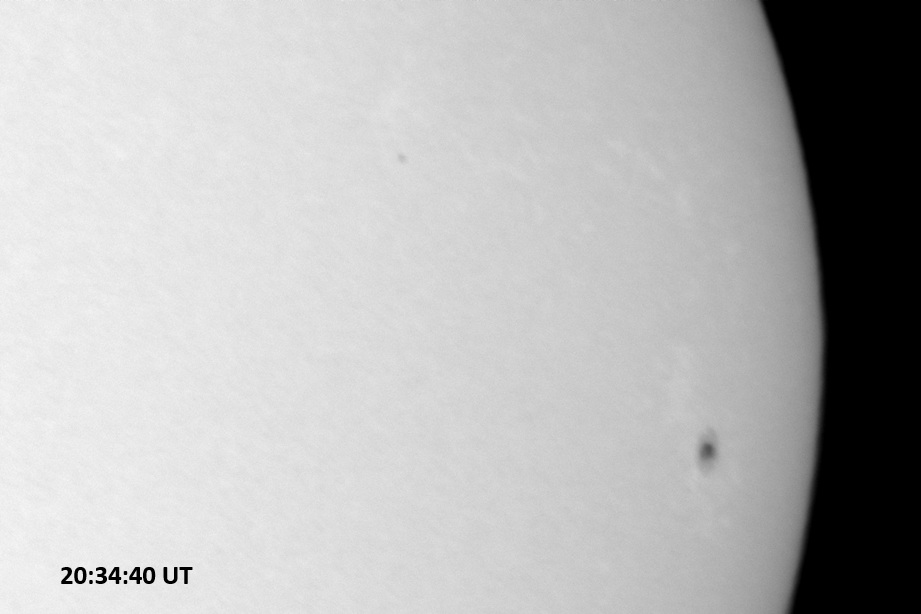 AR 14375 (top center) and 14374 (right). AR 14375 (top center) and 14374 (right). |
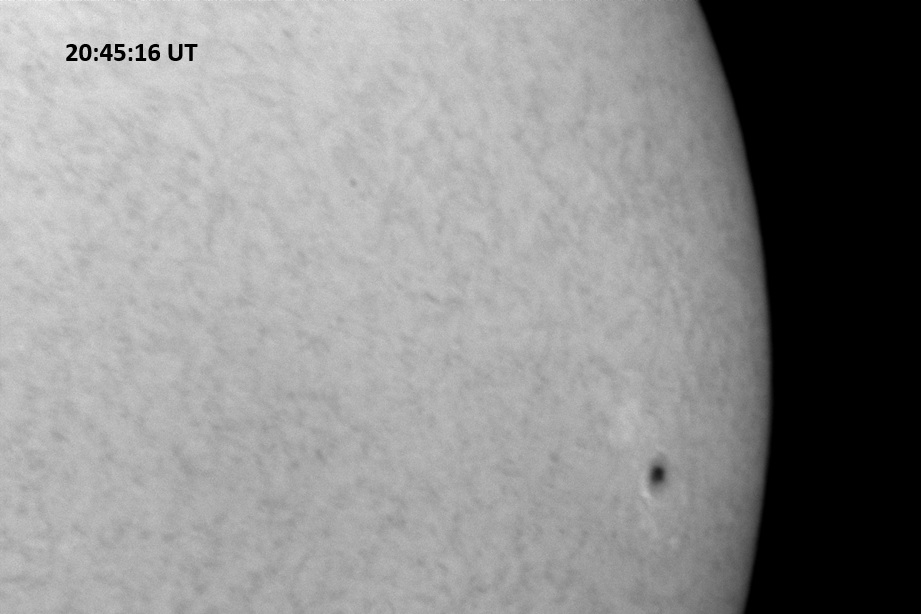 AR 14374 has produced an occasional low level C-class flare but has been quiet. AR 14374 has produced an occasional low level C-class flare but has been quiet. |
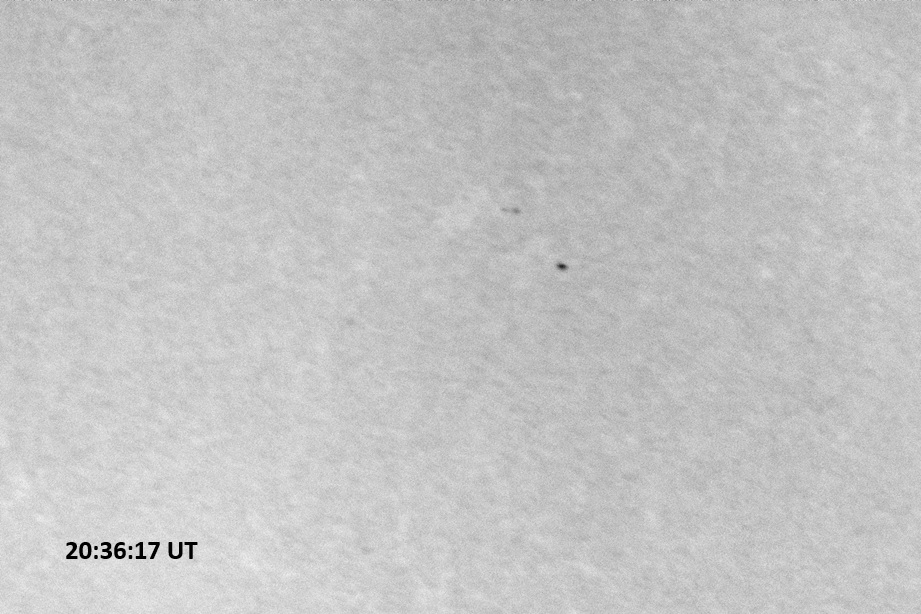 AR 14377 continues to be small and simple. AR 14377 continues to be small and simple. |
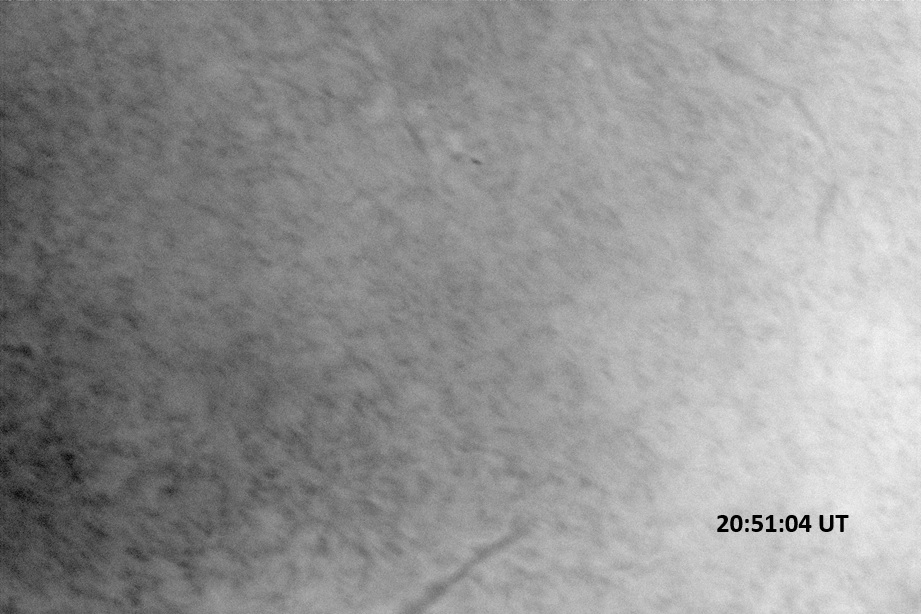 AR 14377 almost disappears in this image, which features a few small filaments. AR 14377 almost disappears in this image, which features a few small filaments. |
Solar activity is expected to be low, with a slight chance for an M-class flare, through 22 February.
February 18, 2026
Solar activity remains at low levels. The strongest event, both yesterday and today (through 21:55 UT 18 February) was a long duration C2.2 flare peaking at 20:42 UT from an unnumbered region near S07 E61. AR 14374 produced a C1.8 flare at 23:23 UT, 17 February; and a C1.4 flare at 0:50 UT on 18 February. An unnumbered region (possibly the source of today’s C2) produced a C1.1 flare from near S05 E85. AR 14374 is slowly decaying, and AR 14373 has rotated over the western limb. There are a total of three spotted regions currently, AR 14374, 14375, and 14377. The latter two were mostly unchanged from yesterday.
Another large filament erupted from beyond the southwestern limb starting at about 4:08 UT on 18 February. This produced a CME that will miss Earth. This is likely the same filament that graced the southern part of the solar disk last week.
Observations were again made under less-than-ideal conditions. Exposures were lengthened due to the presence of high cirrus clouds. The first column below includes red continuum images, each 0.15 sec exposure; and the second column hosts H-alpha line center images, each 0.25 sec exposure. Each of the four images covers 7.8’x11.4′ on the sky. Celestial north is up, west is right in each image.
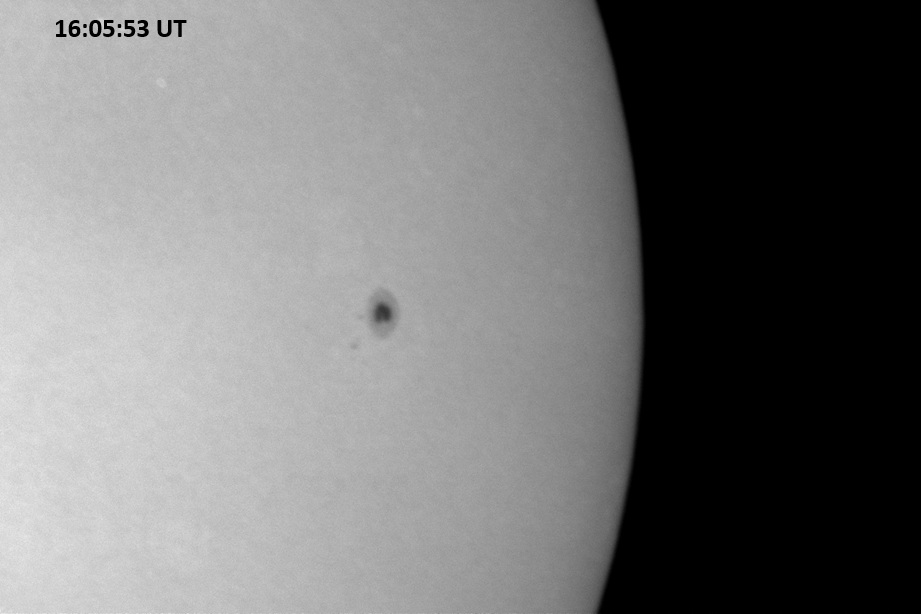 AR 14374 starts to approach the western limb. It is the largest spot currently visible on the Sun. AR 14374 starts to approach the western limb. It is the largest spot currently visible on the Sun. |
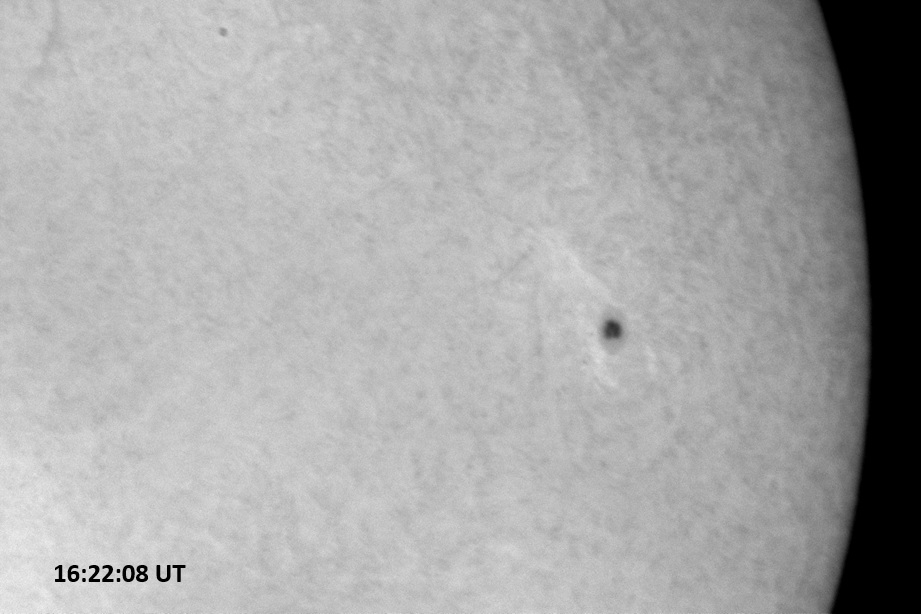 AR 14374 had produced an occasional C-class flare but this part of the Sun has been quiet overall. AR 14374 had produced an occasional C-class flare but this part of the Sun has been quiet overall. |
 AR 14377 (left) and 14375 (right) continue to persist on the solar disk. AR 14377 (left) and 14375 (right) continue to persist on the solar disk. |
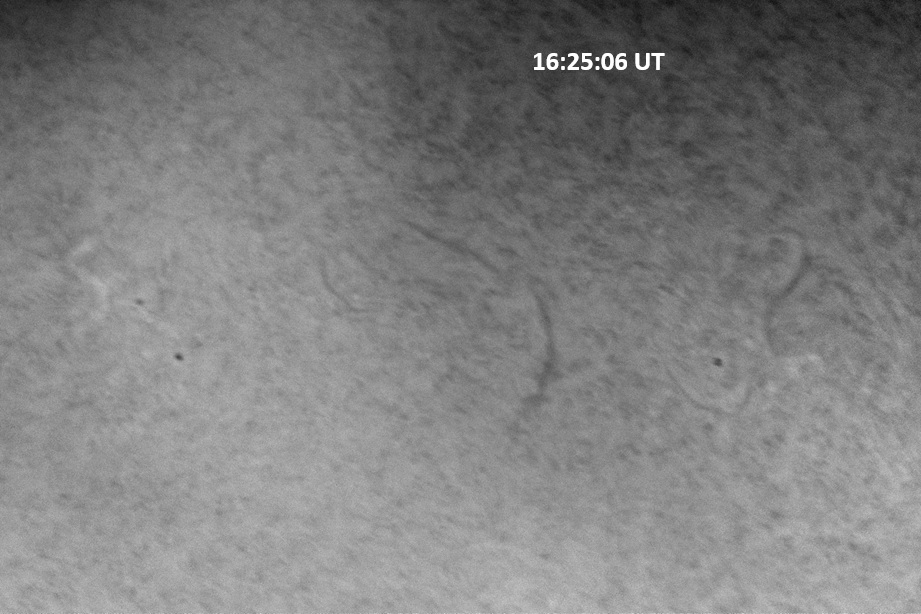 AR 14377 and 14375, along with a lengthening filament, are visible in the above image. AR 14377 and 14375, along with a lengthening filament, are visible in the above image. |
Solar activity is expected to be low, with a slight chance for an M-class flare, through 20 February.
February 17, 2026
Solar activity was very low to low. A filament erupted and generated a C1.0 flare from an unnumbered region just behind the SE limb of the Sun. AR 14374 has grown slightly, with the rest of the sunspot groups (three in total, including 14374) remaining stable. A filament just south of disk-center began to erupt yesterday (16 February) around 12:30 UT. This produced a very faint CME that continued off the northeast limb.
Observations were made under less-than-ideal conditions. Exposures were lengthened due to the presence of high cirrus clouds. The first column below includes red continuum images, each 0.15 sec exposure; and the second column hosts H-alpha line center images, each 0.25 sec exposure.Each of the four images covers 7.8’x11.4′ on the sky. Celestial north is up, west is right in each image.
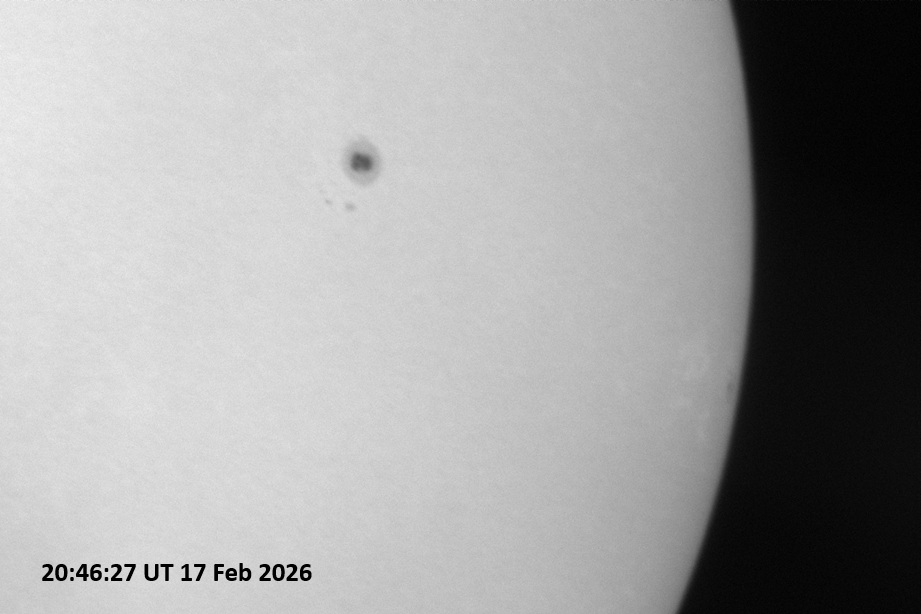 AR 14373 (top center) and 14373 (lower right on Sun’s edge). AR 14373 (top center) and 14373 (lower right on Sun’s edge). |
 AR 14374 has been quiet all day today, as has this zone of the Sun. AR 14374 has been quiet all day today, as has this zone of the Sun. |
 AR 14377 (left of center) and 14375 (right, on edge of frame), two tiny spot groups. AR 14377 (left of center) and 14375 (right, on edge of frame), two tiny spot groups. |
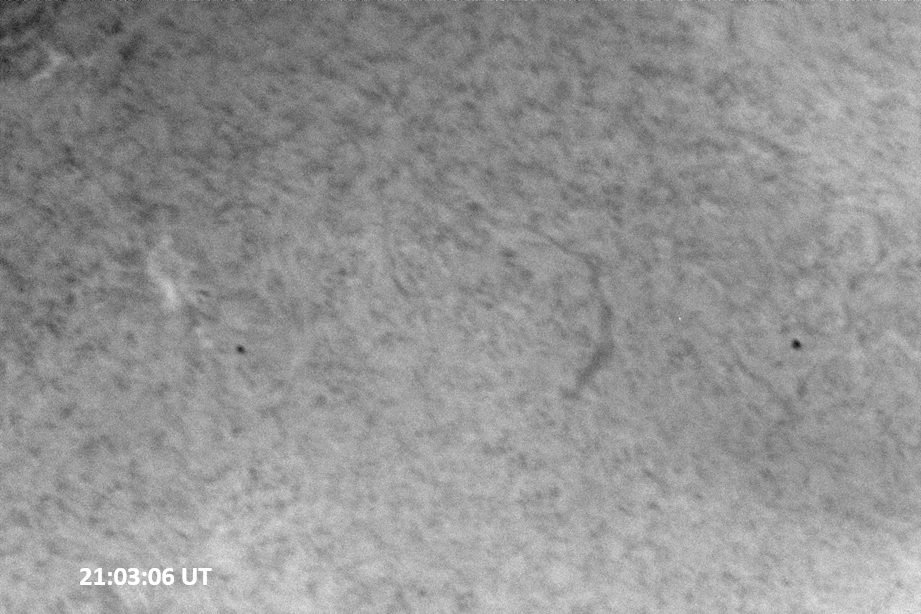 AR 14377 is marked by bright plage (left) and a filament (just right of image center) is visible in this region of the Sun. AR 14377 is marked by bright plage (left) and a filament (just right of image center) is visible in this region of the Sun. |
Solar activity is expected to be low through 18 February with a slight chance of an M-class flare.
February 16, 2026
Solar activity reached moderate levels early today after an M2.4 flare that peaked at 4:35 UTC today (16 February). This came from an active region over the east limb and much of its energy was blocked by the Sun. This region will rotate into view sometime later this week. After this event, solar activity dropped to very low levels with only a C1.0 at 13:06 and an optical sub-flare from AR 14374 at 15:36. All five visible active regions were stable.
The first column below includes red continuum images, each 0.09 sec exposure; and the second column hosts H-alpha line center images, each 0.15 sec exposure. Each of the four images covers 7.8’x11.4′ on the sky. Celestial north is up, west is right in each image.
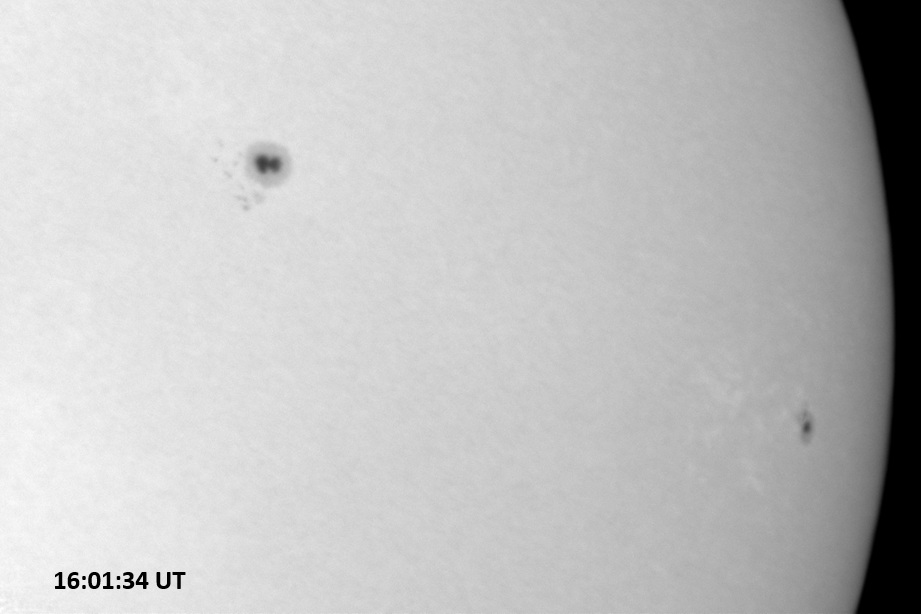 AR 14374 (upper left) and 14373 (lower right) are the two largest spot groups on the visible solar disk. AR 14374 (upper left) and 14373 (lower right) are the two largest spot groups on the visible solar disk. |
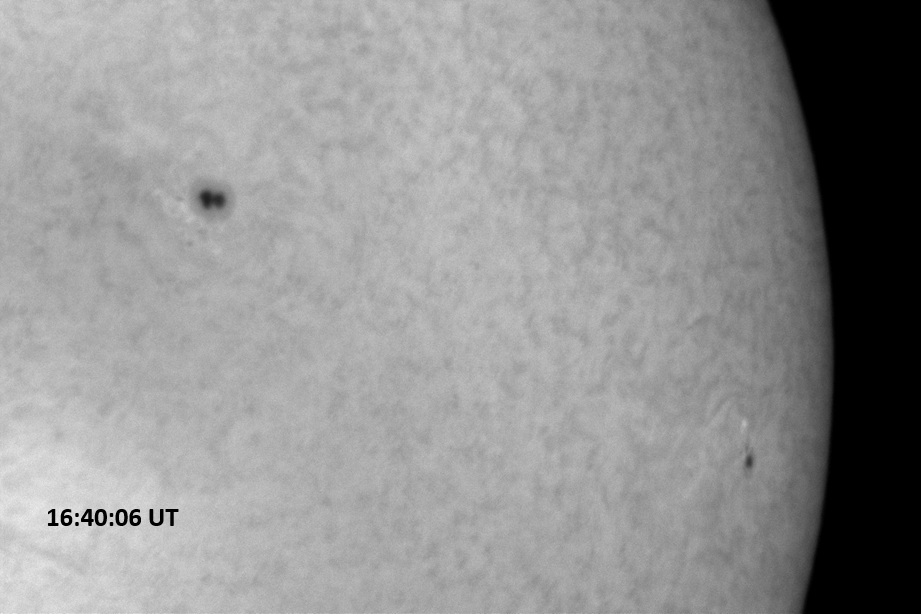 Small localized brightenings were observed next to each of these regions during today’s observations, but were not recorded as sub-flare events by NOAA. Small localized brightenings were observed next to each of these regions during today’s observations, but were not recorded as sub-flare events by NOAA. |
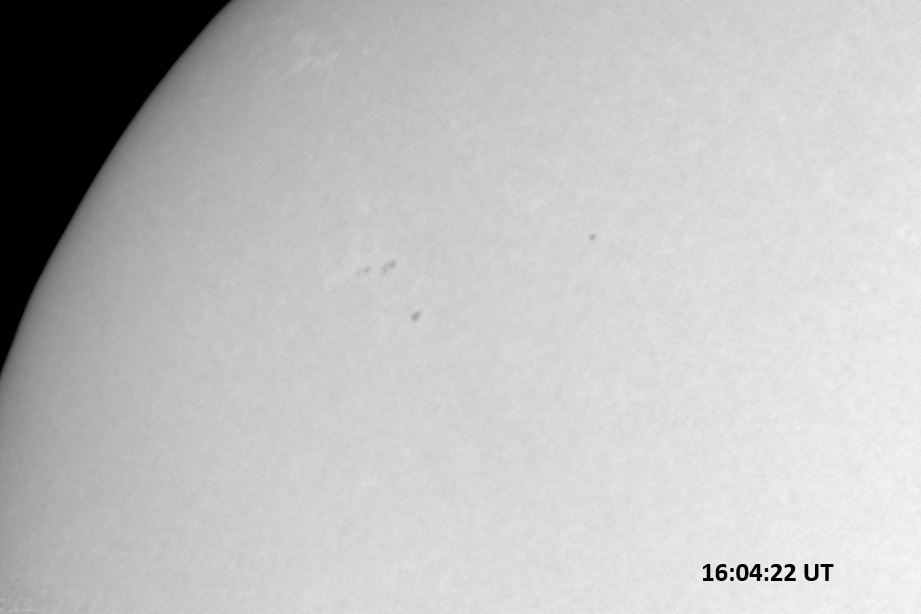 This nearly blank region of the Sun contains two small spotted groups: AR 14377 near image center, and 14376 (single spot) above and right of it. This nearly blank region of the Sun contains two small spotted groups: AR 14377 near image center, and 14376 (single spot) above and right of it. |
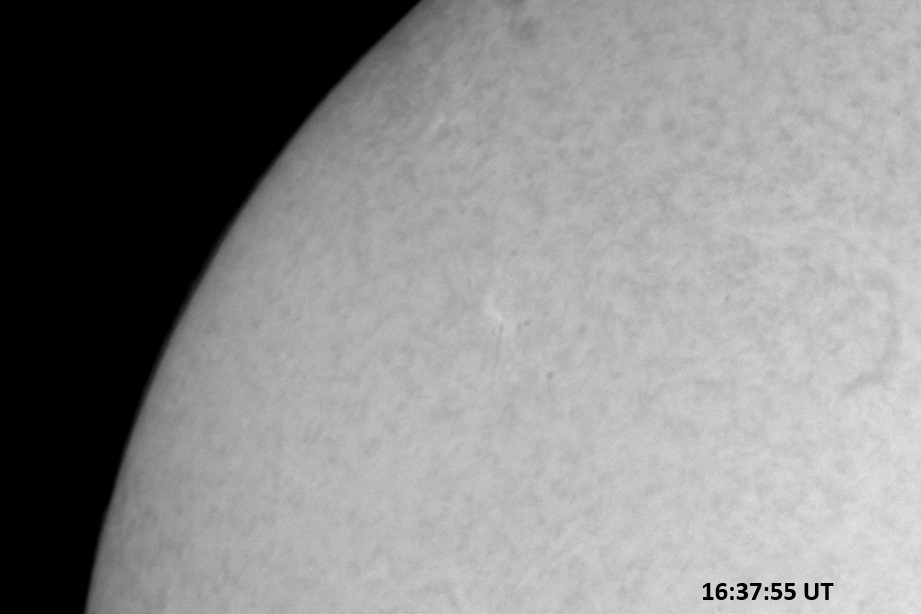 This zone of the Sun hides the two tiny spot groups in H-alpha texture, but AR 14377 shows as a bright spot This zone of the Sun hides the two tiny spot groups in H-alpha texture, but AR 14377 shows as a bright spot |
Solar activity is expected to be low through 18 February with a slight chance of an M-class flare.
February 12, 2026
Solar activity continued at moderate levels through early today with two M1.4 flares: one at 13:12 UT on 11 February, and the second at 2:40 UT today, 12 February, from newly-departed AR 14366. This region was the source of six C-class flares. Since the second M1.4 flare, solar activity returned to low levels, with the background X-ray levels steadily sloping downward as AR 14366 rotates further beyond the west limb. AR 14373 has shown some modest growth and additional sunspots; ARs 14369 and 14371 showed some minor decay. The rest of the regions were unchanged.
The first column below includes red continuum images, each 0.09 sec exposure; and the second column hosts H-alpha line center images, each 0.15 sec exposure. Each of the images covers 7.8’x7.8′ on the sky, unless indicated otherwise. Celestial north is up, west is right in each image.
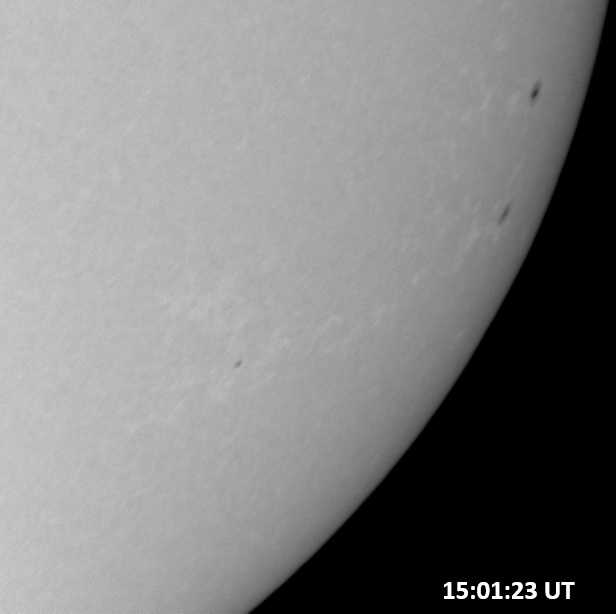 The AR 14369/14368 pair (upper right) is about to rotate out of view. The AR 14369/14368 pair (upper right) is about to rotate out of view. |
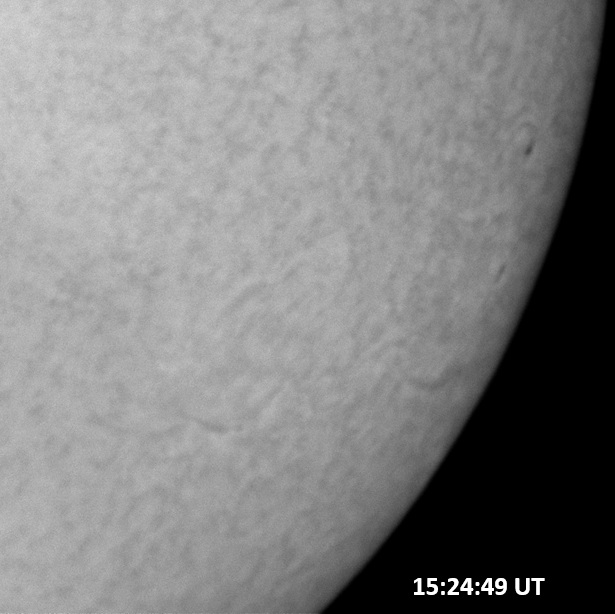 This zone of the Sun has been quiet. This zone of the Sun has been quiet. |
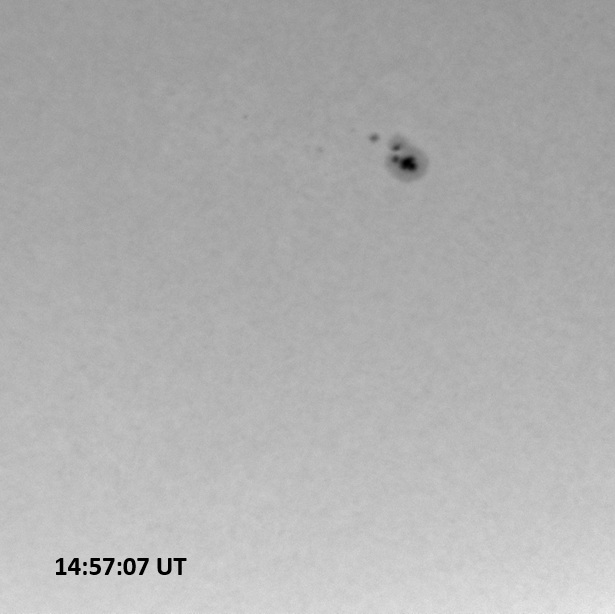 AR 14373 (above) is the only spot group in a large “sea” of featureless solar disk. AR 14373 (above) is the only spot group in a large “sea” of featureless solar disk. |
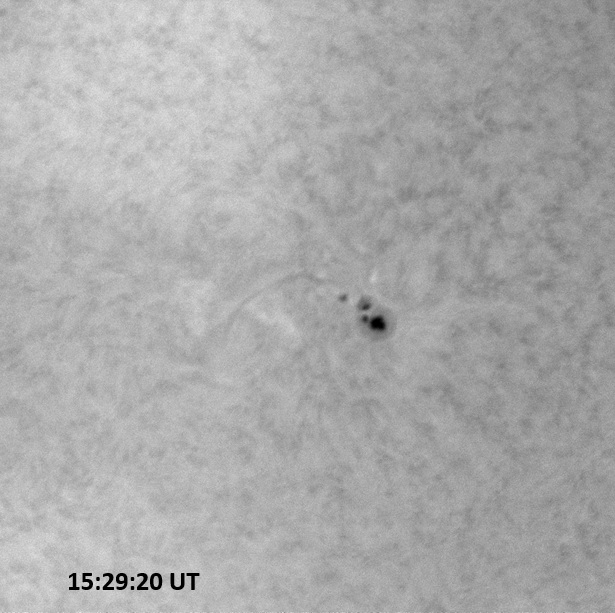 AR 14373 has remained quiet all day. AR 14373 has remained quiet all day. |
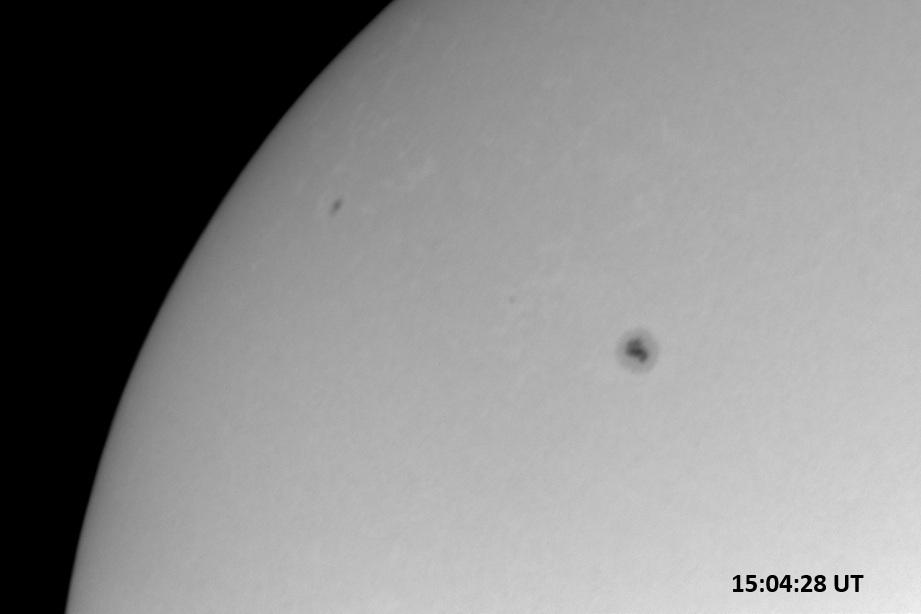 This 7.8’x11.4′ image depicts AR 14374 (right of image center) and 14375 (upper left) as they rotate into better view. This 7.8’x11.4′ image depicts AR 14374 (right of image center) and 14375 (upper left) as they rotate into better view. |
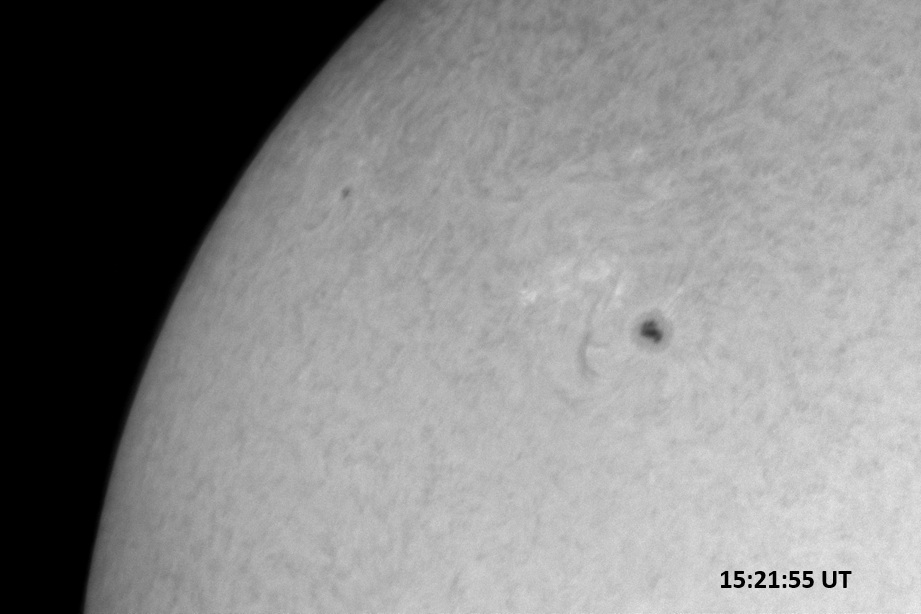 This 7.8’x11.4′ image shows the same view as at left, but in H-alpha. This zone of the Sun remains quiet as well. This 7.8’x11.4′ image shows the same view as at left, but in H-alpha. This zone of the Sun remains quiet as well. |
Solar activity is expected to be low, with a slight chance for M-class flares through 14 February.
February 11, 2026
Solar activity remained at moderate levels today. The largest was an M1.2 at 13:12 UT today from AR 14366. This region also produced a long duration, double-peaked M1.1 event, first peak at 0:44 UT. AR 14366 also produced eight C-class flares yesterday and today. AR 14366 has rotated over the west limb of the Sun and it was not visible either visually or in images taken this afternoon. Some modest limb activity in H-alpha marked the location of the region just over the solar limb. AR 14371 , 14373, and 14374 each produced C-class flares yesterday into this afternoon. AR 14371 and 14369 are in decay, with the other numbered active regions remaining stable. There is another region (AR 14375) that rotated into view behind AR 14374, but this was quiet.
A large filament in the northwest quadrant of the solar disk lifted off and disappeared around 19:10 UT on 10 February. There was possibly another eruption from the west southwest limb of the Sun, seen around 19:24 UT and superimposed on the eruption from the filament. It is yet to be determined if all this has generated a coronal mass ejection.
The first column below includes red continuum images, each 0.09 sec exposure; and the second column hosts H-alpha line center images, each 0.15 sec exposure. Each of the four images covers 7.8’x11.4′ on the sky. Celestial north is up, west is right in each image.
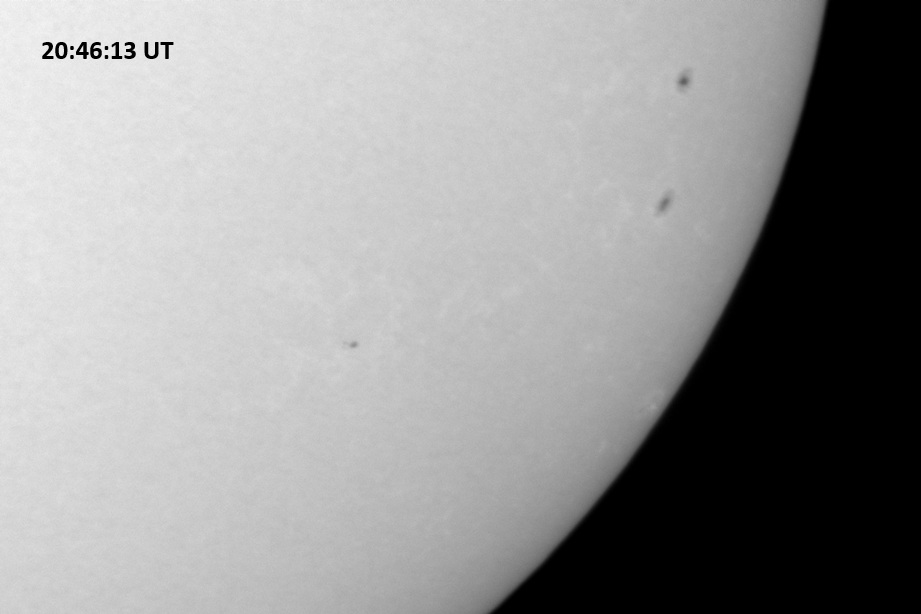 AR 14369 (upper most right), 14368 (upper right) and 14371 (just below and left of image center) appear modest in this view. AR 14369 (upper most right), 14368 (upper right) and 14371 (just below and left of image center) appear modest in this view. |
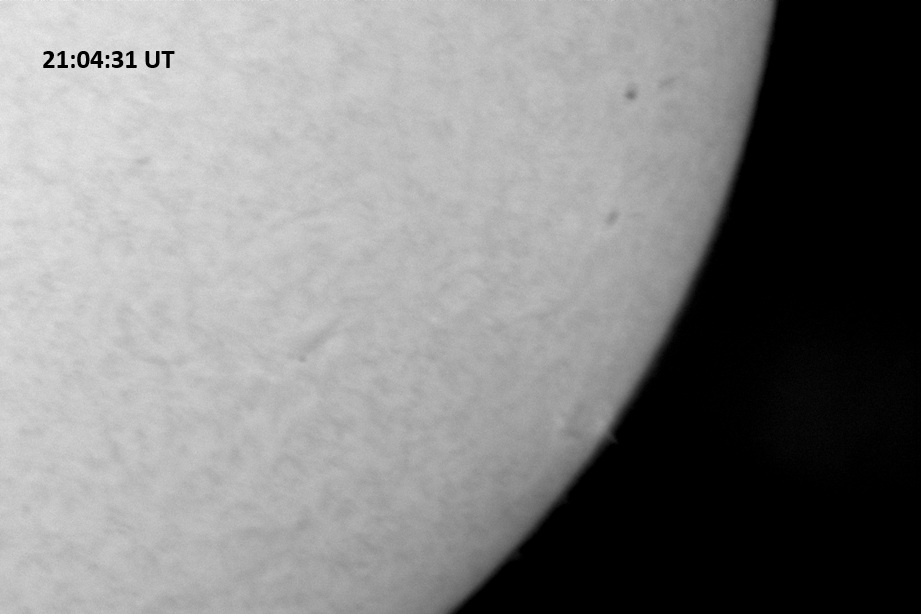 This zone of the Sun had been mostly quiet, except for an occasional C-class flare from AR 14371. This zone of the Sun had been mostly quiet, except for an occasional C-class flare from AR 14371. |
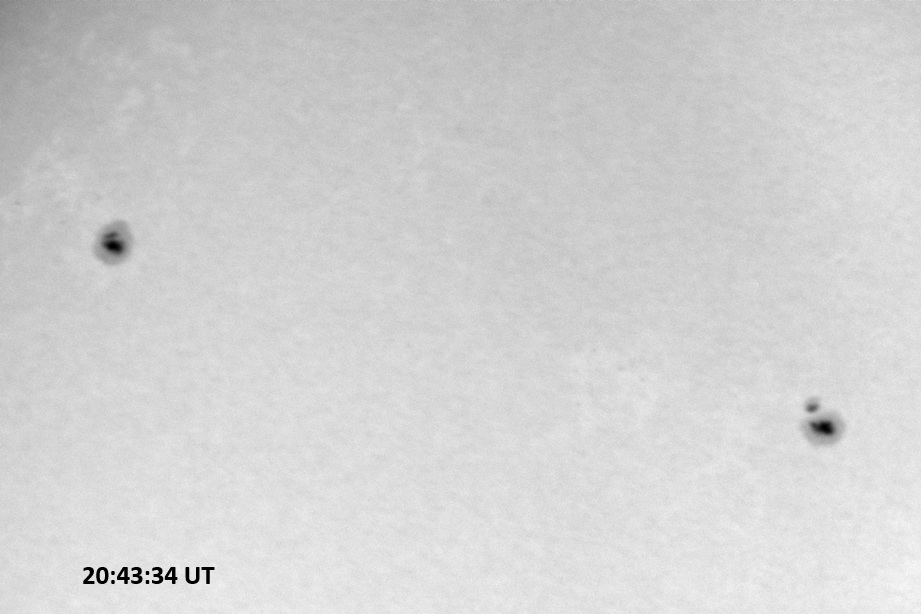 AR 14374 (upper left) and 14373 (lower right) appear rather simple in this view. AR 14374 (upper left) and 14373 (lower right) appear rather simple in this view. |
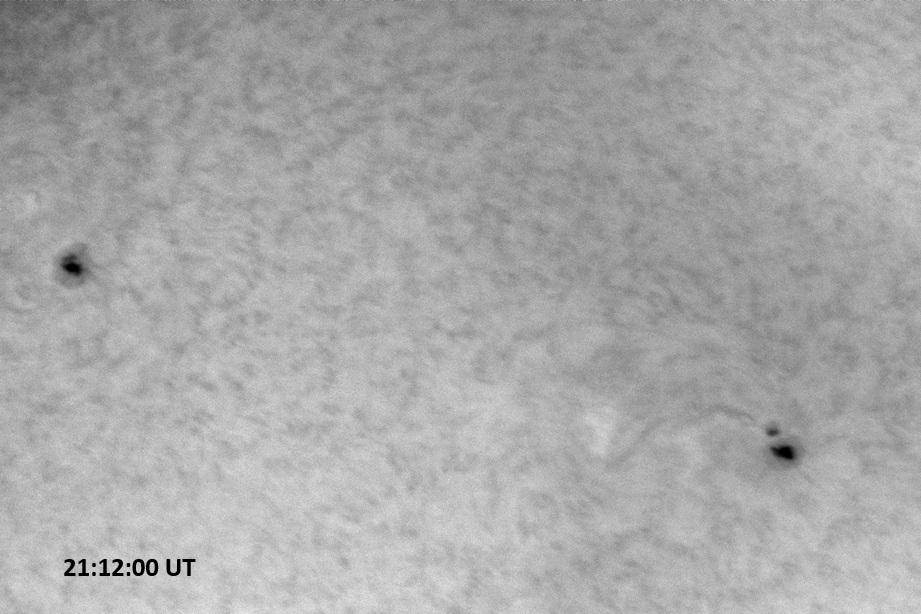 Each of these regions have produced low-level C-class flares today and yesterday. Each of these regions have produced low-level C-class flares today and yesterday. |
Solar activity is expected to be low through 13 February. There remains a slight chance (10-15%) for an M-class and/or X-class flaring from over the western limb by AR 14366.
February 9, 2026
Solar activity reached moderate levels yesterday and early today, before returning to low levels all day today. AR 14366 produced two M-class flares, the largest of which was an M2.8 at 2:27 UT today (9 February). The region continues to be the largest, most magnetically complex on the visible solar disk, but it is approaching the western limb. It has also been on a slow decay. AR 14374 rotated into view and produced a C6.6 flare at 8:36 UT on the 9th. This, and the other active regions on the solar disk were largely stable. AR 14366, beside the M2.8 today, produced 6 C-class flares, the most recent of which occurred at 15:36 UT. Then it went quiet for the rest of the day (through 23:15 UT). AR 14374 produced another C-class flare, a C3.0 at 18:17 UT today.
The first column below includes red continuum images, each 0.09 sec exposure; and the second column hosts H-alpha line center images, each 0.15 sec exposure. Each of the four images covers 7.8’x11.4′ on the sky. Celestial north is up, west is right in each image.
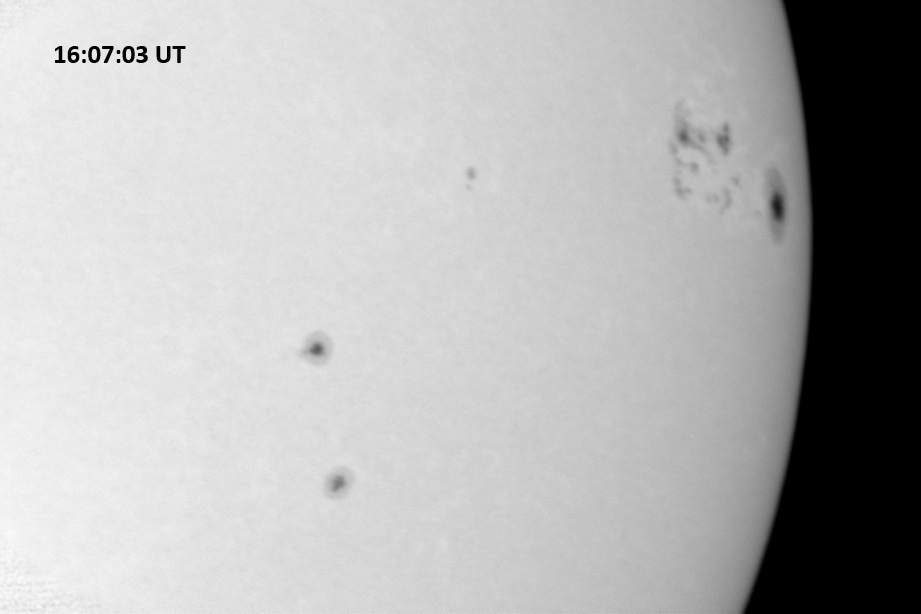 AR 14366 (right, near edge of Sun) prepares to rotate out of view. The remaining spots are (top to bottom) AR 14367, 14369, and 14368. AR 14366 (right, near edge of Sun) prepares to rotate out of view. The remaining spots are (top to bottom) AR 14367, 14369, and 14368. |
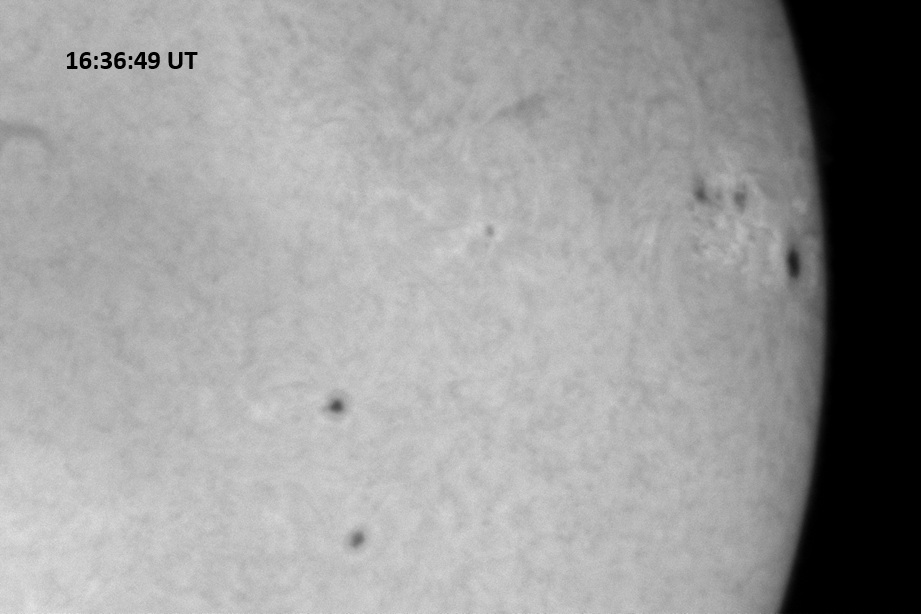 This zone of the Sun, as well as the rest of the Sun, has been mainly quiet for the duration of our long observing session today. This zone of the Sun, as well as the rest of the Sun, has been mainly quiet for the duration of our long observing session today. |
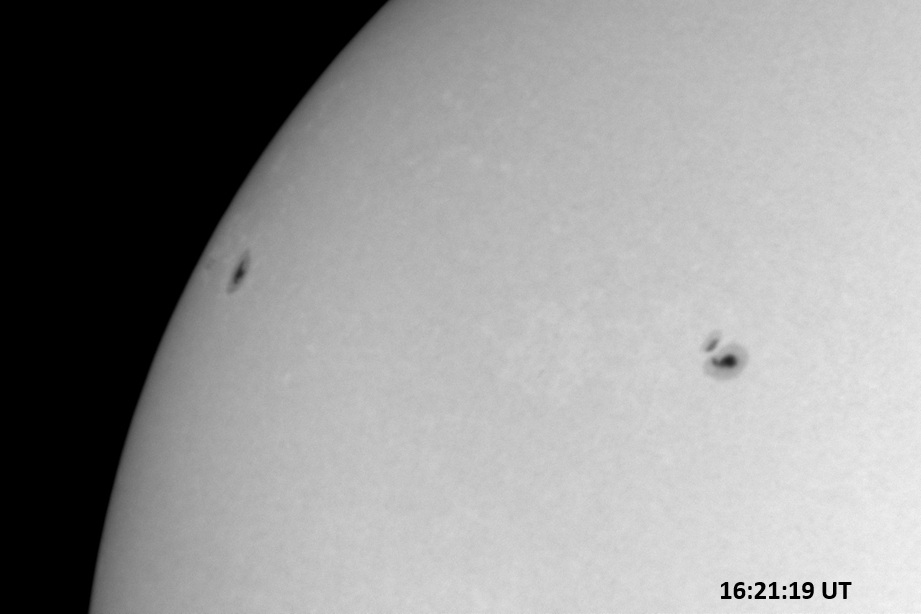 AR 14374 (left, near edge of Sun) and 14373 (right) are the only spotted regions on the eastern half of the solar disk. AR 14374 (left, near edge of Sun) and 14373 (right) are the only spotted regions on the eastern half of the solar disk. |
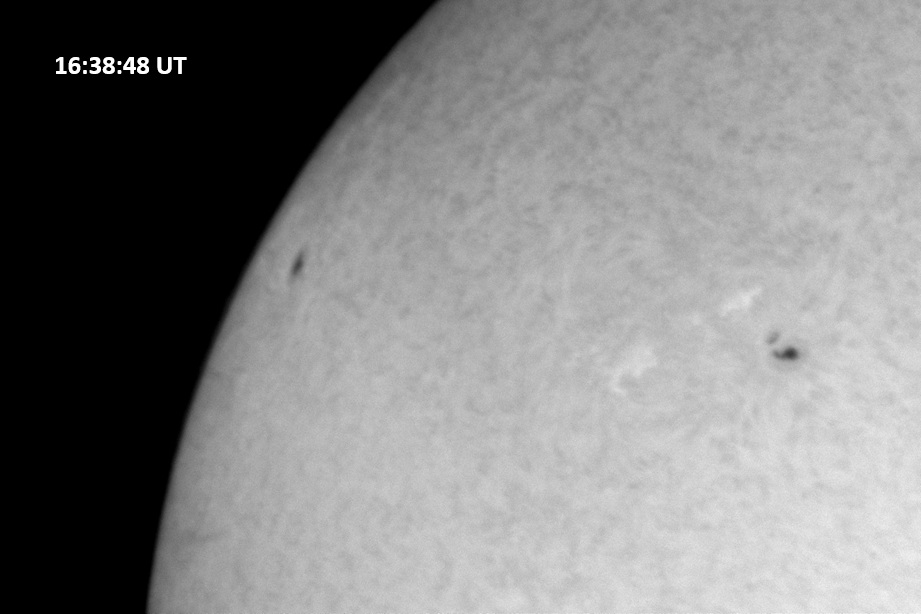 AR 14374 (near the edge of the Sun) produced two C-class flares so far today. AR 14374 (near the edge of the Sun) produced two C-class flares so far today. |
Solar activity is expected to be moderate with M-class flares likely and a chance for an X-class flare from AR 14366 through 11 February.
February 6, 2026
Solar activity returned to low levels today. Since the last of a series of M-class flares (an M1.1 at 22:18 UT yesterday, 5 February, from AR 14272, which has decayed to plage), there has been no further M-class flare activity today, through 23:15 UT. The most powerful flare of yesterday was a long duration M2.7 at 4:41 UT on 5 February from AR 14366. This region continues to slowly decline in magnetic complexity and optical appearance and today’s activity level matches these observations. AR 14371, however, showed rapid growth and became more magnetically complex. AR 14362 has also grown some and together with AR 14371, was the source for most of the C- and M-class flares yesterday. Today, only C-class flares, mostly from AR 14366; the strongest was a C6.9 at 10:20 UT today, 6 February. All of the other visible spotted active regions (there are seven total) were stable or in decay.
A coronal mass ejection launched off the south/southwest limb at 15:48 UT on 5 February, likely from the M1.8/1N flare that was produced from AR 14362, which peaked at 15:13 UT on 5 February. We observed part of the tail end of this event. This CME may graze the Earth’s magnetic field anytime between late on 8 February and early on 9 February (UT).
The first column below includes red continuum images, each 0.09 sec exposure; and the second column hosts H-alpha line center images, each 0.15 sec exposure. Each of the four images covers 7.8’x11.4′ on the sky. Celestial north is up, west is right in each image.
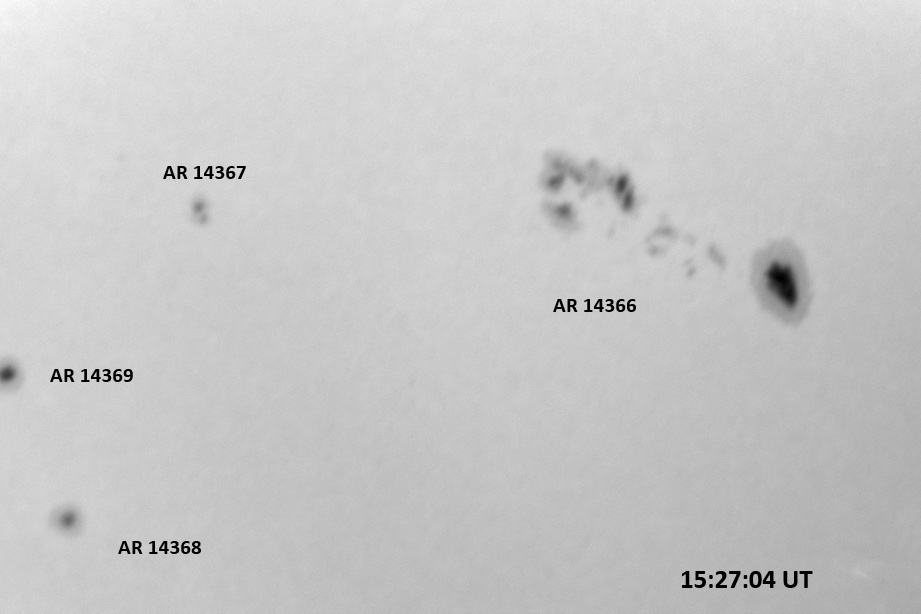 Four spotted active regions (labeled) cross the center of the Solar disk. Four spotted active regions (labeled) cross the center of the Solar disk. |
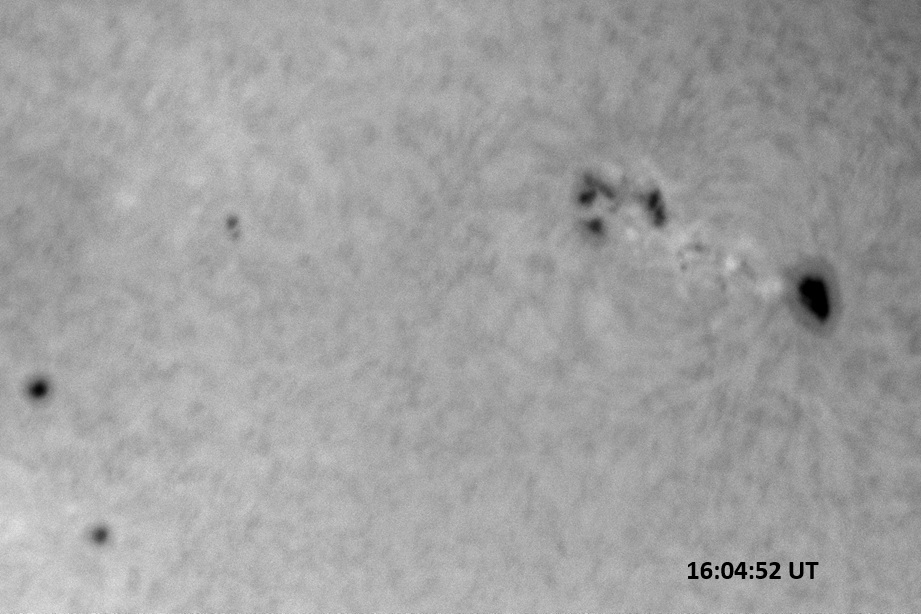 AR 14366 (right) has become increasingly quiet, only producing a few C-class flares today. AR 14366 (right) has become increasingly quiet, only producing a few C-class flares today. |
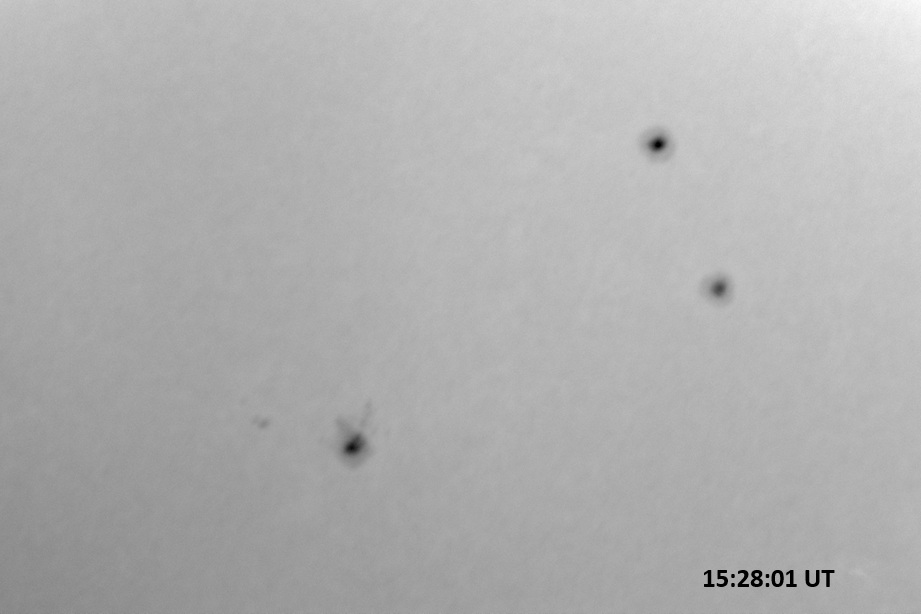 The two spots in the upper right appear in the top image. The one near bottom, left of center, is AR 14371. The two spots in the upper right appear in the top image. The one near bottom, left of center, is AR 14371. |
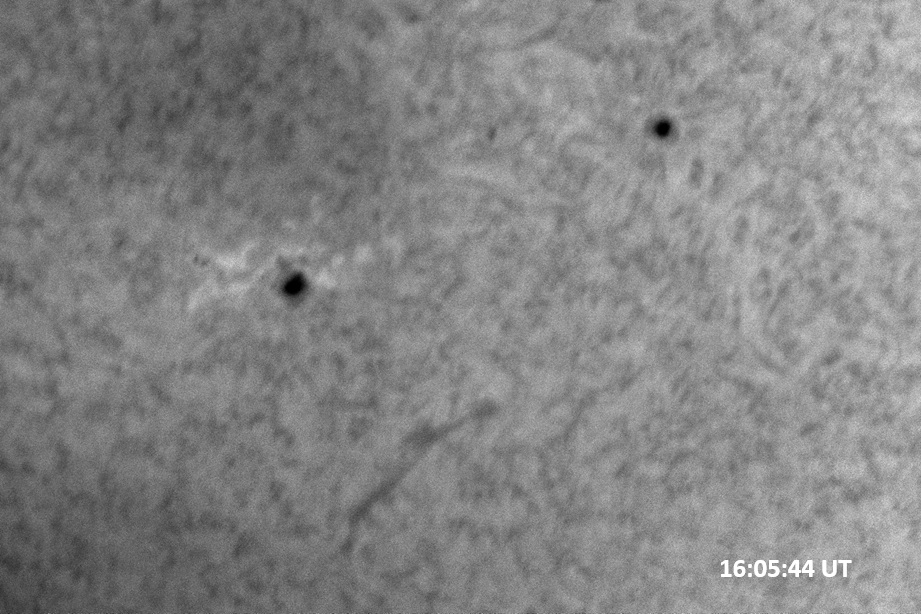 AR 14371 (left), and 14368 (upper right) along with a filament (bottom center). AR 14371 is becoming increasing AR 14371 (left), and 14368 (upper right) along with a filament (bottom center). AR 14371 is becoming increasing |
Solar activity is expected to be moderate to high due to continued M-class flaring with a chance for an X-class flare from AR 14366 through 8 February.
February 5, 2026
Solar activity was high due to the frequent occurrences of M-class flares from various regions today. There were ten M-class flares from three regions (AR 14362, 14366, and 14372). AR 14366 contributed most of these as it slowly decays and simplifies. AR 14369 grew some while 14370 decayed, and the remainder of the regions were stable or in decay.
We monitored AR 14366 for most of the day today. We managed to observe one M-class flare but the other M-class flares that occurred during the period were from AR 14362 (two events, an M1.8 and an M2.2). No further X-class flare has happened since the impulsive X4.2 at 12:13 UT on 4 February.
The first column below includes red continuum images, each 0.09 sec exposure; and the second column hosts H-alpha line center images, each 0.15 sec exposure. Each of the four images covers 7.8’x11.4′ on the sky. Celestial north is up, west is right in each image.
 AR 14366 (larger spot group) is being trailed by 14367 (left). AR 14366 (larger spot group) is being trailed by 14367 (left). |
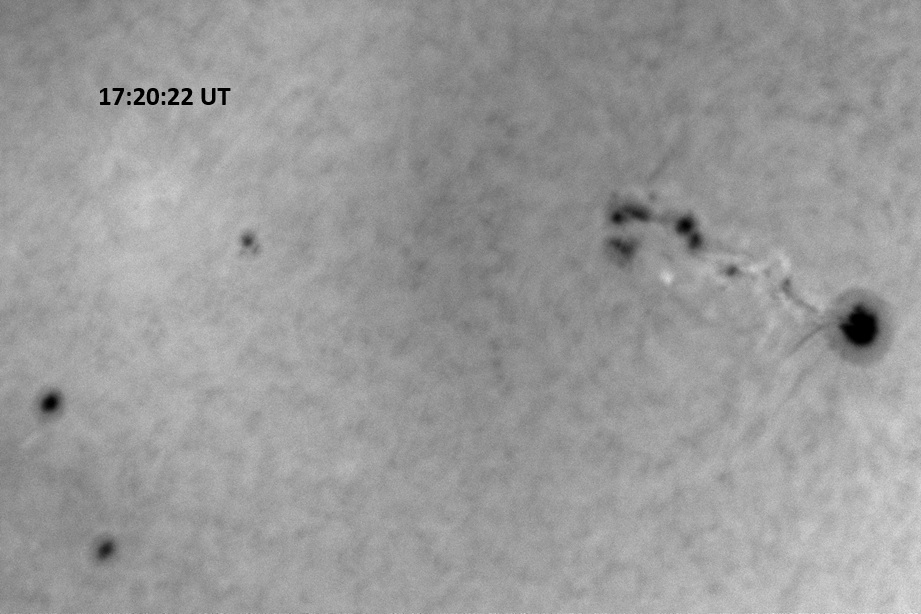 AR 14366 has been the source of a couple M-class flares today. AR 14366 has been the source of a couple M-class flares today. |
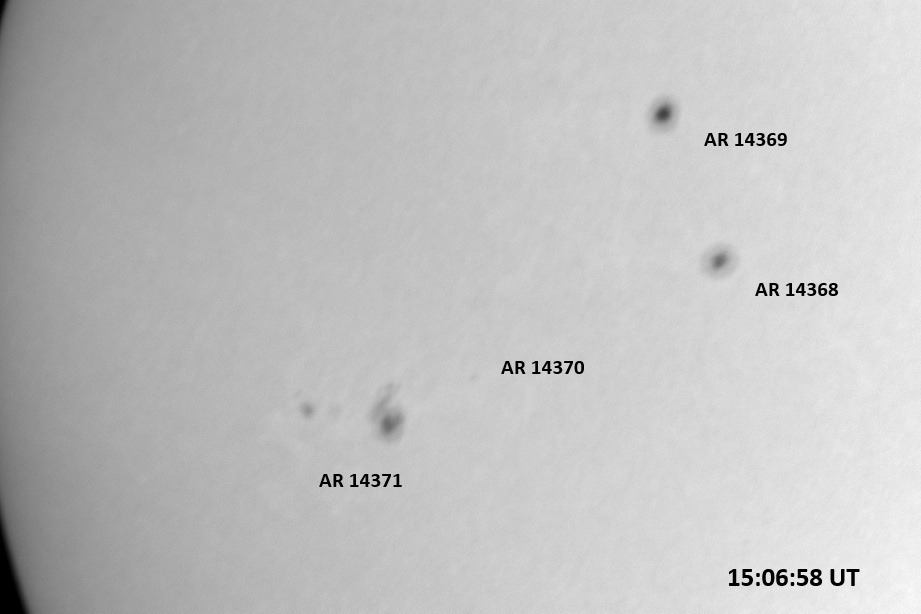 Four spotted active regions are visible in this image. Four spotted active regions are visible in this image. |
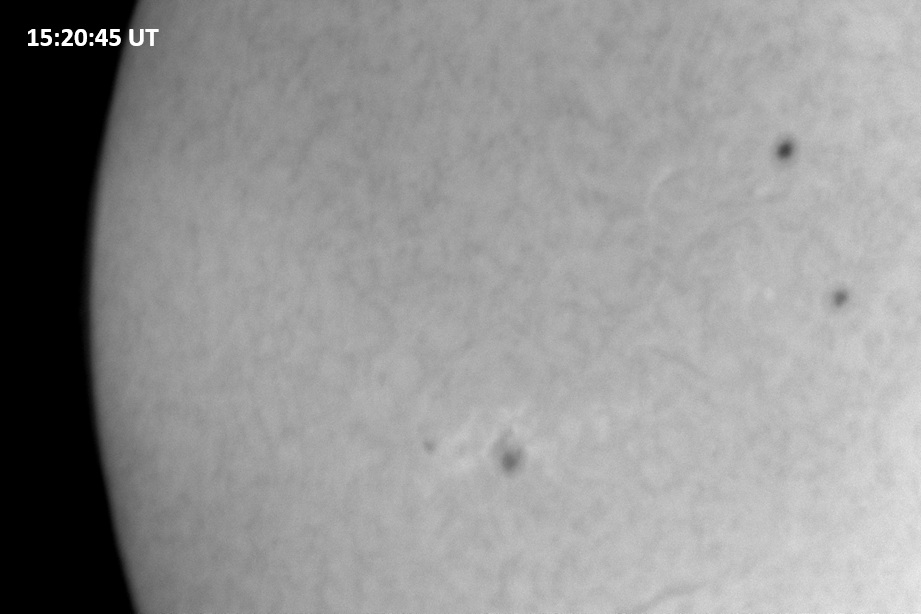 This part of the Sun has been mainly quiet today. This part of the Sun has been mainly quiet today. |
Solar activity is expected to be moderate to high due to continued M-class flaring with a good chance for an X-class flare from AR 14366 through 7 February.
February 4, 2026
Solar activity remains at high levels due to the ongoing activity of AR 14366. It produced an X4.2 today at 12:12 UT today. This occurred nearly a day after an X1.5 flare at 14:08 UT on 3 February, followed by an M7.2. There has been a slight shrinkage in spot area, with the visual appearance of the spot group this morning being a little simpler than in previous days. It is by far the largest spot group of the 9 visible active regions, at 1100 MSH. AR 14372, in the southeast quadrant of the solar disk, emerged yesterday but is already in decay today. AR 14358 developed a few new sunspots after decaying to a spotless region yesterday. AR 14371 is showing growth, as is AR 14362. The rest of the active regions were stable or in slight decay.
A large filament slowly erupted from the northwest quadrant of the solar disk beginning at 4:00 UT yesterday, 3 February. This generated a CME that lifted off the northwest limb around 18:00 UT. Several other filaments are visible today across the solar disk, as well as a well developed hedgerow prominence on the east southeastern limb.
Observations resumed today but with glitches in communication between the mount and computer ongoing. AR 14366 produced an M1.8 flare at 15:34 UT, prior to our opening the dome at 17:00 UT. However, since opening and through our closure at 20:02 UT due to overspreading mid- to high-level clouds, solar activity dropped back to low levels. There had not been any further M-class activity since this morning’s M1.8, through 23:20 UT today (4 February).
The first column below includes red continuum images, each 0.09 sec exposure; and the second column hosts H-alpha line center images, each 0.15 sec exposure. Each of the four images covers 7.8’x11.4′ on the sky. Celestial north is up, west is right in each image.
 AR 14366 is the largest spot group on the visible disk. AR 14366 is the largest spot group on the visible disk. |
 AR 14366 was the most active spot group, and had been for four days now. AR 14366 was the most active spot group, and had been for four days now. |
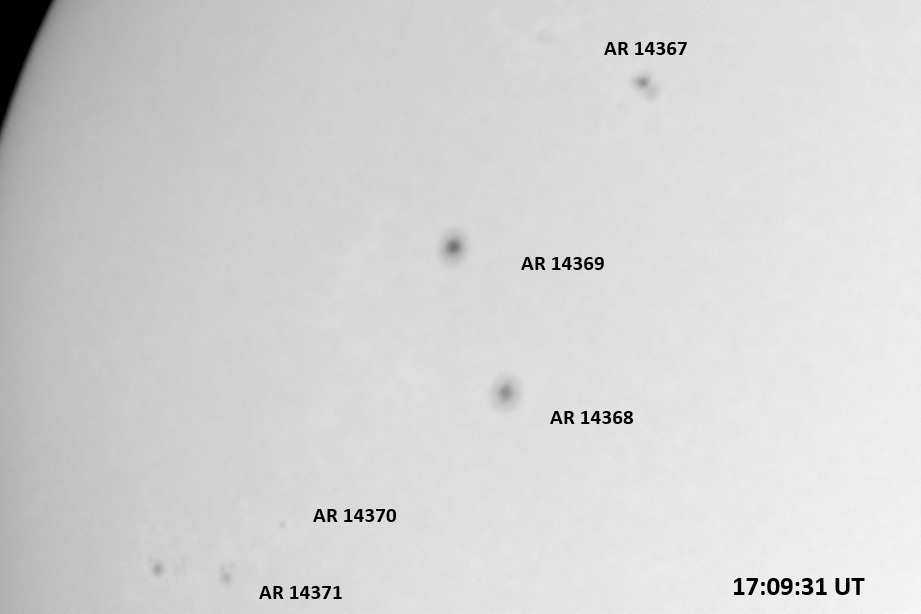 Many small active regions trail AR 14366. Many small active regions trail AR 14366. |
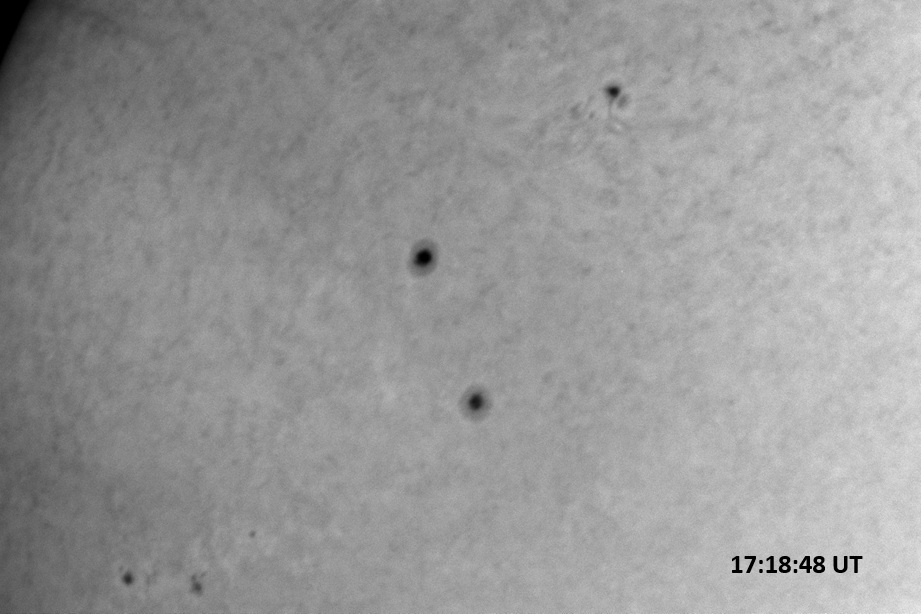 These regions have been comp These regions have been comp |
Solar activity is expected to be moderate to high due to continued M-class flaring with a good chance for an X-class flare from AR 14366 through 6 February.
February 2, 2026
Another attempt to collect solar observations was made this morning. The connection was successfully established with the mount and camera, but when commanded to slew to the Sun, the mount put itself in a safe mode and would not move. This error repeated for all three of the attempts made. We will be making further attempts to get the problem fixed Wednesday and Thursday of this week.
Solar activity has surged to very high levels in the last two days. A new spot group appeared on the Sun and grew explosively. It was invisible on the 28th of January, appeared as a simple pair of spots on the 29th, added new spots and began to fill in on the 30th; by the 31st it had grown dramatically and continued to do so through the 1st and 2nd of February. This is AR 14366, which, in the past 24 hours or so, produced 23 M-class flares and 4 X-class flares, the largest of which was an X8.1 that happened at 23:57 UT yesterday. The complex series of events launched a tangle of three coronal mass ejections into space, but they appear to be on track to mostly miss the Earth
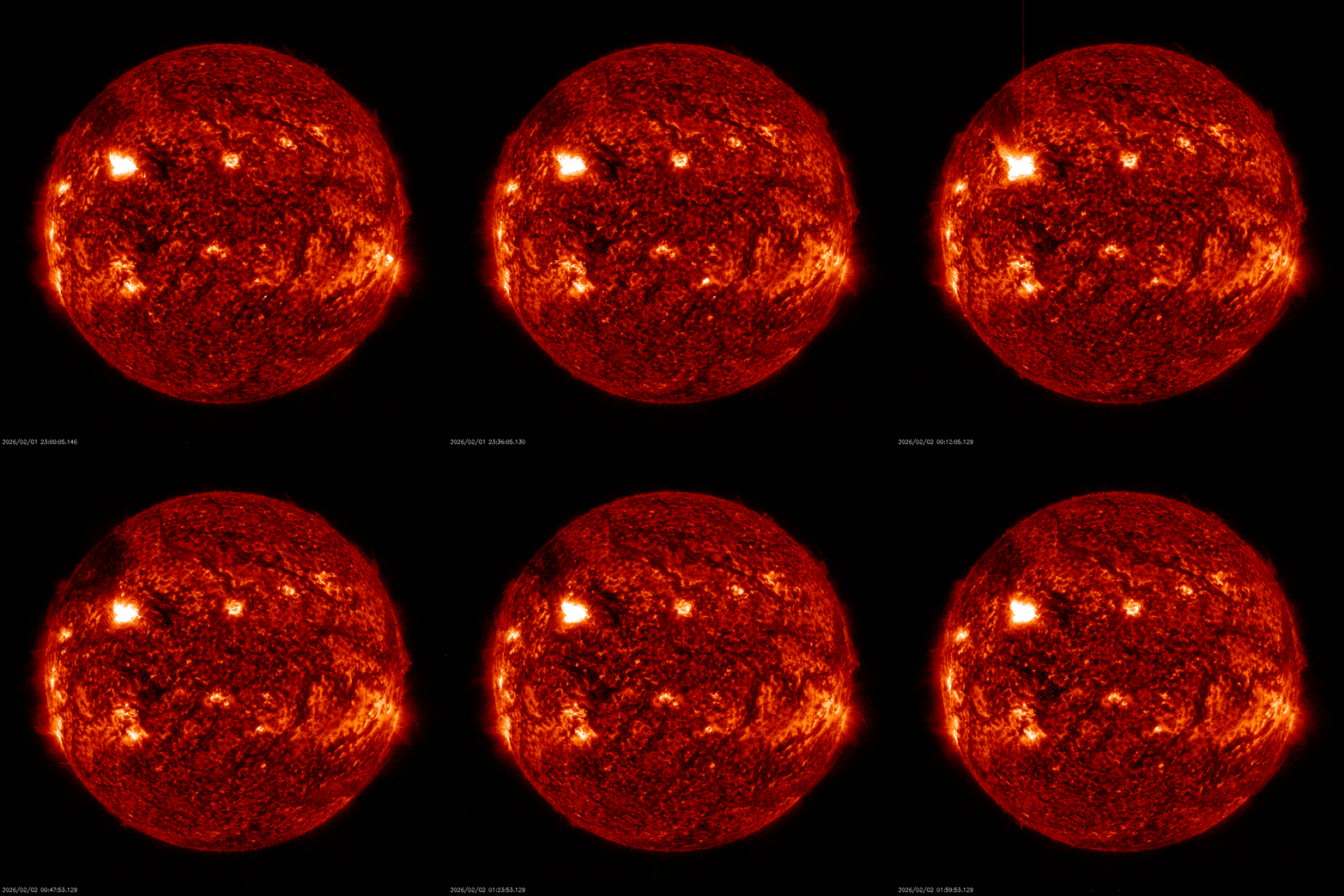
This is an animated GIF image (click on the image for the animation) that shows the flare in action. It is an animated series of images taken in extreme ultraviolet light from the Solar Dynamics Observatory and posted to Spaceweather.com. Solar activity is expected to remain moderate through 4 February with frequent M-class flares (80% probability of occurrence) and occasional X-class flares (40 % probability of occurrence) due to AR 14366.
January 28, 2026
Solar activity reached has been low the last 7 days. The last X-class flare, an X1.9, was on 18 January; the last M-class flare, an M3.4, happened on 21 January. Unfortunately due to a malfunction in our system, we were unable to observe today after being offline for 9 days due to inclement weather. I have no information on when we will be able to remedy the issue, so for the foreseeable future, we will not be able to make further observations from the East Dome.
January 19, 2026
Solar activity reached high levels yesterday (18 January) as a result of a long-duration X1.9/3B flare from AR 14341. This event peaked at 18:09 UT on 18 January. This launched a coronal mass ejection that took only 25 hours to impact the Earth’s magnetic field, producing widespread bright aurorae in Europe. There are eleven spotted active regions on the Sun.
After the X1.9 flare, solar activity returned to moderate levels, before trending to low later in the day. AR 14345 produced an M1.1 flare at 11:19 UT on 19 January. It the produced 8 C-class flares, ranging from C2 to C8 throughout the day. Only one other region flared, AR 14342, producing a C2. AR 14341 remained quiet all day long.
The first column below includes red continuum images, each 0.15 sec exposure; and the second column hosts H-alpha line center images, each 0.15 sec exposure. Each of the images covers 7.8’x11.4′ on the sky, unless indicated otherwise. Celestial north is up, west is right in each image.
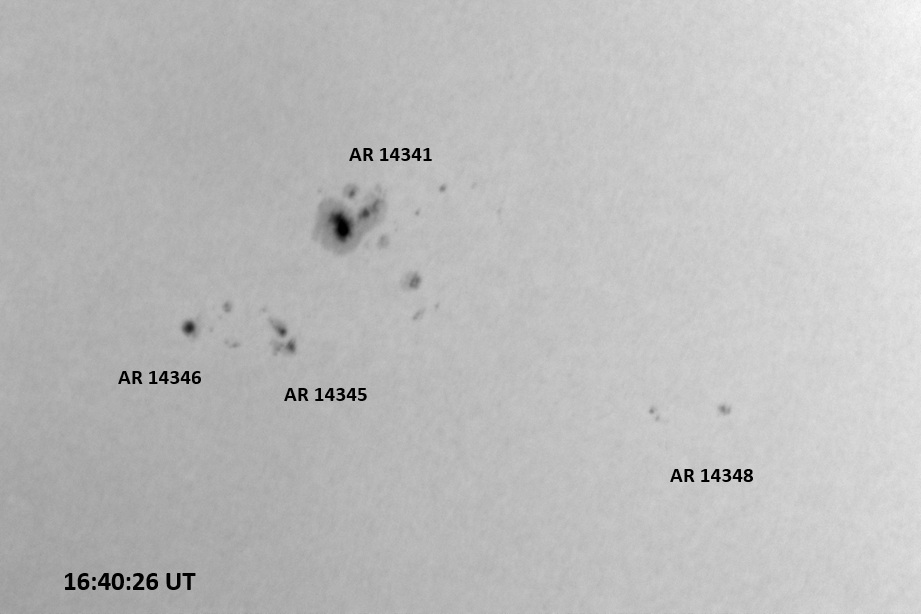 More spotted groups are visible on the Sun these days. More spotted groups are visible on the Sun these days. |
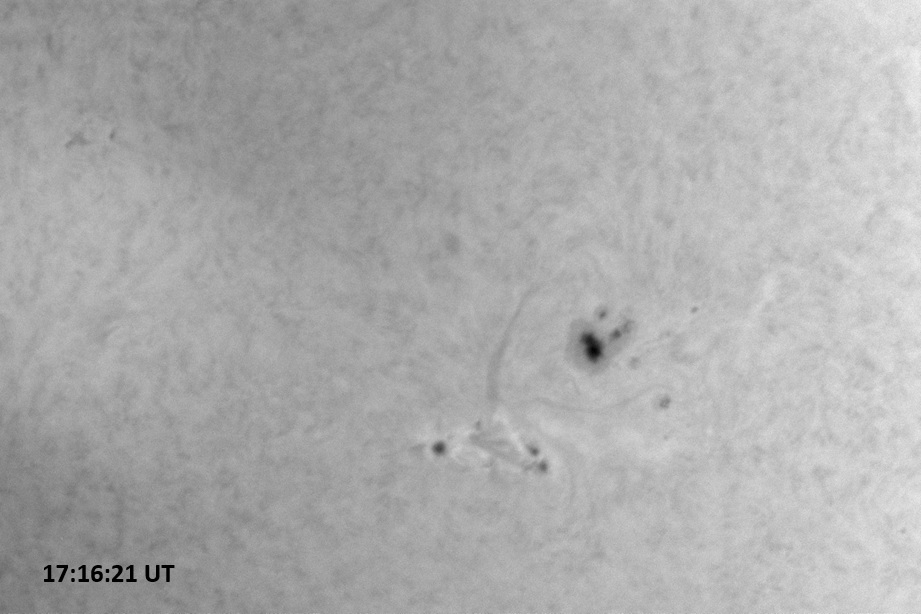 This zone on the Sun was rather active, with most of the flare activity coming from the small spot group below AR 14341. This zone on the Sun was rather active, with most of the flare activity coming from the small spot group below AR 14341. |
 Two spot groups are visible on this part of the Sun. Two spot groups are visible on this part of the Sun. |
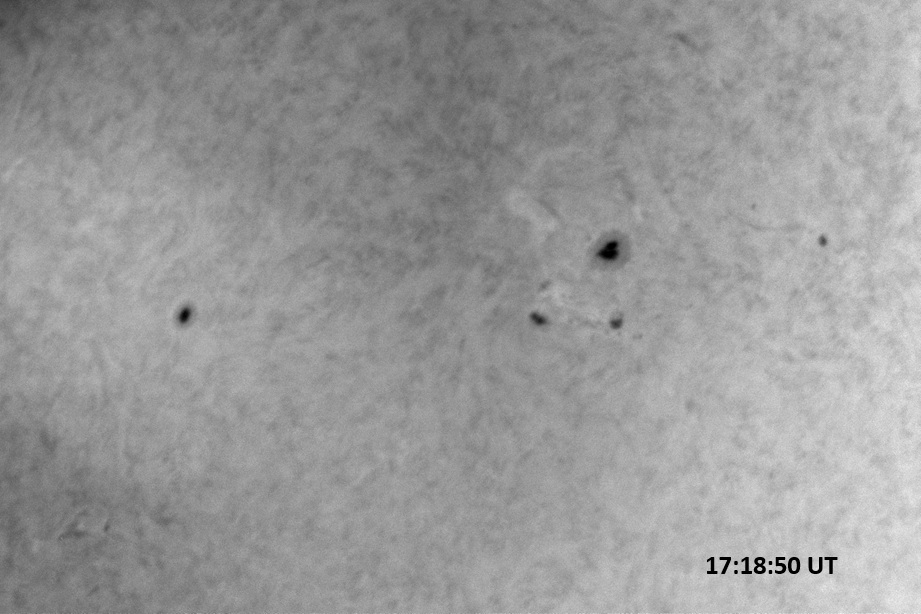 AR 14347 (single spot, left), and 14342 (just right of center). AR 14347 (single spot, left), and 14342 (just right of center). |
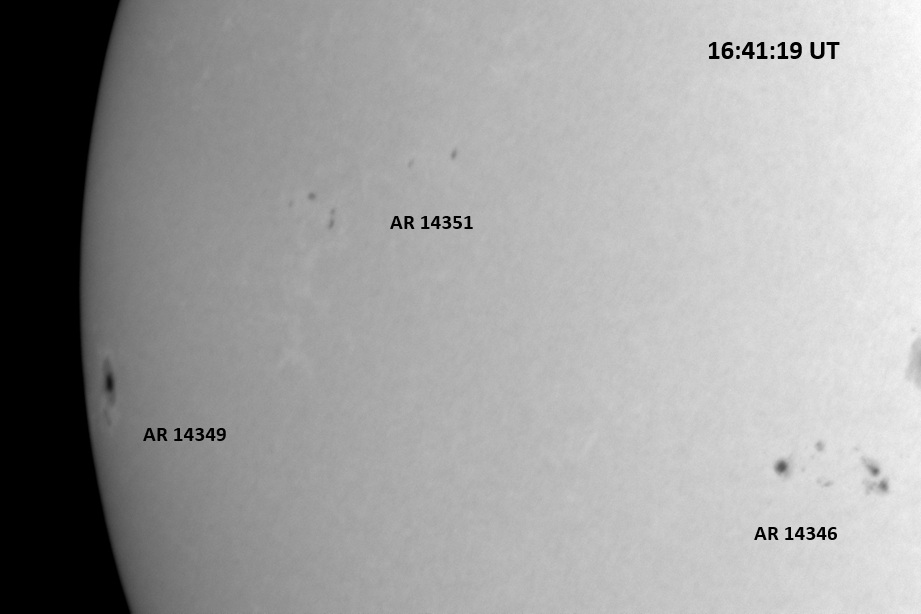 Some additional spots trail the main centers of activity and are labeled above. Some additional spots trail the main centers of activity and are labeled above. |
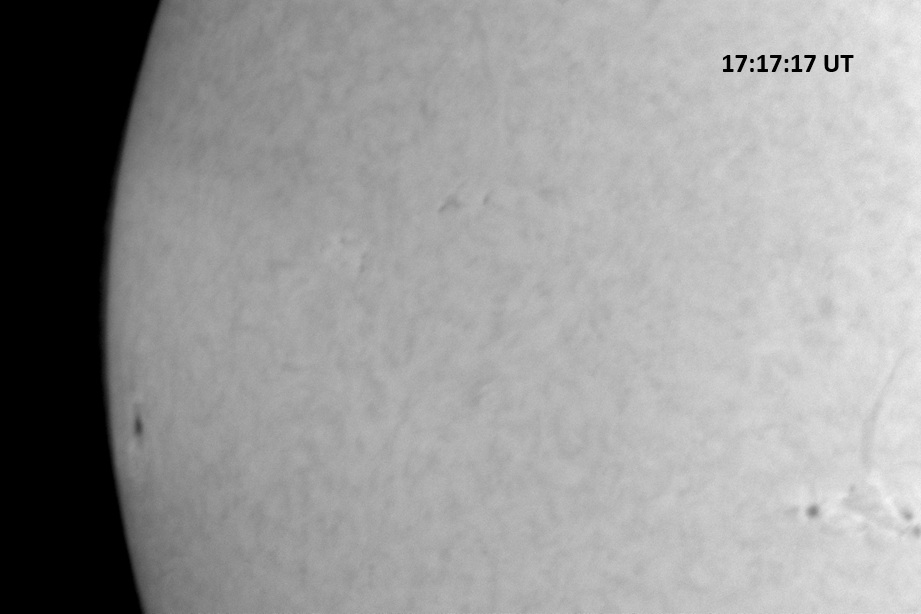 This zone of the solar disk, remains quiet for the time being. This zone of the solar disk, remains quiet for the time being. |
Solar activity is likely to be moderate, with a slight chance of additional X-class flares through 21 January.
January 16, 2026
Solar activity was low. The largest flare so far today (through 22:30 UT, 16 Jan.) was a C6.6/SF from AR 14345, a newly formed region just south of AR 14341. AR 14341 continues to be the largest (420 MSH) and most complex (beta-gamma-delta magnetic configuration) active region on the visible solar disk but it also remained quiet all day. It only produced two optical subflares and a C1 so far today.
The first column below includes red continuum images, each 0.09 sec exposure; and the second column hosts H-alpha line center images, each 0.15 sec exposure. Each of the images covers 7.8’x11.4′ on the sky, unless indicated otherwise. Celestial north is up, west is right in each image.
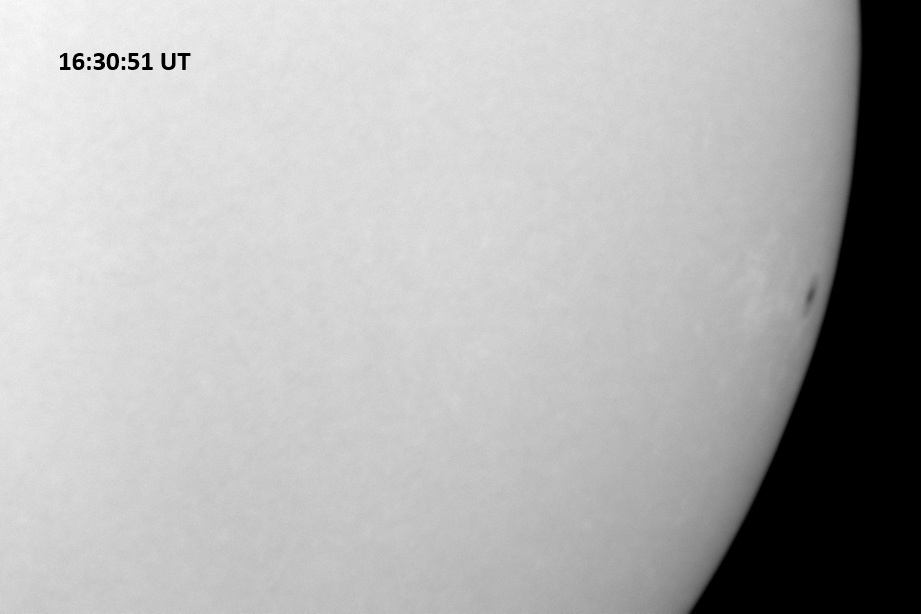 AR 14336 departs over the west limb. It is the second largest spot at 150 MSH AR 14336 departs over the west limb. It is the second largest spot at 150 MSH |
 AR 14336 (and this zone of the Sun) has been completely quiet today. Two filaments remain visible north of the region. AR 14336 (and this zone of the Sun) has been completely quiet today. Two filaments remain visible north of the region. |
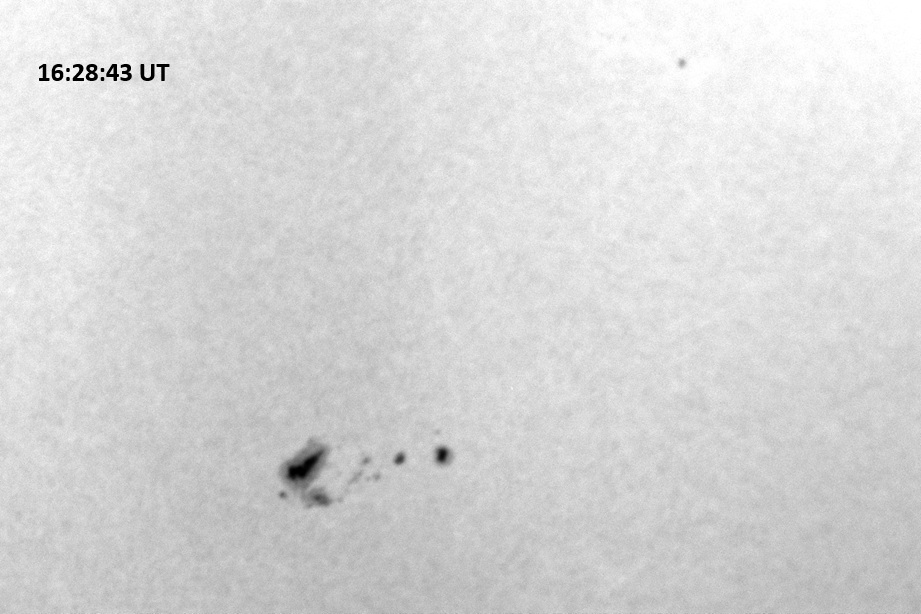 AR 14343 lower part) and 14340 (upper right). AR 14343 continues to grow while 14340 continues to decay. AR 14343 lower part) and 14340 (upper right). AR 14343 continues to grow while 14340 continues to decay. |
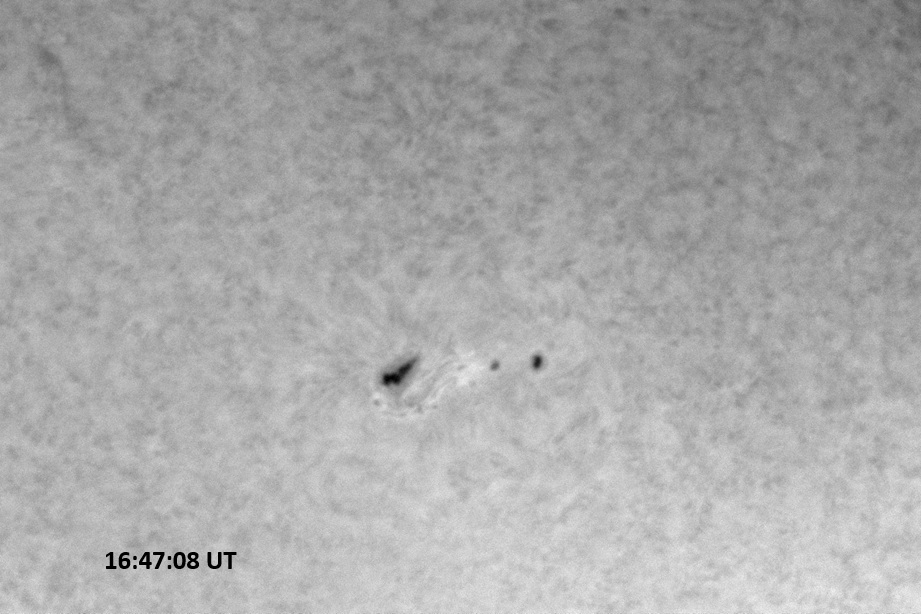 AR 14343 was the source of 2 C1 flares and one c4 flare today. This was one of the most active spot groups today. AR 14343 was the source of 2 C1 flares and one c4 flare today. This was one of the most active spot groups today. |
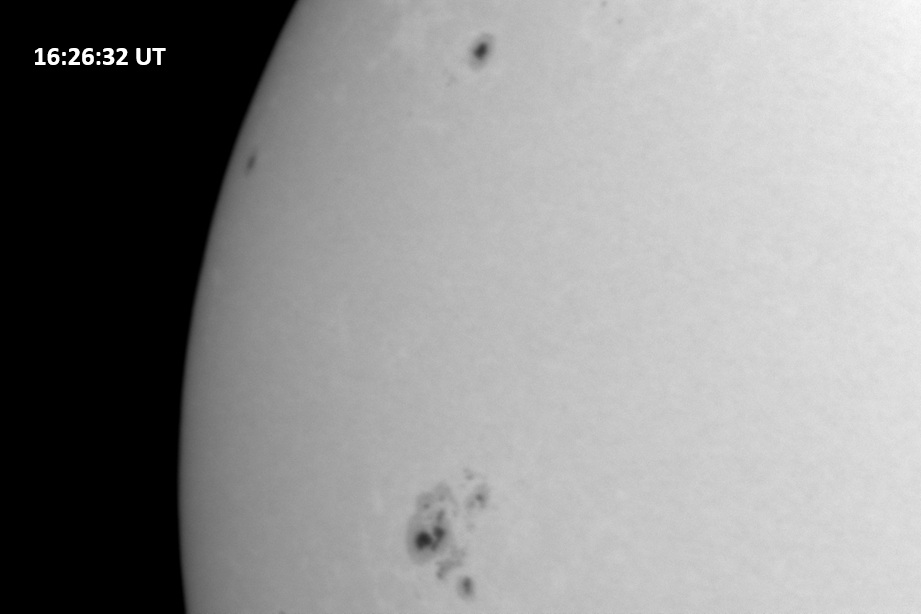 AR 14342 (top center), 14347 (single spot near limb, upper left) and 14341 (bottom center). AR 14342 (top center), 14347 (single spot near limb, upper left) and 14341 (bottom center). |
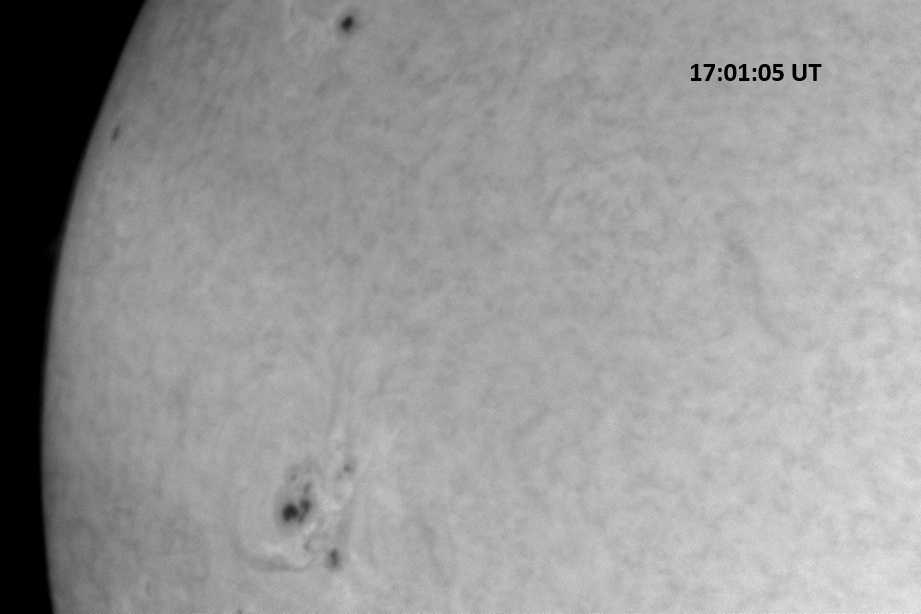 These regions were relatively quiet today. A filament is visible toward the right of the image. These regions were relatively quiet today. A filament is visible toward the right of the image. |
Solar activity is expected to be low, with a chance for M-class flares and a slight chance for X-class flares through 18 January.
January 15, 2026
Solar activity was at moderate levels due to an M1.6 flare that happened at 20:33 UTC on 14 January from AR 14341. This region also produced a C9.7 flare at 6:36 UTC on 15 January. Since then, and through 00:10 UTC, 16 January, solar activity returned to low levels, with only infrequent low-level C-class flaring. AR 14343 has grown quite a bit since yesterday, but was otherwise inactive. A Coronal Mass Ejection came from the area of AR 14340, but the bulk of this debris has been launched northward and is expected to miss the Earth.
The first column below includes red continuum images, each 0.09 sec exposure; and the second column hosts H-alpha line center images, each 0.15 sec exposure. Each of the images covers 7.8’x11.4′ on the sky, unless indicated otherwise. Celestial north is up, west is right in each image.
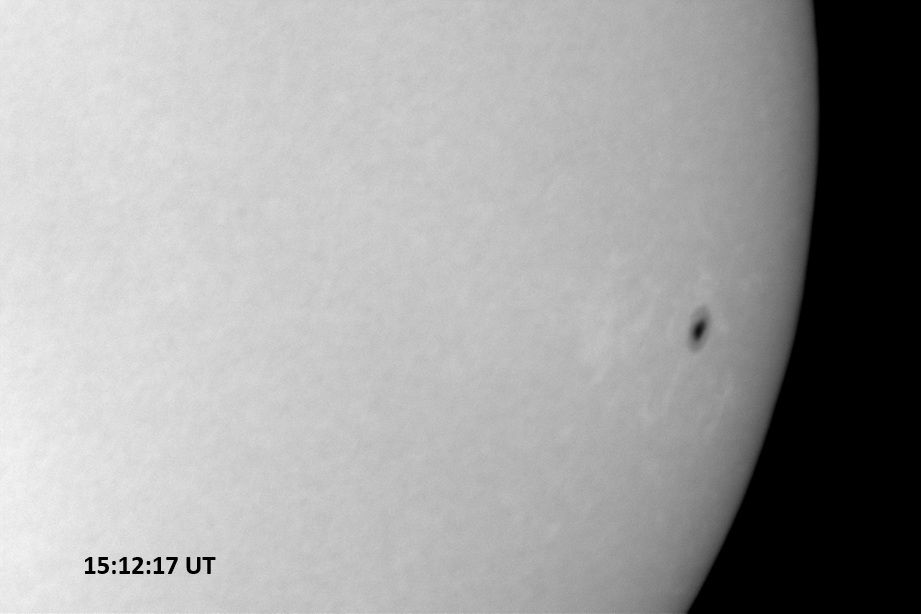 The lone spot AR 14336 is rotating toward the limb of the Sun. The lone spot AR 14336 is rotating toward the limb of the Sun. |
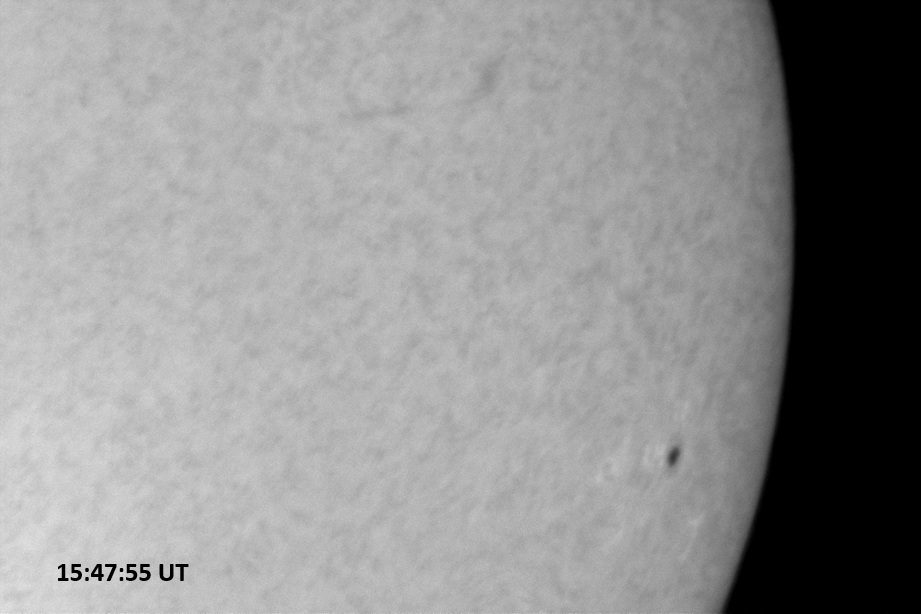 This image also includes a filament (top center), along with an inactive AR 14336. This image also includes a filament (top center), along with an inactive AR 14336. |
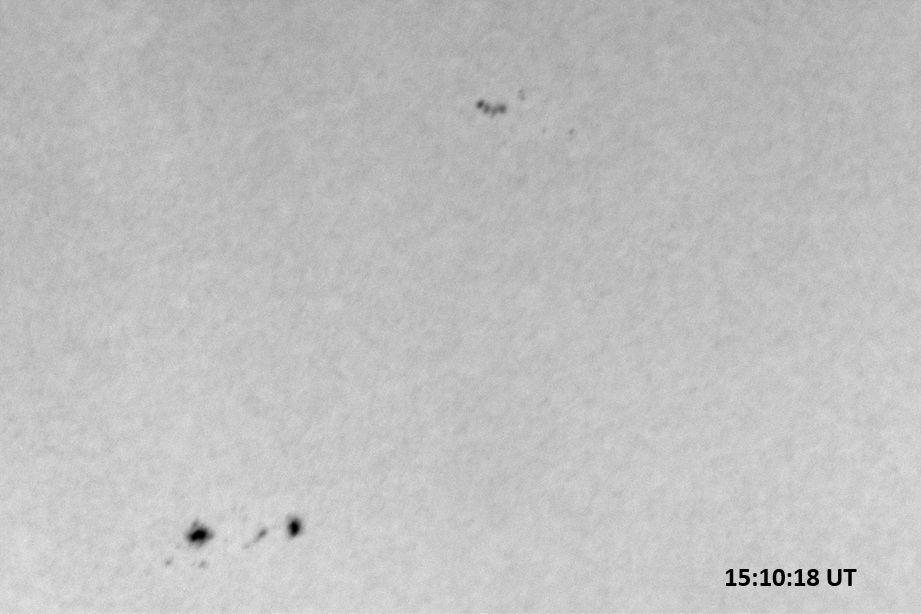 AR 14340 (top center) and 14343 (below left), the latter of which has grown since yesterday. AR 14340 (top center) and 14343 (below left), the latter of which has grown since yesterday. |
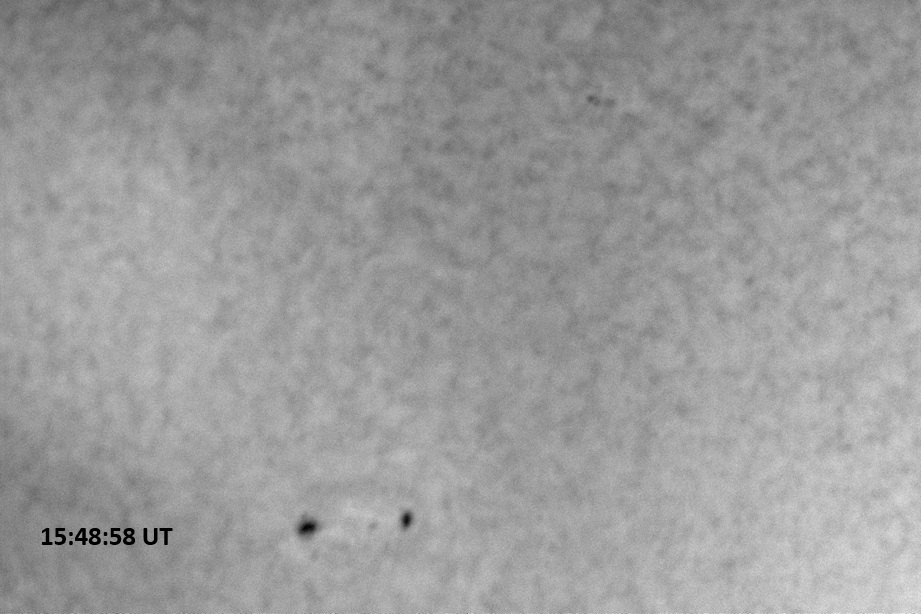 This zone of the sun remains quiet, with 14340 nearly disappearing in H-alpha. This zone of the sun remains quiet, with 14340 nearly disappearing in H-alpha. |
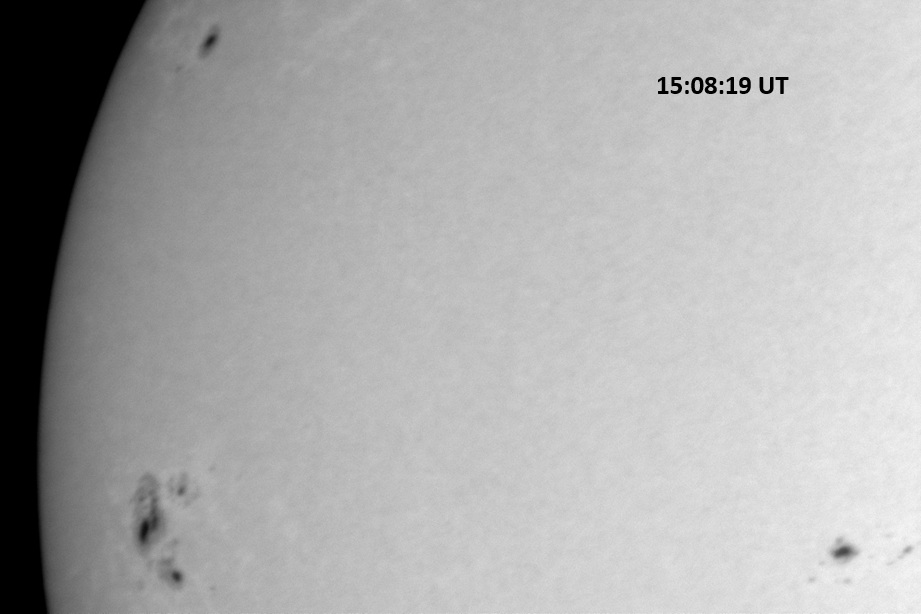 AR 14341 (below left), 14342 (upper right) and 14343 (lower right), AR 14341 (below left), 14342 (upper right) and 14343 (lower right), |
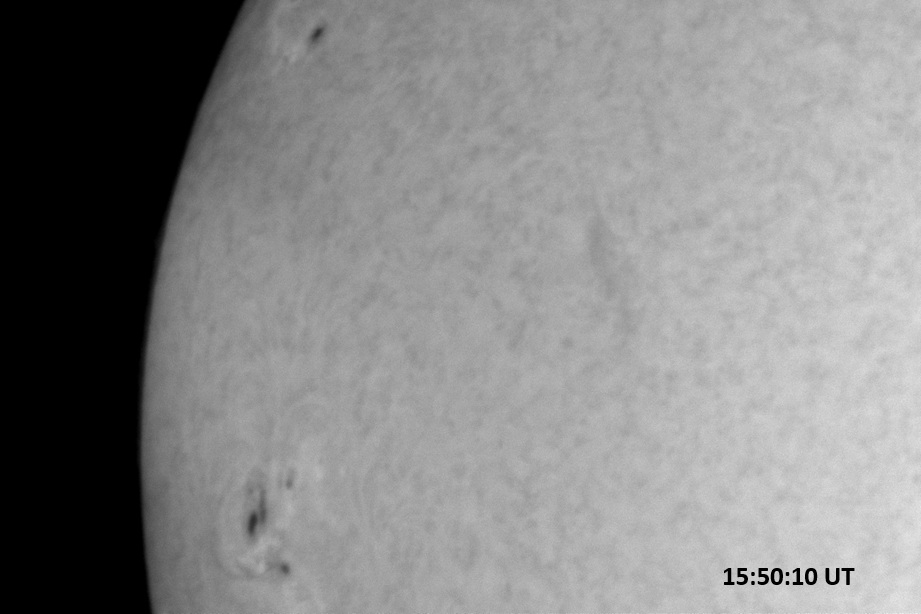 AR 14341 (lower left) and 14342 (upper left), along with a filament (just right of image center). AR 14341 (lower left) and 14342 (upper left), along with a filament (just right of image center). |
Solar activity is expected to be low, with a 25-30% chance for M-class flares from 15 to 17 January.
January 14, 2026
Solar activity is now back to moderate levels. The largest flare over the last 7 days was an M3.3 at 23:10 UTC on 11 July from AR 14341, which was behind the solar limb at the time. Then there was a C9.6 at 3:50 UTC on 14 January. Just happened was an M1.6/1F at 20:32 UT from AR 14341. Slight decay occurred in AR 14334 (barely visible as a single spot) and 14336 (a large spot with a few attendants trailing behind). AR 14340, which emerged several days ago, has also demonstrated some decay. AR 14341 and 14342 are situated along the eastern limb of the Sun and contributed almost all of the flaring activity over the last two days.
The first column below includes red continuum images, each 0.09 sec exposure; and the second column hosts H-alpha line center images, each 0.15 sec exposure. Each of the images covers 7.8’x11.4′ on the sky, unless indicated otherwise. Celestial north is up, west is right in each image.
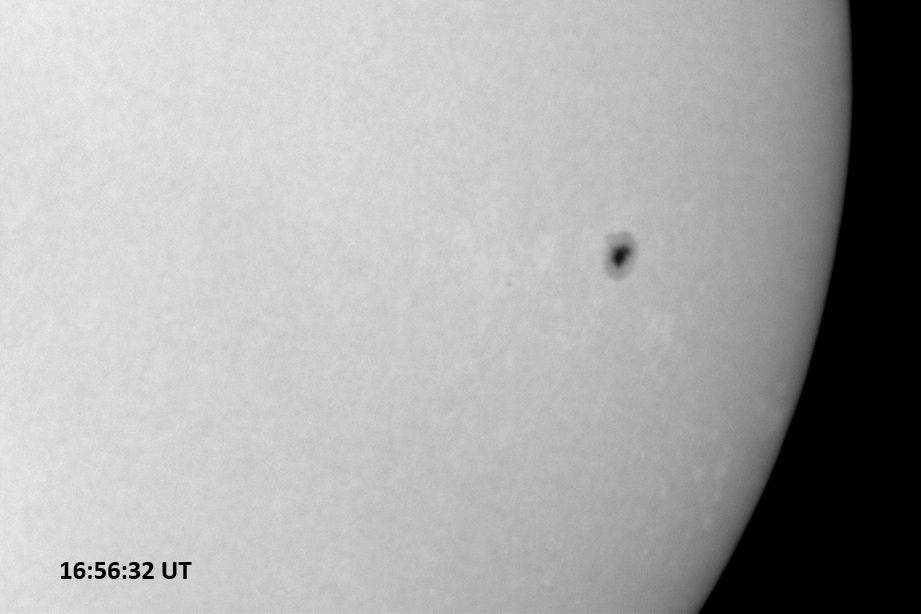 This active region sported many more spots a few days ago but has decayed to what is visible in this image. This active region sported many more spots a few days ago but has decayed to what is visible in this image. |
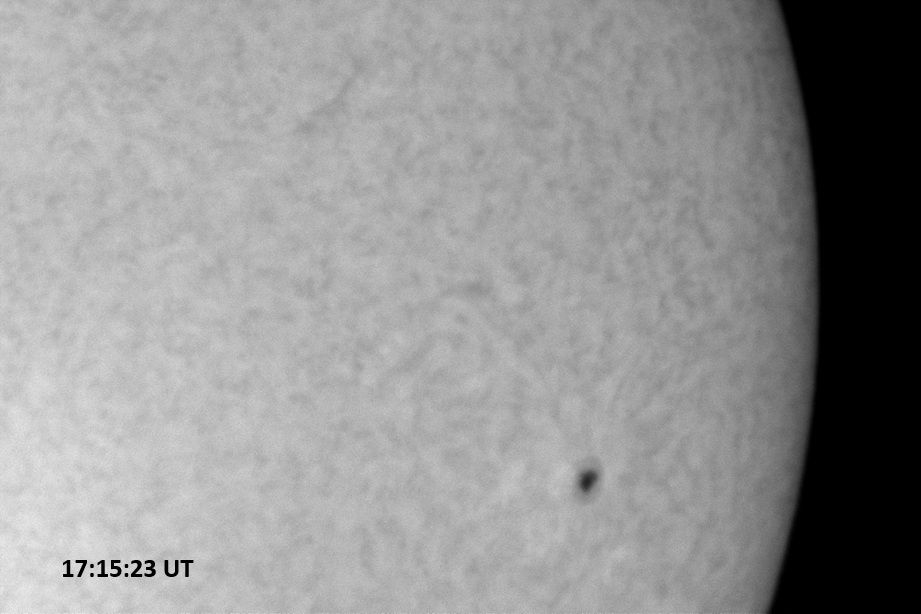 AR 14336 along with a single filament (upper left quadrant of image). This part of the Sun has been quiet. AR 14336 along with a single filament (upper left quadrant of image). This part of the Sun has been quiet. |
 AR 14340 nearing the solar central meridian. AR 14340 nearing the solar central meridian. |
 AR 14340 (top center) has been quiet. In the lower left corner, the bright spot marks another region emerging into view. AR 14340 (top center) has been quiet. In the lower left corner, the bright spot marks another region emerging into view. |
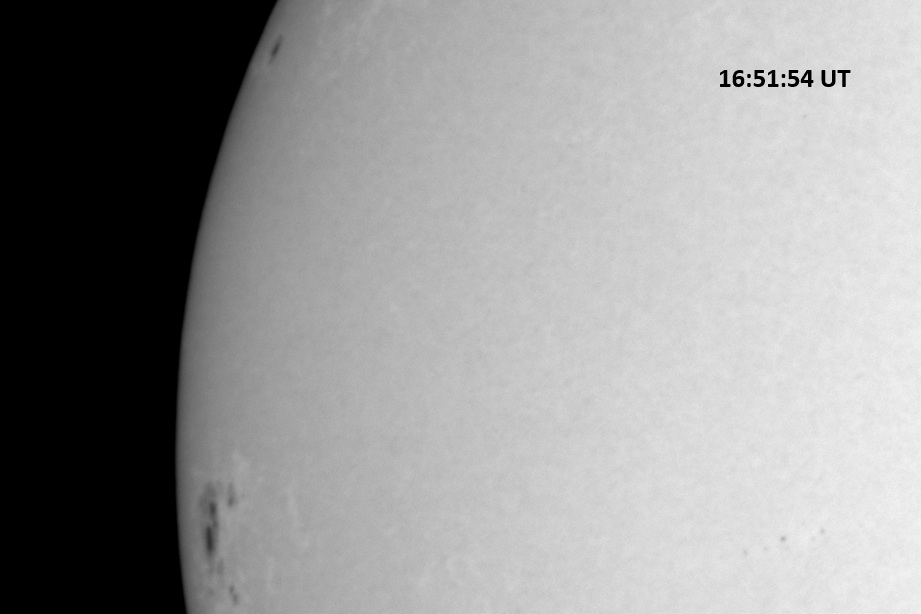 AR 14341 (bottom) and AR 14342 (top) are rotating into view. Small spots from a newly emerging sunspot group are visible in the lower right corner of the image. AR 14341 (bottom) and AR 14342 (top) are rotating into view. Small spots from a newly emerging sunspot group are visible in the lower right corner of the image. |
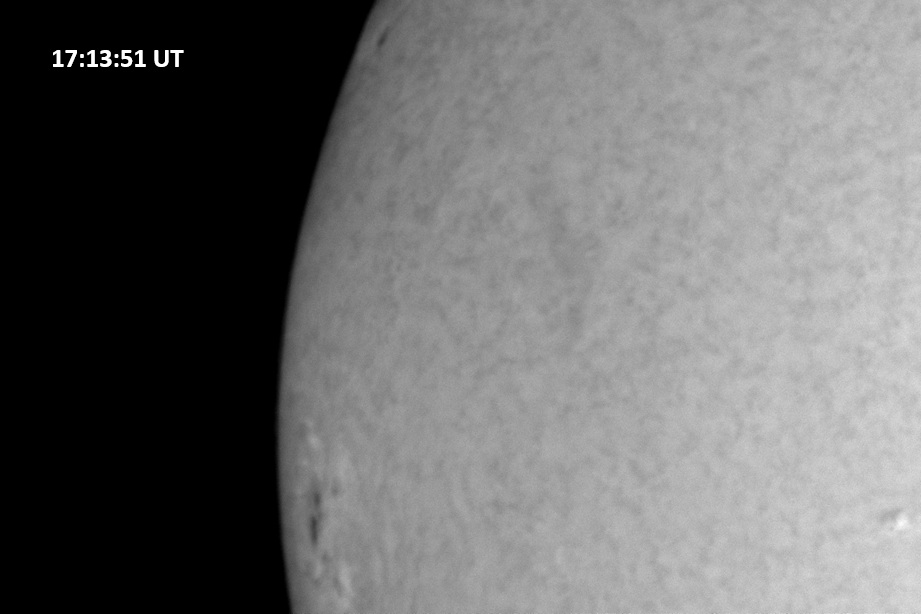 AR 14341 and 14342 as they rotate into view, led by a filament (just right of image center). A new sunspot group is emerging (lower right corner). AR 14341 and 14342 as they rotate into view, led by a filament (just right of image center). A new sunspot group is emerging (lower right corner). |
Solar activity is expected to be low, with a 25% chance for M-class flares from 14 to 16 January.