

With so much happening at Prairie View A&M University each day, it is easy for colleagues to move in parallel without ever truly intersecting, caught in the constant rhythm and responsibility that define life on the Hill.
As students, faculty, and staff prepare for Spring Commencement and anticipation builds for the upcoming Spring Game, which will offer the first glimpse of this season's Panther Football team, finding time to pause and interact becomes even more difficult. But when members of the university community (those with shared backgrounds, aligned interests, and complementary expertise) finally do connect, something meaningful begins to take shape. The stories that emerge in those moments do more than introduce people. They create space for reflection, for teachable moments, and for growth; the kind that reminds us that behind every title is a story, and within every story is an opportunity to build something better.

PVAMU Panther Stadium
That is exactly what unfolded inside the Panther Room (located in the Athletics facility). What began as a simple meeting between Tremaine Jackson, Head Football Coach, and Mia Williams, '00, Extension Agent with the School of Public and Allied Health, quickly became something deeper. Though their paths to Prairie View A&M University took different turns, both learned they are guided by the same belief: if you want to build better outcomes, you start by building better humans. The revealing conversation about upbringing, loss, discipline, survival, truth, and what it really takes to help shape young people into whole, healthy, capable adults.
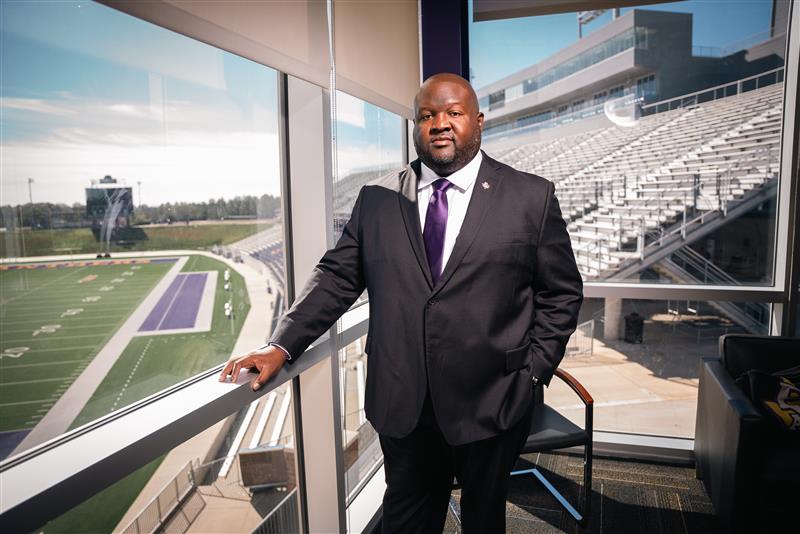
Tremaine Jackson, PVAMU Head Football Coach
We begin with Tremaine Jackson, who we discovered right away does not separate football from life. He never has.
Growing up in Acres Homes, raised primarily by his grandmother, Claire Jackson, he learned early what it meant to navigate two worlds at once. His mother was there, working nights at the post office and attending college during the day, determined to become the first person in the family to earn a degree. He stated adamantly that education was always part of the expectation.
But it was his grandmother who raised him day to day, watched him closely, and saw something in him early that needed direction, especially because in the neighborhood where he grew up, that focus was not guaranteed. For a young Black boy, you needed something to anchor you. Something to keep you occupied, disciplined, and out of trouble. For him, that something was football. And it was not just a sport; It was structure. It was protection. It was one of the first things that gave his energy somewhere to go.
It was also where what he calls his "double life" began. From 8 a.m. to 3 p.m., he was what the environment demanded, tough, aware, able to carry himself and respond to what was around him. After five, he became a church-going kid, because that is where Nana was. She helped build their church. She was rooted in it. So he followed. From about age eight to fourteen, he moved between those worlds, knowing what he needed to be doing, while also knowing exactly what the "cool" things were, and understanding he needed to avoid them. All of that was unfolding without the steady presence of a father. Coach Jack shared that he has seen his father twice in his life. Once at five, briefly. Then again at twelve, on aisle six in a Toys "R" Us, in the bike section, a moment that might have become something more, but never did. He has not seen him since.
He tells it plainly, with no extra dramatics and no need for embellishment. And maybe that is what makes it hit harder. It was what it was, as the saying goes. But it mattered.
Coach added that there is a picture at his house from the Oaks Dad's Club baseball team. The players are lined up in uniform, and behind them are their fathers. The order was: player, then dad, player, then dad. Until it was his turn. There was no one behind him. When the omission became glaringly obvious, a teammate's father moved and stood behind him, positioning himself between his own son and the little boy who otherwise would have stood there alone. Coach hesitated, because he wanted to describe the moment with intention: "He closed the gap like it was nothing." The meaning of the words silenced everyone in the room; it was as if we had to catch our breath after we realized the importance of his statement.
At the time, it was just a picture. But looking back, it was the first time he experienced what it meant for someone to stand in the gap. Not because they had to, but because they chose to. That stayed with him. It shaped his character and became part of the reason he leads and wants to pay that kind of presence forward.
What is most striking about the conversation was not just the story itself. It is the way he tells it. Matter of factly. With just enough vulnerability and reality to let you know that, yes, it was what it was, but it mattered then, and it matters now. And, quite honestly, it lands differently coming from someone like him.
This is a man with a strong, powerful physical presence who stood before a room full of reporters, faculty, staff, the Athletic Director, and his players and all but promised he would deliver a championship…and made good on his word; A 2025 SWAC Coach of the Year. Yet there he was, in a room with a colleague he had just met, and an interviewer asking the most personal questions, speaking openly and vulnerably about absence, about need, and about the kinds of moments that shape a young man long before anyone sees the title. It makes you wonder how many other young men are carrying the same quiet disappointments, haunted by what was missing, yet still showing up as if nothing is wrong. How often brute strength and the appearance of being unflappable mask pain that is not talked about nearly enough. Because two things can be true. You can be strong and confident, smart and accomplished, and still carry scars from the past.
Years later, that old picture and everything around it came into sharper focus. "I wanted to stand in the gap," he said, reflecting on the coaches and men who helped shape him. That belief now defines much of how he coaches. In certain situations, he said, life has a way of callousing a person. Some things have to be confronted head on. "It ain't about gummy bears and butterflies all the time." It is tough being a male. Tough being a Black male. Tough chasing success. Tough choosing education. Tough doing the right thing when easier, riskier roads are always nearby.
That is why he is hard on his players. He believes young men have to be prepared for a world that will not negotiate with them the way people often do. He worries that too many are being catered to and constantly told how good they are, only to be thrown into a world that does not respond that way. So the work inside his program is to break them down to their smallest selves, then help build them back up, so that if life ever puts them in a bind, they know how to fight their way out of it.

Mia Williams, Extension Agent, School of Public and Allied Health
It is well worth noting that he does not mince words about a single thing, especially the fact that he does not negotiate with children. That mindset, he says, came from his grandmother. They can talk and they can reason through some things, he explains. But that is all the grace he will give them. He is not going to beg, bribe, or soften the standard just because something is difficult. At the heart of it, he says, the goal is to protect them from themselves, from the voice that tells them they cannot, should not, or do not want to do what is necessary. He believes too many young people listen to themselves instead of talking to themselves, and left unchecked, that inner voice can take them out in a heartbeat.
Mia Williams, having listened intently to Coach's portion of the interview, took a deep breath before speaking. The weight of his words landed hard, but her journey carried equal heft.
Like Jackson, she is from Acres Homes, and her upbringing was shaped by a grandmother whose presence loomed large in all the right ways. She jokes that she technically grew up in a two-parent home, just not the conventional structure. Her two parents were her mother and her grandmother. It is a line she delivers with humor, but it carries truth. The home she grew up in was untraditional to some, but it was grounded in love, strength, and survival. She tells the story of being unable to get city water until she was a senior in high school. Until then, she carried water from a neighbor's house because her grandmother refused to let them drink the well water. She remembers being in the tub and seeing a clump of sand fall out with the water, sand from the well, sand that became part of the everyday reality of growing up the way she did.
Those experiences, among others, transformed her, as hard lessons often do. So did watching her grandmother, with what she affectionately described as her "little bow legs," show up at school and advocate fiercely for a granddaughter who talked too much, who stayed busy, who was not always paying attention, and who she now knows was living with undiagnosed ADHD.
She leaned it and said, almost with a whisper, back then, that was not a diagnosis people used. She was disciplined for the behavior…her grandmother never spared the rod.
Later, after years working in child protective services and as a mental health clinician, she came to understand that what people call discipline can also become trauma, and that trauma can reverberate and manifest itself in ways families and communities do not always recognize. That realization changed her. She assumed an active role in her community, mentoring those who needed support, protection, and advocates. In many ways, she had already been doing public health work long before she had a formal degree. In 2023, she decided to go back and pursue a master's in public health because she wanted to connect theory to the practical community work, she had already been doing for years. In June 2025, she earned that degree, adding it to the counseling degree she had already received from Prairie View A&M University. For her, returning to PV in this new capacity was not just a professional move. It was a homecoming and an opportunity to bring the skills, theory, and lived understanding she had gathered back to the place that had already shaped her.
When asked about her greatest challenge in applying what she knows to the current generation, especially the students on campus now (including the athletes she met that day) she did not try to make it simple. "It's complex," she said. "It's cumbersome." Ultimately, it is because the work is about the whole person; mind, body, wellness, environment, upbringing, loss, and the messages young people absorb from every direction. She described the brain, the mind, as the central nucleus. If that is off, everything is off. That is why difficult conversations matter. That is why what she and others in the School of Public and Allied Health do matters. Because you cannot claim to care about performance and ignore the psychological and emotional condition of the person expected to perform. Mia's expertise in sports nutrition and the benefits of a healthy lifestyle offered an even greater opportunity to highlight a mutual benefit in this new partnership unfolding during this vital discussion.
None of this is abstract for her.
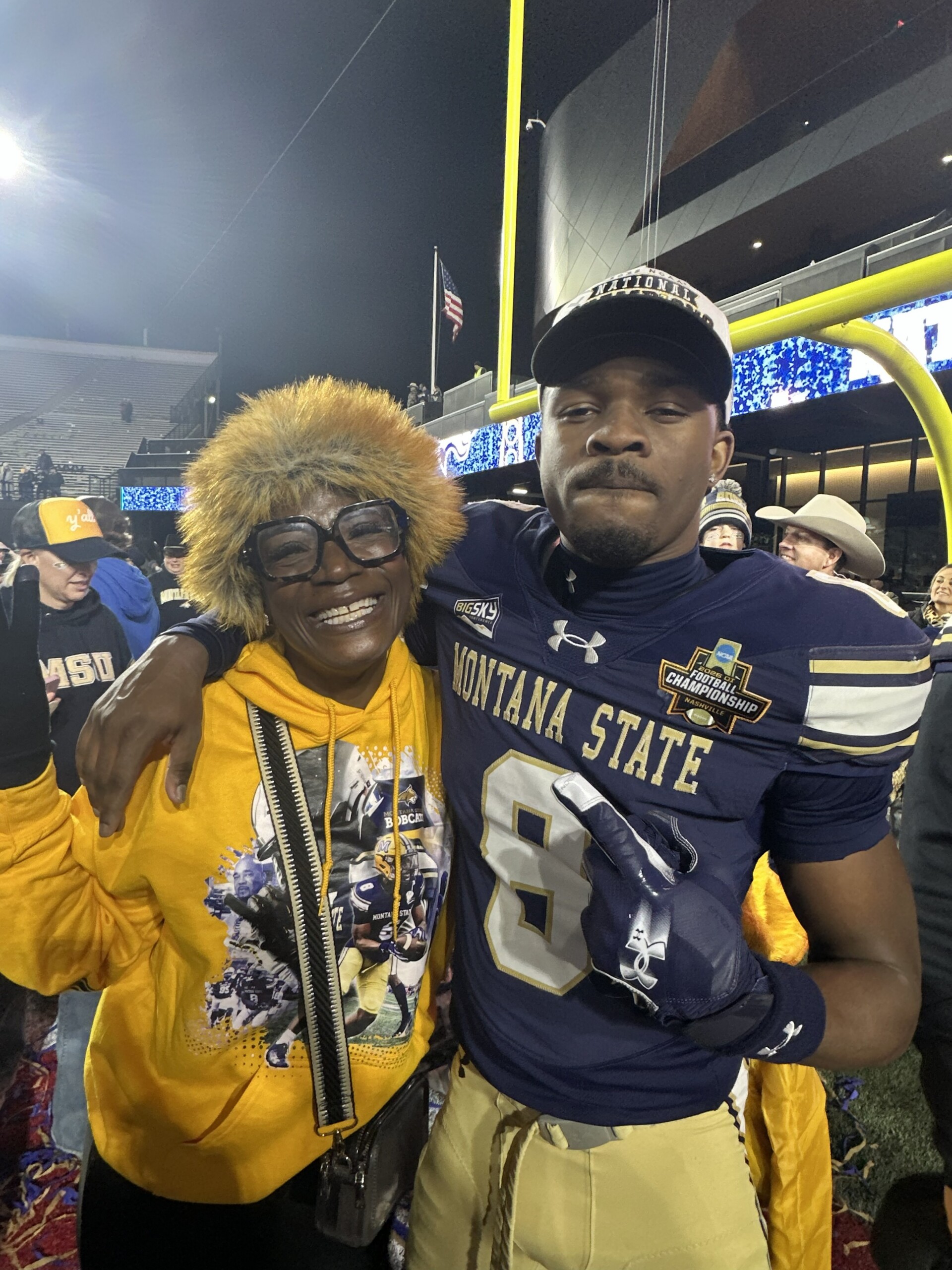
Mia Williams and son, Carson
She is the parent of an athlete. Her son lost his father at fourteen. She knows firsthand what it means to try to keep a young Black boy on a narrow path in an environment full of distractions, pressure, and loss. She knows what it means to try to build a net that works for a community that is not always served by one-size-fits-all solutions. "Our community is different," she said, and the factors that must be considered when helping these young people are different too.
That is part of why this meeting mattered so much to her. "For you having the foresight to bring the two of us together," she said, "is a very foundational marker." Because when the foundation is solid, you can build up. The fact that she and Jackson come from the same neighborhood, that her son has experienced some of the same kinds of grief and loss Jackson knows, and that she brings both a mental health and public health lens to the conversation creates an opportunity to connect dots that otherwise might go unconnected.
She understood exactly what Jackson meant when he described breaking young men down and building them back up. Some of what has been deposited into them, she noted, is not for their benefit. Some of it is harmful. Harmful ideologies. Harmful messaging. Harmful signals coming from social media and culture. The question becomes how people across campus can come together to help build these young men up in healthier, more intentional ways.
Jackson, for his part, sees that responsibility as extending well beyond football.

Coach Jackson and daughter, Harmony
He describes himself as a girl dad. His daughter, Harmony, is a student at Prairie View. He says being her father taught him the importance of telling the truth, especially when the truth is hard. That same standard made its way into his locker room. His players, he joked, ask Harmony whether he has always been like this, and she tells them yes, she is the case study.
More importantly, he does not want his impact limited to football players. If there is a group of Black student leaders on campus, or a biology class, or any group of young people who might benefit from hearing something real, he wants to reach them too. Because with the exposure that comes with being a head football coach in Texas, and especially at a place like Prairie View, he believes he has an obligation to reach the multiples, not just certain pockets of students.
His test, he says, is public every Saturday. That kind of visibility brings responsibility. It also shapes how Coach talks about education. Much of what matters in life, he said, happens outside the classroom. He does not remember needing all the abstract math he was taught. What he needed was to know how to count his money and read well enough so nobody could mess over him, which is exactly what his grandmother taught him. So now he asks, how do we keep people from being messed over? By giving them real life experience. By sharing the lessons life taught the hard way.
That thought resonates deeply with Mia Williams, especially as a boy mom. She agreed immediately that young men have to be told the truth. After her husband died, she said she prayed for guidance because she knew there were things she could teach her son and things she could not. What she felt led to teach him was how to think, but not think like a woman. She wanted him to think like a man, and that meant giving him tools to slow down, look left and right before making decisions, and not allow impulsiveness, including the impulsiveness she jokingly ties back to her ADHD brain, to push him into choices that could affect the rest of his life. As a mother, she said, nurturing comes naturally, but nurturing alone is not enough. She had to learn how to nurture in a way that still allowed and required her son to become a man. When he went off to college, she told the men around him, "I did all I can do. Now it's your turn." She said that plainly, even candidly, acknowledging there were fundamental things she could not teach a young man from her position as his mother. She was not afraid to say it, because, as she put it, "You can't manage what you don't measure."
That phrase has become a kind of mission statement for her. If a student's psychological state is off or the metaphorical "check engine light" is on, the whole person is affected. So people have to pay attention. They have to measure where someone is before they can help manage where they are going.
Jackson meets that with a similarly direct philosophy.
Whether a student comes from a two-parent home, one-parent home, or no-parent home, he tells families the same thing: once their son enters that program, he is his now. Not in the sense of replacing family, but in the sense of responsibility. There are some things young men have to go through and learn without parents breaking the process every time discomfort shows up. Football, he said, is the closest game to life, full of highs and lows, shifts in momentum, moments when you are on offense and moments when you have to defend.
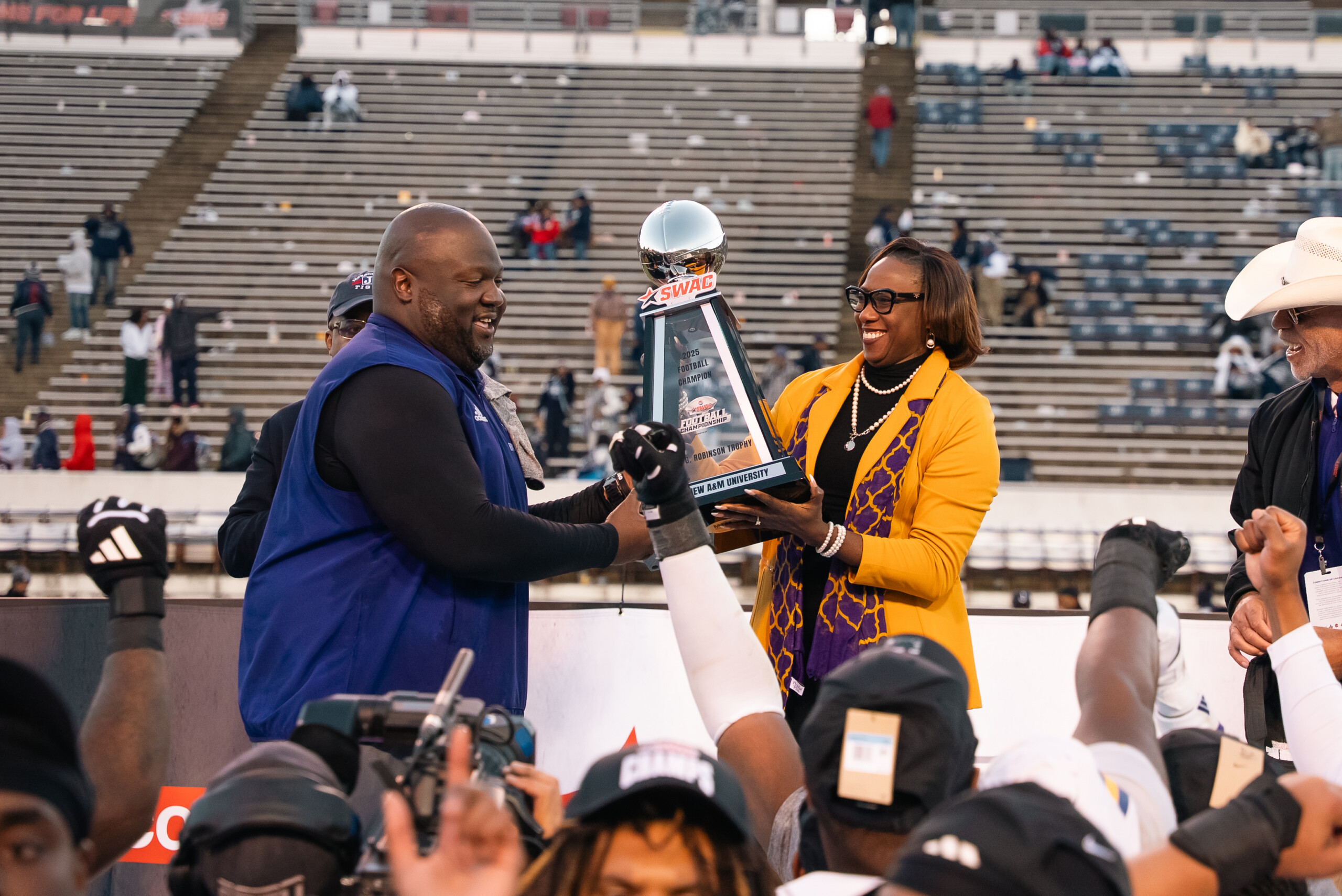
2025 SWAC Championship Celebration
His program's mission statement says it plainly: football is a life-changing game, and their job is to teach, train, and motivate players to be leaders and positive contributors to the world using the game of football. He says that is the real work. Never one to hold back, Coach summed up this portion of our talk like this: He never promised anyone a championship. He never promised anyone graduation. His job, as he sees it, is to teach, train, and motivate, and to make sure these young men can get to the picture, not one with him in it, but the one with their mothers, families, and futures that they have earned for themselves.
That is where his and Williams' stories begin to braid together most clearly. He brings hard truth, discipline, and structure. She brings clinical understanding, emotional insight, and a public health lens that insists on seeing the whole person. He speaks from the perspective of the mentor, coach, and gap-filler. She speaks from the perspective of the practitioner, mother, counselor, and advocate. Together, they create something Prairie View A&M University needs more of, not isolated expertise, but connected expertise. Not parallel work but work in concert. And that, perhaps, is the deeper lesson in what happened in the Panther Room.
This was not simply a conversation between a coach and a health professional. It was a living example of what can happen when people with shared values and complementary gifts stop moving past each other long enough to recognize that their work is connected. It was an example of leadership that is honest, intentional, and willing to do the uncomfortable work of developing people, not just performers. It was also an example of Prairie View A&M University's mission in action. This meeting reflects the University's commitment to invest in its people and performance excellence, to enrich student success and holistic student development, and to foster social responsibility in Prairie View and beyond.
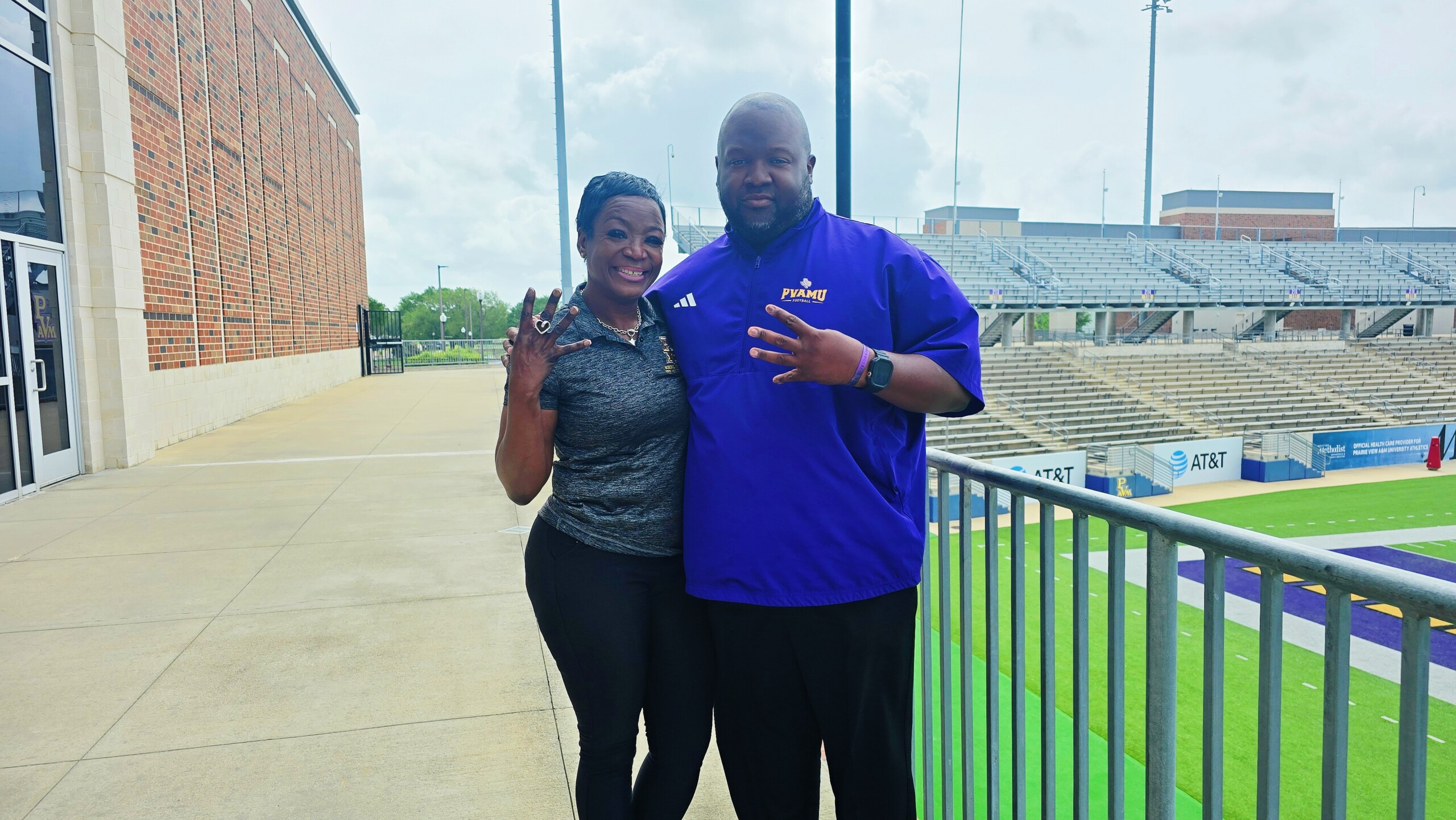
Tremaine Jackson and Mia Williams
Jackson's final thought was rooted in survival and purpose. He cited Psalm 118:17, "I lived and not died," and said that is where he stands, someone who should have been gone a long time ago, in career, in life, in other things, but who is still here and intends to keep helping poor young people.
Williams' closing thought carried a different rhythm, but the same hope. "The best is yet to come," she said, borrowing from a gospel song that had been sitting in her spirit for weeks. No matter what she is going through, she chooses how she approaches it.
She is going to make lemonade out of lemons, pepper sauce out of peppers, and keep moving forward.
And maybe that is the clearest truth this meeting offered. Behind titles are stories. Behind strong people are often scars. Behind the work of building better outcomes is the harder, holier work of building better humans. And when the right people finally meet, when they tell the truth, connect the dots, and commit to doing that work together, the entire community stands to grow.
To learn more about Prairie View A&M's football program, click here. For more information about PVAMU Extension at the School of Public and Allied Health, click here. You can also visit the website to explore the College of Agriculture, Food, and Natural Resources.
By: Liz Faublas-Wallace