

Events
-
-
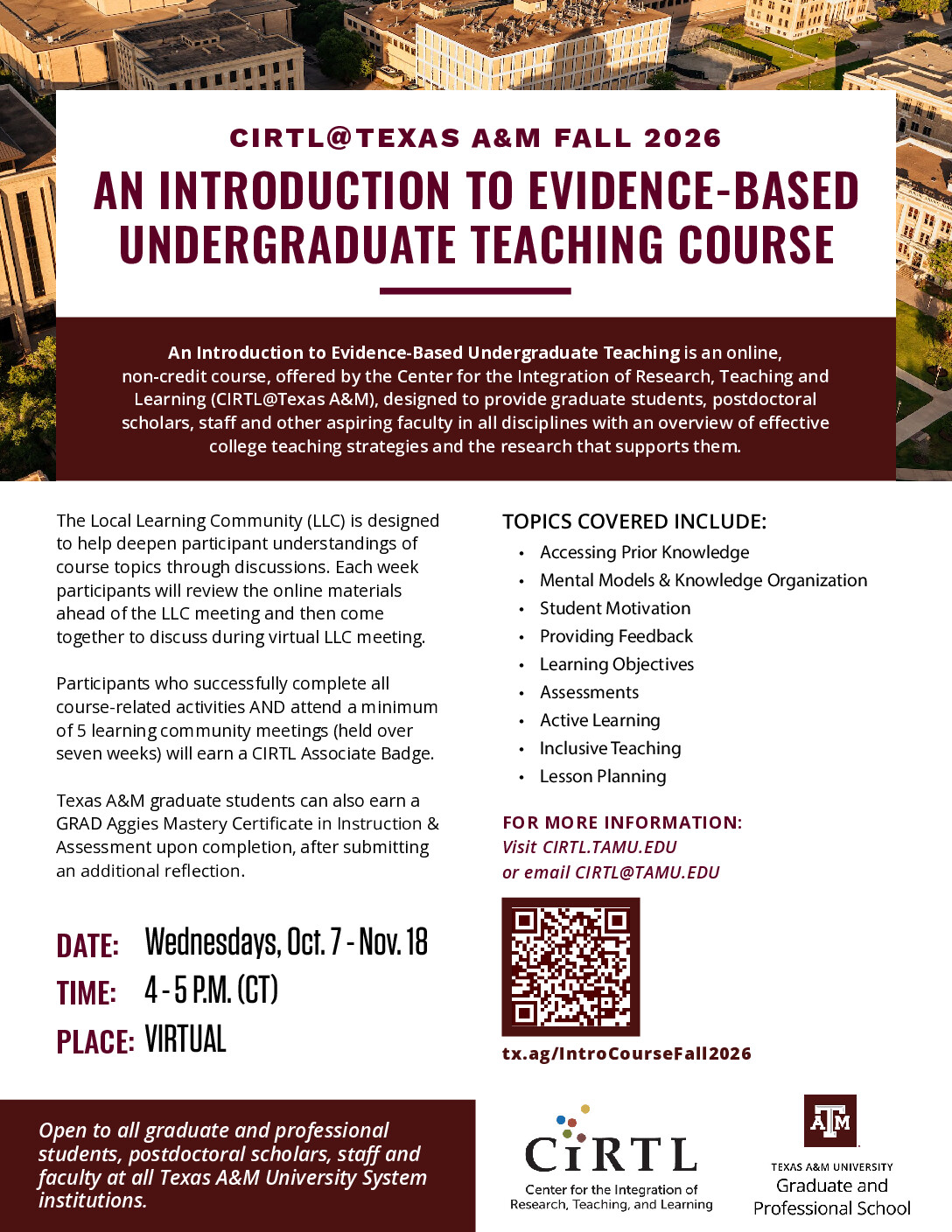
Registration Open | CIRTL Introduction to Evidence-Based Undergraduate Teaching Fall Course
We are excited to share that our fall 2026 offering for the Center for the Integration of Research, Teaching, and Learning (CIRTL) is available to your graduate and professional students, faculty, and/or postdoctoral scholars. Registration is now open for An Introduction to Evidence-Based Undergraduate Teaching. Completers of this weekly local learning community can earn a CIRTL Associate-level digital [...]
-
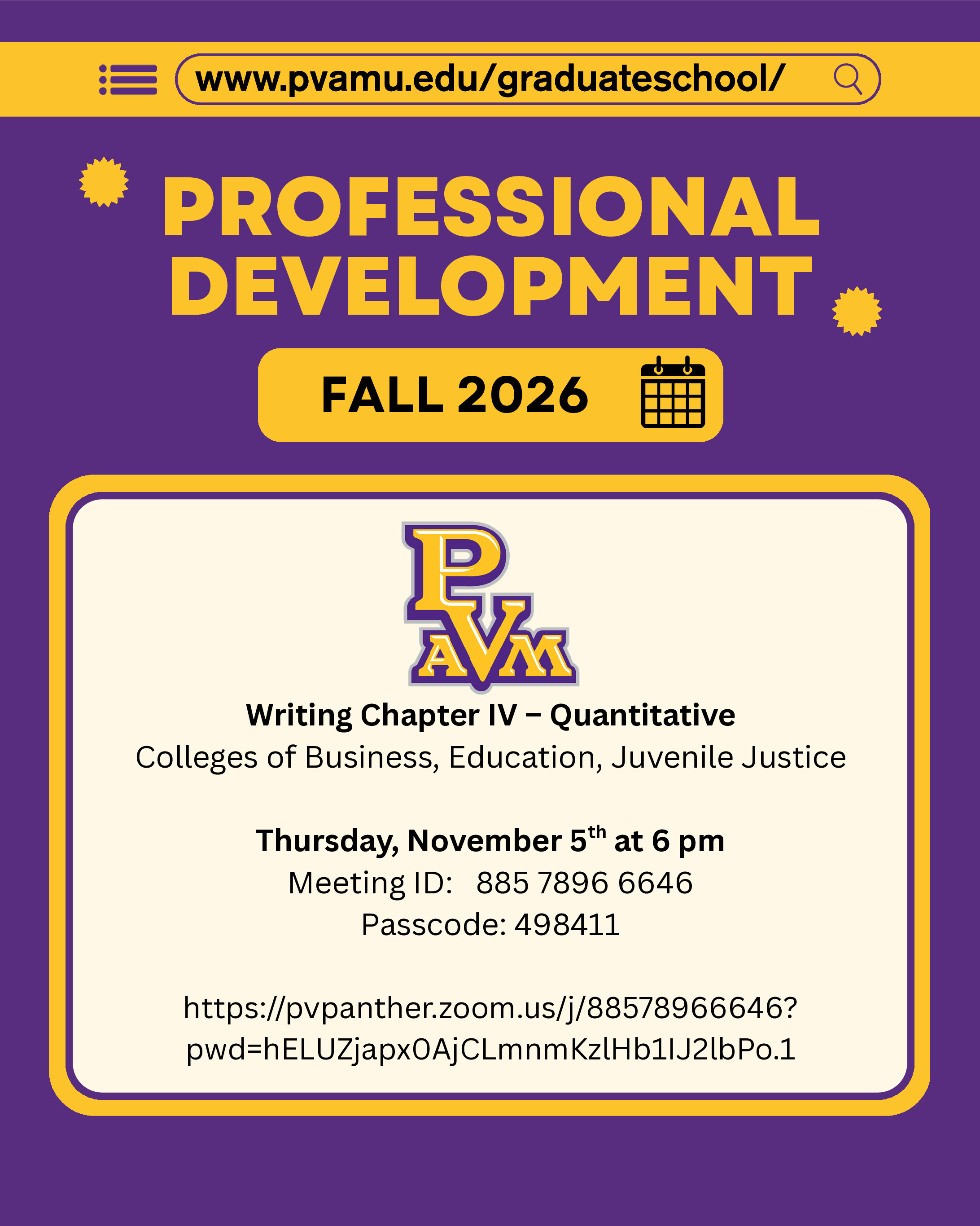
Writing Chapter IV – Quantitative (Colleges of Business, Education, Juvenile Justice)
Meeting ID: 885 7896 6646 Passcode: 498411 Link: https://pvpanther.zoom.us/j/88578966646?pwd=hELUZjapx0AjCLmnmKzlHb1IJ2lbPo.1
-
Andrew Appiah Darkwah Master’s Thesis Defense, Wednesday, November 18, 2026 @ 11:30 am Central Time
COMMITTEE CHAIR: Dr. Jennifer Quinlan TITLE: ASSESSMENT OF MICROBIAL QUALITY AND SAFETY OF WILD-CAUGHT SHRIMP AND FARM-RAISED SHRIMP ABSTRACT: Introduction: Shrimp consumption is on the rise in the US. This demand is met by imported, farm-raised shrimp, where antibiotics are commonly used for disease prevention, resulting in antibiotic-resistant bacteria (ARB) in the final product. Purpose: This [...]
-

Monijesu Fadamiro Master’s Thesis Defense, Friday, November 20, 2026 @ 11:00 am Central Time
COMMITTEE CHAIR: Dr. Jennifer Quinlan TITLE: EXAMINATION OF FOOD SAFETY AND MICROBIAL QUALITY IN LOW-INCOME RURAL VS. HIGH-INCOME SUBURBAN RETAIL ESTABLISHMENTS ABSTRACT: Introduction: Previous research has shown that food quality and safety at the retail level can vary based on the size and resources available to food retailers, particularly in urban areas, however rural retail food [...]
-

Christian Onyeke Dissertation Defense, Friday, November 20, 2026 @ 1:00 pm Central Time
COMMITTEE CHAIR: Dr. Xishuang Dong TITLE: INTERPRETABLE ARTIFICIAL INTELLIGENCE FOR KNOWLEDGE TRACING AND PERSONALIZED LEARNING ABSTRACT: Knowledge tracing (KT) models estimate learners’ evolving knowledge and predict subsequent responses from interaction histories. Their application to personalized learning requires interpretable predictions, reliable probabilities and explicit connections to instructional decisions. This dissertation presents four complementary studies addressing [...]
-
-
-
-
-