

Images of Recent Lunar Eclipses
From time to time we get to enjoy lunar eclipses of various degrees from Southeast Texas. What follows are images and information concerning three of the recent lunar eclipses of note as seen from the greater Houston area. The next lunar eclipse visible from Southeast Texas is the near-total partial lunar eclipse on the evening of August 27, 2026. At maximum eclipse, 92% of the Moon (as measured by diameter) will be covered by the Earth’s shadow. We plan a viewing session for students just starting their fall 2026 semester at the Prairie View Solar Observatory, since this falls during Week 1 of Fall 2026. Check out https://eclipse.gsfc.nasa.gov/eclipse.html for information on solar and lunar eclipses, and the info sheet about the August 27 (August 28 UTC) event.
Total Lunar Eclipse (March 14, 2025)
There was a total lunar eclipse visible from the local area in the early morning hours of March 14, 2025. This was the first such event since the total lunar eclipse of November 8, 2022. We used the department’s SeeStar50 smart telescope to capture images of the event, through many clouds, from a dark sky observing site just west of Columbus, TX.
Unfortunately the weather was not as cooperative as we would have liked but it was still possible to get plenty of peaks and photos through the frequent breaks and openings in the clouds. This continued through totality but the clouds increased shortly after the end of totality and the sky was soon overcast, with only stray moonlight filtering through unbroken clouds.
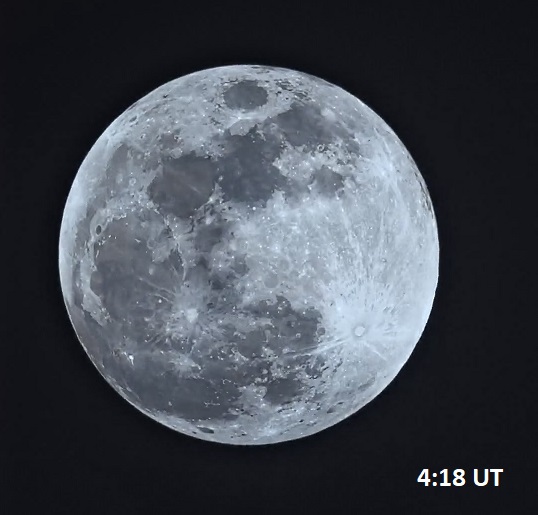
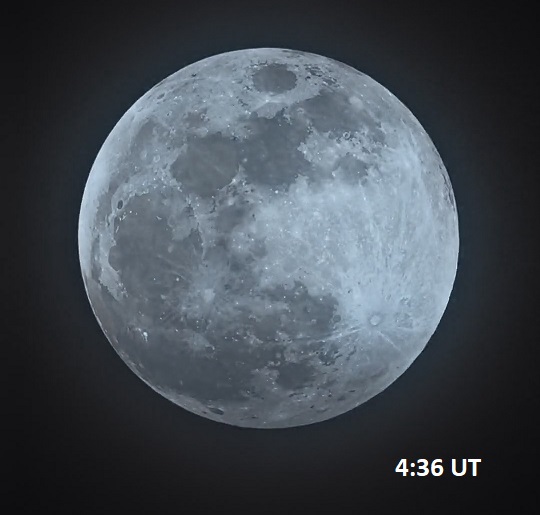
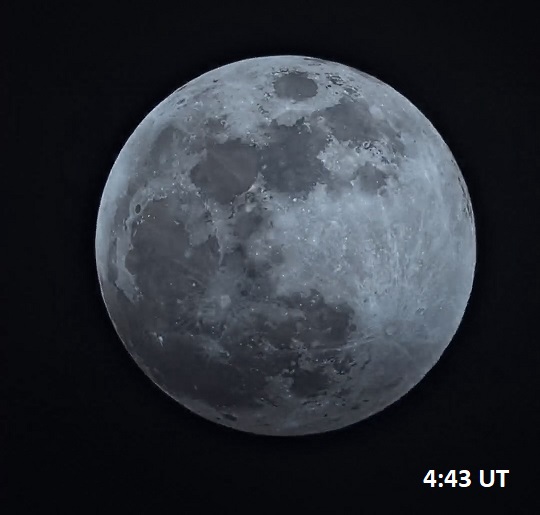
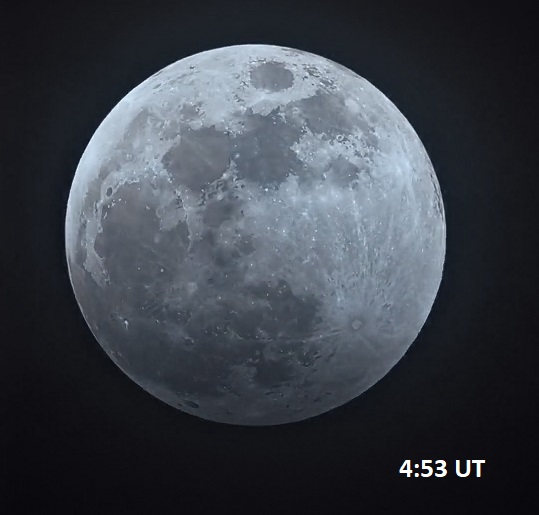
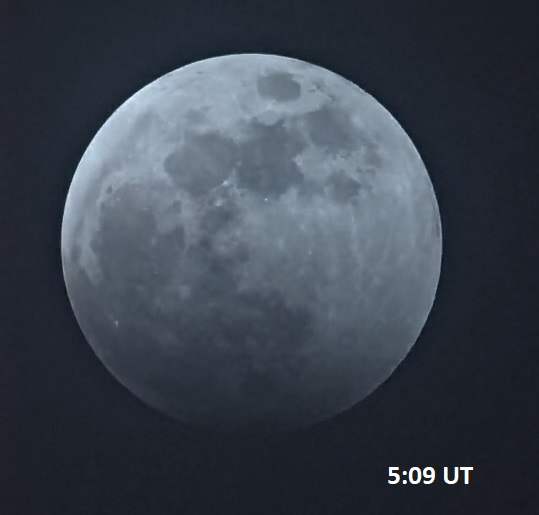
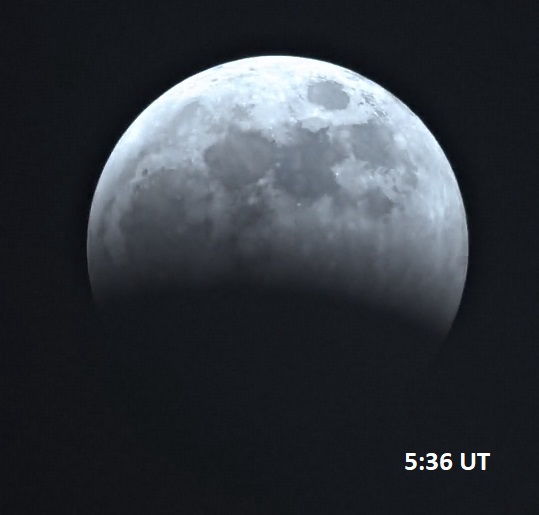
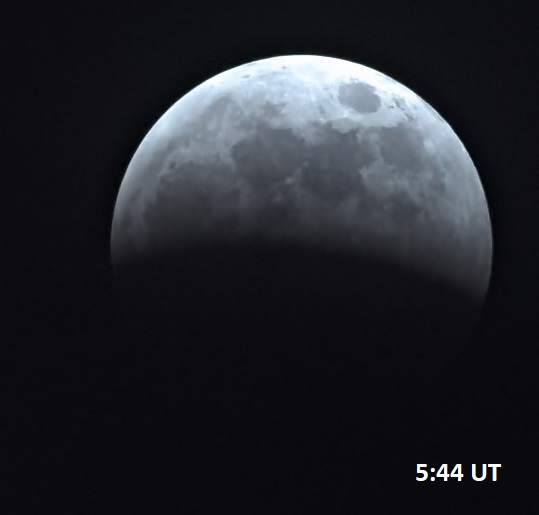
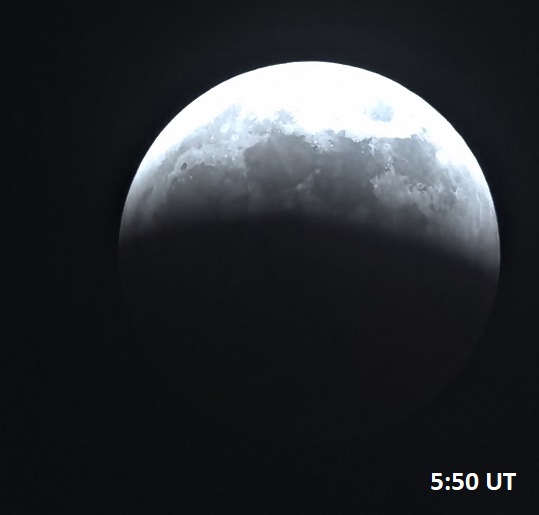
The first image (below) was taken one minute before the Moon entered the penumbra, or outermost fringes of the Earth’s shadow. The next four showed the progressive shading darkening (along the bottom of the Moon) as the penumbral phase deepened. First contact with the umbra (the dark central shadow) of the Moon was at 5:09 UT. All mages © 2025 by Brian Cudnik.
 |
 |
 |
 |
 |
 |
 |
 |
 |
 |
 |
 |
As the partial eclipse progressed, the part of the Moon in shadow usually becomes visible as a faint glow minutes after umbral contact. However, this visibility was hindered due to high cirrus clouds that were present all evening but were slow to clear. As these cleared, the low stratocumulus began to come up from the south and provided an almost continuously varying view. It was only during the clearest moments, and when the partial eclipse became deeper, that the shadowed part of the Moon became visible (the bottom three images above).
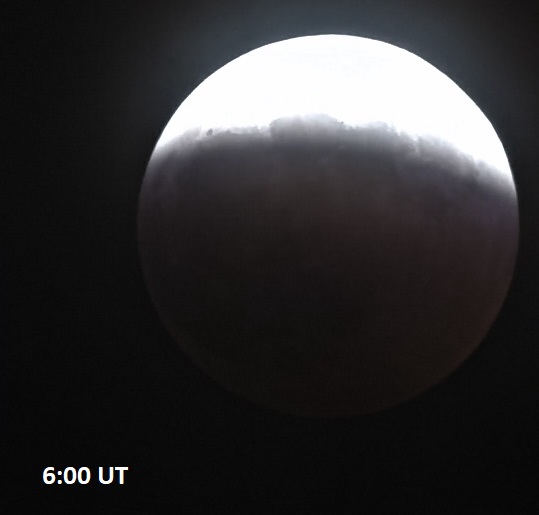
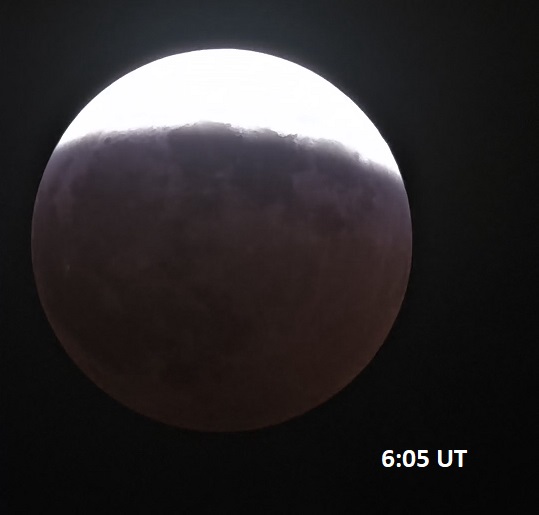
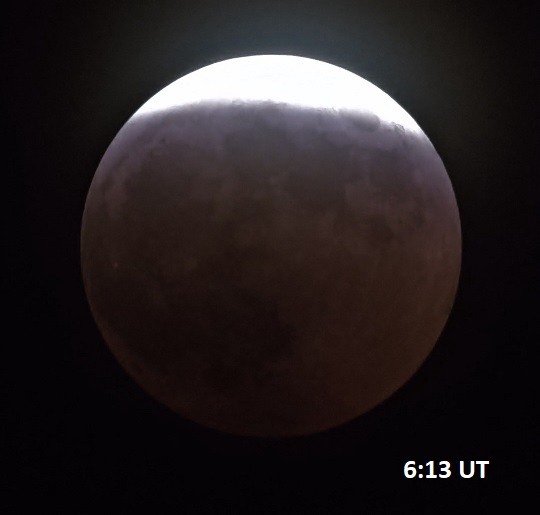
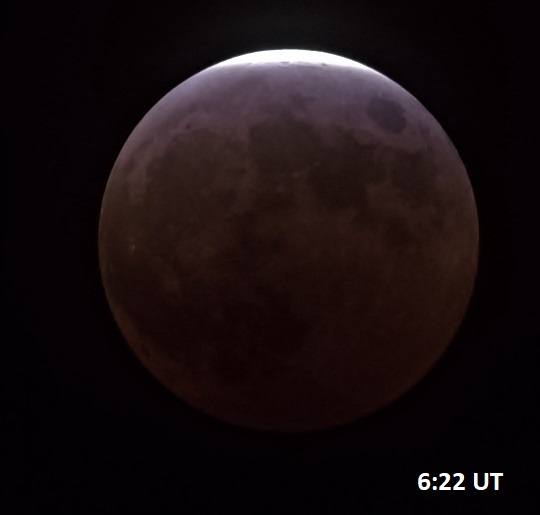
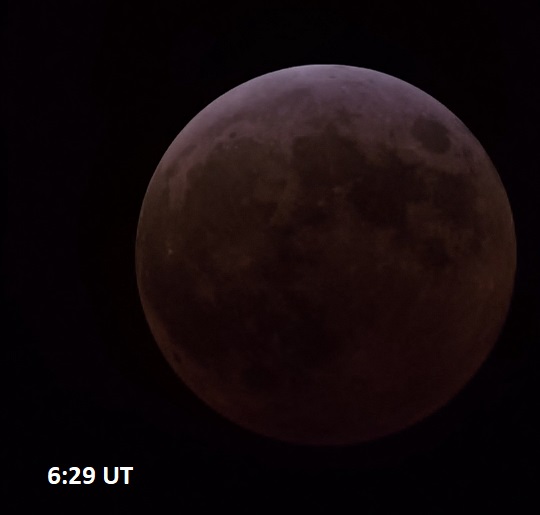
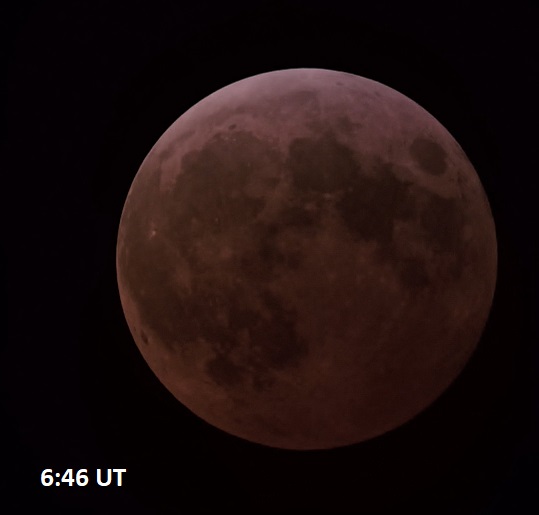
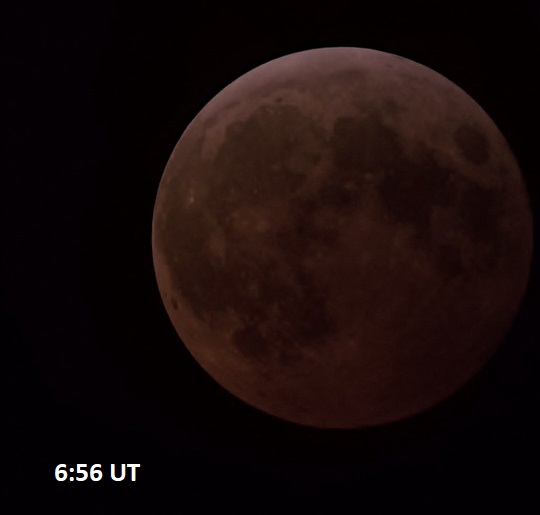
The next six images show the transition from partial to total eclipse. Totality began at 6:26 UT, so the Moon is shown in mage form some four minutes before and three minutes after second contact. The top (northern) part of the Moon was brighter than the rest throughout the event, with this bright “cap” slowly rotating counterclockwise as the Moon slid through the umbral shadow. The middle part of the eclipse, when the Moon is deepest into the Earth’s umbra, was at 6:59 UT.
 |
 |
 |
 |
 |
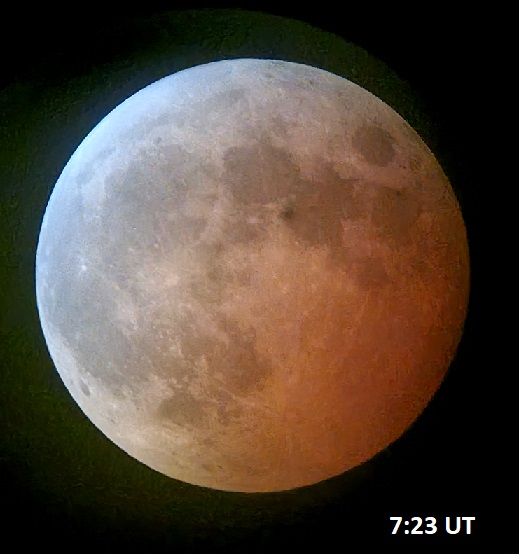 |
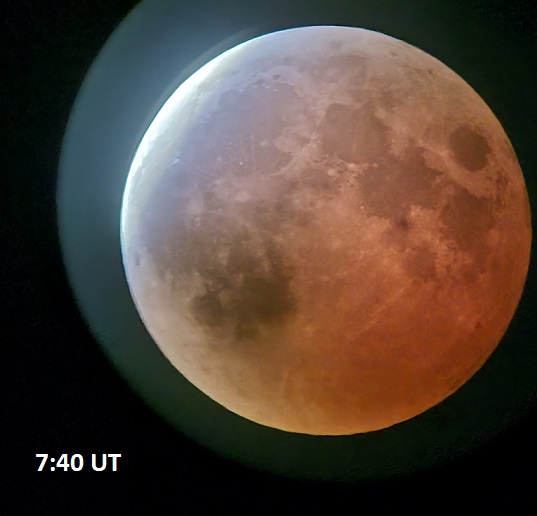
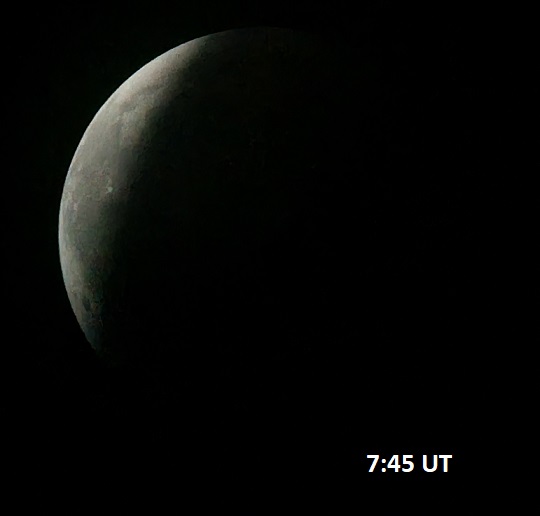
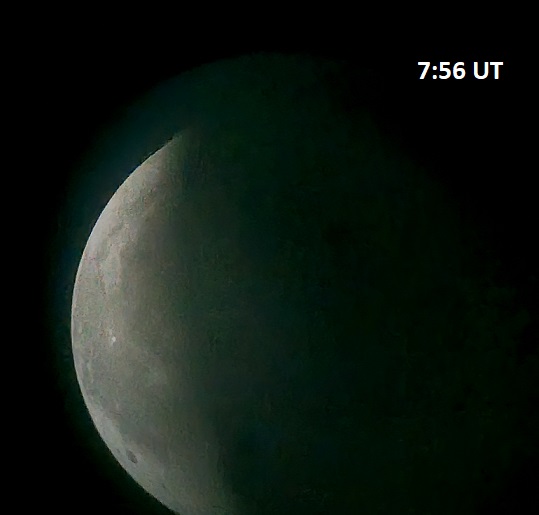
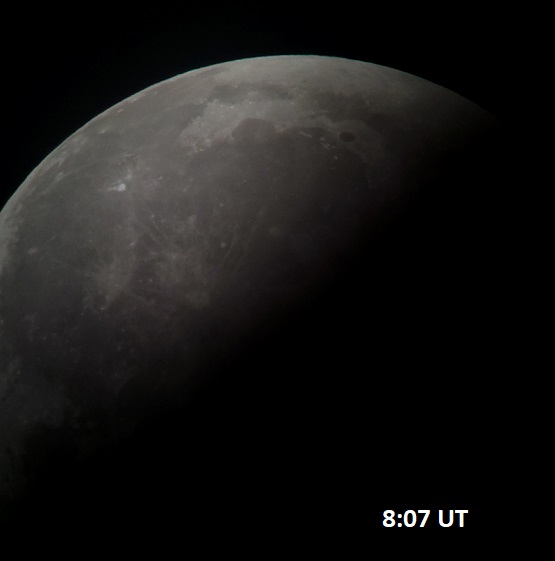
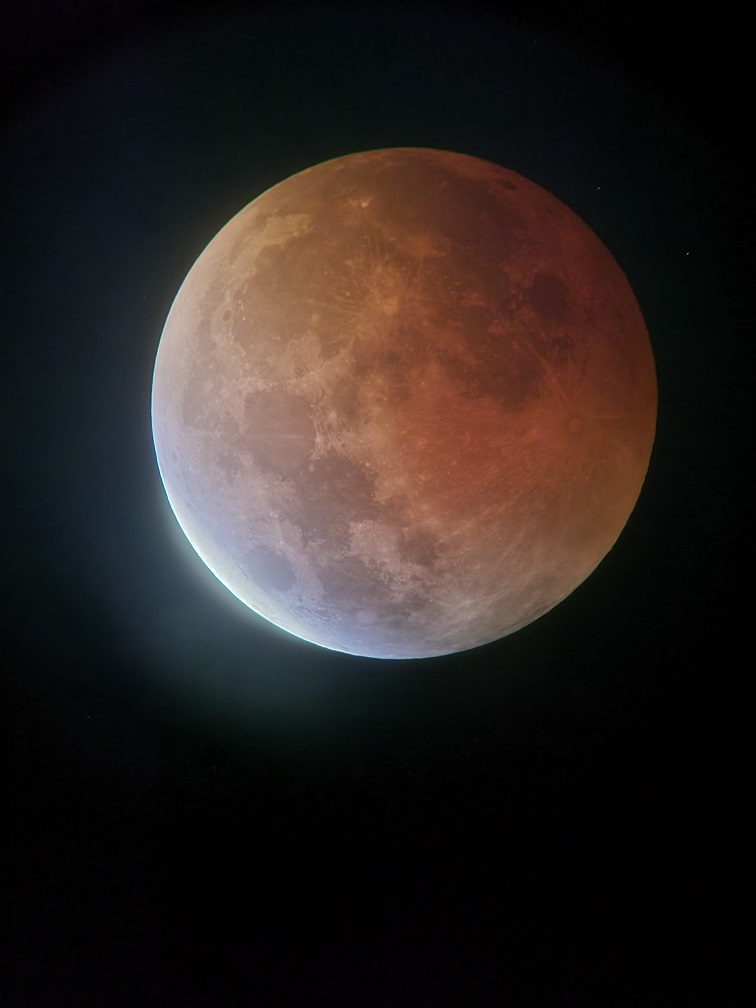
The image above and right was made using a different imaging technique: a camera held at the low power eyepiece of a 14-inch Cassegrain telescope. This shows more realistically how the eclipse appeared visually. The blue along the upper left part of the Moon is referred to as “the Ozone Fringe” where light passing through the ozone layer is sorted so that the reds and oranges are scattered away, allowing the blues and violets through. This is opposite to what usually happens at sunset and sunrise on Earth’s surface. The 65 minute totality came to an end at 7:31 UT. The last images below, particularly the ones taken at 7:56 and 8:07 UT, were taken when the breaks in the clouds were becoming shorter-lived, making it much more difficult to get a proper alignment for a picture. Partial eclipse ended (behind a solid deck of clouds) at 8:47 UT; the eclipse was completely over at 10:00 UT, when the Moon exited the penumbra. This otherwise unobservable event happened behind a solid deck of clouds.
 |
 |
 |
Partial Lunar Eclipse, September 17/18,2024
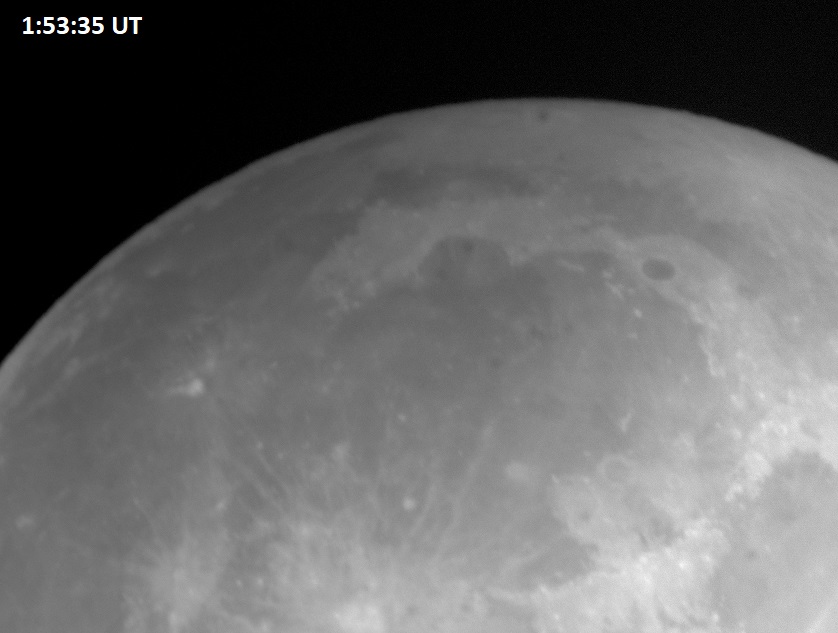
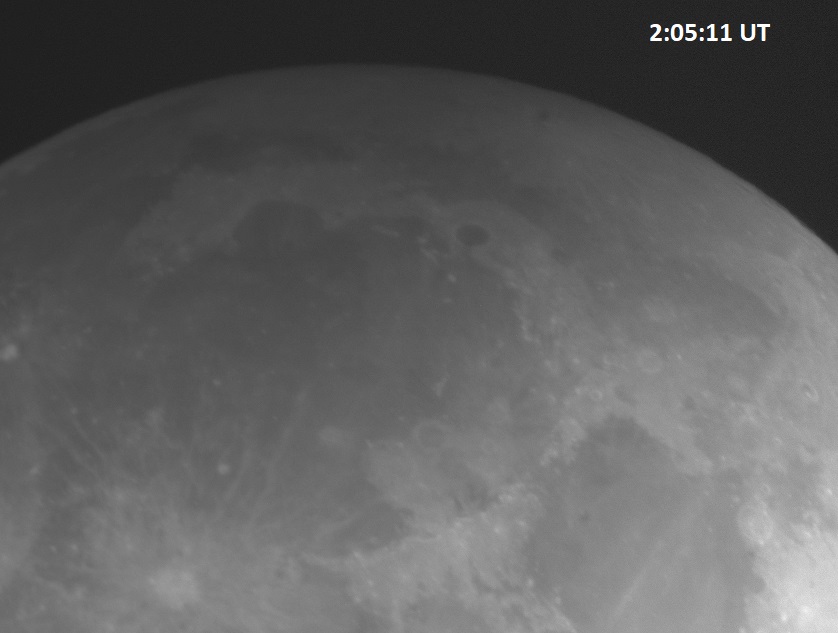
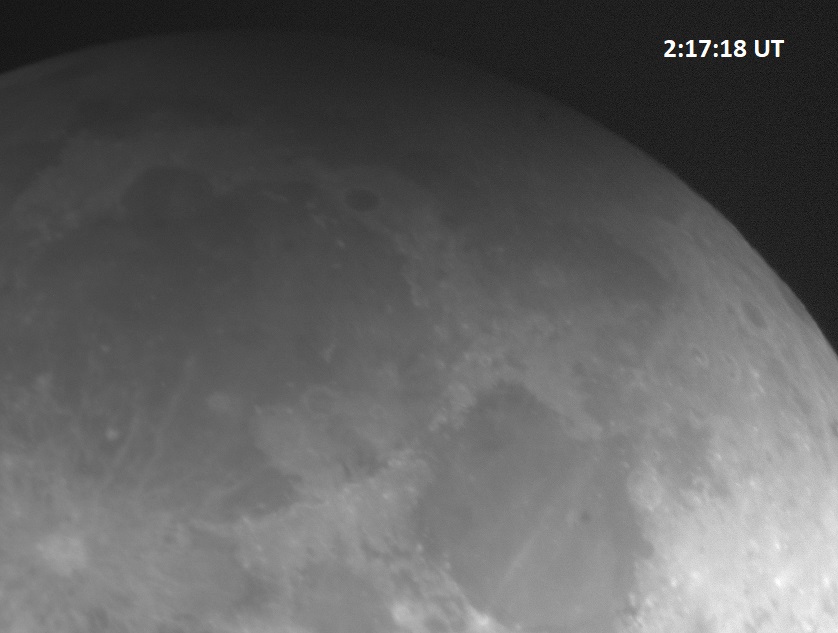
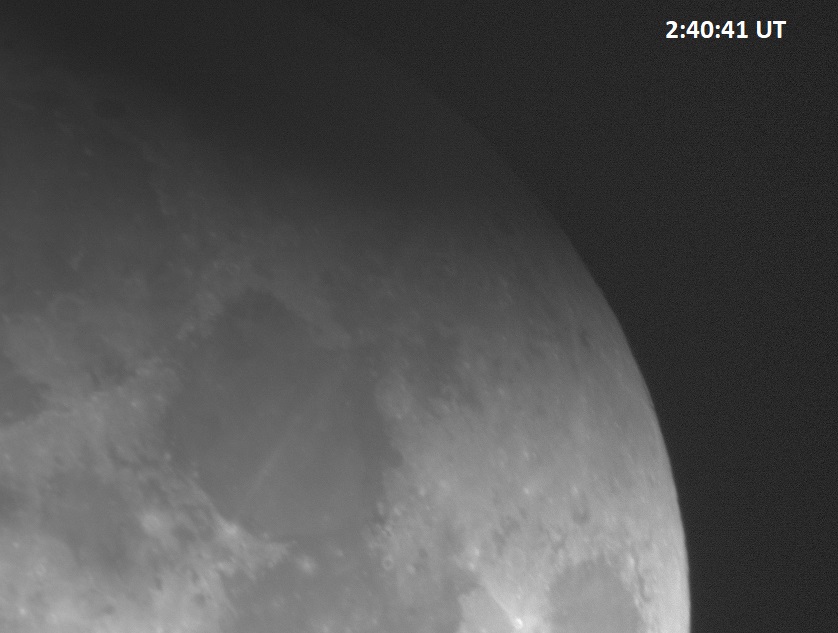
A partial lunar eclipse occurred during the evening of September 17, 2024 (early 18 September 2024, UTC). Some 50 individuals visited the Solar Observatory for the eclipse viewing where four small telescopes were set up for their viewing and imaging. The Solar Dome Scope was configured to observe the Moon by removing the H-alpha filter, but leaving the red Energy Rejection Filter at the main aperture in place, along with the neutral density filter. Both of these served to control the glare from the Full Moon. Each of the below images cover 13.8’x18.0′ on the sky, so since the Moon was 33.8′ across during the eclipse, it was not able to fit in the field of view. So we focused on the region where the shadow would appear to skim the lunar limb. The faint, dusky shade of the Penumbra was visible as early as 1:25 UT (8:25 pm CDT) as an amorphous gray shading. Partial eclipse begain at 2:12 UT (9:12 pm CDT) as the Moon started encountering the inner umbra shadow. Maximum eclipse happened at 2:44 UT (9:44 pm CDT), when 8.5 % of the Moon’s disk was in the shadow. Then the reverse came: partial eclipse ended at 3:15 UT (10:15 pm CDT), with the last penumbra visible around 11:15 pm CDT; the eclipse formally ended at 4:47 UT (11:47 pm CDT) when the Moon exited the outer penumbral shadow.
 |
 |
 |
 |
 |
 |
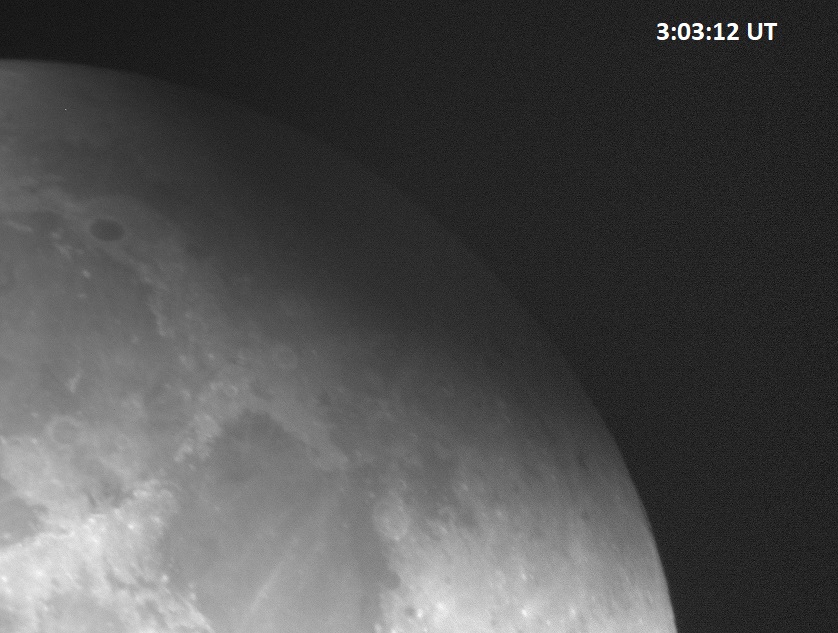 |
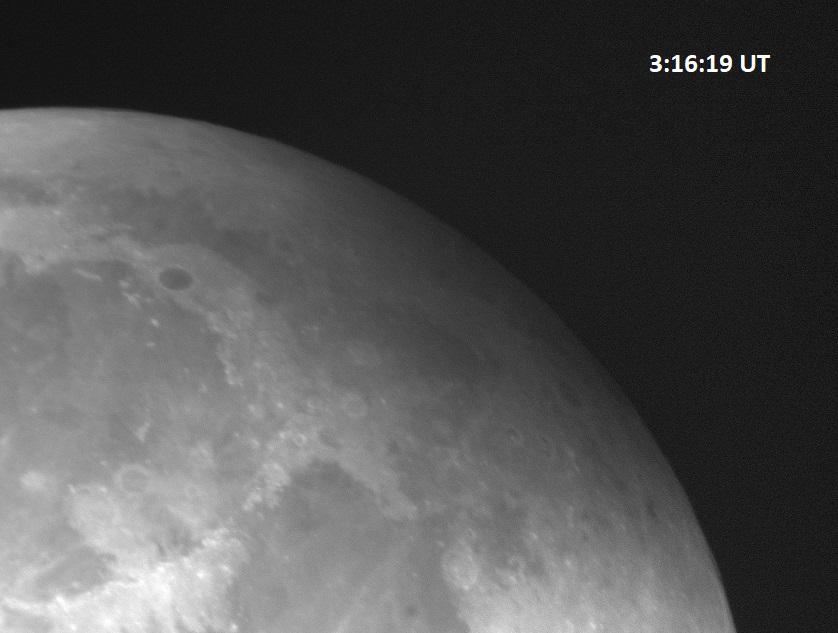 |
 |
The next lunar eclipse will be a total eclipse that will occur over the Spring Break, specifically on March 13/14, 2025.
November Beaver Mini-Moon Total Eclipse, November 8, 2022
Earlier this week featured a total lunar eclipse, the second this year, visible from the United States. This was a pre-dawn celestial event with the moon setting just after, or during, the final phases of partial eclipse (depending on which part of the country it was observed). We hosted a gathering of 25 students and 5 faculty at the Prairie View Observatory on Monday evening November 7 for a pre-eclipse telescope viewing session. The Moon was bright and full in the eastern sky, with Jupiter high in the south southeast and Saturn medium high in the south southwest. These were the targets viewed with four telescopes: a wide field view of the Full Moon (especially easy to take cellphone images through) with the Takahashi 5.1-inch refractor; a close-up view with the Meade 10-inch Cassegrain; and the planets through our 10″ Dob reflectors, one looking at Jupiter and another viewing Saturn.
The graphic below provides the circumstances for the eclipse, with times listed in CST. The image at left is from last May’s total lunar eclipse.
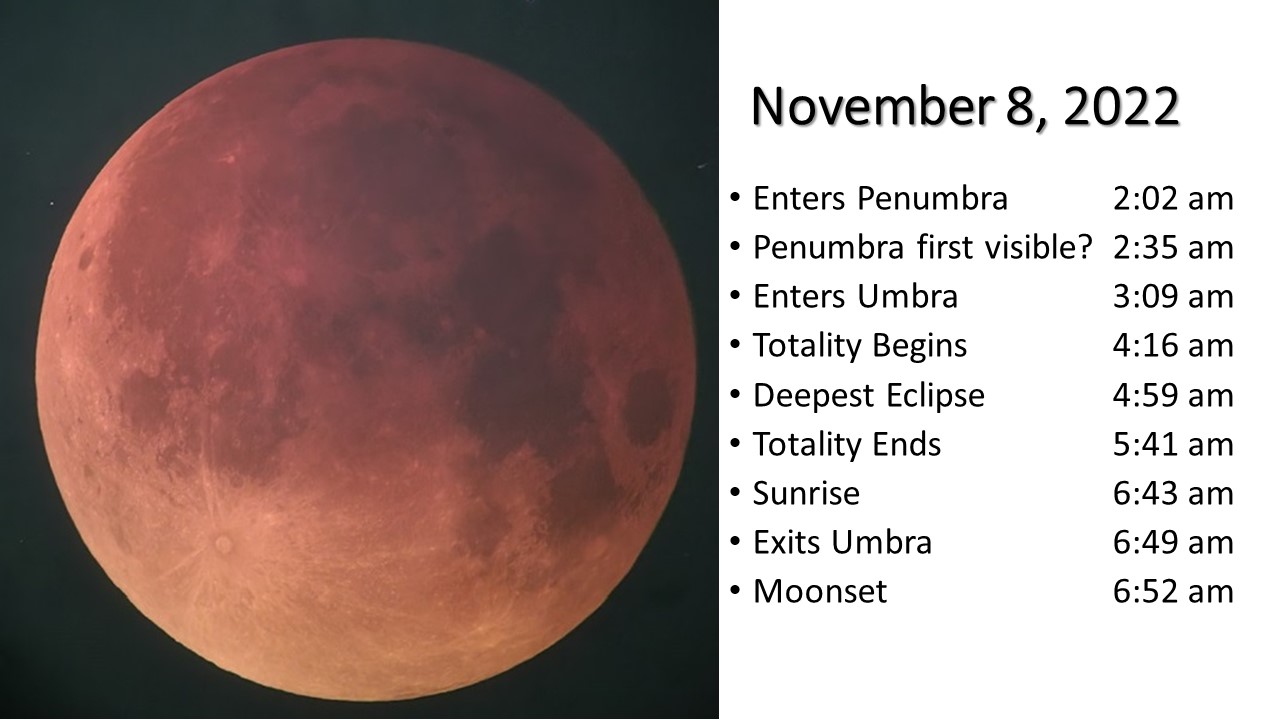
All of the images below were made afocally (taken through the eyepiece) with a Samsung Galaxy 21 smart phone in pro mode or night imaging mode, exposure times ranged from 1/500 second to 2 seconds at ISO 400. The telescope was a University-owned CPC 1100 (11-inch f/10 Cassegrain, with 41 mm eyepiece). The times of each image are listed in Coordinated Universal Time, or UTC, where CST = UTC – 6 hours.
After the Moon entered the penumbra (the fuzzy outer part of a shadow) at 8:02 UTC, the eclipse is invisible at first. Then, 35 to 40 minutes after this event, the first hint of shading appears on one side of the Moon. It is very subtle and hard to see, but it gradually gets darker and darker (as shown in the two images below) in the last 20 minutes before first contact with the umbra (the dark core or main part of the shadow, which marks the start of partial eclipse), which happened at 9:09 UTC.
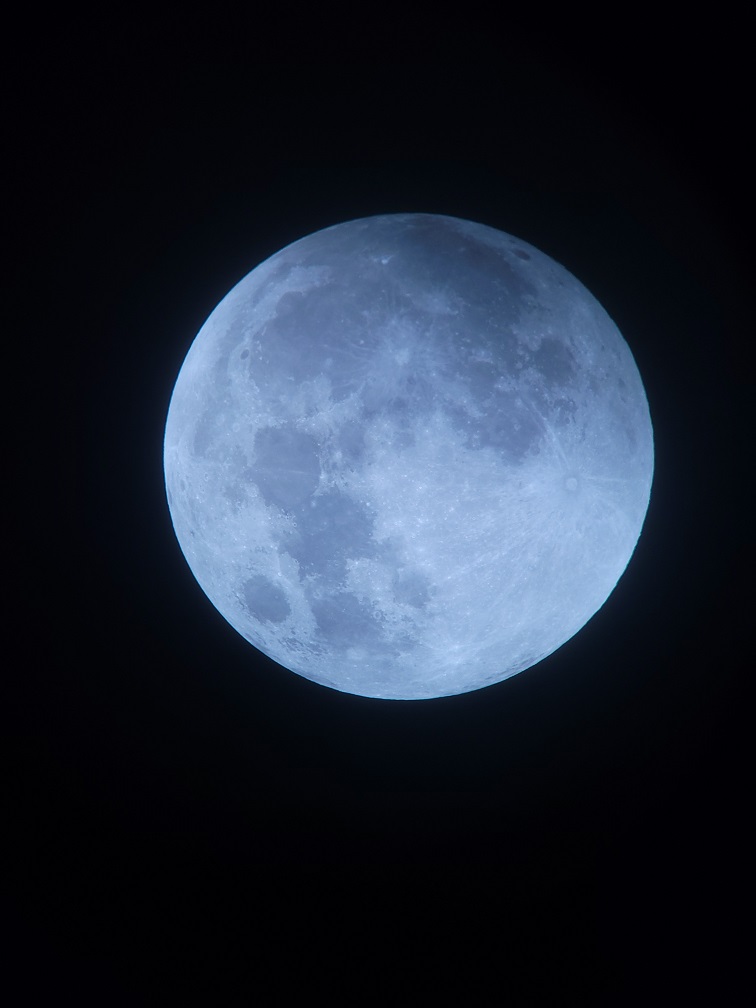 8:52:21 UTC, 50 minutes after first penumbra contact. 8:52:21 UTC, 50 minutes after first penumbra contact. |
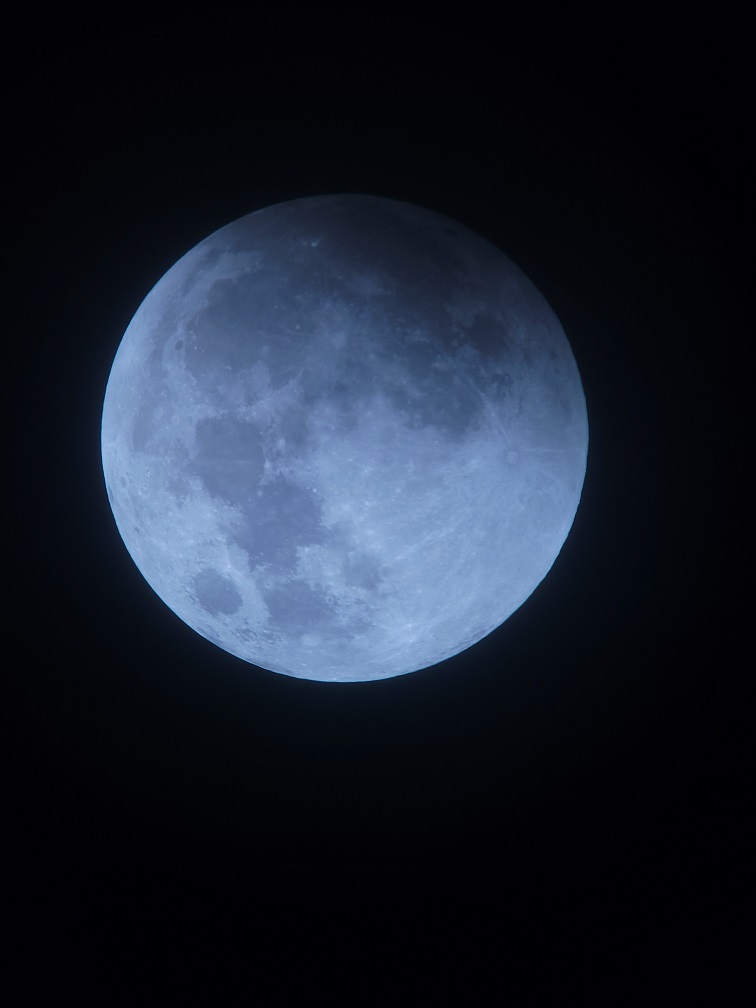 9:03:14 UT, less than six minutes before first umbral contact. 9:03:14 UT, less than six minutes before first umbral contact. |
The first of six images below show that the penumbral shading can be quite obvious in the last few minutes before partial eclipse begins.
For the next 67 minutes after the start of partial eclipse, the Moon steadily slips deeper into the dark umbra shadow. Even with only about a third of the Moon covered in shadow, the moonlit surroundings are noticeably dimmer. By about 50% immersion, the part of the Moon in shadow can be seen, even with the naked eye. It looks like a ruddy version of the earthshine phenomena that is commonly seen when the Moon is a thin crescent. Binoculars bring out the colors more. The progression of the partial phases is summarized in the six images below. The exposures are short to emphasize the overall visual appearance of the Moon as it gets deeper into the umbra.
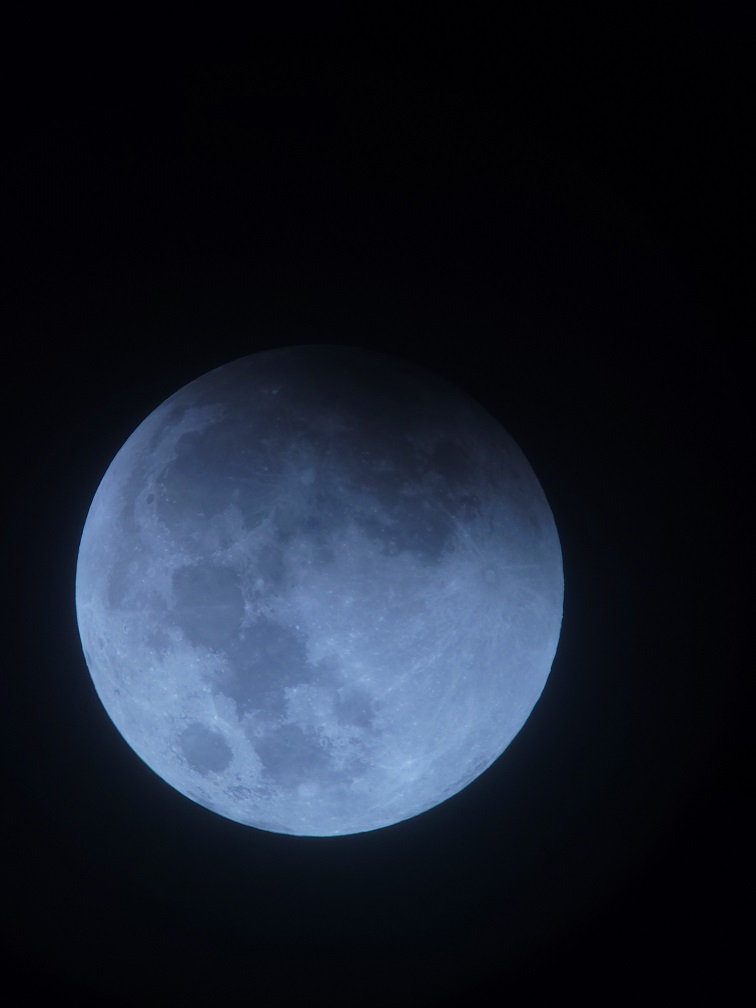 9:07:24 UTC 9:07:24 UTC |
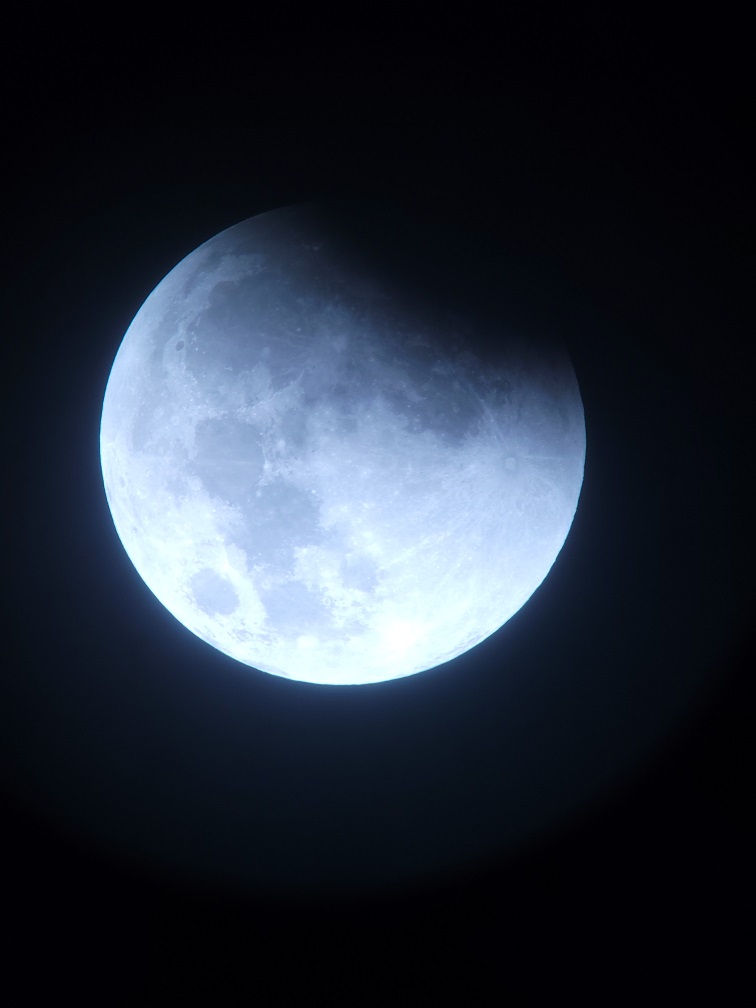 9:16:51 UTC 9:16:51 UTC |
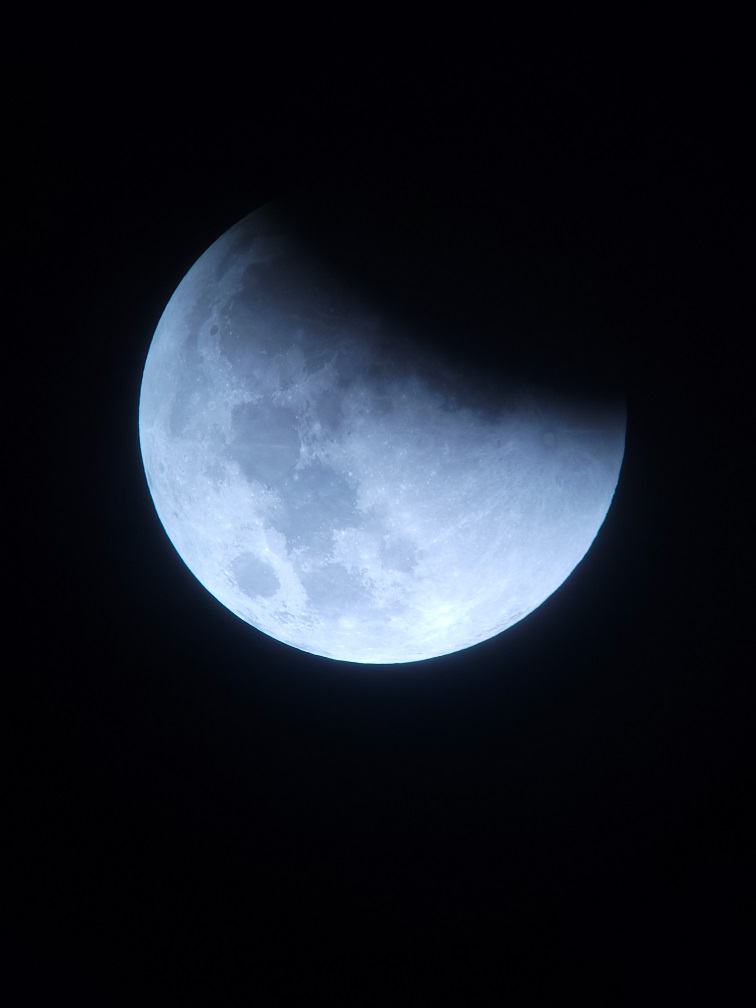 9:26:17 UTC 9:26:17 UTC |
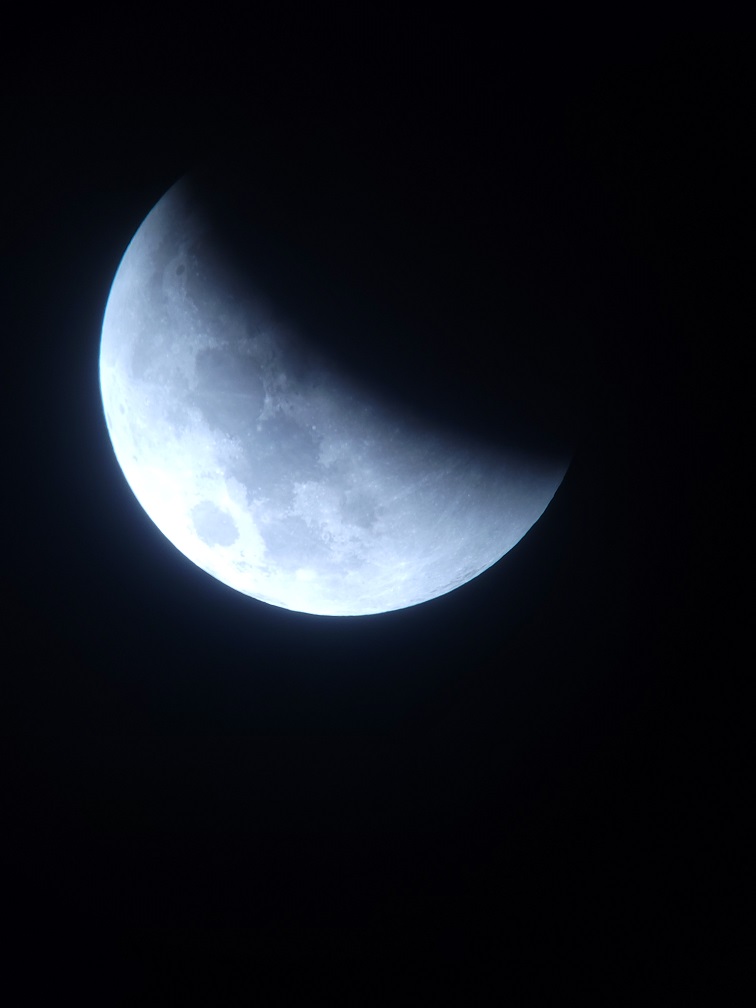 9:38:26 UTC 9:38:26 UTC |
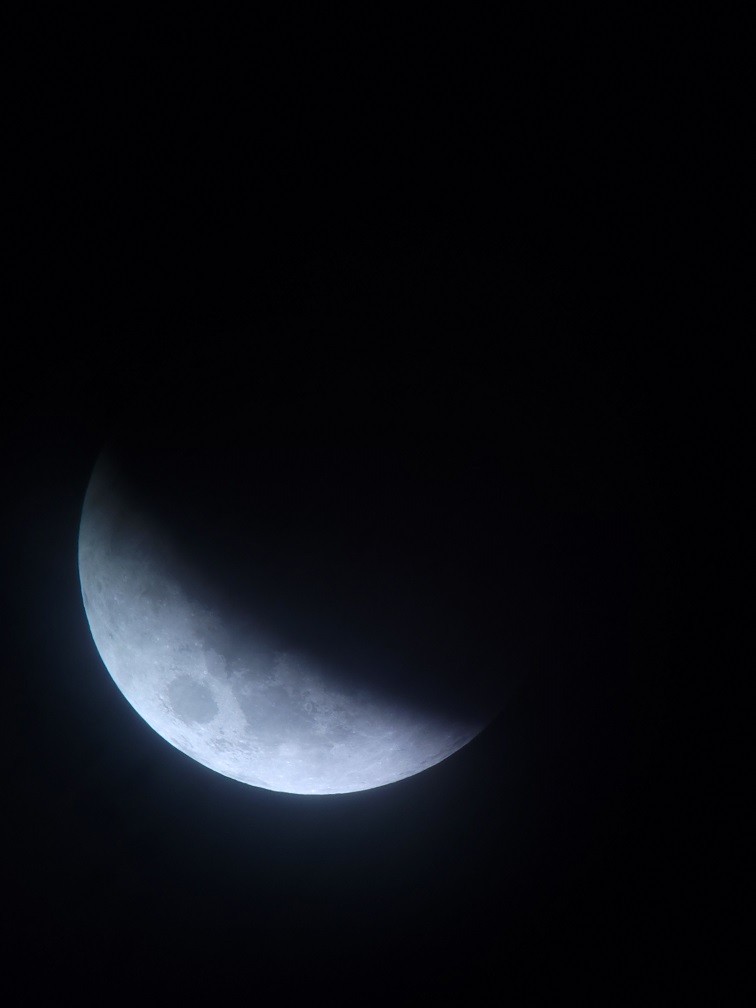 9:53:58 UTC 9:53:58 UTC |
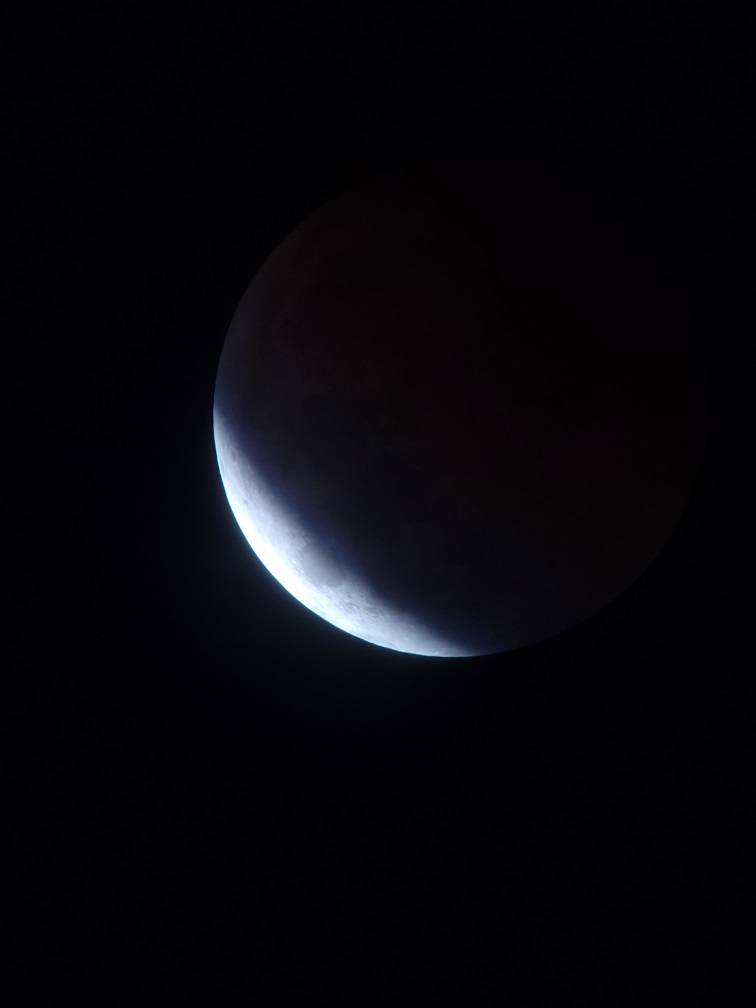 10:07:15 UTC 10:07:15 UTC |
It is always interesting to watch the transition from one phase of the eclipse to the next, especially through a telescope with a wide field of view that allows the entire moon to be seen. Totality began at 10:16 UT, so the first two images below are actually very deep partial phases, moments before the onset of totality, when the entire Moon lies inside the umbra shadow.
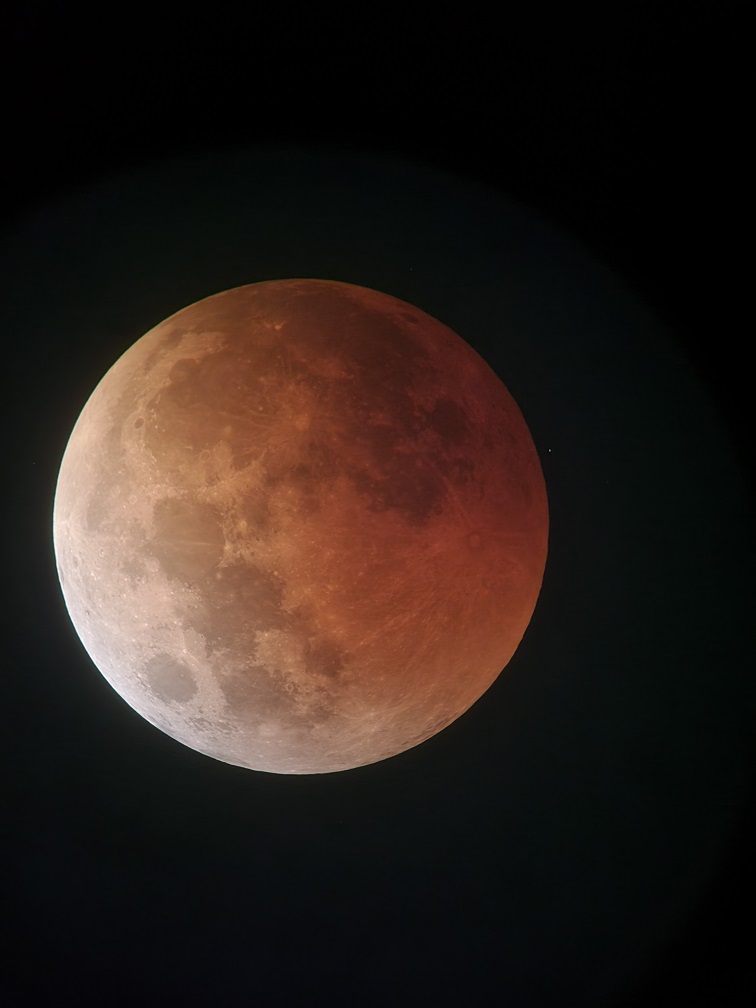
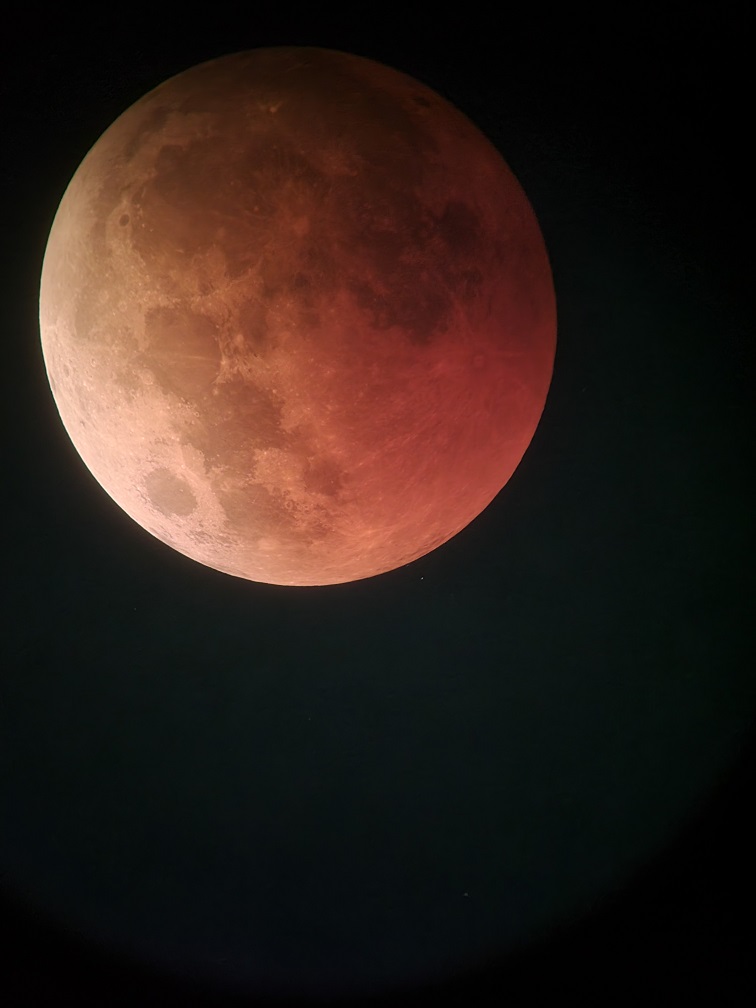
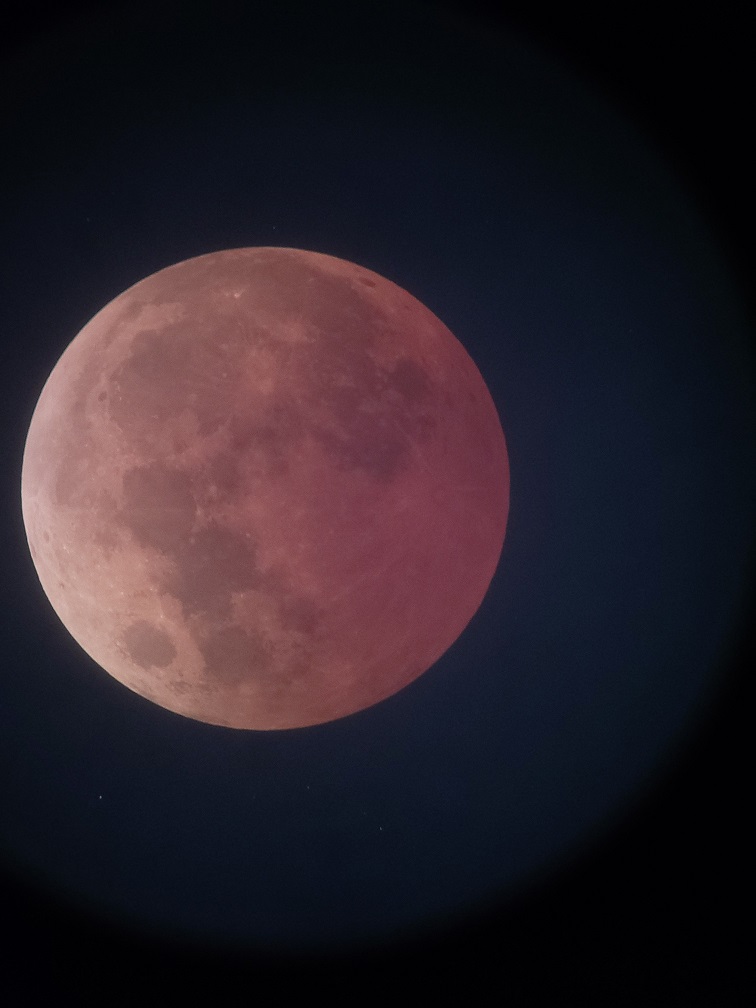
It can also be interesting to see how different settings in imaging can result in different color balances in the results. The “night mode” produced more orange-colored eclipse images. The “pro mode” showed more of a pinkish hue, which I also noticed visually. Overall the Moon glowed softly in shades of orange, but with a hint of pink overall. The images were taken at various times throughout the 85 minutes of totality. Maximum / Mid-eclipse (when the Moon is deepest in the umbra, and thus darkest) was at 10:59 UT.
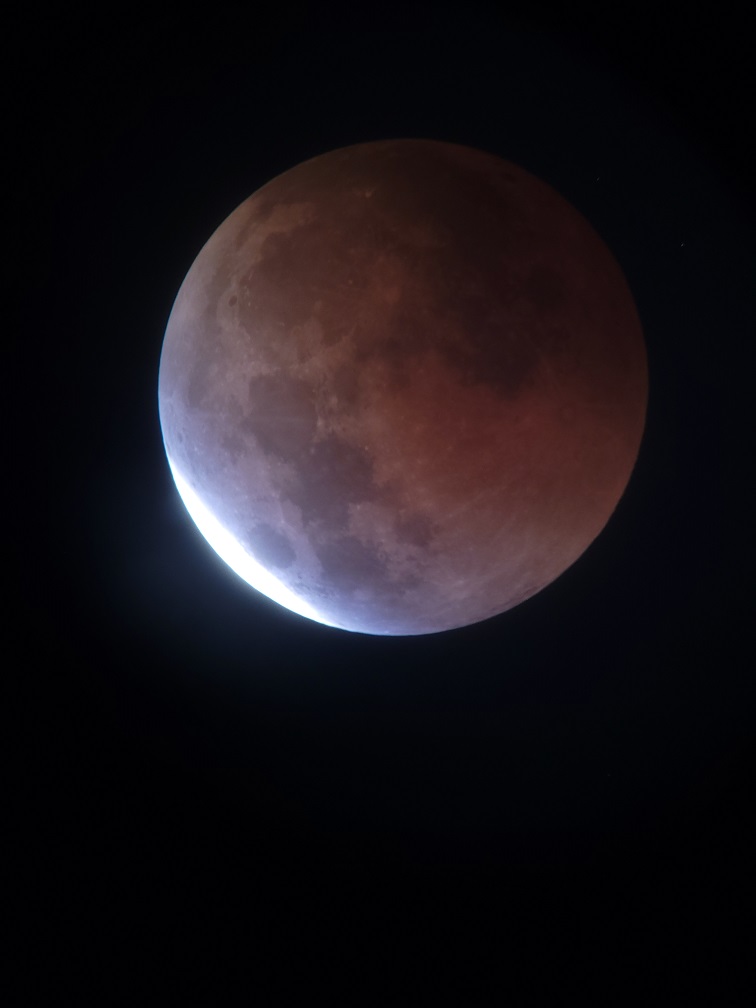 10:12:48 UTC 10:12:48 UTC |
 10:13:10 UTC. 10:13:10 UTC. |
 10:22:04 UTC 10:22:04 UTC |
 10:34:52 UTC 10:34:52 UTC |
 10:49:34 UTC 10:49:34 UTC |
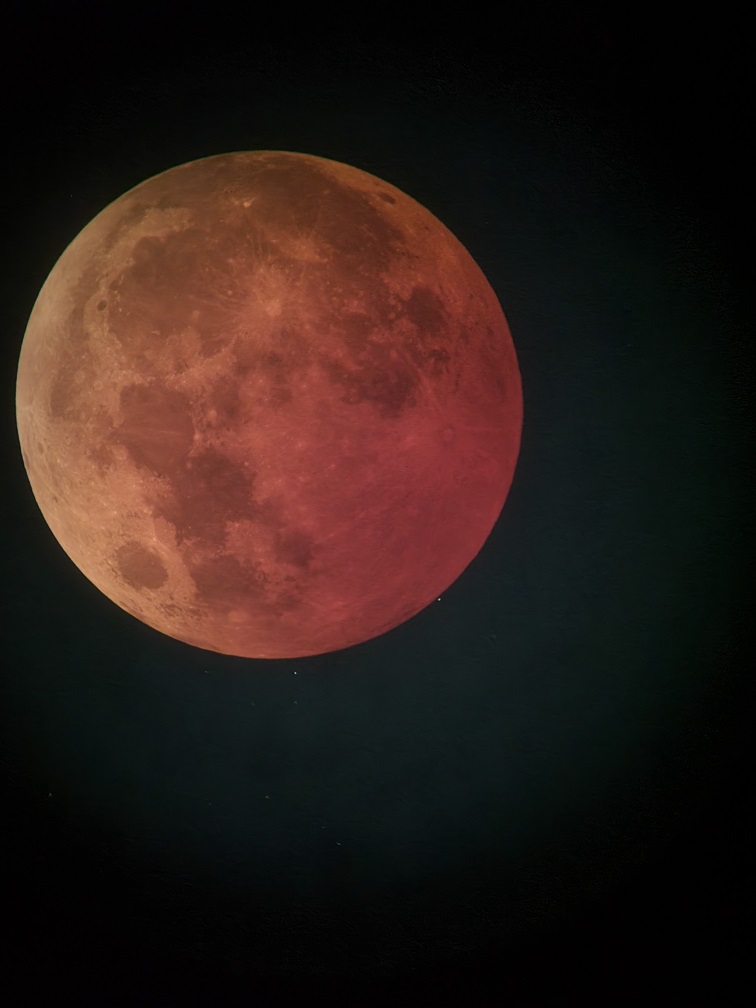 10:59:51 UTC-mid-eclipse 10:59:51 UTC-mid-eclipse |
Nearing the end of Totality, which occurred at 11:41 UT. As this event neared, one side of the Moon became noticeably brighter and brighter, until it returned to sunlight. The last of the four images below was taken about a minute after end of totality.
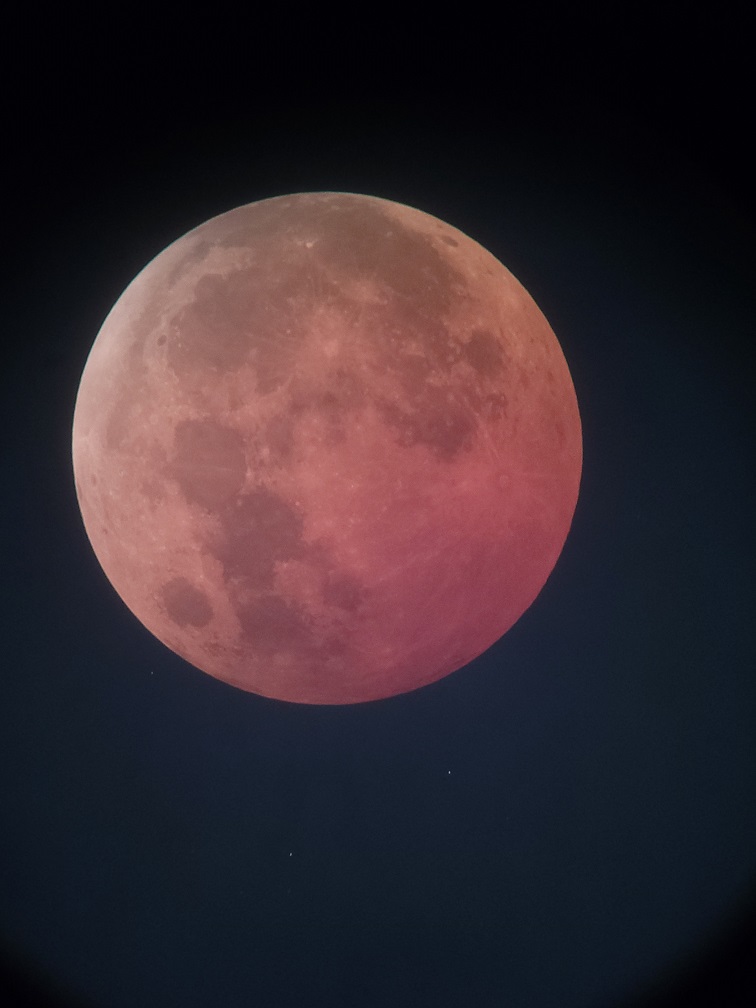 11:16:10 UTC 11:16:10 UTC |
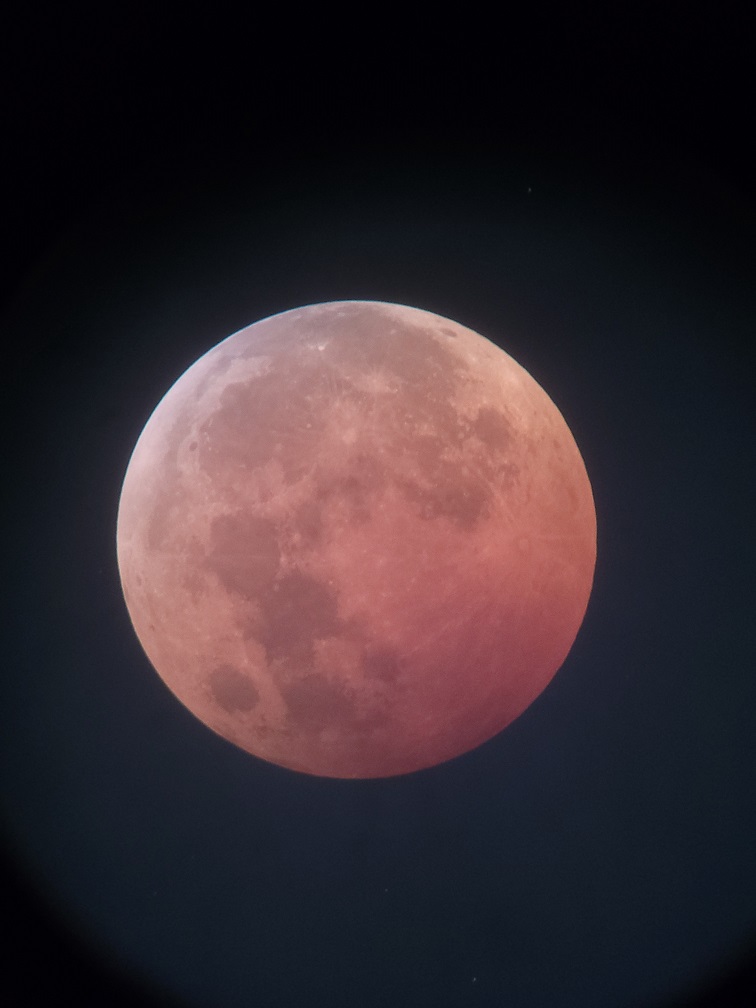 11:30:31 UTC. 11:30:31 UTC. |
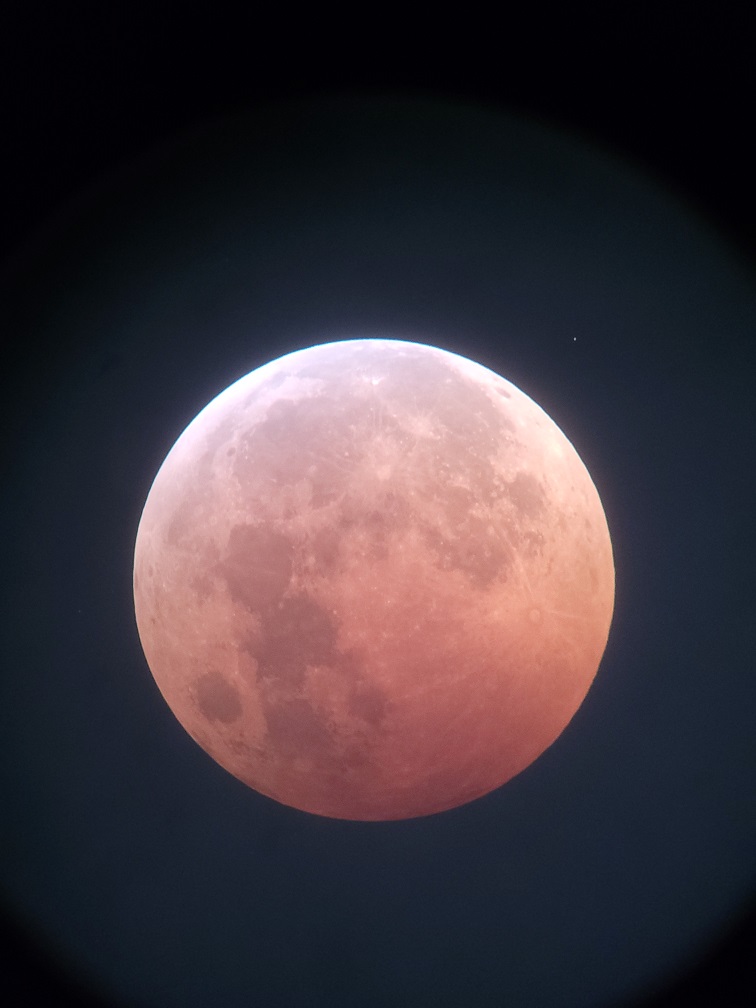 11:38:37 UTC. 11:38:37 UTC. |
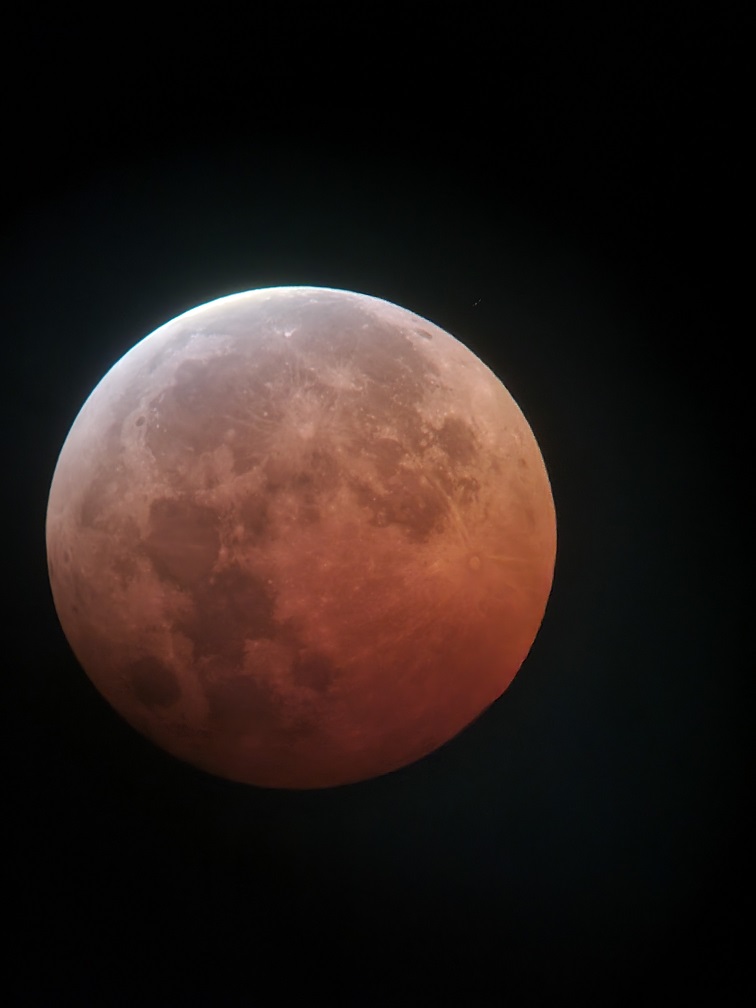 11:42:33 UTC. 11:42:33 UTC. |
The partial phases as the Moon moves out of the Earth’s shadow… As the Moon got lower in the sky, I needed to change to a smaller, more portable personal telescope, a 4.5-inch f/8 reflector. This needed to be moved to various locations as the Moon sank behind houses and other obstructions. The images below were taken through the eyepiece of this instrument.
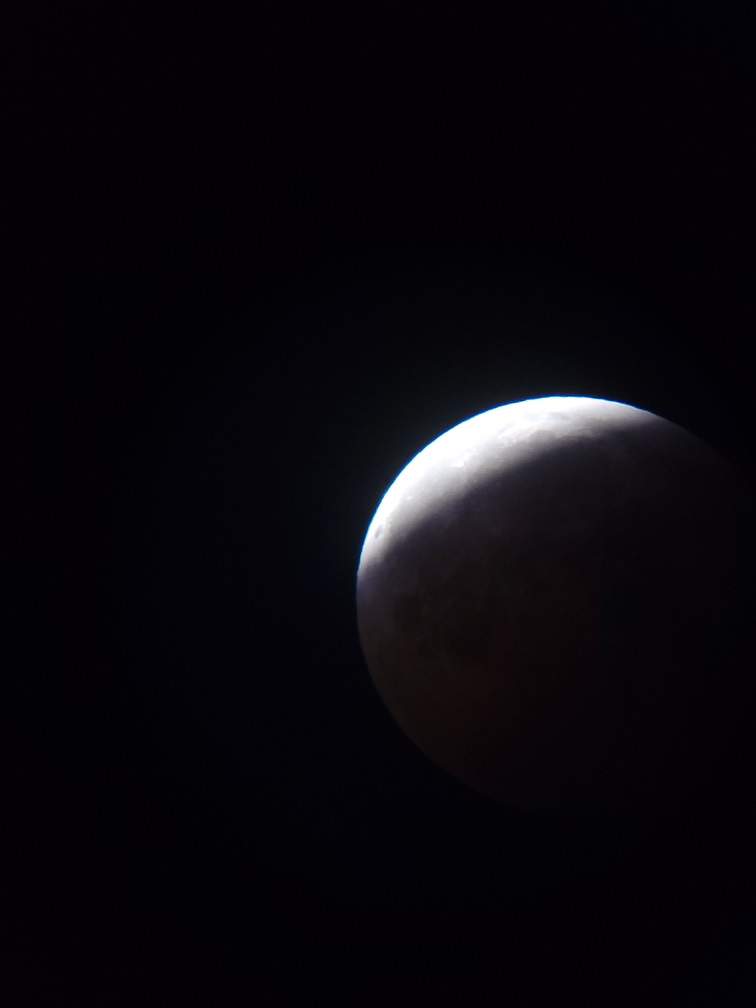 11:53:38 UTC. 11:53:38 UTC. |
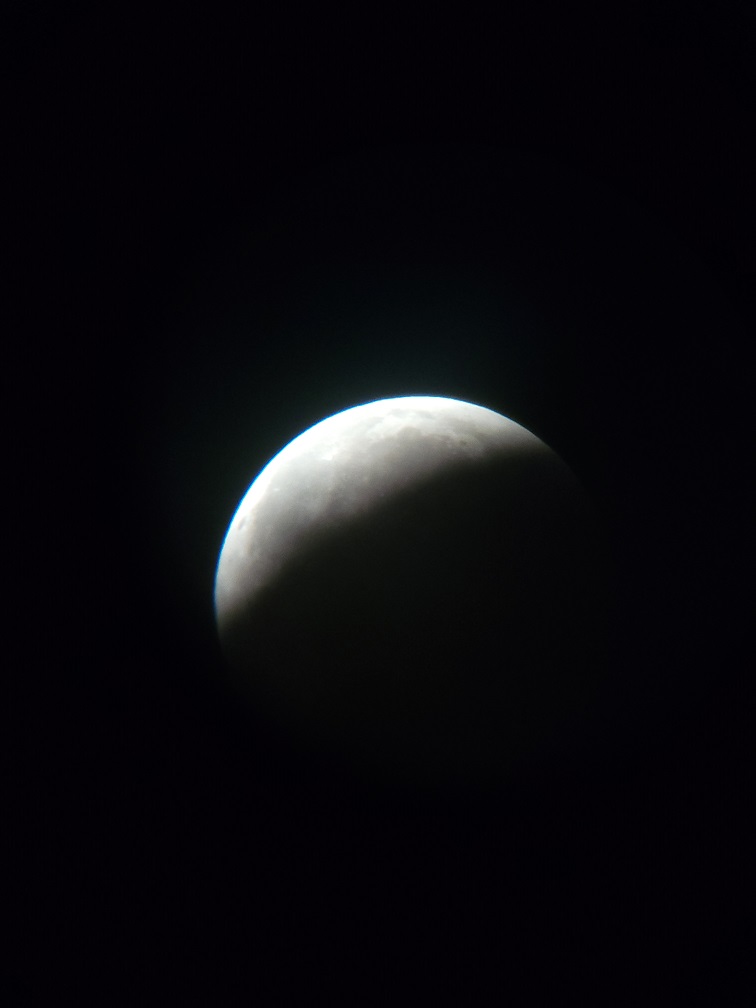 12:01:02 UTC 12:01:02 UTC |
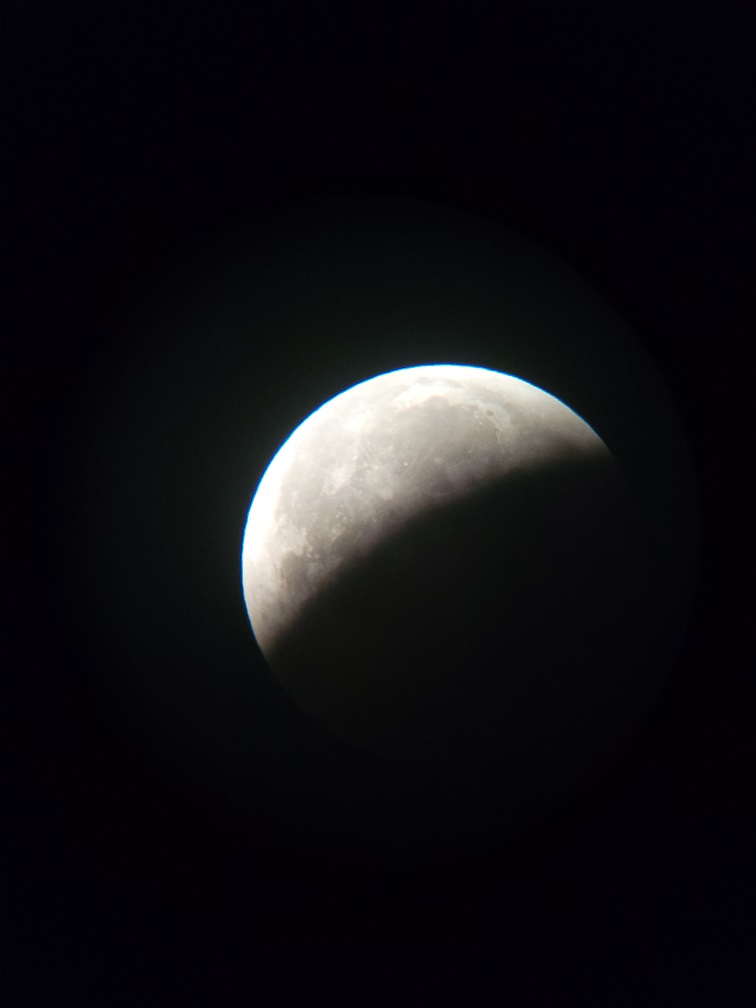 12:09:31 UTC. 12:09:31 UTC. |
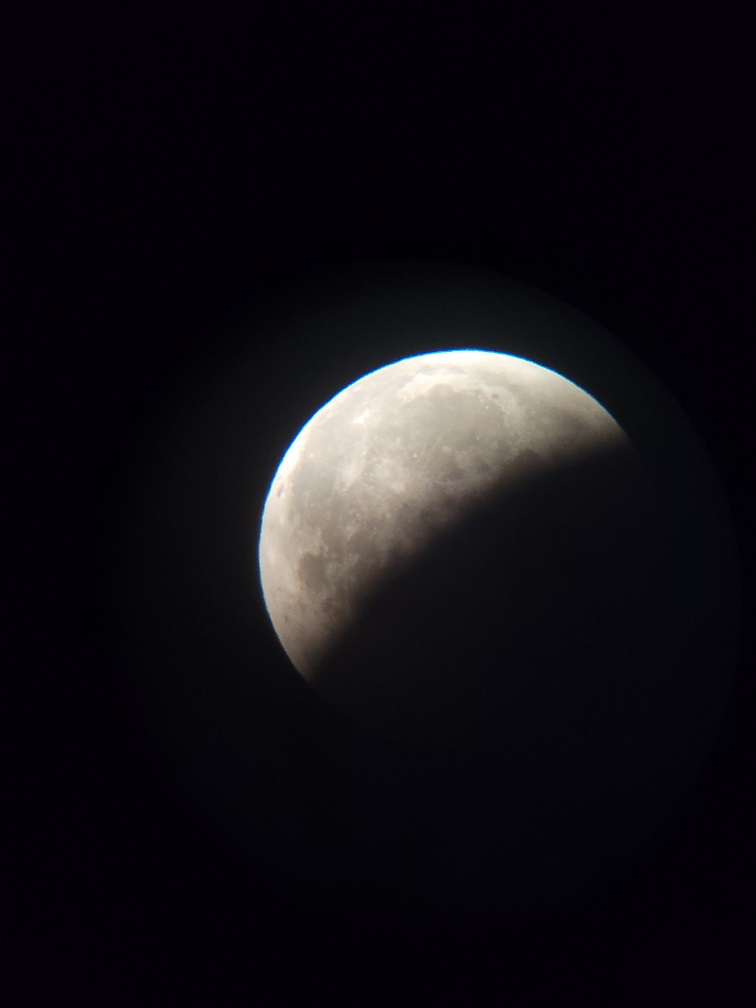 12:13:55 UTC. 12:13:55 UTC. |
My last view of the Moon for this event was at 12:24 UT through a space in the trees. It was still 25 minutes short of exiting the umbra and about two-thirds in sunlight. Actual moonset was about three minutes after the end of the partial phases, or nine minutes after local sunrise.
May Flower Super Moon Total Eclipse, May 16, 2022
Last night featured the first “full length” total lunar eclipse visible from the Continental United States since January 2019. This is one of two similar total lunar eclipses to grace our skies this year. Weather largely cooperated in the greater Houston, Texas area to allow observations to take place. I was able to follow all the stages of the eclipse, from the very first hint of penumbral shading, through “first contact” (when the Moon first enters the dark umbral shadow). Then the partial phases where I followed the progression of the covering of the bright lunar disk, watching and timing the moments the terrestrial shadow sweeps over pre-selected lunar features. This looked to be a dark eclipse, even from the early partial phases, because normally the shadowed part of the Moon is still visible due to light scattered in the umbra. This part looked noticeably dimmer than during previous eclipses.
All of the images below were made afocally with a Samsung Galaxy 21 smart phone in pro mode, exposure times ranged from 1/500 second to 2 seconds at ISO 400. The telescope was a University-owned CPC 1100 (11-inch f/10 Cassegrain, with 41 mm eyepiece).
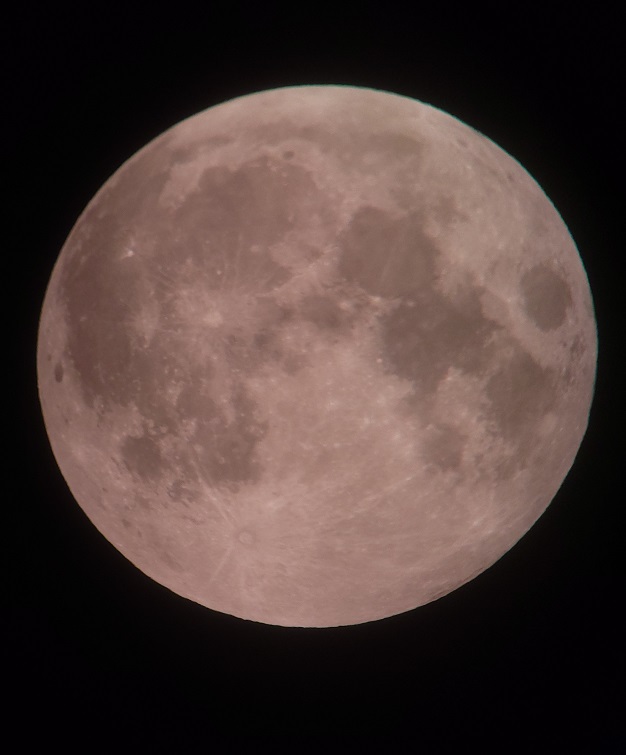
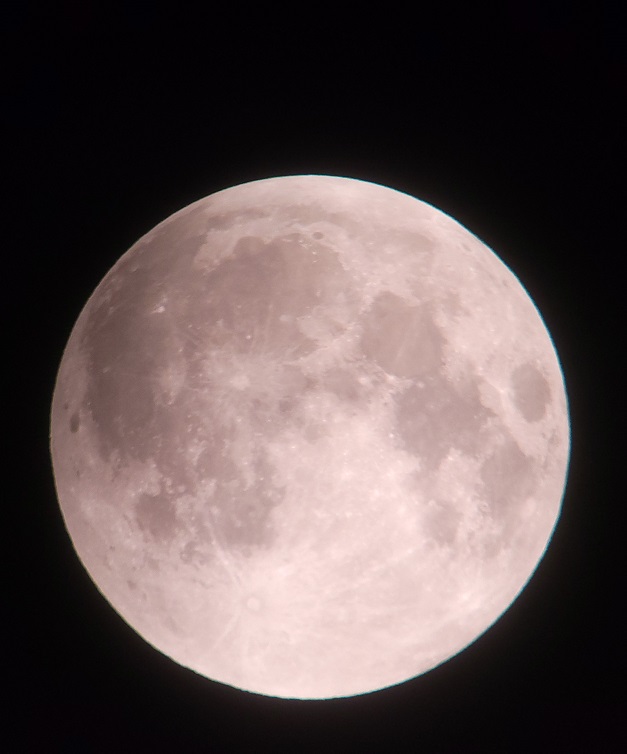
This pair of images was taken during the penumbra phase of the eclipse. First penumbral contact (invisible) was at 1:32:07 UT (8:32 CDT) and the shading was expected to be first seen 30 minutes or so later. This stage of the total eclipse is the most subtle type of lunar eclipse, visible as a faint shading (left side of lunar disk). The first image above was taken at 2:01:41 UT, and the second was taken at 2:13:47 UT. During the last 10 minutes before partial eclipse began, the shading intensified in the region, leading to the subtle entry of the Earth’s dark umbral shadow onto the Moon’s disk at 2:27:53 UT (8:28 pm CDT).
The progression of the partial phases is summarized in the six images below. It took a little over one hour for the Moon in its orbit to slip entirely into the shadow of the Earth. The below images represent the changes seen as the Moon gets deeper into the umbra. The last two images were made such as to emphasize the eclipsed part of the Moon. The beginning of the total eclipse phase was at 3:29:03 UT (10:29 pm CDT).
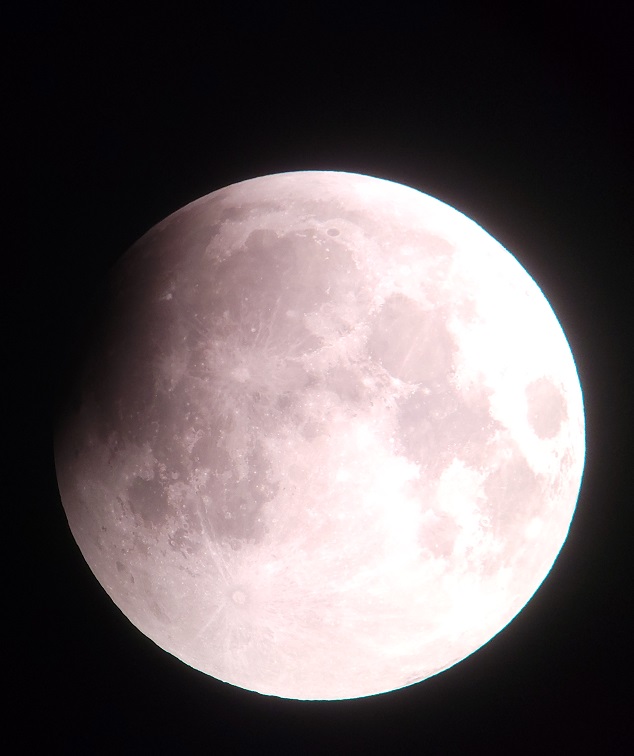 Just after start of partial eclipse, 2:30:06 UT. Just after start of partial eclipse, 2:30:06 UT. |
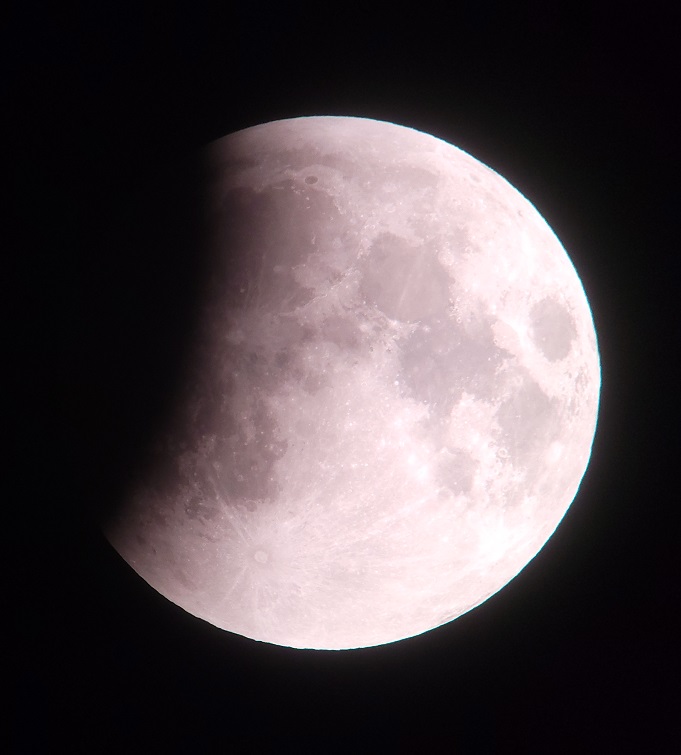 2:31:04 UT. 2:31:04 UT. |
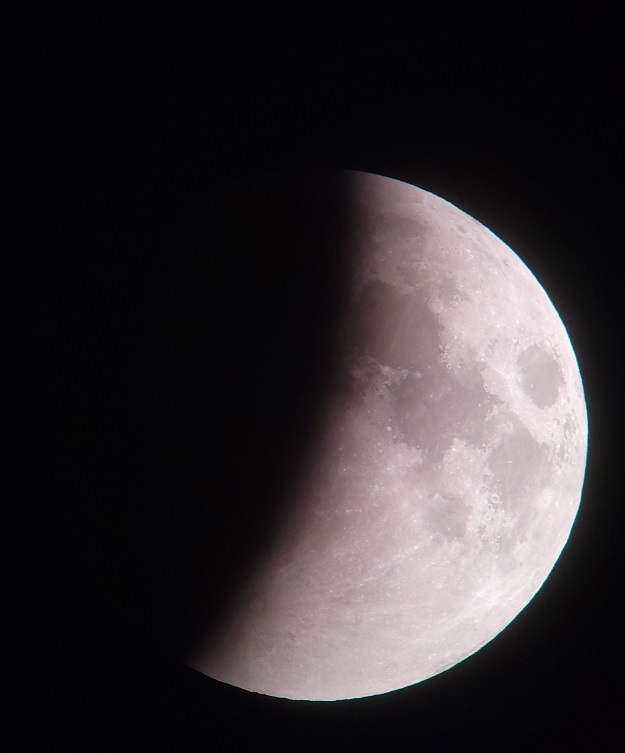 2:58:25 UT 2:58:25 UT |
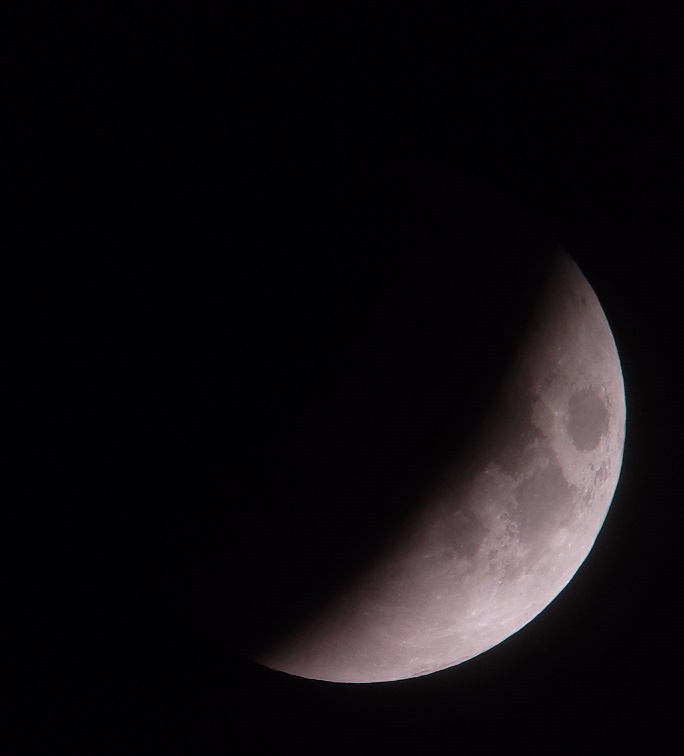 3:10:30 3:10:30 |
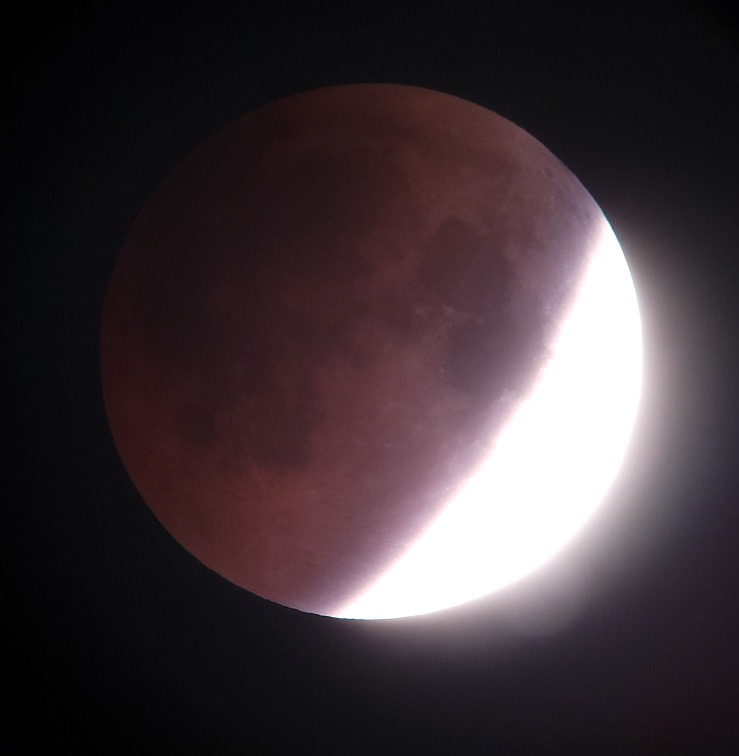 3:16:13 UT. 3:16:13 UT. |
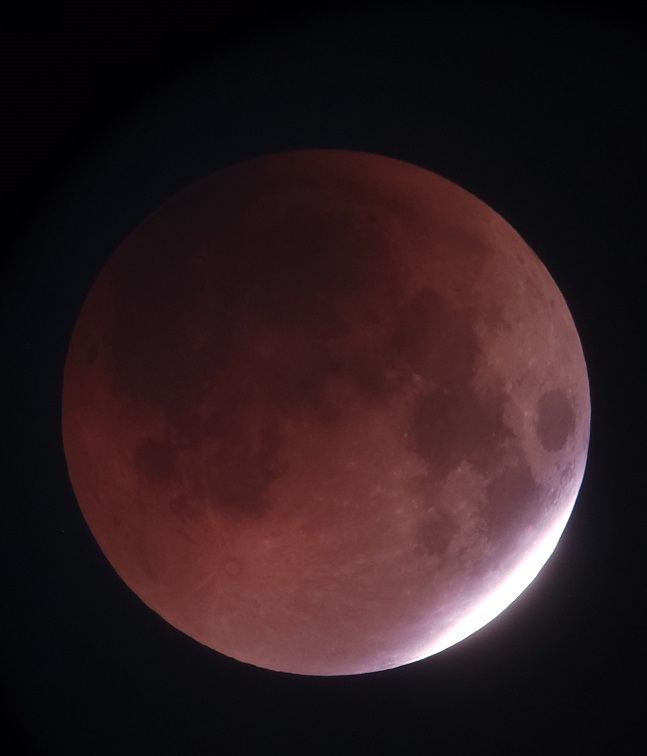 3:26:42 UT 3:26:42 UT |
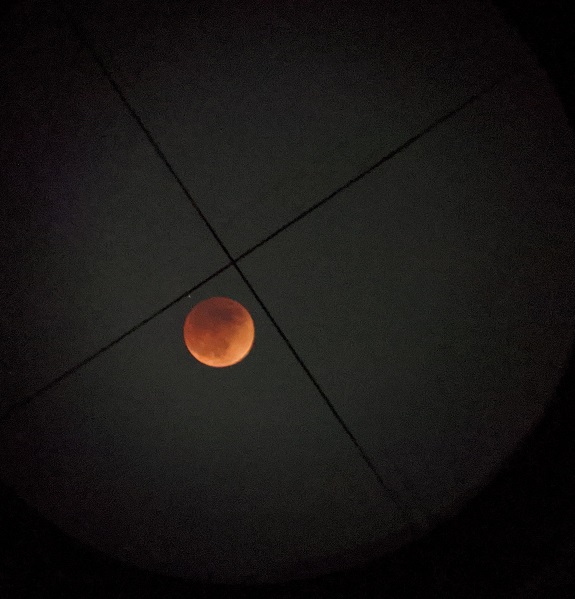
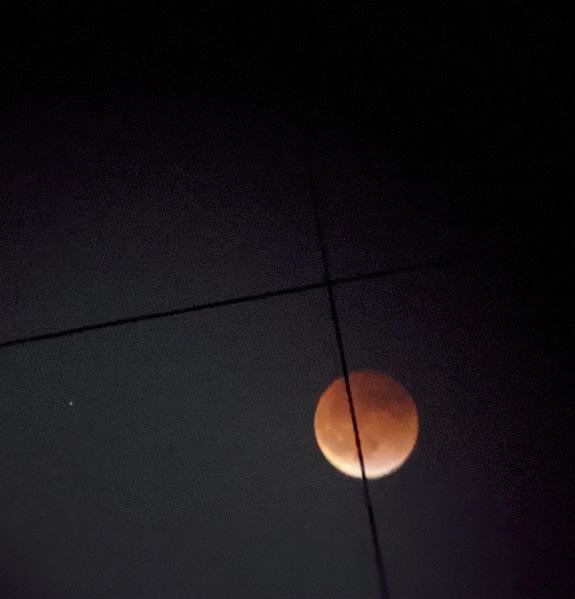
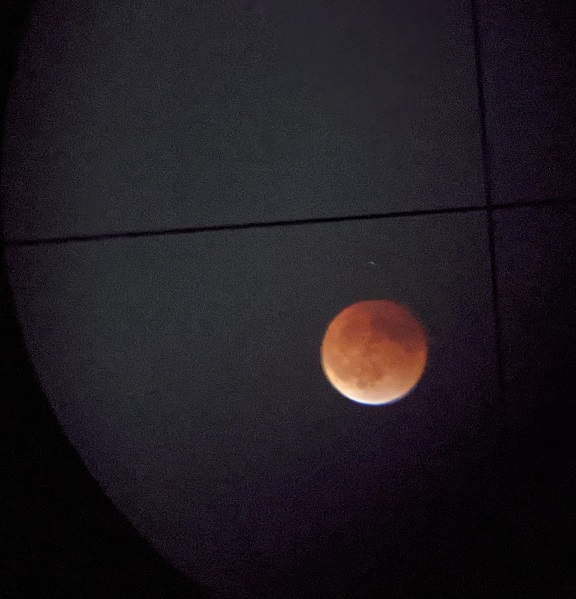
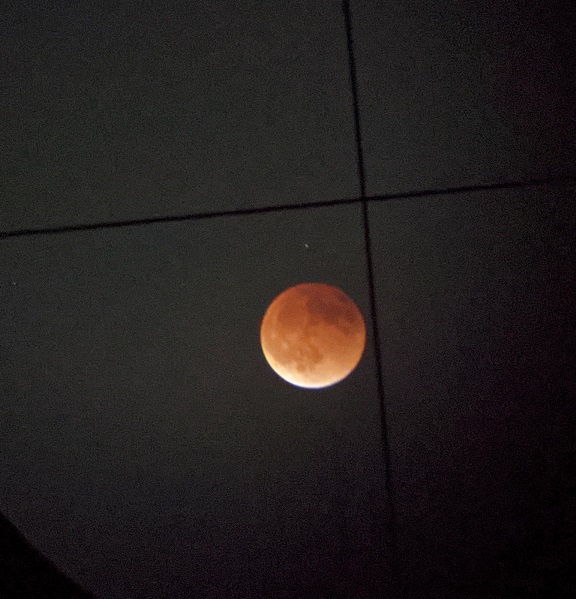
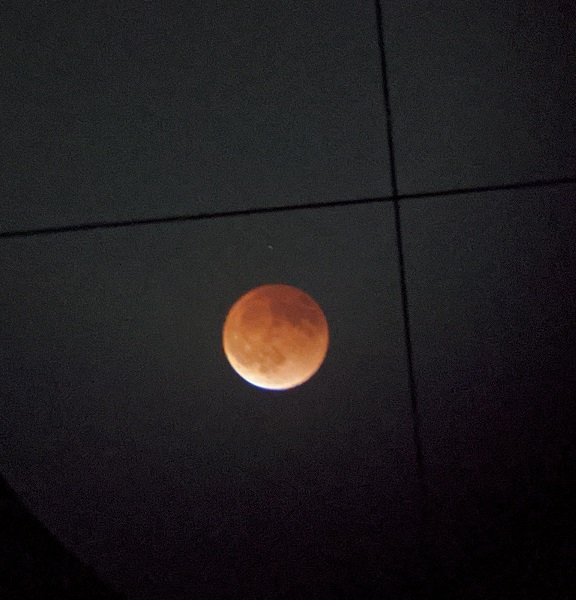
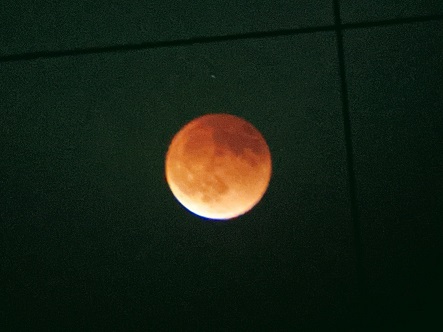
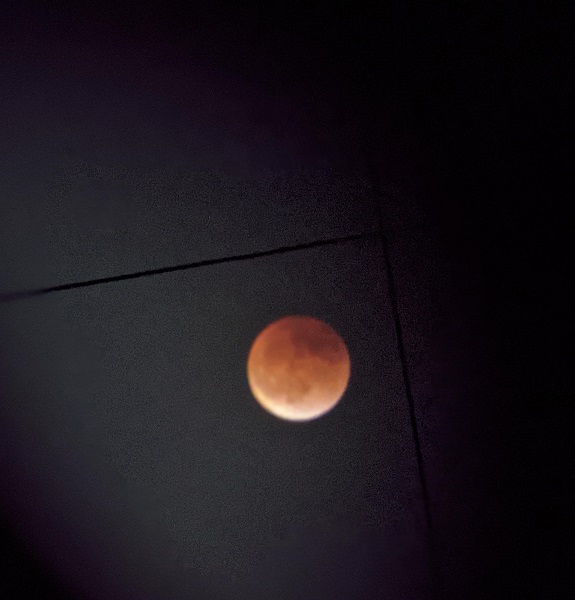
It is always interesting to watch the transition from one phase of the eclipse to the next, especially through a telescope with a wide field of view that allows the entire moon to be seen. It can also be interesting to see how different settings in imaging can result in different color balances in the results. The images were taken at various times through the 86 minutes of totality. Maximum / Mid-eclipse (when the Moon is deepest in the umbra, and thus darkest) was at 4:13 UT. The image below at 4:16 UT best represents the visual appearance of the Moon as seen through a small telescope: as seen by me it had more of an orange color than a red color; in fact the brightest section took on a golden orange hue.
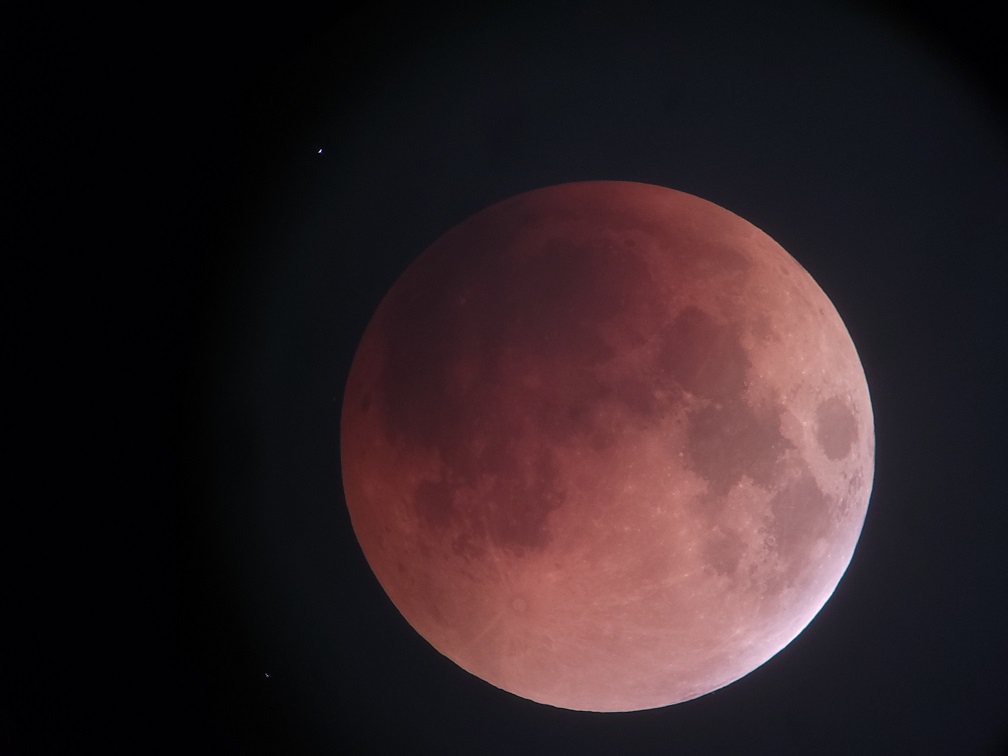 3:30:13 UT, a wide field view showing stars 3:30:13 UT, a wide field view showing stars |
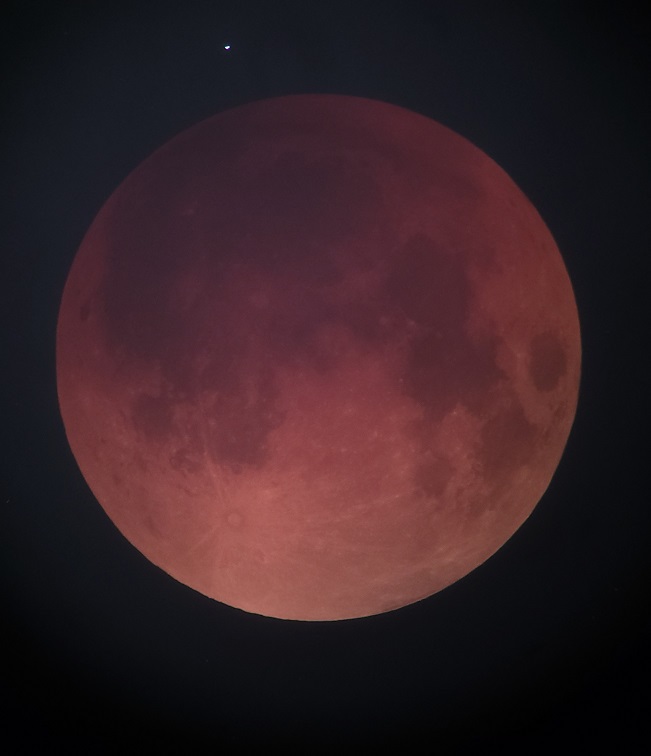 3:51:59 UT 3:51:59 UT |
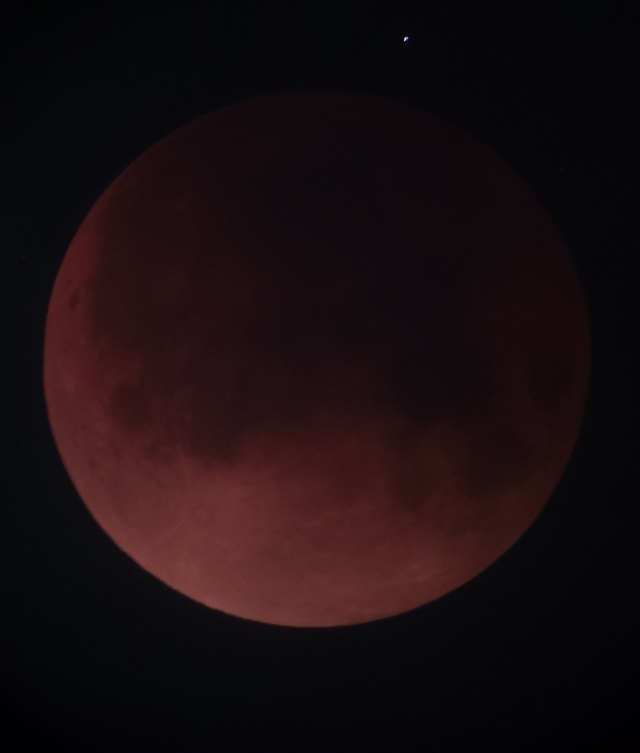 4:13:24 mid-eclipse 4:13:24 mid-eclipse |
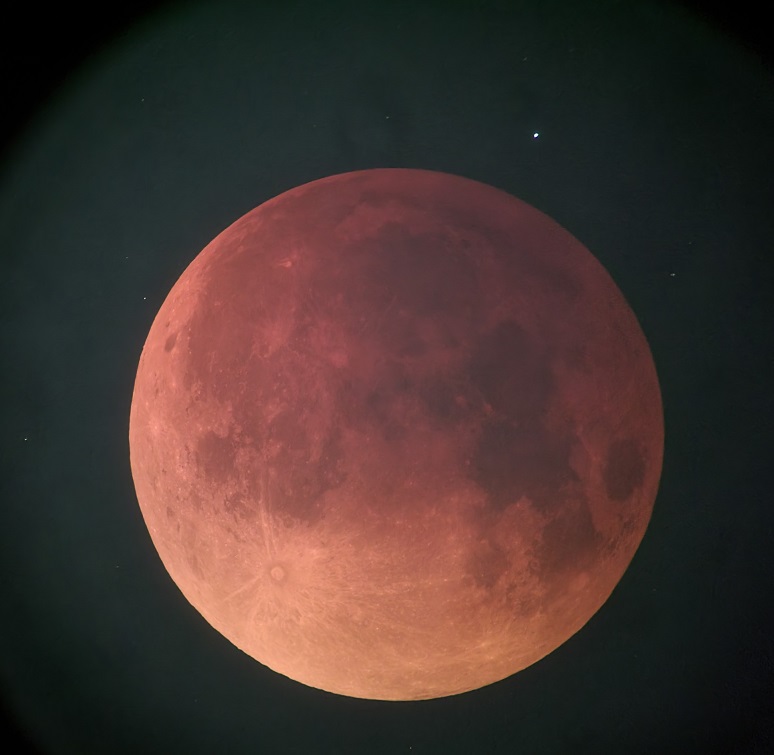 4:16:07 UT 4:16:07 UT |
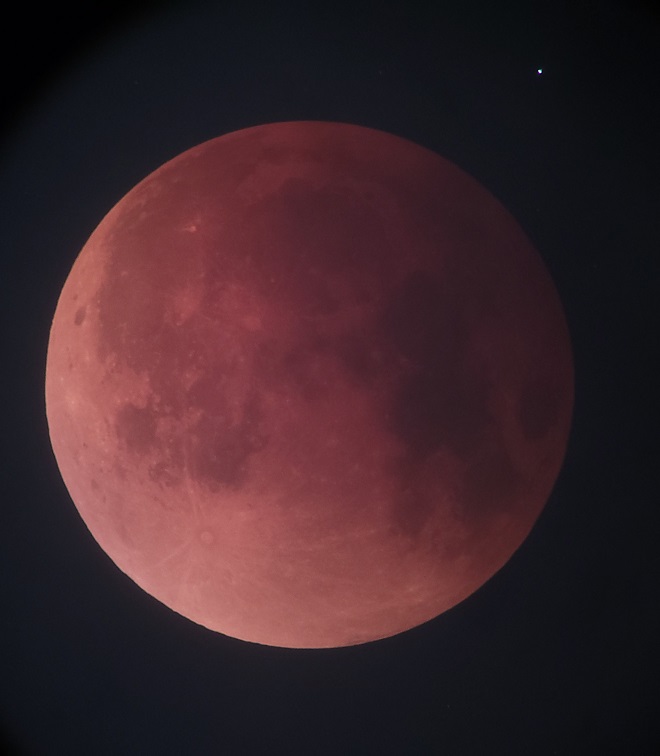 4:29:30 UT 4:29:30 UT |
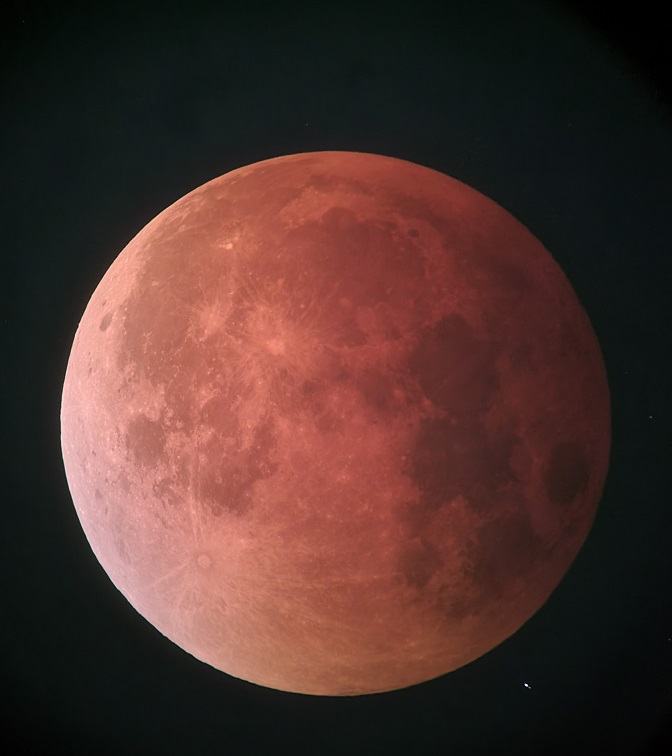 4:44:29 UT 4:44:29 UT |
Dr. Saganti recorded a series of wide field images during totality, with the magnification provided by a hand held finder scope. The images were erected to approximate the orientation visible to the unaided eye.
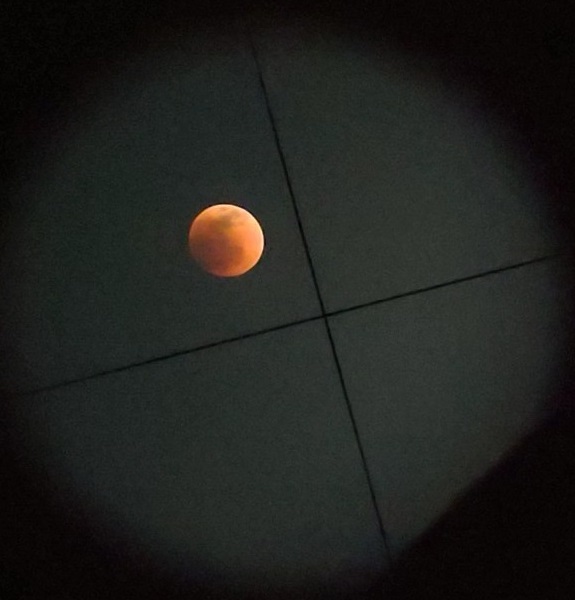 |
 |
 |
 |
 |
 |
 |
 |
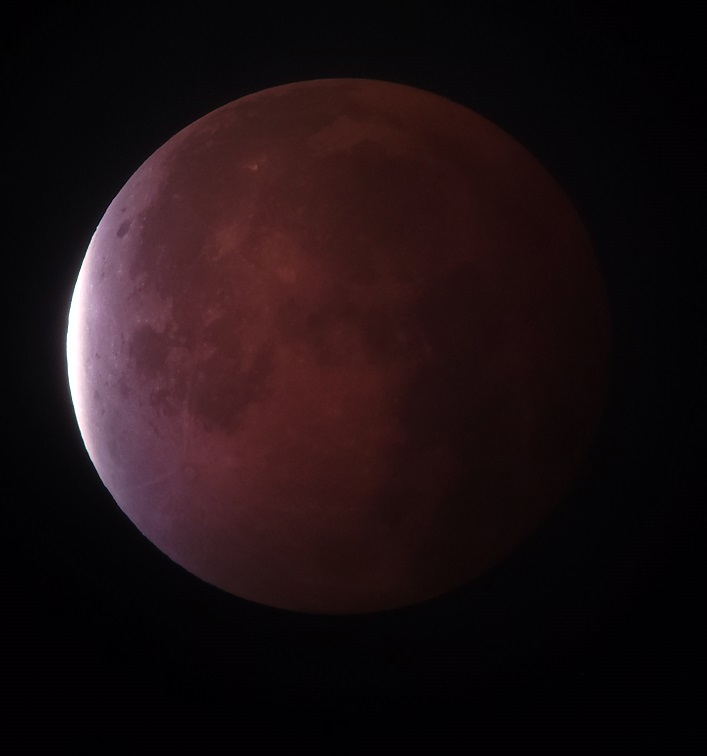
Once totality ended, at 4:53:56 UT (11:54 pm CDT) the bright part of the moon grew steadily as the partial phases played out in reverse from before. At this point, some high clouds moved down from a set of storms in northeast Texas and made it difficult to distinguish subtle hues of color in the eclipsed part.
 4:56:25 UT 4:56:25 UT |
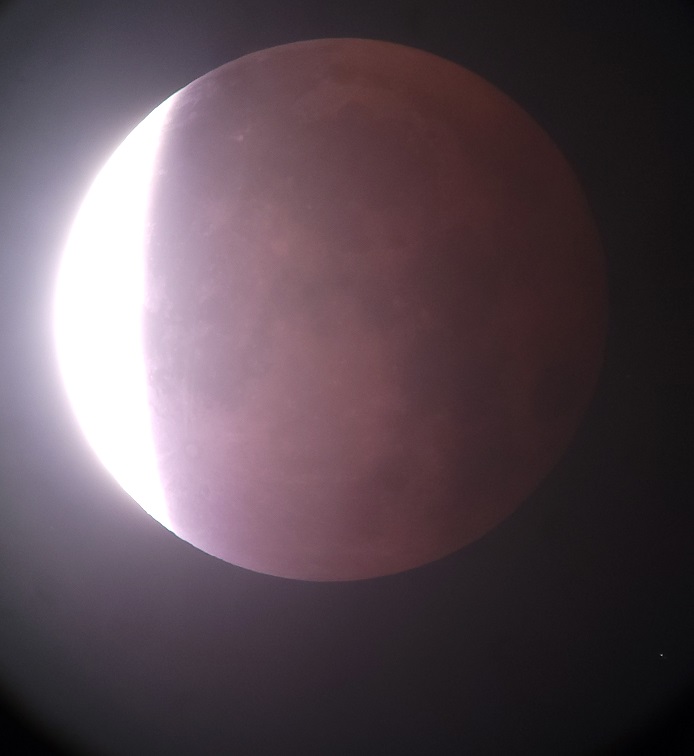 5:04:43 UT. 5:04:43 UT. |
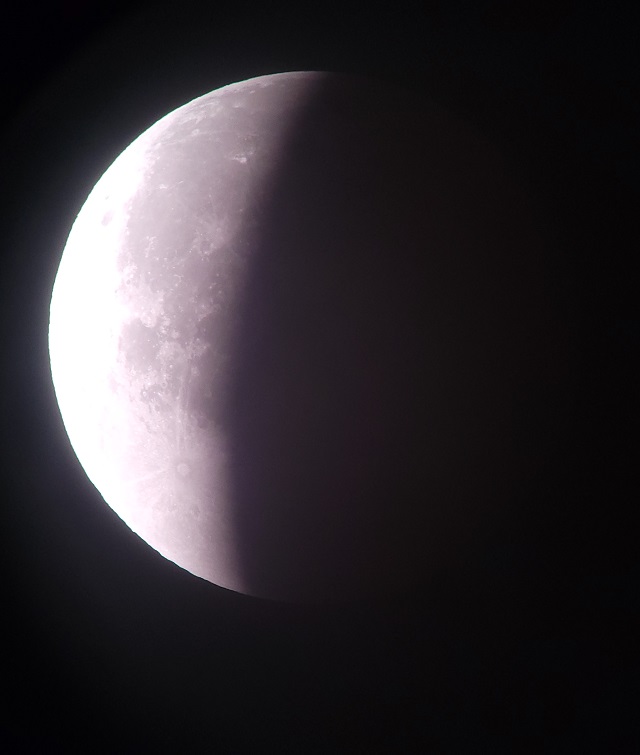 5:17:02 UT. 5:17:02 UT. |
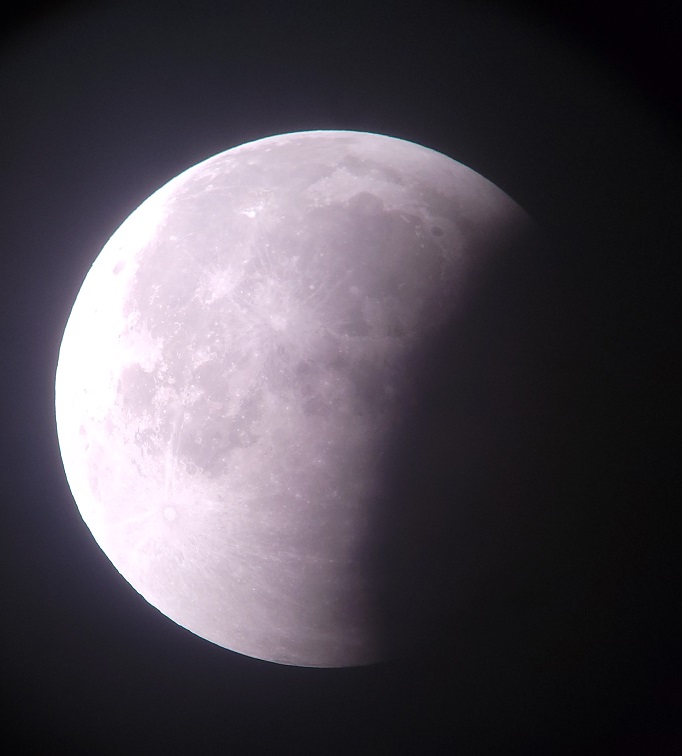 5:38:32 UT 5:38:32 UT |
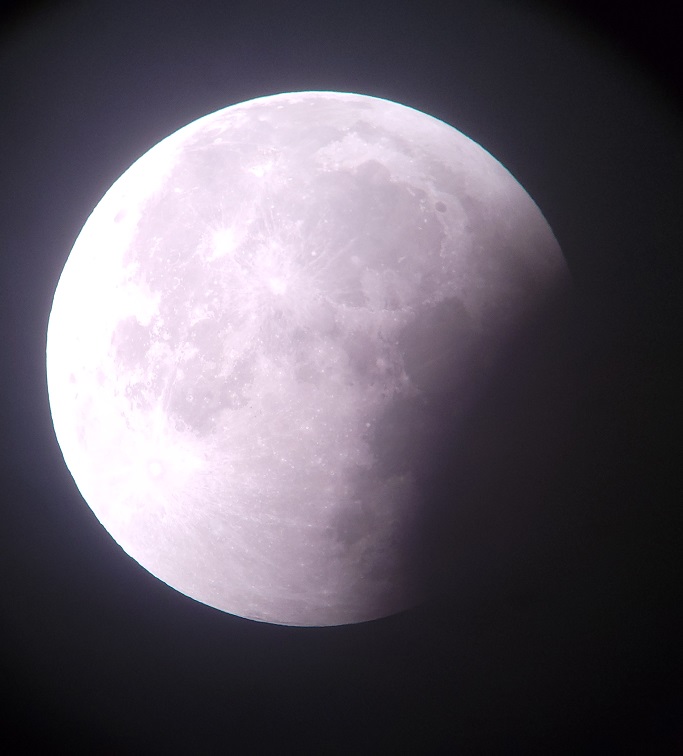 5:46:09 UT. 5:46:09 UT. |
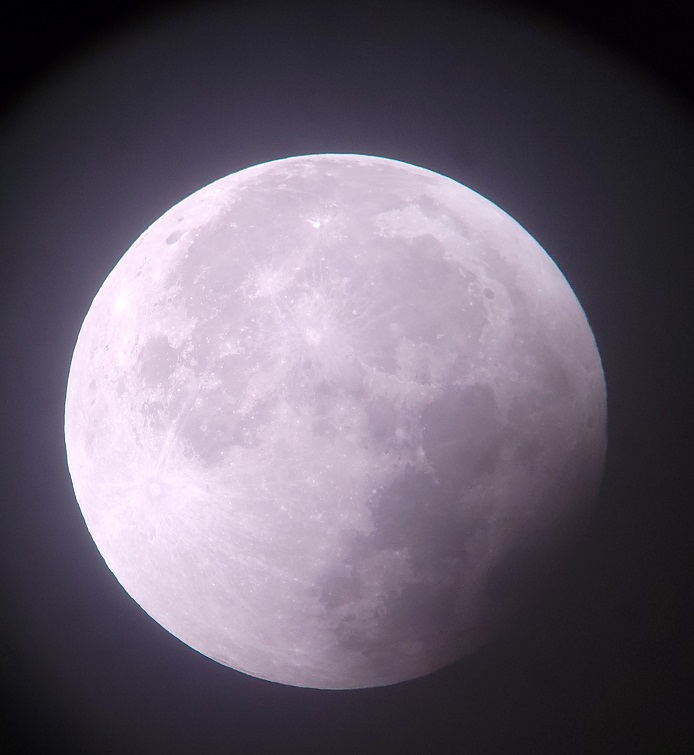 5:54:40 UT. 5:54:40 UT. |
Finally, fourth contact (5:55:07 UT, 12:55 am CDT), then the latter penumbra stages as the Full Moon returns to its former brilliance. The last of the penumbral shading fades from optical view about 30 minutes after fourth contact, with the last lunar contact with the penumbra occurring at 6:50:48 UT. The whole eclipse, from start to finish, lasted 5 hours, 18 minutes, and 40 seconds; the umbral part lasted 3 hours, 27 minutes, and 14 second; and the total eclipse part lasted 1 hour, 24 minutes, 53 seconds.
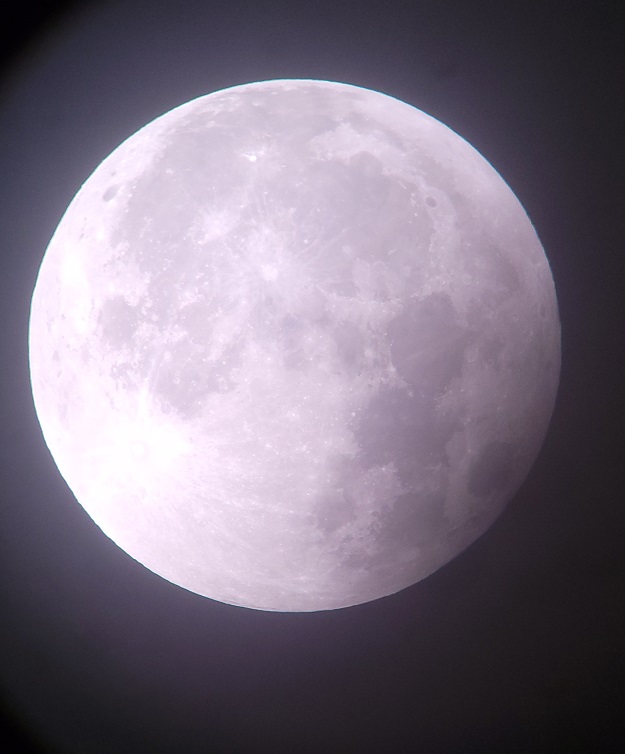 5:58:27 UT 5:58:27 UT |
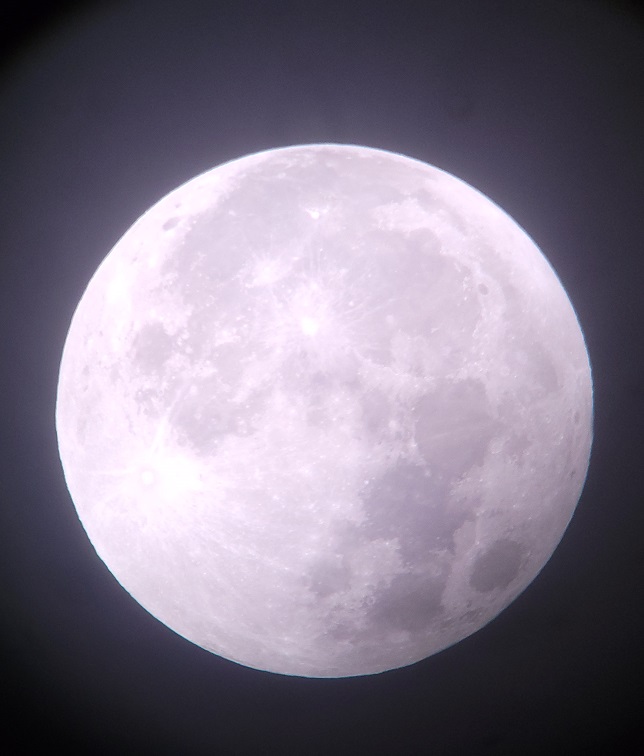 6:10:49 UT. 6:10:49 UT. |
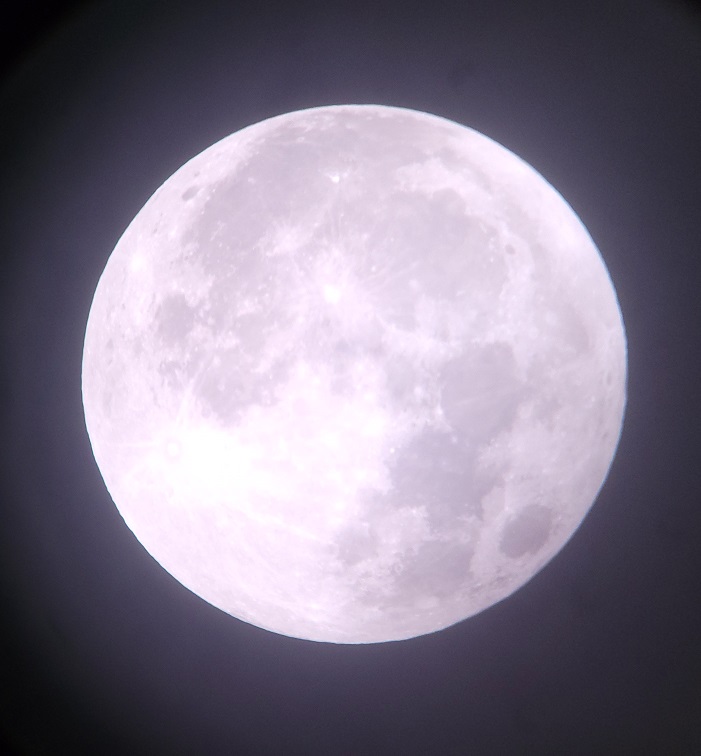 6:16:26 UT. 6:16:26 UT. |